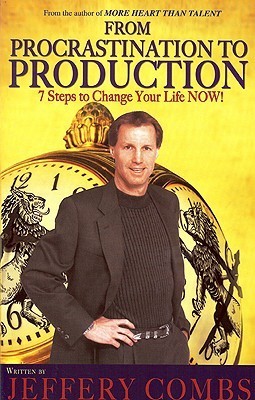
Almost everyone procrastinates occasionally. Procrastination is delaying a project, task, or intended course of action, despite expecting to feel guilt or shame because of the delay.
Jeffery Combs (also spelled Jeffrey Combs) is a top-tier success coach specializing in personal breakthroughs. He has a unique ability to break down the cause that creates the effect of why people do what they do so he can assist them to release the mental and emotional obstacles that prevent them from achieving their goals and dreams. Jeffery has a high rate of success in assisting people to breakthrough their conscious and unconscious anxieties.
In the last 20 years, he has written 5 Books and created over 20 other motivational and personal development products. Jeffery has been featured on ABC, CBS, NBC, FOX, Lifetime and in Networking Times Magazine. He speaks 40 plus times a year across the U.S. and has shared the stage with John Assaraf, Dr. Joe Dispenza, Jim Rohn, Tom Hopkins, and Mark Victor Hansen. He most recently appeared on the Brian Tracy show. He has personally consulted with over 12,000 clients and has devoted over 60,000 hours coaching since 1998. He is highly sought after by rising business leaders and people seeking to create their own intellectual property. Jeffery has built 6 and 7-figure businesses and also assists top-tier clients to do the same.
Jeffery spent 14 years of his life as an addict and alcoholic. He now has 28 years of sobriety and has gone from rock bottom to multi-millionaire. As founder of Golden Mastermind Seminars, Inc., Jeffery has built a multiple 7-figure a year coaching and speaking business consistently for the past 18 years.
This is a self-help book to understand why we tend to procrastinate and how to overcome procrastination. The author, Jeffrey Combs had discussed the root causes of procrastination, how to recognize and diffuse the feelings that lead to it. Combs had elaborated the six types of procrastinators.
The best things about this book is that the author shared many key strategies of recovery from procrastination. The practical solutions and real-life examples given in the book tends to give readers a sense of direction in life.
I find that Chapter Nine - The Seven Habits of Recovering Procrastinators are truly useful. The author developed on how to break the procrastination habit that lies at the path of your ambition.
Finally, there's the procrastination quiz at the end of the book that consists of 40 true-or-false questions which assist to identify the reader's current level of procrastination.
This book is suitable for those who wanted to reinvent themselves to become the person that they deserved to be.
TL;DR: Needed a better editor. Probably should have been a blog post. The whole middle section (all 6 chapters), could have been condensed to a single chapter. Reads like self-published schlock (is Career Press a self-publishing outfit?).
Chapter 1: Not a promising start. A lot of left/right brain, feel it in your gut/crotch junk. Denigrates (and thereby stigmatizes) pharmaceutical interventions for a number of mental health conditions, including anxiety. His characterization of medication is as the easy way out. Claims to be the 12-steps for curing procrastination (but the evidence for the 12-step program is pretty slim). Says that people who are abused naturally attract abusers.
Chapter 2: Better, but still some not great stuff. Neurotic perfectionists often wear glasses. Huh? Do they have worse eyesight than the general population? Less left/right brain garbage, but it's still there. On the whole... decent advice.
Chapter 3: What's with these dumb cartoons? He seems to think organic food is healthier, but it isn't. More 12-steps business. Living out of your car in a Pizza Hut parking lot is a great character-building experience. Say what??
Chapter 4: "Worry" is a hereditary condition, but then says "[w]e aren't born worriers". What?? Also, more dumb cartoons. More left / right brain garbage. Go see a chiropractor, even if you don't have back problems. Get X-Rayed monthly. Um... no. If you're an entrepreneur, your family probably thinks you're a flake.
Chapter 5: These nonsense cartoons serve no purpose. Was there no editor? Also women (mothers) are often meak/week rebels (addicted to disappointment, overweight, focus on blaming others). Just a little sexist. Passive-aggressivity is genetic (citation please?). Expectations (Beliefs) become reality. What is this, "The Secret" for business people?
Chapter 6: Just eye-rolling every time I see a stupid cartoon at this point. Drama addicts have a high rate of suicide. F*ck you. Being mentally ill does not make you a drama queen, nor vice versa. Just f*ck you. Don't write sh*t that sounds dismissive and I won't call you out on it. Also, you can choose to be rich and not a loser? Wtf man?
Chapter 7: A decent amount of humble bragging and another dumb cartoon. This last type of procrastinator isn't really a procrastinator at all from the sounds of it (although they do have other issues). Ends with a blank list you should fill out yourself, just to pad out the page count.
Chapter 8: 12-Steps feature prominently again with repetition of the early chapters. The reason people don't hire me to coach them is that they're procrastinating, not because my prices are astronomical for normies (the real estate developer who also works as a full-time attendant [for fun] didn't see anything wrong with my prices). Insert plug for a 10-CD set you can buy off his website. Don't set unrealistic goals, but you too can have a 7 figure salary, an airplane, helicopter, multiple cars in multiple garages... you're not a loser. You're a winner. Oh, and there's actually the occasional good point in here, but it's buried in a lot of cruft about being an entrepreneur.
Chapter 9: A Buzzfeed listicle. Literally repeats a whole paragraph in two different places. Where the hell was the editor?
Procrastination is rooted in emotions. Emotions that rule us because we don't recognize, understand, and address them. I love how well the book is presented with classified topologies, and I definitely find myself in the neurotic perfectionist category. Now I feel I know how to address it, and I see more worth in addressing it because it's affecting my career as well. Many thanks to the author.
What’s the trick to beating procrastination? Is it putting your phone in your closet? Blocking distracting apps and websites? How about a padlock on your fridge to keep you from snacking?
While tips and tricks may help, if you’re struggling with frequent procrastination, you may have deeper things you can work on.
Procrastination isn’t who you are. It’s a pattern of behavior that arises out of specific psychological dynamics – dynamics that may run deep, but that you can still change.
Procrastinators tend to fall into types and, while we won’t be able to cover every single case in this book, we’ll focus on three of the most common types of procrastinators – and the specific steps and strategies that benefit each.
Alright, no time to delay! Let’s get going.
---
Procrastination and Its Toll
What’s the longest you’ve ever spent procrastinating something? A few days? Weeks? The author once coached a client who had put off filing her taxes… for fifteen years!
While this may be extreme, it’s not without precedent. Every year, people pay millions in excess taxes for procrastination-related reasons; getting penalized for filing late or making expensive mistakes while in a time crunch. Experts estimate that 40 percent of Americans have suffered needless financial setbacks due to procrastination.
But it’s about much more than your bank account.
Consider our 15-year tax-avoider. What was going on there? It all stemmed from fear. Her initial procrastination started with some anxiety or discomfort, which escalated into dread as the potential consequences loomed larger and larger. A vicious spiral of fear, winding slowly upwards until, by the time she sought the author’s help, she was so afraid she couldn’t sleep at night!
This is perhaps the greatest toll procrastination takes. The loss of happiness and well-being.
So, why do people do it? What is procrastination, anyway?
It’s not the same as delaying a task. After all, we sometimes delay a task for perfectly good reasons: you can’t do everything at once. Procrastination is a particular kind of delay – it’s putting something off even after you know it’s time to start.
Procrastination is related to indecisiveness, but it’s not exactly the same. Indecision is struggling to make up your mind, while procrastination is when you’ve made up your mind, but still somehow fail to take action.
Psychologists Albert Ellis and William Knaus have their own definition – procrastination is when you delay performing a task up to the point where you start to experience discomfort or bad feelings.
This rings true. And yet – paradoxically – we procrastinate out of a vain effort to avoid discomfort. Something feels stressful, painful, or uncomfortable; and so we come up with a reason to do something – anything – else until, eventually, we start to feel discomfort about the avoidance.
As we’ll see, curing procrastination is less about managing your time and more about managing your emotions. A big step is getting clear about which emotions are driving us.
We each have unique life histories and experiences that inform our behaviors. But – lucky for us – the author has coached thousands of people struggling with procrastination, and there are some patterns that come up again and again.
---
Good Enough to Start – And to Finish
Picture this: you’ve dreamt for years of writing a screenplay. In your mind, it’s going to be a masterpiece. You read and research. You obsess over each scene, plot point, and character arc. You brainstorm, you draft, you revise. But you never quite get around to finishing. Years go by and, instead of making your mark on the industry as you hoped, your masterpiece is still stuck in “draft.”
This is the plight of the “neurotic perfectionist.”
Neurotic perfectionists, while often smart and talented, are their own worst critics. They’re typically dissatisfied with their work; the reality never seems to compare to the shining vision they carry in their heads. It’s hardly a surprise that they struggle to carry projects through to completion. This striving to avoid flaws causes them anxiety and even paralysis. Their fear of weakness becomes their weakness.
These perfectionists often end up as adrenaline junkies – that is, they depend on the rush of an imminent deadline to get things done. Why?
It’s actually simple. Only at the eleventh hour – in that last night before a test, or that last week before a months-long project is due – does their fear of missing the deadline suddenly surpass their other fear, their greatest fear: the fear of not being good enough.
Does this ring true to you? If so, what’s to be done? How do you break the cycle?
First, you need to recognize that perfectionism isn’t just having admirably high standards or a discerning eye. Underneath it all, it’s likely linked to long-standing feelings of shame and inadequacy. To overcome perfectionistic procrastination, your first job may simply be to recognize this fact – and then, slowly, gradually, start to affirm in yourself a new narrative – a new idea – that you are enough. Let that sink in. You are enough … already.
This isn’t about giving up or producing inferior work. It’s about letting go: of baggage, of your psychological need to be perfect in order to feel good enough. It’s letting go of your desperate attachment to sky-high expectations and overly ambitious goals that you, deep-down, hope will validate you.
On a practical level, recovering from perfectionistic procrastination is about working with new priorities; prioritizing getting started and getting done over getting it perfect.
Here’s a tip – one that’s deceptively simple, though hardly easy: at the end of each day, write out a list of things you can, and want to, accomplish tomorrow. These need to be tasks you can actually finish in one day. (If not, break them into subtasks.) Make this list brief and modest. And when you think it’s modest enough, bite the bullet and make it even more modest. It takes discipline, but it’s a technique that can keep you grounded and help free you from the overwhelm and disappointment that afflict so many.
Remember, perfection is an illusion; good is good enough!
---
Preparing to Prepare
Let’s look at John – another coaching client. John was a successful insurance salesman who decided to switch careers. So, he immersed himself in learning; he listened to audio programs, attended webinars, seminars, rallies, and conventions. He built a strong network of contacts and top coaches. For nearly three years, John prepared for his career switch, lining up everything just so.
Unfortunately, John was doing all of this preparation on borrowed money – and going deeper and deeper into debt in the process. John wasn’t lazy. He was doing stuff. But he was still procrastinating; procrastinating starting his new career in earnest by, let’s say, actually reaching out to clients.
John’s problem? He was a “chronic worrier” – a close cousin of the neurotic perfectionist. You could say that, while the perfectionist is dominated by shame, the worrier is dominated by fear. These two tendencies often go hand in hand.
Fear of failure, fear of the unknown, fear of rejection; all of these can manifest as pathological over-preparation, or what the author calls “getting ready to get ready.”
Worriers and perfectionists do this as a way of staying in the safe- and comfortable-seeming world of prep – far away from the big bad world. Or else they get caught in the trap of so-called “analysis paralysis” – over-intellectualizing instead of taking action.
Imagine the classic boxing movie Rocky, but in this version, the protagonist is stuck in a training montage that never ends – skipping rope and doing pull-ups interminably until, eventually, the film cuts to black; the credits start to roll.
Well, friend, you’ve got to get in the ring! It’s ok to be afraid, but you’ve got to accept that some risk and uncertainty is inevitable. You’ve got to work on building your faith that, no matter what, you’re going to be ok.
Win or lose, at least you came out swinging. That’s the ethos you need to cultivate.
---
Rebel Without a Cause
Okay, here comes another movie metaphor. Picture the iconic James Dean in the 1955 film Rebel Without a Cause. Dean embodied a spirit of youthful defiance that resonated with a generation. He’s a powerful, passionate character, admittedly. But not a very happy one.
There's a unique breed of procrastinator the author calls “rebellious procrastinators.” For these people, their identity becomes entwined with a sense of resentment and defiance.
Rebellious procrastinators often possess remarkable talents. But their inner turmoil, marked by frustration and feelings of being wronged, leads them to rebel against their work. They may avoid tasks that seem too trivial, unimportant, or beneath them – rejecting tasks outright, or else resisting them passive-aggressively, by simply never getting around to them.
Frustrated by their work and their place in life, rebellious procrastinators may find themselves blaming others – ultimately in a bid to avoid blaming … who? You guessed it: the person in the mirror.
While seductive, blaming others is a trap – one the author himself fell into. He was once, in his own words, “addicted to resentment.” While righteousness may feel good in the short term, it only leads to disappointment later.
To escape the fate of the rebellious procrastinator, it’s essential to acknowledge the role that your feelings of frustration and unfairness play in holding you back. Your anger may be masking a deeper, unresolved frustration you harbor towards yourself, or people in your past.
The key here is forgiveness.
Forgiving those who have wronged you, those who rejected you or hurt you, is actually a step towards forgiving yourself. And that forgiveness is transformative.
Because amidst the frustration and anger that rebellious procrastinators hold, lies a potent force – a genuine passion that you can harness; a fire within you. As the author puts it: “Your anger is passion turned inside out.”
So, as glamorous as the rebel may seem – don’t let resistance and resentment sabotage your chances of success. Let go of your anger, so you can liberate your strengths.
---
Reconnecting and Recreating
Alright, so when it comes to procrastination, we’ve talked about the big picture – you’ve got to understand and let go of the specific emotional dynamics that fuel your self-destructive behavior. But is there something else you can do, day-to-day, to help ease this transition? Here are two strategies. Be warned, though: they’re probably not what you’re expecting.
The first: focus on addressing your anxiety and discomfort as they manifest within your body. While your fears may, in some sense, be “all in your head,” sooner or later they start creeping outwards – into a stiff neck, a tense jaw, a tight lower back. Your mind and body are inseparable. So, get a massage, see a chiropractor; start a yoga or tai chi practice; try martial arts. The choice is yours, but the point is to soothe and loosen your tense muscles and bring some relaxation and balance to the body. You’d be surprised how caring for your physical-self can feed into your work-self.
The second strategy: escape from isolation. It’s important to make and maintain strong connections with others. Try to spend a bit less time online and a bit more face-to-face. Reach out to old friends and look into activities you can do together. You’re not meant to be alone in this world!
Many chronic worriers and perfectionists, especially, find themselves ensnared in a web of “what if”' questions. “What if I don’t succeed? What if I do? What if I fail to get that promotion? What if I do get it?” This kind of runaway self-talk makes it hard to take action.
Connecting to your body – and to other people – is about getting you “out of your head” and into your heart; and in touch with the present moment. Because the present moment isn’t just where you live – it’s where you work, too.
So, when it’s time to work, take your newly relaxed body and your newly connected heart and simply focus-in on the immediate task at hand. You know: the one right in front of you.
No need to delay. Just get in there and do your best.
---
Everybody knows: procrastination is a scourge. Millions of creative and intelligent people self-sabotage by chronically delaying and deferring their goals.
Procrastination is a complex behavior, but it has roots in basic emotions like shame, fear, and anger. Overcoming it requires developing the self-awareness to spot which emotions are driving you — and learning to let them go. Along the way, you can help by releasing emotions stored in the body and connecting with those around you.
Rome wasn’t built in a day. But if you’re committed, you can overcome even the most deep-seated patterns, and lead yourself to a better life.
مبدئيا كتاب لطيف جداً ..زاد من حجم الوعي بالمشكلة اللي الواحد أبتدع فيها بكل الطرق.. جميل أن تلاقي كتاب بيوصف حاجات بتمر بيها ..ويديك الأمل إنه خد خطوة والدنيا هتتغير بإذن الله .. لغته هادئة ..وتشعر بذلك التكرار الذي يركزّ لك على المشاكل ..وتشعر كأنك تريد أن تقول له "ماخلاص يابا الحاج"
He used too many words, took way too much time to get his point across.
3.5/10 of this book is relatively useful. The other 6.5...not so much. Though, I must mention that I did selective reading, based on the chapters. To save more time, figure out which of the 7 types of procrastinator you are before reading. But some may need to read all 7 before coming to a conclusion. I didn't need to, so I guess my review isn't really considered "complete" or "substantial" compared to the others.
I don't know why I read self-help books anymore. I am sure I have pretty much covered everything there is to read about productivity at this point.
Why did I even read this books? I don't even procrastinate!
Am I becoming a "productivity geek"? Oh, the horror. Next thing you'd know that I'll start carrying a moleskin notebook everywhere and read lifehacker.
I bought this book awhile back and read part of it so long ago I had forgotten when I started on it, but never actually got around to finishing it (the irony!). Recently, I opened it up again and while I appreciate the author describing the various types of procrastinators, their procrastination causes and bits on how to overcome them I just couldn't identify with any of them personally so I ended up skimming through the bulk of the book. The best part of the book for me is near the end where he explains the 7 habits of a recovering procrastinator (managing yourself in time, setting small goals etc.). Then again, if you have read books on managing habits and making time these items would already be familiar to you. It just felt like I picked up where I had left off a little too late.
Combs produced a practical guide for those seeking to overcome their procrastination tendencies. Using broad personality types, he illustrates how our predilections can impact our capacity to achieve important priorities.
The book possesses a positive tonality and offers practical suggestions for improving our quality of life. Combs works off a basic premise that we all struggle with procrastination on some level and that these challenges are not insurmountable. His overall vision is not simply productivity but how our efficiency leads to a well balanced life. It is on this last point that the book resonated with me.
*(Summary in one word): Just do it stay in the moment *(From other books):tabel problem- solution-memory of joy to imagine and feel it. *
—————book summary——- Experts estimate that 40 percent of Americans have suffered needless financial setbacks due to procrastination it originates from anxiety or discomfort or fear of weakness and failure becomes their weakness so that you are enough it doesn’t need to be perfect it need to be done just take action /the solution/ yoga or anything relax you + connections with others to stay in the present moment .
I think this book has relatable material for anyone that will read it with an open mind, and who is willing to be objective and is looking to take action. There are a couple of opinions expressed that I don't agree with, but each to their own (no judgement on belief systems here)
This book was good. It really covered the different kinds of procrastinators and the reasons why people procrastinate. I agree wholeheartedly that procrastination is not a cause but an effect and that it takes time to get used to NOT being a procrastinator once that cause is narrowed down to a treatable point.
He utilizes steps from the AA's 12-step program which is fine, except when he emphasizes the use to surrendering to God. I'm all about spirituality, I'm a Buddhist after all, but the Combs specifically focuses on God in this manner. That's not cool as far as I'm concerned because not everyone believes in God. There are different religions that don't use the term God. And what about Atheists? He made it sound as if a procrastinator will not be able to get a grip on their procrastination if they don't believe in God at all. Personally, that is ridiculous. If a person is a spiritual person then by all means utilize your higher power to help you get through the tough times. But Atheists' higher power is logic and science, not God.
Even as a Buddhist, I'm taught to rely on myself and my own abilities to figure out what to do. That means using all my resources and common sense. For atheists, its the same thing. My husband is an atheist and he's perfectly fine like that. He able to do what he needs to do without divine intervention. If he needs inspiration he looks to the every day role model. The point is Comb really should not have made the effort to utilize God as a way to cure procrastination without balancing with concepts and inspiration for atheists. It is unrealistic to suggest that God is required to be successful in defeating procrastination.
Besides that, the book has a lot of advice and if you are not God-fearing and can look past those things this book is still great. If you're highly offended by the idea, look someplace else.
Like all self-help books, they are only as helpful as you are willing to let it be. If you don't put it into practical use, congratulations, you just have a little more knowledge on a topic.
This book is actually inspirational as I'm sure the author is as well. The entire book is oozing with his enthusiastic character and personality. He probably lives out this stuff every minute of the day. For most people though, this kind of over extreme desire to be productive is unrealistic. It sounds exhausting. And sometimes even boring... Sometimes the value in life is the time spent without thinking of value (in monetary terms). I think a balance must be reached.
I admit this stirred in me some gung-ho, "just do it" feelings but towards the end I started to procrastinate about finishing the book. I kept thinking, "if I finish, and this is the 'cure', and I don't change significantly, then what will ever make me change?" The answer is: I will. This book was helpful, and I will use it's tips for sure, but it wasn't groundbreaking or enlightening. It wasn't anything I didn't already know or read about in some other article.
Also it lays out the different types of procrastinators. This part is an amusing read, the way you might think it's fun to read your horoscope. You can find a part of yourself in every type, but also a description that is totally not fitting to yourself. I think most people will find they have characteristics of each trait but they don't fit into any specific one like a cookie-cutter mold. So the advice that is specific to each type is not entirely helpful, so use your own judgement to discern how much you need to change and what you should do to get there.
After the sales spiel intro, this book looked to hold the cure to procrastination. Part Two 'The Six Types of Procrastinators' is fictitious but written in a way that gives promises of a cure if you keep reading. Though The Six Types are all muddled into one (i.e. you'll recognise bits of yourself in all of them) the descriptions are at times funny and the repetition (which I usually dislike) works. Sadly Part Three 'Changing Your Life' will do no such thing, as it only a repetition of all that's gone before Jeffrey Combs ends as he started, with a sales pitch to get you buying more of his products . . . what a disappointment. If you've picked up this book, limit your procrastination time and just have a laugh, reading part two :)
Read this books via getabstract. If procrastination, which is an effect and not a cause, is stopping you from what needs to be done, then you may need to read this book. Author discuss about different types of procrastinators and gives 7 tips on avoiding procrastination which includes managing our self with time, planning achievable small goals, avoid distractions, understand what & why we are doing a task, write down things, self-evaluate and rewarding ourself. Self-talking that you are going to finish a difficult task, is one way to avoid procrastination. I recommend this book.
This entire review has been hidden because of spoilers.
Some interesting thoughts on procrastination. Felt very anecdotal and not well researched. After the initial chapters on procrastination, the whole rest of the book is dedicated to different types of procrastinators, which didn't feel very helpful. I took some ideas from this book but feel there are better books on procrastination out there.