Babel is the second part of the Peace Child trilogy. Kaleem has found his father and soon finds the love of his life, Rozia Laurence, but he is still not comfortable with his role as Peace Child. He also has to face some of the less palatable truths about his home planet: it is blighted by the existence of the Z Zone, a place where poorer people live outside of society, and by switch-off, compulsory euthanasia for a healthy but aging population, including his mentor, Razjosh. The Babel Tower still haunts him, but it begins to make sense as he uncovers more of the truth about his past and how it is connected with the problems in the Z Zone. Kaleem knows he can and must make a difference, but at what personal cost?
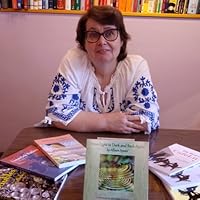
Gill James writes novels for middle grade and young adults and short fiction for everyone. Her current work consists of a cycle of novels set mainly in Nazi Germany and of some texts of experimental fiction.
She is published by Crooked Cats, Tabby Cat Press, The Red Telephone and Butterfly. She is an associate lecturer in Creative Writing at Salford University, UK, where she formerly worked as a senior lecturer. She has published several academic papers.
Her stories are published on Litro, CafeLit, Alfie Dog, Ether Books and in several anthologies.
She offers workshops on creative writing, book-building, creative writing in other languages and the Holocaust and life in Nazi Germany.
Reviews by Gill can be found in Armadillo Magazine, IBBY, Troubador, GoodReads, Amazon and on her own web site.
Member of the Society of Authors, the Society of Children's Book Writers and Illustrators, Literature Wales and the National Society of Writers in Education, Gill has an MA in Writing for Children and PhD in Creative and Critical Writing
She edits for Bridge House Publishing, CaféLit, Chapeltown Books and The Red Telephone. Before becoming a writer and an academic she taught modern languages for 23 years in various schools and has continued to make school visits as a writer of fiction for children and young adults.
Pulling the plug, switching off. Same thing different time periods, only there is one HUGE difference. The people being switched off are healthy, very much alive older people. Its hard enough watching a loved one pass on, but I could only imagine how hard it would be to have to say goodbye to a vibrant, functioning member of society.
Kaleem is what is called a Peace Child, AKA in our terms, an ambassador. His life has been pretty screwed up thus far, his life growing up, the mystery behind his own birth, his parents now committed...It's a lot for one Peach Child to process. In order to fit in better with the planet he is now on, he even disguises his appearance to make things a bit easier on himself.
Right about the time Kaleem find true love, he also learns that his mentor is about to go through the switch-off ceremony. This is the damper in his glowing source of happiness, and this poor kid needs all the happiness he can find. ENTER THE Z ZONE - a not so popular place on his home planet and things are being stirred up. With all the chaos in Kaleem's life, can he possibly find the strength, determination and desire to correct the wrongs that have been happening there? What will it mean to his life if he does?
There are a few things about this book I would like to talk about. The first thing was that I did enjoy the changing points of view throughout the book. I like how it changed back and forth, I really felt that I got a good feeling of all the characters and who exactly they were and what their motivations were. The chapters were well labeled so it was easy to know what was going on before you got too far into it.
The writing style was very easy on the eyes and easy to comprehend - no tedious over-wordiness to gunk up the flow of the story, I appreciate that. While I do love beautiful prose from time to time, I also enjoy my sitting back and reading a straightforward book.
Now, where I had a few problems in the story. I really had a hard time trying to figure out the actual purpose of the switching-off ceremony. It says it has to be done, everyone accepts it, but never an explanation that I understood anywhere in the book. I got the phrase...it is what we pay for living such a good life on this planet...it's not an exact quote, but as I read this in e-book form, I'm not going to try to find the exact line...That is pretty much the best description I got out of the entire story. Maybe I missed something, but I don't think so.
Also, I guess I missed something by not reading the first book, and this is a shame. In a series book, the story should continue from one book to the next, but each book should be able to stand alone as their own book without needing any other books there to help explain or guide the readers through. This book left much out, and I felt a bit cheated that I really didn't know everything that was going on.
I'm on the fence about going back and reading the first book, and even less sure about going to read the next book. While there were some things done well with the book, the few things that were done wrong with the book were really wrong, and it kind of killed the feeling of it for me. But I will say, the relationship in this book is really adorable, and worth the time to discover.
This novel is for readers who enjoy complete fantasy worlds and like to utilize their imaginations. Everything appears to be going smoothly for Kaleem, except that he doesn't particularly know what to do with his role as the "peace child". The reader will be able to make inferences to the real world-euthanasia as a growing force in the medical fields, the "outcasts" living on the edges of society, etc...the author cleverly integrates these concepts into the novel. The novel itself is easy to understand, the plot and characters are memorable, and the idea is a fairly unique one. Kaleem faces many of the problems mentioned in the synopsis with bravery; he is deathly afraid (apologize for the pun) of his mentor being euthanized, but he isn't sure how to broach the subject or how to stop the event from taking place. The reader will enjoy sifting through Kaleem's past with him as he processes unknown memories and forgotten events. The secondary characters work to give the novel comedic relief, an antagonist, and Kaleem's advocates. The reader will find him/herself finishing this novel too quickly. The novel is terrific for young adults/adults who enjoy fantasy mixed with bits and pieces of reality.
I received this novel for review, but this in no way alters my review.
This is the second book in a trilogy with an exciting ‘premise’: in a fractious interplanetary empire the Peace Child is half-negotiator, half-hostage. With an interesting twist on the classic ‘prophecy/chosen one’ narrative, we meet Kaleem and wonder, what will he be called upon to do, and will he be able to deliver?
The story opens with a ritual euthanasia (‘Switch-off’) whose Master of Ceremonies, although evidently quite experienced with his role in a practice which appears to have been customary for some time, is nevertheless haunted with guilt.
Only in the story’s closing chapters do we find out why.
The cultural background has some reflections of our own world, including culture shock - we meet young women who are dealing with the differences between progressive planet Zandra and more ‘traditionalist’ planet earth (‘Terrestra’). One point that puzzled me and which was never fully explained was the agonising over why they ‘had to teach’ somebody from Terrestra ‘about there not being a God’, when this didn’t seem particularly necessary.
We get to meet the two main characters very much ‘from the inside’, with plenty of inner monologue of their thoughts and plans and, in a nice ‘nothing-ever-changes’-type touch, Rozia’s diary. Her notes seem a little soppy at first, but we soon see her true character. The portrayal of awkward teenage love is particularly realistic.
Although many of the earlier chapters end with wrap-ups, there are still some good points of tension:
What was Kaleem’s mother’s involvement with the immiserated and resentful ‘Z Zone’?
Will Kaleem’s antagonist succeed in raising the population there against him?
And will Kaleem succeed in reconciling the freedom-embracing, impoverished but life-loving people of the Z Zone with the more ‘civilised’, complacent, and even a little selfish (through having had life too easy), people of the Normal Zone?
An interestingly prescient aspect of the plot is the source of the movement against ‘Switch-Off’ in the Normal Zone. No spoilers, but they wouldn’t have been ‘the usual suspects’ for radical thinking when the book was written, back in 2011.
The story confronts the reader with a moral dilemma - ‘Switch-Off’ vs. letting people fall ill and die naturally. The premise is that the fight against illness will sharpen people’s minds and empathy, and indeed the medics’ expertise in dealing with imperfection, for example when people get injured, or have to deal with new diseases such as the ‘Starlight Fever’ mentioned as an incident in the past in the opening chapter.
My one criticism would be that the prose is uninspiring - there’s too much “he was anxious” “she was relieved”, “there was something bad going on and he had no idea what it was,” and the like, when better and more immersive expressions could easily be found. And we never get convinced of why ‘Switch-Off’ is so dreadful that it must be stopped - other than its being the only way of reconciling Z-Zone with the rest of Terrestra.
‘Babel’ is a very Moral tale - bordering on too moral (depending upon your point of view). The choice of name for the population management programme particularly jarred, at least with me.
However, in the end the ‘Chosen One’ trope gets a nice twist, and we are left wanting to know what happens in the next book of the trilogy.
I have a very soft spot for YA novels (despite not having qualified for that category myself for decades now!). I also like books with characters who struggle with their past and/or with carrying out a role they really don't want to do because they can see the difficulties, worry about their abilities to fulfil the role they are destined for and so on. (Frodo Baggins is probably the best known character for this). It's fascinating to see how they overcome this and DO go on to fulfil their role.
Gill James's Babel, a continuation of her Peace Child trilogy, follows Kaleem Malkendy as he comes to term with knowing he is different and really doesn't want to be! It would be far easier for him if he did fit in with everyone else. Anyone who feels they are different and struggles with this will identify with how Kaleem feels. And that I think would cover most YA. I remember feeling "different" because I didn't fit in with the "in-crowd" at school and college (and it probably explains why The Ugly Duckling and Cinderella are my favourite fairytales).
Babel is an easy read and Terresta and Zandra, the worlds Gill portrays, are brought vividly to life. If someone wanted to explore science fiction The Peace Child Trilogy would be a good place to start. And Gill does not shy away from the ugly side of life on Terresta. Highly recommend.
stayed up late because I had to finsh before I could sleep. It kept me interested most of the time. Still trying to find out what else is kaleem to do. Kaleem is living with his grandparents that he just met. His mother and father just got committed together and are living on Zandra planting all the oak trees. Kaleem meets old school mate Rozia that he had a crush on and they become a couple. Lot of people dont believe is mother story, so Kaleem wants to go to zzone to prove her right. Kaleem also he knows he needs to bringzzone and normal zone together again. He finds his old friends of his mother and him. He trys to learn and fit in the zone. Kevik wants the fame and glory of peace child but he thinks with violence he can bring changes for the better. there is still a lot of questions that I want to know hopefully the third book will be out soon. I was given this ebook in exchange for honest review.
Babel is the second book in the Peace Child Trilogy and I recommend that you read the first book, Prophecy to understand Babel better. At the time I entered the giveaway it was not clear that it was part of a trilogy, and it was a confusing read, because there were so many references to what had happened previously.
The book skips easily from one section to another and although the character of Kaleem is likeable, and his goal admirable, it is difficult to follow all the complications involved.
I received the e-book version and don't believe that it was an ARC copy because a print version is available. Babel is sorely in need of some good editing, particularly grammar and spelling checks for this e-book version. Those errors were very distracting.