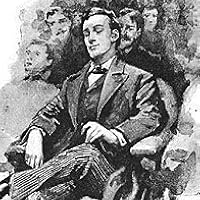
A collection of classic supernatural tales from the Edwardian period. Originally published in 1914 between 4 July and 22 August in The Weekly Tale-Teller, the stories were belatedly collected into the current volume in the late 1990s by Jack Adrian.
This is a collection of eight ghost stories, written by the remarkably prolific husband and wife team of Claude and Alice Askew, centering on Aylmer Vance, an investigator of the supernatural. Dexter, the narrator, meets Vance during a fishing holiday and Vance tells him three ghost stories on successive nights, each story involving Vance more closely in the action. The fourth story brings Dexter himself into the action, and reveals him to have unsuspected clairvoyant powers. The remaining stories feature Vance and Dexter as a sort of Holmes-and-Watson team investigating incidents not all of which prove to have supernatural causes. The final story, "The Fear" is very effective, describing a house in which a general feeling of extreme fear grips the inhabitants at various times and locations; the emotion of fear is effectively evoked and an interesting tale is constructed as Vance and Dexter work to assign the fear "a local habitation and a name."
She was part of the husband-and-wife team of Alice and Claude Askew, both of whom perished when their passenger ship was torpedoed during the Great War in 1917. Askew was co-author of the Aylmer Vance stories wherein the protagonist, Vance, undertakes investigations on behalf of the ‘Ghost Circle’ and regularly exposes false mediums and the like.
This slim volume of eight occult detective tales, written by the remarkably prolific husband and wife team of Claude and Alice Askew, has little to recommend it. These adventure stories written for the Edwardian magazines benefit from the excellent popular literary climate of the time: they are clear in style, well-crafted in plot, and thoroughly professional--ideal for a lady or gentleman who wishes "something to read on the train." They lack imagination, however, delivering few thrills and no real chills at all.
Holmesian psychic investigator Vance and his "Watson" Dexter become friends at a fishing lodge, share a few stories, and solve a handful of cases together--cases which may (or may not) have a supernatural explanation. I'll remember little from this collection, except the general impression that the Edwardian man was stuffy and boring and the Edwardian woman a potential conflagration of banked fires. (I bet I have Alice to thank for this impression, not Claude.)
As I have said elsewhere, this reader has long been a sucker for the Victorian/Edwardian ghost hunter. Previously, I had enjoyed the exploits of Algernon Blackwood's John Silence--who had tackled, in the author's five-story collection of 1908, a haunted house, a French town peopled by shape shifters, an Egyptian fire elemental, devil worship, and a nontraditional werewolf--and William Hope Hodgson's Thomas Carnacki, who had gone up against, in the six-story collection of 1913 that was expanded to nine stories 35 years later, haunted abodes, a ghostly horse, weird noises, spectral daggers and maggots, a haunted ship, and a soul-sucking swine monster! But even lovers of these two classic volumes may not have had the opportunity to encounter the supernatural sleuth known as Aylmer Vance, whose eight adventures first appeared in eight consecutive issues (July - August) of "The Weekly Tale-Teller," back in 1914. This British weekly magazine consisted of new short stories and ran from 1909 - 1916, managing, over the course of its 365-issue run, to keep its cover price at "one penny" all that time. The Aylmer Vance stories were written by the wife-and-husband team of Alice and Claude Askew, both of whom had been born in London (in 1874, for Alice; 1865, for Claude), and who wrote some 90 (!) novels together before their premature deaths in 1917 (the Italian steamer that they were on was sunk by a German submarine). All of those books have likewise sunk into obscurity, but thanks to the fine folks at Wordsworth Editions, and their Tales of Mystery and the Supernatural series, this 2006 volume, entitled "Aylmer Vance: Ghost-Seer," survives as a token of what terrific writers the Askews apparently were. All eight of the stories here are winners, penned in a supremely readable style that manages to pull the reader right in. Personally, I loved every single one.
The eight tales here are loosely connected and are narrated by a man named Dexter, who meets Vance while the two are staying at the same countryside inn. The first three stories consist of experiences that Vance had previously gone through; old cases that he regales Dexter with. (These older cases were truly in the Edwardian era; the others, transpiring as they do in current times--that is, 1914--must technically be deemed Georgian.) In the fourth, transitional story, Dexter is made to realize that he has certain latent psychical abilities himself, and in the final four tales, he becomes something of a right-hand man to Vance, going so far as to move into the same house as his mentor in London. The two make for a good and fearless team, if hardly an effective one. In story after story, the two manage to ferret out the source of a haunting or spectral occurrence, but are yet powerless to prevent the ghastly sequence of events from progressing. Often, their only suggestion to the owner of a haunted pile is to move out and raze the place to the ground. Many of the stories thus end in tragedy, even for the innocent, and those early 20th century clients looking for a quick and easy solution to the supernatural mishegas that had been besetting their lives might have been advised to look elsewhere. Vance is courageous and keen witted, but it seems that there is only so much that he is capable of doing. No easy exorcisms in this book, that's for sure! The eight cases that we become privy to are invariably atmospheric, although some are more chilling than others. Happily, none of the spooky events told of here has as its provenance a hoax or spurious causality. All of the ghosts that we encounter are real, not fakes, and most of them are inimical, nasty, and holders of grudges against the living. In short, they make for an octet of real challenges for the experienced Vance and the tyro Dexter.
As for the stories themselves, in "The Invader," Vance tells of the tragedy that had befallen on his old college friend, George Sinclair, and on George's new bride, a Scotch girl named Annie. George had dug up an ancient armlet on his property and had later begun to perform experiments on his wife, using her as a medium to effect communication with the dead. But matters grew fairly serious when the spirit of a long-deceased British princess had entered Annie’s body...and then refused to leave after the séance was over! George, thus, was forced to watch as his sweet and gentle wife became progressively more unhinged, ultimately resulting in a double--and possibly triple--tragedy for all concerned. Truly, a chilling tale to get this collection under way.
Vance's next tale, "The Stranger," is one that Algernon Blackwood might well have smiled upon with approbation. Here, Vance tells of his young ward, Daphne Darrell, for whom Aylmer once served as guardian. Daphne had been a true child of nature, cavorting in the woods, sleeping every night on a hammock outdoors, and, as she would tell Vance on the eve of her wedding, in love with another man; a godlike youth whom she'd been encountering in the forests ever since she was a young girl. Vance, naturally, advises her to forget this fantastic stranger, to marry her solid Englishman, and to lead a normal life. But again, our story ends with tragedy. Or does it? On second reflection, this seemingly unfortunate conclusion might be just the outcome that Daphne may have wished for....
In "Lady Green-Sleeves," Vance tells Dexter of the great love of his life. The only problem is: The woman happened to be over a century dead. Vance had met the charming lass at a costume ball, and had asked her to dance after seeing that the beauty was being ignored by everybody else. But the 17-year-old had promptly admitted to Vance that she was unfamiliar with the music, and was only a ghost who had returned to her old home for a look around. Lady Green-Sleeves, as Vance would think of her in later years, is the only spectral manifestation in this volume that is not a frightening or threatening one. Indeed, the story is as charming as can be, and concludes on a pleasingly wistful--as opposed to tragic--note. My only problem with the story: when Vance remarks that the events had occurred 12 years earlier, and, a little later, 10.
"The Fire Unquenchable" is the tale in which our Mr. Dexter realizes that he has the ability to close his eyes and visualize distant events, causing him to quit his dull job as a barrister and become Aylmer Vance's assistant. His first vision is a truly disorienting one, which he obtains after reading an unpublished book of poetry that Vance had given him to peruse. The recently deceased poet had once lived at Cheswold Lodge, which abode is currently giving its new owner many problems. Mysterious fires have erupted all over the property, some of them out of thin air, and Vance had been called in to investigate. Eventually, our ghost busters learn the truth about the lengths that a writer, poet or artist will go to to see his or her genius reach the light of day....
In "The Vampire," newlywed athlete Paul Davenant comes to Vance's office with a strange show-and-tell story. He'd been losing weight and energy as of late, had become increasingly pale, and also had what looked like two bite marks on his neck. His bride, a flame-haired Scotswoman née Jessica MacThane, claimed that her family lived under the curse of vampirism, begat centuries before by a witch named Zaida. Could that possibly have anything to do with it? Well, what would you think? In what is perhaps this collection's most atmospheric story, Vance and Dexter travel up to Jessica's ancestral home, Blackwick Castle, in an attempt to get to the bottom of this dilemma, and for once, Vance's efforts are successful in averting another tragedy. His method of disposing of the story's nemesis, however, is an unconvincing one. Still, over all, a most impressive piece of work.
"The Boy of Blackstock" gives us the story of the current Lord Rystone, who had just moved into the ancestral pile known as Blackstock Priory with his family, only to have the legendary poltergeist known as "The Mischievous Boy" start to make trouble. As the legend goes, the boy would appear to each Lord Rystone immediately before that august personage's death, a tradition that has dated back to the time of the Stuarts. The current Lord Rystone believes that someone is merely trying to drive him away from his new home, and has enlisted Vance to find out the truth. Many suspects do indeed crop up in Rystone's household, including the servants, his sons' suspicious-looking tutor, and his young, unhappy and secretive wife. But what is actually going on in the secret-passage-riddled relic known as Blackstock Priory?
In "The Indissoluble Bond," Vance and Dexter make the acquaintance of one Col. Verriker and his family. The colonel, sometime later, comes to Vance with a problem: His daughter, Beryl, has lately become abstracted, has been complaining of headaches, is going into trances, and has been wandering off for hours from her home. Upon investigation, Vance learns that she has come under the domination of a local church organist named Cuthbert Ford, whose weird, unearthly melodies have been pulling Beryl to him, even over great distances. He claims to be Beryl's soulmate, although Beryl is already engaged to another man. Cuthbert's eventual death causes one and all to breathe a sigh of relief, but as events prove, in one of the most shocking wedding scenes that you'll ever want to read, not even the timeworn phrase "Till death do us part" can make a difference to the truly infatuated....
This collection concludes with the appropriately titled story "The Fear," in which a wealthy businessman, Robert Balliston, hires Vance to find out why his new home, Camplin Castle, radiates an aura of disabling horror to all who step into it. Thus, Vance (who, we learn in this story, prefers to be thought of as a dilettante in the field of psychical research, and not a professional) and Dexter do indeed spend a few nerve-racking nights in the Hampshire abode, hearing the cries of a whimpering child and the pattering of bare feet, before finally learning the history of the wretched home. As the tale concludes, Vance is compelled to admit his powerlessness in the face of such saturated and concentrated nastiness, bringing this collection to a grimly downbeat close.
If I would level one small complaint about this octet of stories as a whole, it is that we never learn enough about Aylmer Vance himself, other than the fact that he is a member of an organization called the Ghost Circle. The eight Aylmer Vance stories that the Askews left us are all marvelous, and I cannot imagine any reader not wishing that there were a dozen more such, so as to learn more about this fascinating character. Such a pity that the Askews' careers--and their lives--had to be cut so tragically short! Impressively written, evocative and spooky, the Vance tales in "Aylmer Vance: Ghost-Seer" are perfect fare for all fans of the literate supernatural. As for this reader, I still have not gotten around to reading the stories featuring Sheridan Le Fanu's Dr. Hesselius, Ella Scrymsour's Shiela Crerar, or Kate Prichard's Flaxman Low, and those are the Victorian and Edwardian ghost busters whom I hope to be encountering next....
(By the way, this review originally appeared on the FanLit website at http://www.fantasyliterature.com/ … a most ideal destination for all fans of the literate supernatural....)
This is a book I picked up for 2 quid in a local remaindered bookshop and so could not have really moaned overmuch if it was total tosh. I love ghost stories and the shiver of fear they bring and so opened this little volume up with uncertain feelings of hope tinged with a two-pound reality check. Well it was not a waste of two pound but I will not be rushing to excavate any more of the stories of this married couple's literary output buried under the 100 or so years of neglect after their drowning during the Great War. (I hasten to add that i do not think the drowning was anything to do with the literary standard or otherwise of their stories but I would say I do not think ghost story genii were lost in the cold waters of wherever their boat sank).
There are eight short stories all linked by the narrator, a sort of Dr Watson with ouija board tendencies who relates the eight encounters he and his Holmes-like chum have with ghosts and nether world sprites of varying levels of cuteness, nastiness and downright wickedness. The stories vary from pretty 'gels' back visiting scenes of previous triumph, the inane and soakingly wet 'Lady Green-Sleeves', through the disturbing and nasty 'The Indissoluble Bond' in which we get insights into the Askews' vision of marriage or at least eternal love which quite frankly makes me grateful I am never likely to have to toast, with any level of sincerity, their own relationship; up to a couple which i would love to have read as perhaps more detailed novellas.
There was one called 'The Fire Unquenchable' in which a disastrously unsuccesful but talented poet, ghost writes, pardon the unavoidable pun, through his tragically beautiful widow. It had the seeds, I thought, of a lovely story but, as with so many of their ideas, seemed rushed out on to the paper and on to publication when if a little pause and reflection had taken place something really marvelous might have been created.
The last story entitled 'The Fear' should have been chilling and truly scary and in the hands of a better writer might have been. It had all the elements of a classic; not least the opportunity for a great writer to emote and create feelings of terror and horror as the unnamed 'fear' extended its cold grip around the throats, hearts and imaginations of the main dramatis personnae. Yet it failed to do any of those things. The idea, the concept was excellent, its actual creation was limp and lifeless and not in an undead type way but just in a dead on the page type way.
Eight stories, none of which take time to read but none of which are going to have you seeking out more of the same. The imaginations behind the stories seem lively and colourful, sadly this was not, in my opinion, matched by the writing.
This is another foray in to the world of Mystery and Supernatural by Wordsworth Publishing and I must admit it was just as enjoyable. This time it is the adventures of Aylmer Vance and his companion and biographer Mr Dexter.
The stories are very reminiscent (and a fact not lost on whoever was writing the cover blurb and preface) of other detecting duos - in this era name Mr Holmes and Doctor Watson. However rather than performing feats of deductive reasoning and heightened observations (or is that the other way around) the pair conduct a series of cases with a definite supernatural flavour to them (although not all of them are directly as a result of it).
The early stories are more of a biographical natural - basically recounting certain events while later stories took you in to the midst of the events. You can certainly see their serialised nature - as they were originally published in instalments.
Reading this book you certainly get a feel for a more genteel age - almost to he point where the stories become bogged down with prevarication and etiquette however it does not make the stories unreadable - I think to be honest it marks them more of an age and considering that the target audience was fixated with mysticism and spiritualism you cannot really blame them.
A nice little collection of ghost and supernatural stories. Not the best I've read, while the stories were very enjoyable the style of the book was less than inspiring. The stories were told by a psychic investigator and his assistant and the two seemed to have a larger than usual amount of subtext (or perhaps that's just me). Most of the tales ended in tragedy, even after the mystery was revealed, which made them more appealing. There was possession of a young woman by a Celtic queen, love with a strange old god in the woods, a ghost, a vampire, family curses, soul stealing organ players and castles filled with terror. All in all a very good book to be reading this time of year.
A nice little collection of pre-World War I(in fact they were all written in July-August 1914) ghost stories. There are stores of haunted county halls and castles, ancient forces reaching out in the county side to harm the living, and loves that spell death. Vance and friend Dexter do try to help their clients,(the first three stories are told by Vance to Dexter in a old inn and later the duo take rooms together in London....were the Askews turn them pale copies of Holmes/Watson) but there are forces greater then mere mortals. These stories do not rival E.F. Benson, M.R. James, but for a nice stormy evening they are fine. Also in this is book a delightful introduction by Jack Adrian, about the Askews, their careers in writing, life together and tragic fate. Plus he details Edwardian publishing world were husband/wife teams were common in the new world of the penny papers and paperbacks. Entertaining.
This is a compiliation of short stories published on the verge on the year of the First World War. We met Dexter and Aylmer Vance as they are on a Inn on vacations. Dexter becomes interested on Aylmer stories and each night he tells him one. Seanse, Ancient Gods, Ghosts, Vampires, Possession, Haunted Castles and so on. All the requisites for a good anthology of Gothic stories.
1) The Invader is a story of a session of spiritism séance that goes wrong. An husband distress to find out who did belong some ancient bracers ask his wife to be a vessel for an ancient princess. After some seansés something goes wrong and the wife is possessed by a spirit who doesn't want to leave. He then tries everything at his dispossal but to no avail. The ending is quite dramatic leaving the husband killing his own wife and then commiting suicide. Here Aylmer has a small part on this story. Most of it he is telling what happenned to their friends and not participating.
2) The Stranger: tale about love between a girl and an old being of the wilds. In the end we learn that that being may be a ancient god. Again these tale as minor intervation of Aylmer and the plot itself. This was one of the most interesting tale on this book.
3) Lady Green-Sleeves: This story is about the meeting between Aylmer and a ghost in a ball. Only in the end he discovers as she dissappears. Quite good.
4) The Fire Unquenchable: a poet return from the grave to finish his poetry by sheer possession of his wife. In this tale we learn about Dexter clairovyan powers.
5) The Vampire: This is one of the best tales of this lot. A curse that makes someone of that bloodline to "consume" other. It's quite nice tale and it's the first Aylmer solution is to destroy the castle so the curse can be cured.
6) The Boy of Blackstock: Another tale that Aylmer almost doesn't have any part except being there.Villanious human and ghosts competing "who's the worst". It was in my opinion one of the worst of the lot.
7) The Indissoluble Bond: Another weak story in my opinion and not that frightful tale. But interesting. Love and Hate.
8) The Fear: This tale supposedly is quite frightfull but it isn't. Suposedly there is a castle where at some time of night a terrifying aura surrounds it and we get a fear that almost kill a person. Again... "Destroy the place".
To whom I would advice this book? To anyone who wants to try reading Edwardian/ghotic tales. Very interesting. If you want a frightful story of horror then... no.
This entire review has been hidden because of spoilers.
This is a nicely structured collection of eight ghost stories centering on Aylmer Vance, an investigator of the supernatural. Dexter, the narrator, meets Vance during a fishing holiday and Vance tells him three ghost stories on successive nights, each story involving Vance more closely in the action. The fourth story brings Dexter himself into the action, and reveals him to have unsuspected clairvoyant powers. The remaining stories feature Vance and Dexter as a sort of Holmes-and-Watson team investigating incidents not all of which prove to have supernatural causes. I enjoyed the first few stories, particularly the first, “The Invader”, involving a woman’s possession by a prehistoric revenant, but found some of the later stories, “The Vampire” and “The Indissoluble Bond” too long for all their relative brevity. The final story, “The Fear” is very effective, describing a house in which a general feeling of extreme fear grips the inhabitants at various times and locations; the emotion of fear is effectively evoked and an interesting tale is constructed as Vance and Dexter work to assign the fear “a local habitation and a name”.
Well... on the positive side it is great that Wordsworth is rescuing obscure works from long ago in this excellent reprint series. And the stories here are actually very well written.
However, Aylmer Vance, the title's "ghost seer", isn't much of a hero. He sees ghosts. He acquires a Watson who conveniently turns out to be clairvoyant. And he dabbles in exorcism. Unfortunately, he is not very good at it. Clients die. Haunted houses are razed to the ground. Sigh.
If you are up against supernatural menaces, you should come out with all guns blazing - bring garlic, crucifixes, holy water, ancient spells. Carnacki would have brought his electric pentagram; Van Helsing his wooden stake. Send for someone like them if you have a haunted house. Vance may be cheaper, but his results reflect that.
As the evening grew rainy & thunderous, I felt the need of immersing myself into something dark, sombre, and yet with a silver lining. A good collection of Occult Detectiver kind of stories seemed to be the need of the hour, and I hastily got hold of this collection, and managed to devour it in no time. The only reason behind the somewhat deficient rating (only 3 stars) is that the stories appeared somewhat shallow. But let me give a story-wise description here: -
1) The Invader: a classic case of en evil spirit coming to occupy another body, and its consequences. The protagonist, despite all his "experiences", could not accomplish anything.
2) The Stranger: a powerful tale of love between a carefree (almost pagan) girl and an old god. Again, Aylmer Vance accomplished nothing.
3) Lady Green-Sleeves: the germ of this idea is so oft-repeated (ghost coming back for the thrill of present) and has been bettered by so many other authors (esp. Seabury Quinn) that this story appears very light, almost an exotica in a dark & dangerous terrain.
4) The Fire Unquenchable: a poet returns from beyond the grave to finish his poetry, and Aylmer Vance's companion (a Barrister, to boot) relaises that he is clairvoyant!
5) The Vampire: a solid, horrific, and suitably gothic tale. Unfortunately, the only solution that Aylmer Vance can offer is of destroying the castle of the forefathers of the central character, apparently because a very bad person had lived there, and seems to have a morbid hold over the present incumbents!
6) The Boy of Blackstock: a good story, with villanious human beings and ghosts from the past competing to become more horrific. Aylmer Vance understands the problem quite well, but has no "role" to play. The characters were worthy of being the centrepiece of a suitably nasty tale by H.R.Wakefield, and the story belongs to that vein more than the other stories in this collection.
7) The Indissoluble Bond: music and death combining to have a ghastly effect upon a lovely girl. Once again, Aylmer Vance "sees" the ghost (technically he is yet to die), but does nothing about it.
8) The Fear: Once again, this story lies squarely within H.R. Wakefield terrain, and all that Aylmer Vance has to say is: "Destroy" (the entire castle), to solve the persisting problem (people getting almsot scared to death at certain points of time, without actually watching or hearing anything).
When you have a "ghost-seer" whose strike-rate is like that of Dr. Hesselius of Le Fanu (whose patients had unusually high mortality rate) you really can't be very hopefull about the character. But, the ghosts were good, and rather than being cosmic, were horrific enough by virtue of being more earth-bound. Recommended for stormy evenings.
Every now and then, I attempt to read a book from Wordsworth’s Tales of Mystery & the Supernatural, in which they showcase classic works in that genre. Every time, I read one, I do so with trepidation.
Classic is generally something of a stretch, and we might be better simply saying that they are older works have lapsed from popularity, often deservedly. As with many Virago ‘classics’ I am inclined to commend the attempt to disinter old forgotten works for our perusal, whilst simultaneously feeling that many of them were buried for a good reason. They are not actually very good.
I am happy to report however that the execrably-named Aylmer Vance: Ghost Seer is actually a surprisingly decent entry in the Wordsworth collection. This is a collection of eight supernatural stories written by a husband-and-wife team, Alice and Claude Askew.
The Askews were very prolific writers, though not it seems of Aylmer Vance stories. They wrote together, suggesting a harmonious relationship, and sadly they died together three years after these stories were written, when their ship was torpedoed during World War One. Alice was in her forties; Claude in his fifties. They left behind a legacy of over 90 novels.
Both writers were hacks, no doubt, and Aylmer Vance is certainly not a work of serious literature. Still the stories are atmospheric, and weave a certain power of their own. They will not appeal to those who require direct or visceral thrills when reading horror or supernatural fiction. They are straightforward, something that may not appeal to the person who is sceptical, or who prefers ambiguity. None of the stories leave us in any doubt that there is an other-worldly presence.
The stories are most often compared to the Sherlock Holmes stories. There are some parallels. Aylmer Vance is the intelligent and well-informed amateur and dilettante who investigates supernatural phenomenon. Dexter is the junior partner who chronicles Vance’s works.
There the parallel ends. Vance is no expert like Holmes. He knows a little more from his studies, but the ethereal world is mostly a mystery to him. In the last story in this collection, he sadly opines:
“And that’s the worst of this hobby of ours…for people come to us…begging for assistant, and thinking that by some strange mysterious power we can lay the ghosts, or what they are pleased to call the ghosts. But that’s just what we can’t do; we can only prove what has been proved hundreds of times before, that there more things in heaven and earth than the human philosophy of the present day can understand.”
This is certainly true. Many of the stories here end on a melancholy note, often involving death and murder. Sometimes death is seen as being almost the happy ending – that somehow the dying person will be united with a spirit that will make them happier than a mediocre life would. One death is a moment of romantic glory surpassing a loveless marriage; another death makes way for an adulterous wife to live with her kinder lover.
The fact that the Askews are willing to end the stories on an unhappy note is a great boon to reading them. Some stories will end well, but others do not. As a result, the stories are never too bland or predictable, as the fate of the characters is uncertain.
The first three stories are past experiences of Vance that he narrates to Dexter. What is important here is how Dexter responds to what he hears. Dexter impresses Vance with his intelligent open-mindedness, and this leads Vance to test him as a future partner. The discovery that Dexter is receptive to psychic forces only increases his usefulness.
There are ghost stories of a kind, but there is much variety in them. The Invader deals with psychic possession of a living body by a dead soul; The Stranger may be about an ancient god; Lady Green-Sleeves is a misplaced ghost exploring her old haunts (if you will forgive the pun); The Fire Unquenchable has a literal fire generated by a poet from beyond the grave.
The Vampire also involves a ghastly figure from the past inhabiting the form of the living; The Boy of Blackstock is a poltergeist; The Indissoluble Bond has a living organist who exerts power over a woman that increases with his death; The Fear deals with an unseen phenomenon that generates intense fright in the inhabitants of an old house.
Typically the stories then involve possession – old inhabitants possessing a house, malignant forces possessing the body, or powerful beings influencing the minds of the living. Characterisation is basic. The males are bluff and sceptical. The females are ravishingly beautiful, but of low intelligence.
This is not a judgement on my part. They are frequently described in these terms. They are described in terms that are slighting of their intelligence. She didn’t read books. She was a poor student with atrocious spelling and no grasp of dates. Or consider this outrageous passage in the first story in the volume:
“If she hadn’t been so beautiful I expect I should have thought her a dull woman, for she certainly lacked ideas, but she was so good to look at that one really hardly wanted to maintain a long conversation with her; you could stare at Annie for hours just as you could stare at a beautiful picture, and with the same pleasure.”
I sincerely hope Alice had no hand in writing these passages, and I do wonder what her relations with her husband were like. Still this was the Edwardian/Georgian age, so perhaps she was happy to stay in the background, and let him express what opinions he liked.
Overall then the stories are immensely readable. If you wish to try some ghost stories that are over a hundred years old and which you may not have tried before, this collection is a pleasing one that you might find appealing.
This was an OK book.Nothing special.I much prefer John Silence to Vance.Blackmore's stories were way more interesting and less misogynistic. The only women in these stories were again the 'ornamental' ones.Beautiful,charming yadda,yadda. I'm kind of sorry I bought this book.There is much better stuff out there.
Well, this is Sherlock Holmes with Dr. Watson and Supernatural mixed. It's a great read and it's SO sad that there isn't more than this collection of short stories. I can recommend it to everyone who loves Sherlock (and who loves to ship the detective with the doctor ;D because you can do this with those to guys to hehe).
Interesting take on the Victorian Dilettante detective trope. Also provides a good commentary on how the fear of something may be worse than the event itself.
This is a collection of short stories, written by Alice and Claude Askew. I couldn't find out my about Alice and Claude Askew except they were a married couple who wrote nearly a hundred stories between 1904 and 1917. They were killed when the ship they were on was sunk by a German submarine in the Mediterranean.
These stories feature Aylmer Vance. Initially we are introduced to him through Dexter, a barrister, who meets Vance at an Inn whilst on a fishing holiday. Vance and Dexter are, basically, Holmes and Watson, except their investigations revolve more around the supernatural. There's actually something of the X-Files about it too.
The first three stories - The Invader, The Stranger and Lady Green-Sleeves - are told to Dexter by Vance. The fourth - The Fire Unquenchable - sees Dexter reveal clairvoyant powers and Vance and he begin a working relationship.
The last four stories - The Vampire, The Boy of Blackstock, The Indissoluble Bond and The Fear - are stories that involve Vance and Dexter working together. I think these four are the best stories. I never really felt scared by any of them. I suspect that is more to do with the style in which they're written.
The interesting thing is Vance and Dexter don't always 'win'. They might have worked out what is going on but they can't stop what is happening from happening. In a couple of the earlier stories you get the impression that Vance fails to act more firmly when he should.
I get the impression that these are the kind of stories Conan Doyle would have written if he'd let his spiritualist side out for a bit. They are, I think, of their time which was that late 19th/early 20th century period fascination with seances and clairvoyants (which the First World War and its death toll would only make more of a thing, see Strong Poison by Dorothy L Sayers.)
The Fear is probably my favourite story in the collection, although I have a soft spot for Lady Green-Sleeves because it is the least scary story but perhaps the most delightful.
I enjoyed the collection, but it isn't something that I felt bowled over by. But Aylmer Vance is a character that is ripe for someone to take hold of as he's almost certainly out of copyright. A series of period horror stories. You could do crossovers with Carnacki, The Ghost Finder, which was written at roughly the same time.
Inu, Almyre Vance a jeho kolega Dexter nejsou až tak známí nadpřirození detektivové jako třeba Carnacki, the Ghost Finder či Flaxman Low, Occult Psychologist, ač pochází z přibližně stejné doby. (Což je trochu škoda, neb zejména poslední povída Strach je, dle mého, výborná.) Vzniklo osm povídek - velmi slibný rozjezd série - a pak, žel, zasáhl život. Domnívám se, že pakliže by manželsko-autorskou dvojici nepostihlo ono osudové neštěstí a Vance s Dexterem by se dočkali dalších případů, časem by tato série bezesporu předčila obě výše zmíněné. Žel tomu nebylo přáno.
Co se budování atmosféry týče, musím přiznat že - zkrátka se tomu porovnávání s Carnackim a Flaxmanem nelze vyhnout - v této oblasti manželé Askewovi poněkud pokulhávají. Za mě to ovšem plně vynahrazuje fakt, že Vance má vlastní charakter a povahové tiky (potřebuje zaměstnávat prsty, má preferovanou pozici v křesle při poslouchání okolností případu a tendenci pochodovat po místnosti) a není jen jakousi kulisou atmosférického strašení.
Líbilo se mi také celkové koncipování povídek - první tři příhody (a dle mého mínění zároveň i tři nejslabší) vypráví Vance Dexterovi a teprve od čtvrté spolu začínají spolupracovat na objasňování nadpřirozených jevů. Oceňuji, že jedna z povídek (Nepřetrhnutelné pouto) neskončila zrovna nejšťastněji. Co mě však mrzelo, že Upírka a Strach měly velmi podobnou tematiku i řešení, což na tak malém rozsahu hodně bije od očí.
This is a very enjoyable collection of Edwardian ghost stories. While not as dark or as intense as the psychical detective stories of Blackwood or Hodgson, the cases investigated by Aylmer Vance and his friend Dexter are memorable and the supernatural phenomena is varied enough to sustain interest.
Of the eight stories, my favorites are “The Intruder” (a married couple’s experiments with the occult lead to a disastrous and tragic possession), “The Vampire” (set among the Highlands with a red-haired vampiress), and “The Fear” (the occupants of a cursed castle are overwhelmed by an inexplicable sense of fear).
Eerie music is integral to “The Indissoluble Bond” which features a sinister organist preying on an impressionable girl while a mad poet seeks to finish his work from beyond the grave in “The Unquenchable Fire.”
Aylmer Vance is more of an enthusiast of the supernatural rather than an accomplished exorcist of paranormal disturbances. He doesn’t always solve the cases but he has enough knowledge and experience to navigate them. The final tale directly addresses this aspect of the stories in a smart way.
I only regret that Claude and Alice Askew didn’t write more of these stories (I’m fairly certain that this collection has gathered all of the Aylmer Vance tales). This is yet another solid entry in Wordsworth Classics’ invaluable “Tales of Mystery & the Supernatural” series. It is not a particularly demanding collection, but I was entertained for sure.
This entire review has been hidden because of spoilers.
Bugüne kadar okuduğum en berbat çeviriydi. Çevirmen resmen Türkçede gizli özne nedir bilmiyor. Cümlelerin yarısı "ben, sen, o, biz, siz, onlar" ve türevleri ile doluydu. Bazı cümlelerde kim ne yapmış, kime ne olmuş, ne nereye gitmiş anlaşılmayacak hale geliyordu. Google Translate'e yazsam bu kadar kötü çeviremez. Örnekler bırakayım;
-O sandalyesini bana yaklaştırdı -O öne doğru eğildi, ateşin ışığı onun solgun yüzüne vurmuştu. -Ben sana Daphne Darrell hakkında bilgi vereceğim. Ben onun koruyucusu olmuştum. O benim kuzenimin ölmüş çocuğuydu. Yeğenim evlendikten yaklaşık altı ay sonra çok trajik koşullar içinde ölüm ile karşı karşıya gelmişti. O ve eşi açık-hava hareketinin öncüleriydiler. -Ben, sen yabancılarla oynamamalısın Daphne diye uyarıda bulundum -Ben "Sen böylesine hayalci olmamalısın" dediğini hatırlıyorum. "Tabii ki bu yalnızca olduğuna inandığın bir oyun, sen gerçekte ormanda bir yabancı ile karşılaşmıyorsun."
Ben sen ben sen o o ona.......gerçekten midem bulandı. Aman elinize geçerse okuma hatasına düşmeyin, en azından Türkçe çevirisini okumamanızı şiddetle tavsiye ederim.
Book #11 of 61 for the Great Big Monster, She Wrote Reading Project
Oh man, I can totally see why this might not be for your typical fans of either Gothic short fiction or Victorian ghost stories (yes, I'm aware these stories were published about 10 years after the real end of the Victorian Era; you get my meaning), but as someone who appreciates but isn't devoted to either of these genres, it was excellent for me. There were eight stories in this slim collection, and each of them offered something different. From bittersweet romantic fairy tales to vampire stories to meditations on the loss of one's muse, almost all of the stories here resonated with me in some way and those that didn't were still sufficiently suspenseful.
More coherent thoughts to come but suffice it to say I enjoyed this so much that I spent nearly $20 USD to buy a raggedy old paperback of this out-of-print book from a random online bookseller based in Odessa, TX just so I could have a physical copy. And if that isn't commitment, I don't know what is.
i expected fear but no, it was a bit mysterious at the beginning of each story then it was easily predictable. Overall, an entertnaing short stories, the one you read once and move on. suitable for a road trip or airport waiting, these sort of times
Ceritanya mengingatkan kepada Sherlock HOlmes dan dr. Watson tapi "from another world", karena investigasinya adalah terkait paranormal activities. Menarik, deskripsinya jelas sehingga seakan-akan kita berada di tempat itu. Tetapi tidak ada penyelesaian berarti di setiap cerita.
Probably doesn't deserve 4 stars but at the moment pretty much any Edwardian horror story seems to suit me. The stories were entertaining, if thin. I also like the name Alice Askew, and she has a great hat in her photo on Wikipedia. She and her husband drowned when their passenger boat was torpedoed by a German sub in WWI. I like to imagine the lives of these literary also-rans writing mediocre stories together.
I spent nearly two years trying to track down my copy of this book before I found it in the process of moving; two years unfortunately wasted, as it just doesn't stand up as well as I would like. Carnacki is a far more interesting character, for all his faults; Vance makes the mistake of being far too involved.
Edwardian period, short stories showing the developing friendship between Vance and the narrator Dexter. Likened to Holmes and Watson, these tales feel a little tame in modern times. Not at all spooky and at times a little laboured, but it was a short read.
eight short stories of the supernatural from the edwardian period.very well written and entertainingly done.from a writer new to me.give them a try you'll be surprised how good they are.
Orta karar, çerezlik bir kitap. Aslında her hikaye sona yaklaşırken hayalet ve buna benzer şeylerin aslında olmadığını anlatacakken ortaya çıkan sonuç sizi şaşırtacak;)