I've been curious about this book for years and I've finally had the chance to read it. 3 stars, because it's not stellar writing - just puts the facts out there. But....oh, such interesting, fascinating facts. You can't just sit and read it through, because it's case after case after case, and they will all run together. I found it best to read about a few saints per sitting.
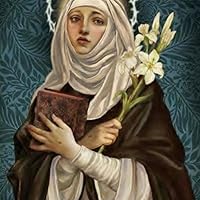
The book's cover photo of St. Bernadette Soubirous of Lourdes is of one of the better preserved incorruptibles. It's amazing! She looks like she's sleeping and will just open up her eyes at any moment. Here are some enticing facts about St. Bernadette:
The body was first exhumed thirty years after her death. On September 22, 1909, in the presence of representatives appointed by the postulators of the cause, two doctors, and the sisters of the community, the coffin was removed by workmen from the place where it had been entombed thirty years before. On opening the lid, they discerned no odor and the virginal body lay exposed, completely victorious over the laws of nature.
Although the clothing was damp, and sawdust and charcoal surrounded the body, the arms and face were completely unaffected and had maintained their natural skin tone. The teeth were barely visible through the slightly parted lips and the eyes appeared somewhat sunken. Her perfect hands held a rosary which had become rusty, and the crucifix which lay upon her breast was coated with verdigris. (288-289)
Other tidbits:
St. Rita of Cascia 1381-1457:
...there is still growing in the courtyard the five hundred-year-old vine, which owes its existence to an incident in the Saint's early religious life. To test her obedience, her superior ordered Rita to plant a certain piece of dry wood and to water it each day. The stick eventually sprouted into a healthy grape vine, which still bears fruit. Each year the harvest is distributed among high ranking ecclesiastics, while the leaves are dried, made into a powder, and sent to the sick around the world. (132-133)
The intact body of St. Rita of Cascia, "Saint of Impossible and Desperate Cases," displayed in a glass case in the Basilica of St. Rita in Cascia, Italy. She died in 1457: her body has shifted positions several times, plus the eyes have opened and closed unaided. (134)
Blessed Eustochia Calafato 1434-1485:
Perhaps the most dramatic miracle performed by the Beata, who had so often protected the city from damaging earthquakes, occurred in 1615, when the city was shaken day and night by almost constant vibrations. The senate and people of the city petitioned the sisters to pray to Bl. Eustochia for protection. The sisters removed the perfectly preserved body from the oratory where it had been conserved for almost a hundred fifty years and placed it in an upright position in her old choir stall. After they had charged Eustochia to pray for the protection of the city, the lips of the obedient Beata opened and her voice was heard chanting the first verse of the Psalm of the Night Office. The sisters, completely terrified, nevertheless joined in the recitation and bowed their heads during the Gloria in unison with the Blessed. The earthquake is reported to have ceased at that moment.
Still preserved at the Monastero Montevergine is the perfectly preserved body of the Beata. Although darkened after the lapse of five centuries, the body is nonetheless perfect in every respect, with the two fingers of the right hand poised in an attitude of perpetual blessing. (150-151)
St. John of God 1495-1550:
He founded the order of the hospitalliers. I've been curious about the history of the hospitalliers for some time, and I've discovered it in this book, which makes me quite happy. A very small Catholic hospital in northern Wisconsin still hires hospitaliers. In 1886, Leo XIII declared this saint, with St. Camillus de Lellis, the patron of hospitals and the sick, and in 1930, Pope Pius XI extended the patronage to include nurses. (171)
St. Philip Neri 1515-1595:
The night following his saintly passing, several physicians officiated at the autopsy, during which the viscera were set aside. The doctors opened his chest, which played a prominent part in one of the Saint's most remarkable mystical experiences. The day before Pentecost in the year 1544, while meditating in the catacombe of St. Sebastian, he had felt in an extraordinary way "filled with God". The doctors found that the swelling which had existed since that experience was caused by two broken ribs which were raised to form an arch over his enlarged heart. The pulmonary artery was very large, but the other organs appeared normal. They could not explain how the Saint had lived without experiencing extreme pain, and after a lengthy examination and a detailed consultation, they attested in the form of a written oath that the cause was supernatural and miraculous.(210-211)
Venerable Mother Maria of Jesus 1560-1640
The fragrant odor of jasmines and roses presaged the discovery of the incorrupt body of Venerable Mother Maria of Jesus at the opening of her sepulcher in 1929. To the amazement of witnesses, it was found that the body had exuded an oil which saturated her garments and kept the skin constantly moist. this mysterious oil and other wonders were declared to be unexplainable by the attending physicians and distinguished men of science who were present.(235)
Joan Carrol Cruz ends the book with this appropriate quote from St. Cyril of Jerusalem: "Even when the soul is gone, power and virtue remain in the bodies of the saints because of the righteous souls which have dwelt in them."
The miracle and mystery of the incorruption of the saints continues today. Saint Josephine Bakhita, who died on Feb. 8, 1947, lies incorrupt in a glass coffin. Pope John Paul II canonized her on Oct. 1st, 2000, and she is the Patron Saint of Sudan. Her's is a fascinating, beautiful story, too. Also, Padre Pio of Pietrelcina, who died in Sept. 1968. He was exhumed 40 years after his death, on March 2, 2008, and found incorrupt. Fascinating!