Words fail me when I most need them. This is one of the saddest books I have ever read. Also a necessary book, a much needed testimonial for those whose lives have perished with their song unsung, victims of the last century’s ethnic cleansing and forced exile. A quiet desperation permeates almost every page, a slow dissolving into nothingness, a loss of innocence, a disconnect between generations that translates into a decaying present. Bad Kissingen was once a gem of a town, a Bavarian baroque extravaganza. Few landmarks survive today to illustrate its past glory.
When I reached the gate it turned out that neither of the keys fitted the lock, so I climbed the wall. What I saw had little to do with cemeteries as one thinks of them; instead, before me lay a wilderness of graves, neglected for years, crumbling and gradually sinking into the ground amidst tall grass and wild flowers under the shade of trees, which trembled in the slight movement of the air.
Old pictures in family albums, faded pages in leather-bound journals, childhood recollections, letters from parents sent to gas chambers, hazy memories of old people waiting for the final curtain – W G Sebald erases the border line between fact and fiction, between novel and documentary evidence, between family life and history.
The longer I studied the photographs, the more urgently I sensed a growing need to learn more about the lives of the people in them.
A Dr. Selwyn, retired from a business practice in England, talks to the author about his yearning for his homeland in Lithuania. The author’s childhood professor, Paul Berrutyer, is an enigma that he tries to unlock through interviews with the people that knew him. Sebald’s great uncle Adelwarth goes to America and befriends there a young wealthy scion of a famous family. They travel the world together before Adelwarth retires to a solitary room. The author himself revisits his youthful days in soot stained Manchester, where he meets an expatriate painter named Max Ferber.
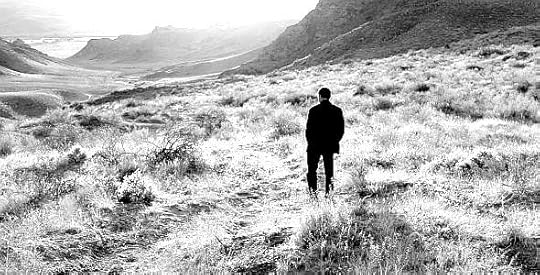
In 1960, when I had to give up my practice and my patients, I severed my last ties with what they call the real world. Since then, almost my only companions have been plants and animals. Somehow or other I seem to get on well with them, said Dr. Selwyn with an inscrutable smile, and, rising, he made a gesture that was most unusual for him. He offered me his hand in farewell.
What brings these people together is their solitude, their alienation in a foreign land, their attempts to find solace in things that grow (a counterpoint to the wholesale destruction of the war?), and the dignity of choice, the last thing that truly belongs to them being the decision to leave this sorry world behind.
As I remember it, he even turned away in order to conceal from us the sob that rose in him. It was not only music, though, that affected Paul in this way; indeed, at any time – in the middle of a lesson, at break, or on one of our outings – he might stop or sit down somewhere, alone and apart from us all, as if he, who was always in good spirits and seemed so cheerful, was in fact desolation itself.
>><<>><<>><<
Paul spent a lot of time gardening, which I think he loved more than anything else.
>><<>><<>><<
The whole house was always very neat and tidy, down to the last detail. Often it seemed to me as if Uncle Adelwarth was expecting a stranger to call at any moment. But no one ever did.
>><<>><<>><<
He felt closer to dust, he said, than to light, air or water. He himself once remarked, studying the gleam of graphite on the backs of his hands, that in his dreams, both waking and by night, he had already crossed all the earth’s deserts of sand and stone.
>><<>><<>><<
Since mid May 1969 – I shall soon have been retired for fifteen years – I have spent my life out of doors here, in the boathouse or the apiary, depending on the weather, and I no longer concern myself with what goes on in the so-called real world. [Dr. Abramsky]
The gardening could also be a metaphor for the need of roots, a need to belong to a community, a need for continuity of traditions and family values – all of which have been destroyed in the Holocaust. Sebald is focused not on the grisly details of the extermination camps, but on the effects on those displaced or left behind, whose scars are not always visible from outside. Uncle Kasimir, another member of the family who emigrated to America remembers:
In those days, he began, once I had managed to steer the talk to the subject of emigration, people like us simply had no chance in Germany.
Even when business picks up and a new family is formed, the yearning and the sadness remains a constant in their lives, illustrated in a visit to the Jersey shore and a blurry, dark snapshot:
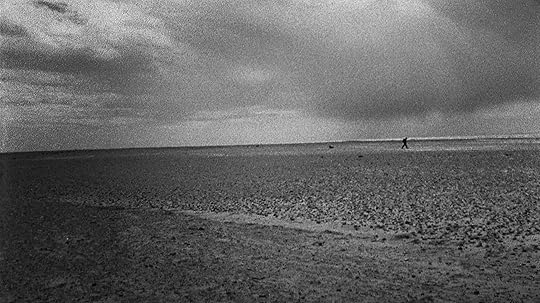
This is the edge of darkness, he said. And in truth it seemed as if the mainland were submerged behind us and as if there were nothing above the watery waste but this narrow strip of sand running up to the north and down to the south. I often come out here, said Uncle Kasimir, it makes me feel that I am a long way away, though I never quite know from where.
Sebald’s emigrants are moving like slow dancers in and out of focus, both attracted by an idyllic past and repulsed by memories of outrage, their silent eyes accusing us for our indifference out of old-fashioned sepia photographs, now only names on tombstones in locked-out places nobody cares to visit. Who now plays with cockchafer bugs, or collects Hummel figurines? Who remembers what a tea-maid is, or a candlewick bedspread?
Mother wrote not a word about the events of the moment, said Ferber, apart from the odd oblique glance at the hopeless situation she and Father were in; instead, with a passion that was beyond his understanding, she wrote of her childhood in the village of Steinach, in lower Franconia, and her youth in Bad Kissingen.
Sebald strives for putting these things in perspective, accumulating hundreds of minor details that put together might wove back the tapestry of the past. The poet in him sees this work as similar to climbing up in the Jura mountains and gazing over the wide, sparkling expanse of Lake Geneva.
Memory, he added in a postscript, often strikes me as a kind of dumbness. It makes one’s head heavy and giddy, as if one were not looking back down the receding perspective of time but rather down on the earth from a great height, from one of those towers whose tops are lost to view in the clouds.
With the bluring between fact and fiction that I already mentioned, it is difficult to know which parts of the novel come from imagination and which from personal experience. I am sure though that Sebald knew all there is to know about alienation and decay intimately. Most evocative for me are the passages where the author describes the early days of his first visit to Manchester in the 1960’s.
As for myself, on those Sundays in the utterly deserted hotel I would regularly be overcome by such a sense of aimlessness and futility that I would go out, purely in order to preserve an illusion of purpose, and walk about amidst the city’s immense and time blackened nineteenth-century buildings, with no particular destination in mind. On those wanderings, when winter light flooded the deserted street and squares for the few rare hours of real daylight, I never ceased to be amazed by the completeness with which anthracite-coloured Manchester, the city from which industrialization had spread across the entire world, displayed the clearly chronic process of its impoverishment and degradation to anyone who cared to see.
A city that once boasted to rule the industrial world is now slowly breaking down into ruin, yet memory can still recall the glory days, and a writer’s job is to capture these images like prehistoric insects in a drop of amber.
Given the motionlessness and deathly silence that lay upon the canal now, it was difficult to imagine, said Ferber, as we gazed back at the city sinking into the twilight, that he himself, in the postwar years, had seen the most enormous freighters on this water. They would slip slowly by, and as they approached the port they passed amidst houses, looming high above the black slate roofs.
A final word proved to be as elusive to capture for me as the introduction, but Sebald comes to the rescue like the English teacher he once was, reminding me that time has not the fixed value claimed by science books:
... but time, he went on, is an unreliable way of gouging these things, indeed it is nothing but a disquiet of the soul.