Winner of Poetry Magazine’s Levinson Prize • An illuminating collection of poems from the middle of Carver's career that “function as distilled, heightened versions of his stories, offering us fugitive glimpses of ordinary lives on the edge” ( The New York Times ).
"The stories poems tell are so wonderfully self-contained, so self-evident, so gracefully metaphorical." — The Village Voice
"There is a severity of language, an understatement of emotion, that endows the poems of his first major collection with the feel of extraordinary experience. To read them is to have the sense this man has lived more than most of us. We trust him because of the plainly conversational diction and the lapel-grabbing rhythms.... They are very moving, very memorable." —Poetry
Carver was born into a poverty-stricken family at the tail-end of the Depression. He married at 19, started a series of menial jobs and his own career of 'full-time drinking as a serious pursuit', a career that would eventually kill him. Constantly struggling to support his wife and family, Carver enrolled in a writing programme under author John Gardner in 1958. He saw this opportunity as a turning point.
Rejecting the more experimental fiction of the 60s and 70s, he pioneered a precisionist realism reinventing the American short story during the eighties, heading the line of so-called 'dirty realists' or 'K-mart realists'. Set in trailer parks and shopping malls, they are stories of banal lives that turn on a seemingly insignificant detail. Carver writes with meticulous economy, suddenly bringing a life into focus in a similar way to the paintings of Edward Hopper. As well as being a master of the short story, he was an accomplished poet publishing several highly acclaimed volumes.
After the 'line of demarcation' in Carver's life - 2 June 1977, the day he stopped drinking - his stories become increasingly more redemptive and expansive. Alcohol had eventually shattered his health, his work and his family - his first marriage effectively ending in 1978. He finally married his long-term parter Tess Gallagher (they met ten years earlier at a writers' conference in Dallas) in Reno, Nevada, less than two months before he eventually lost his fight with cancer.
This morning there’s snow everywhere. We remark on it. You tell me you didn’t sleep well. I say I didn’t either. You had a terrible night. “Me too.” We’re extraordinarily calm and tender with each other as if sensing the other’s rickety state of mind. As if we knew what the other was feeling. We don’t, of course. We never do. No matter. It’s the tenderness I care about. That’s the gift this morning that moves and holds me. Same as every morning.
Two poems ('The Minuet' and 'An Afternoon' also featured in another (bilingual) collection of Carver’s poems I did read two years ago, Het woord liefde – a collection (as obvious from the title) concentrating on Carver’s love poetry.
As Carver wrote all poems are love poems, quite a few of the poems reflect on the versatility and multiple sides and manifestations of love and affection – romantic as well as parental love. His poems capture tender moments in the relationship with Tess Gallagher, his second wife to be (some poems are directly dedicated or addressed to her); quiet despair and wryness are conjured up when focussing on the falling apart of his first marriage ('The Other Life','Next Year','Hope'; the painful ‘To My Daughter’ shows him as a father helplessly watching when he sees his own mistakes – drinking - repeated by his daughter.
This collection points out that Carver didn’t confine himself merely to observations on love in his poetry; he had more strings to his lyrical bow. His scope of themes widens to death, failure, loss, alcoholism, family and, surprisingly, the unstinted beauty of nature, the landscape, the sea (looking out over the Strait of Juan de Fuca).
Some poems amaze by displaying astounding outbursts of intense happiness, hope and gratitude, even when facing the end (in the moving poem ‘My Death'). Tones and moods range from wonderment, melancholy and bitterness over grace and tenderness; childhood memories entwine with observations on aging and the eventual loss of the parents; contemplating when fishing. While Het woord liefde mainly focussed on the interaction (and emotions) of lovers which are taking place inside (in bars, motel rooms, at home), this collection shows how Carver’s perspective and sensitivity also turned outward, towards nature.
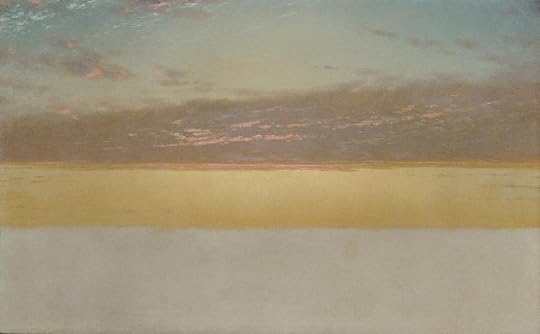
(John Frederick Kensett, Sunset sky, 1872)
Where water comes together with other water
I love creeks and the music they make. And rills, in glades and meadows, before they have a chance to become creeks. I may even love them best of all for their secrecy. I almost forgot to say something about the source! Can anything be more wonderful than a spring? But the big streams have my heart too. And the places streams flow into rivers. The open mouths of rivers where they join the sea. The places where water comes together with other water. Those places stand out in my mind like holy places. But these coastal rivers! I love them the way some men love horses or glamorous women. I have a thing for this cold swift water. Just looking at it makes my blood run and my skin tingle. I could sit and watch these rivers for hours. Not one of them like any other. I'm 45 years old today. Would anyone believe it if I said I was once 35? My heart empty and sere at 35! Five more years had to pass before it began to flow again. I'll take all the time I please this afternoon before leaving my place alongside this river. It pleases me, loving rivers. Loving them all the way back to their source. Loving everything that increases me.
When considering the free-flowing form, the aesthetics of the images or word choices, the musicality and rhythm, Carver’s parlando-style poetry might come across as quite prosaic and casual; the poems seem rather resemble compressed micro-stories then poetry. Nonetheless, some of the poems moved me profoundly. Purity, simplicity, sincerity are what make some of these poems stand out. The poetic voice of Carver chimes transparently like water, revealing now and then similar depths. Guided gently through the lines of Carver’s conversational writing, reading halts at the sparse lines of a singular stanza, shedding a light on the simple essence of life, revealing a moment of deep insight, coming unexpectedly, touching the heart - like happiness does.
Happiness. It comes on Unexpectedly. And goes beyond, really, Any early morning talk about it. (From ‘Happiness’, 1985)
(John Frederick Kensett, Sunset, 1872)
In the posthumously published anthology of Carver’s essays Call If You Need Me: The Uncollected Fiction and Other Prose (which also contains a few previously unpublished stories), Carver reminds of what truly counts in life: ‘Love, death, dreams, ambition, growing up, coming to terms with your own and other people’s limitations’.
This poetry collection illustrates that awareness magnificently.
Should I pretend that I'm not desperately in love with this book? With Raymond Carver's writing?
Should I reveal to you that other poetry readers would probably give this collection a 3 or 4 star rating, shrug their shoulders, and toss it carelessly back on the shelf?
Should I tell you that readers under 40 might even find themselves unable to relate to the central themes here?
I don't care. I don't care! I love this book. I want to own it forever, read out of it forever.
Well, not forever, silly. I mean, read it until I die. And, that's the thing, see. Our bodies are all going to die some day, and we won't be able to read, or do a helluva lot of other things, either. And sometimes, just sometimes, we need to think about that. . . because denying death doesn't keep it away, it just uses up our energy and keeps us from living.
But, this book isn't all about dying. It's also about revelations in mid-life: the power of nature to restore us, the power of regrets to destroy us, the embarrassments of our past mistakes, the freedom (the sweet release!) that comes with the maturity of learning from those mistakes. (For those of us who have chosen the painful learning route).
And, beyond this. . . what you may think of as random, Carver's “scribbles” so to speak. . . are never as casual, or as trivial as they appear. Almost every poem of Carver's is loaded. Loaded with wisdom, epiphanies, and powerful language. Carver is a swift imagist, almost a master of juxtaposing light and dark (both conceptually and visually) in his brief verse. He can knock his reader out, quickly, with his shifts, and I want to leave you with my favorite poem in this collection, Woolworth's 1954. May it. . . linger. . . in your mind, as it has mine:
Where this floated up from, or why, I don't know. But thinking about this since just after Robert called telling me he'd be here in a few minutes to go clamming.
How on my first job I worked under a man named Sol. Fifty-some years old, but a stockboy like I was. Had worked his way up to nothing. But grateful for his job, same as me. He knew everything there was to know about that dime-store merchandise and was willing to show me. I was sixteen, working for six bits an hour. Loving it that I was. Sol taught me what he knew. He was patient, though it helped I learned fast.
Most important memory of that whole time: opening the cartons of women's lingerie. Underpants, and soft, clingy things like that. Taking it out of cartons by the handful. Something sweet and mysterious about those things even then. Sol called it “linger-ey.” “Linger-ey?” What did I know? I called it that for a while, too. “Linger-ey.”
Then I got older. Quit being a stockboy. Started pronouncing that frog word right. I knew what I was talking about! Went to taking girls out in hopes of touching that softness, slipping down those underpants. And sometimes it happened. God, they let me. And they were linger-ey, those underpants. They tended to linger a little sometimes, as they slipped down off the belly, clinging lightly to the hot white skin. Passing over the hips and buttocks and beautiful thighs, traveling faster now as they crossed the knees, the calves! Reaching the ankles, brought together for this occasion. And kicked free onto the floor of the car and forgotten about. Until you had to look for them.
“Linger-ey.”
Those sweet girls! “Linger a little, for thou art fair.” I know who said that. If fits, and I'll use it. Robert and his kids and I out there on the flats with our buckets and shovels.
His kids, who won't eat clams, cutting up the whole time, saying “Yuck” or “Ugh” as clams turned up in the shovels full of sand and were tossed into the bucket. Me thinking all the while of those early days in Yakima. And smooth-as-silk underpants. The lingering kind that Jeanne wore, And Rita, Muriel, Sue, and her sister, Cora Mae. All those girls. Grownup now. Or worse. I'll say it: dead.
I would always count Carver on my top 10 list, and I’m not certain how many original works I’ve yet unread, so when I decided to read this slim volume, it was with some trepidation. I’m worried my tastes have changed, or I’ve moved past a time of wonder when reading this author was like crystalline truth, unbearable and heartbreaking. Has my sense of taste evolved, or become too jaded, where I can no longer enjoy what used to bring intense joy, of course interlaced with longing and traces of manageable pain (just enough to perfect the flavor). My sense of smell and hearing aren’t what they used to be, and my childhood memories sometimes feel a tad petrified, this scares me. My first Carver was a collection called Where I’m Calling From, actually gifted to me (in idea) from one of my brothers who doesn’t read now, but in college became aware of this author (or the idea of this author, he is more cerebral than literary). This book shocked and amazed, I recall bitter alcoholic and violent feuds with lovers, parents and family in the great northwest where rivers run cold and human habitation is poor and harsh. I obtained a cassette with several stories read by Peter Reigert (the animal house guy) which were stunning, especially the semi-autobiographical one of his time in rehab, recalling his first taste and early lover affair with ethanol as a young man, and the tales he heard from others in others over cigarettes during the cirrhotic end times. Carver wrote so purely, I just knew his art was perfect and I drank it up like a sublime elixir. Once during a fever I read the entire Carver Country about his life, his loves, his home with beautiful black and white photos alongside.
So here I am, a couple decades or more past my first experience with Ray, trying to catch up on my reading list and clearing my decks to read something else my reading buddy and I have planned (obligations, that’s my life). At first I was underwhelmed by these poems, a tad disappointed, and somewhat ashamed that I would give this a 3 star rating (average, by my lights), a minor tragedy since with my (hopefully) 20 years of reading life left I hope to only consume what is good to great (4-5 stars) in my carefully stocked library of actual books. Reading this late at night, in bed, with the pains in my neck and overall fatigue wasn’t the way to go. Poetry isn’t always so easy for me, I need to stay focused. But I did have lingering doubt that my dulled senses were missing the essence. This was published in 1986, originally in 1984, later in life for Carver who died at 50 in 1988. His reminiscence of his old life, stitched together later with his beloved Tess (second wife) runs throughout. Eventually, later in the book we got back to old times & I enjoyed. But this isn’t his best, I’m sure, his own health issues were likely draining energy at this point, or so is my guess.
p. 49, where he imagines the unimaginable in 2020 in the title (surely a worldwide pandemic was not in his mind then): “Which of us will be left then- old, dazed, unclear- but willing to talk about our dead friends? Talk and talk, like an old faucet leaking. So that the young ones, respectful, touchingly curious, will find themselves stirred by the recollections.”
p. 80: “At that moment, bright blood burst rushed from his nose, spattering the green felt cloth. He dropped the dice. Stepped back amazed. And then terrified as blood ran down his shirt. God, what is happening to me? He cried. Took hold of my arm. I heard Death’s engines turning. But I was young at the time, and drunk, and wanted to play. I didn’t have to listen.” Like Carver, I have flashes of odd memories, he managed to commit them to verse.
p. 91: “More blood on the counter. A trail of it. Drops of blood on the bottom of the refrigerator where the fish lay wrapped and gutted. Everywhere this blood. Mingling with thoughts in my mind of the time we’d had- that dear young wife and I”. Here Carver is likely remembering that he once loved his first wife, and was happy. These poems are full of those bittersweet memories before he went through is crises. (fame, divorce, 3 times committed for alcoholism in one year in the late seventies).
p. 129, more fond memories, this time of his father, and for which I love this author: “And from the trestle I could look down and see my dad when I needed to see him. My dad drinking that cold water. My sweet father. The river, its meadows, and firs, and the trestle. That. Where I once stood. I wish I could do that without having to plead with myself for it. And feel sick of myself for getting involved in lesser things. I know it’s time I changed my life. This life- the one with its complications and phone calls- is unbecoming, and a waste of time. I want to plunge my hands in clear water. The way he did. Again and then again.”
Carver can break your heart without seeming to try, and there is that quality in many of these poems. Written in the mid 1980s, in the last years before his death, they are that mix of bittersweet memory, melancholy, and joy taken in the here and now. Living with poet Tess Gallagher in a house overlooking the Strait of Juan de Fuca in Washington (Carver grew up in Yakima, Washington), he writes of the days that pass there, the frequent rains and the boats passing on the water, and he tracks the course of fleeting emotions, often triggered by long-forgotten memories.
He has this ability to discover the extraordinary in the absolute ordinary, and he can bring together ideas with images drawn from everyday life that disturb and shock the heart, as when he recalls an old relationship while describing the drops and smears of blood left in a kitchen sink after gutting fish. As with his stories, these poems are written in plain, conversational language while evoking at the same time the darkly inexpressible. Simple and direct on the surface, they are like being in a small boat on deep waters.
De gedichten van Carver zijn kleine verhalen. En -net als zijn verhalen- pakken ze mij bij de keel. Mooie vertaling door Joris Iven. "Hij trekt aan zijn sigaret en kijkt haar aan zoals een man onverschillig kan kijken naar een wolk, een boom of een tarweveld bij zonsondergang. Hij knijpt zijn ogen dicht tegen de rook. Van tijd tot tijd gebruikt hij de asbak, terwijl hij wacht tot ze ophoudt met huilen."
-Radio Waves -Fear -Still Looking Out For Number One -Where Water Comes Together With Other Waters -Happiness -The Old Days -Next Year -Locking Yourself Out, Then Trying To Get Back In -Wenas Ridge -Reading -Rain -At Least -My Boat -In The Year 2020 -My Dad's Wallet -Ask Him -Next Door -In Switzerland -A Squall -The Party -The Hat (I'm Mexican, I can confirm this is just what Mexico City is like irl) -Extirpation -My Death -The Cranes -Reading Something In The Restaurant -For Tess
Holy shit was this overflowing with bangers, so much amazing stuff
Carver’s poetry doesn’t go marching about proclaiming the big things in life: he’s all about the little things around the big things. Not about the deep thoughts on a day outside, but the big sky above him and cold water around him when he was thinking.
Very enriching reading Raymond Carver. Not only are his short stories brilliant but his poems are in many ways an extension of himself. He is, and was, America's greatest writer. And if he had written novels too he would be recognized as such by more than just a few of us. Yes, I feel he is more important than Mark Twain, Hemingway, Faulkner, Melville, and anyone else who comes to mind. He wrote often, and well.
Carver's poetry is much like Carver's prose: spare yet evocative, and that Hemingway-esque rhythm of the short declarative sentence, punctuation so often at the end of lines that I found myself wondering if this was really poetry at all, or just lists, short-shorts in the guise of poetry. (I tend to feel that they're more the latter.) It's not typically what I'd seek out in poetry. But Carver is evocative for me in a way that Hemingway is not, and the stories he tells in his poems are haunting and memorable. There's "Wenas Ridge," in which the narrator's friend is struck at (but missed) by a rattlesnake, leaving the narrator to confess:
This was the moment my life had prepared me for. And I wasn't ready. . . . Jesus, please help me out of this, I prayed. I'll believe in you again and honor you always. But Jesus was crowded out of my head by the vision of that rearing snake. That singing. Keep believing in me, snake said, for I will return. I made an obscure, criminal pact that day. Praying to Jesus in one breath. To snake in the other. Snake finally more real to me.
Or there's "Happiness in Cornwall," in which a family hires a maid for their widower father, and the end of the poem finds him "listening to her read poetry/in the evenings in front of the fire. Tennyson, Browning,/Shakespeare, Drinkwater. Men/whose names take up space/on the page." Dozens upon dozens of little stories with Carver's wry commentary and philosophical musings, like in "The Juggler at Heaven's Gate":
. . . What's his story? That's the story I want to know. Anybody can wear a gun and swagger around. Or fall in love with somebody who loves somebody else. But to juggle for God's sake! To give your life to that. To go with that. Juggling.
And then there's "Aspens." "Aspens," which I will write down and stick to my wall--a lovely, winding tale of loneliness that ebbs and flows, that takes on some cosmic significance and then reduces down to its own ash again.
God bless Carver for proving that the story can be a poem, the poem can be a story, that poetry has room for prosaic narrative after all.
Who knew I’d love poetry. I’m a poetry lover! At least a Raymond Carver poetry lover.
I want help finding other poets of this caliber. One's who don't try and impress us with metaphors and similes.
I found this collection lively. Parts where dark but so is life. Apparently Raymond's contained some dark parts. I felt guided, talked up to and not asked to figure out tricky metaphors.
Favorites: Fear, The Ashtray, The poem I didn’t write, My Dad’s Wallet, The Pipe, My Death, and A Haircut.
This Carver cat is quickly becoming one of my favorite writers. I don't even like poetry and I liked this book. The poems here aren't a whole lot different than Carver's short stories. They chronicle the same kinds of sinking mundaneness that comes with aging, and achieve the same kind of clear-eyed profundity from observations and appreciations of love and the homestead.
As much as I enjoy his stories, I wonder if his poetry might be the more enduring legacy? All three of the poetry collections from his last years are loaded with great poems. Eighty poems in this collection, not all to my taste, of course, and after years of rereading I have only twenty-one of the poems bookmarked. Usually I just read the bookmarked poems, but this time I reread them all and did not bookmark anything else. So I have my Favorites: "Woolworth's, 1954." "Anathema." "Locking Yourself Out, Then Trying To Get Back In." "Next Door." "Harley's Swans." "The Windows of the Summer Vacation Homes." "The Trestle." Some of the others I've bookmarked because of a line, or a stanza, or a technique. Others because of a theme that traces through his work, or because they are mini-stories, or could have been stories.
His poetry is recognizably Raymond Carver, but it's got a different MO from his fiction. While the short stories tend to be dark, the poems that make up Where Water Comes Together with Other Water are contemplative, nostalgic, and sanguine. Often, they're narrative poems. They still contain stories but they're more like character sketches told in very plaintive language. They're easy and convivial. They are voicey and filled with the wisdom of a life lived. Reading this collection was edifying. It was also entertaining. Carver creates a small world where time moves slowly, where clocks tick inside wood-paneled rooms, and people sit and think about how they got where they are. It does what good poetry is meant to do: it moves you. I fuck with it and think you will, too.
Carver is better known for his short stories, but his poems also deserve consideration. Carver is a very intentional writer. Composed during his happier years, the poems reflect the life of a man who is aware of his demons, and who for the time being has them under control. Carver’s style is direct, and filled with a realism that intends profundity. My favorite passage is the following verse from “Hominy and Rain”: It’s a little like some tiny cave-in, in my brain. There’s a sense that I’ve lost—not everything, not everything, but far too much. A part of my life forever. Like hominy. (10) This is an apt metaphor. It is intellectual and real at the same time, and it speaks to loss in the context of an overall life. Other favorites are “The Ashtray”, which is an extended meditation on a brilliant quote of Chekov’s. Finally, I love the poem “Venice”: The gondolier handed you a rose. Took us up one canal and then another. We glided past Casanova’s palace, the palace of the Rossi family, palaces belonging to the Baglioni, the Pisani, and Sangallo. Flooded. Stinking. What’s left left to rats. Blackness. The silence total, or nearly. The man’s breath coming and going behind my ear. The drip of the oar. We gliding silently on, and on. Who would blame me if I fall to thinking about death? A shutter opened above our heads. A little light showed through before the shutter was closed once more. There is that, and the rose in your hand. And history. (102) This poem is stunning in its message and imagery. The remainder of the collection is very personal. While not a masterpiece, it is very good and worthy of everyone’s attention.
Poetry -- still a mystery to me. Still something to be wary of, because if you are not guarded and you happen to come across an emotionally stirring work, it could wound you. I'm not sure if I got it right, but if a poem makes you feel fragile, if it holds up an unbidden mirror to the reflection you don't want to see -- is it a good one? In any case, this is how this book moved me. It's short and makes me want to drink it slowly, in measured sips. Reanne got this from a thrift store in LA, I think; that it spent a few weeks inside a box, that it travelled across the Pacific to find me, and that it therefore came with this distinctly musky scent makes it all the more special.
So I won't forget, I will list my favorites, to return to: The Road, Fear, The Ashtray, Where Water Comes Together With Other Water, Happiness, Rain, The Poem I Didn't Write, A Walk, Listening, Tomorrow, Venice, Reading Something in the Restaurant, and My Work. There's also a Zurich piece here that I'm bookmarking, to share with my godmother who lives in Switzerland; I've never been, but she might find something lovely from the words.
I think I can afford to give this collection the best compliment that writers can receive: it makes me want to write. It makes me want to think, to be more mindful, to be more careful. It makes me want to live, if only to experience firsthand the places and feelings described so well here. It makes me want to be less haphazard with the day to day. I'm grateful this book came to me when it did -- I hadn't realized I was looking for it.
Raymond Carver is goed, verschrikkelijk goed. Poëzie over zijn eigen leven (en dus Het Leven), telkens met een verhalend element, een ervaring of een gebeurtenis als kern. Niet puur beschouwend of esthetisch maar realistisch, als bekentenissen en/of herinneringen. Steeds over de menselijke liefde, die soms lelijk is, soms zwak, soms donker, soms zoek en ook sterk, subtiel, mooi... Meer Carver graag!
At least one poem is outstanding in this collection. I can't get the image of it, a woman cutting a man's hair, with the snow falling outside, out of my head. See it clearly, pother bleak winter day in the Midwest, a bedroom, a gable-front house, the hair and snow falling simultaneously— as if written by Haikun or Basho. The book otherwise, it seems, has not aged too well.
I had not read any of Carver's poetry prior to this. The poems range in such topics as life, love, smoking, drinking, fishing, and death. They are straightforward and convey an honesty and intimacy many poets fail to convey.
Really, these are like Carver mini stories - or stray thoughts. It doesn't matter if they qualify as poems, I like reading them. He's that worldly-wise friend who also appreciates details and beautiful moments and you like listening to him.
I'm not really much of a poetry reader, but I think the sparseness and clarity of Carver's writing here is amazing. The poem "For Tess" has been a favorite for years. Beautiful, quiet imagery that I can't quite stop thinking about.
Carver may write a lot about drinking (a demon he eventually conquered) and cigarettes, but there are also universal themes of simple joy and grace. Some poems were 3 stars for me (not bad), but others (At Least and My Death) were a solid five stars. I'm eager to read more.
I read this book in conjunction with the Carver memoir, "What It Used to Be Like." Carver's poems are accessible and for the most part, autobiographical.