

What do you think?

The Alien Life of Wayne Barlowe
Barlowe creates entire planets packed with details in his artistic science fiction pictures: enjoy a fine profile of the development of Barlowe's science fiction art career in a title which pairs his startling images with his own insights on the development of each. Fine color throughout brings each drawing alive while Barlowe's own comments provide essential insights.
This stunning retrospective of the career of SF/fantasy artist Wayne Barlowe showcases 20 years of his remarkably detailed drawings and meticulous paintings depicting bizarre alien life forms and thrilling, futuristic space ships, weapons, and other fantastic inventions. 70 color photos. 30 line drawings.
This stunning retrospective of the career of SF/fantasy artist Wayne Barlowe showcases 20 years of his remarkably detailed drawings and meticulous paintings depicting bizarre alien life forms and thrilling, futuristic space ships, weapons, and other fantastic inventions. 70 color photos. 30 line drawings.
72 pages, Paperback
First published December 15, 1995
Ratings & Reviews
Friends & Following
Create a free account to discover what your friends think of this book!
Community Reviews
Displaying 1 - 6 of 6 reviews

October 10, 2021

This is both a delightful and frustrating book for the Barlowe fan. Delightful because it gives insight into his artistic process, thoughts on art, his sources of influence and inspiration, and, of course, the images. Frustrating, because of its brevity, because of the many projects mentioned in its pages that will never see the light of day, and because the book is only about 10 by 12 inches. So many times I was thinking to myself, "If only this pictures were about 6 feet tall..." But at some point, I realized what Barlowe's pictures make me want to do is fall headlong into the worlds he imagines, for them to be real and living places and things (not so much Hell, though the paintings are still great).
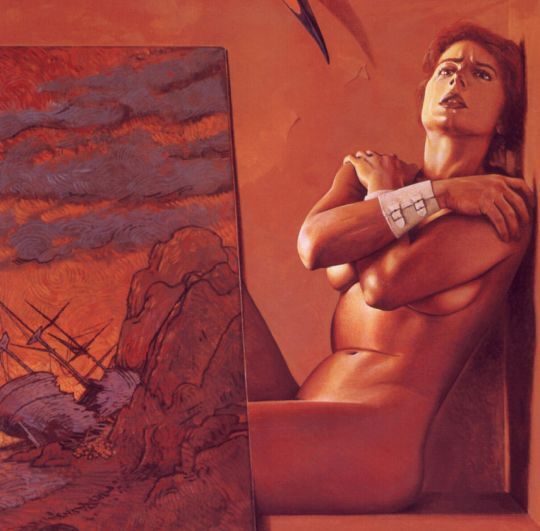
The first section covers his early and commissioned work, mostly book covers. It's amazing to think there was a time when tons of science fiction and fantasy novels got painted covers. Extravagant, even. Granted, most weren't up to Barlowe's standard, where he actually read the novel in question, and carefully considered the best characters, symbols, and moods to represent. But I think even the crappier and slapdash painted covers were better than the generic emblems and robed actors in wind tunnels we get now. It's always a delight when I see a Barlowe cover in a bookshop, and every time I have to remind myself the contents probably won't live up to the cover.

Another section is given over to his dinosaur paintings. Dinosaurs are great. Barlowe is a great artist. His dinosaur paintings are great.

The third section is "projects", where he discusses his long-gestating and still unrealized weird fantasy warrior Thype, Expedition, his Hell works, and some others. Several of the Thype paintings here are recognizable as completed versions of sketches that appeared in Barlowe's Guide to Extraterrestrials, just as Barlowe's Guide to Fantasy features several Hell sketches. The difference is Hell spawned two art books and two novels, and he still regularly paints Hell pieces. I don't know if he's ever talked about why Thype fell by the wayside, because from this book it sounds like his baby.

While Barlowe's thoughts on his goals with his Expedition pieces are interesting, it was kind of annoying having any space taken up by them. They're bigger in the Expedition book, and I would've preferred more book covers or Thype instead. Reading about how the Victorian "nocturnal landscape" painter Atkinson Grimshaw influenced the look of the ebony blisterwing piece was interesting at least, as was learning of the greater hornbill's mate imprisoning behaviour related to the sackback.

Barlowe mentions a lot of artists throughout the book, whether as influences in general or providing inspiration for specific pieces.
Stanley Meltzoff
Zdeněk Burian
Andrew Wyeth
Robert Vickrey
Robert Mcginnis
Joseph Pennell
Ernest Lumsden
Gustav Klimt
Max Klinger
Gustav Doré
Hiremy Hirschl
John Martin
John Singer Sargent
Wildlife artists Fuertes, Jaques, Kuhnert, Liljefors
Hans Holbein
Jim Dietz
Atkinson Grimshaw
For the Hell pieces, he cites Ernst Fuchs, Joel-Peter Witkin, Henry Moore, Francis Bacon, Takayuki Takeya
June 27, 2021
An amazing collection of works by one of Sci-Fi's best illustrators. The background descriptions on each work provided a very insightful view of Barlowe's creative process and were also just very endearing.


January 9, 2025
The aliens felt neither fantastical nor grounded in an understanding of biology and/or physics and/or architecture.
Snack read 5 of 2025
Read in a library with overhead lighting
Snack read 5 of 2025
Read in a library with overhead lighting

August 28, 2014
This book follows the career of Fantasy Artist Wayne Barlowe and gives you a good overview of his work in several different mediums and genres. It gives a great insight into what it takes to be a Fantasy Artist and I found that element fascinating.

August 30, 2010
Overall, I found the art much more interesting than the text... which is not necessarily a bad thing in an art book! :)
Displaying 1 - 6 of 6 reviews