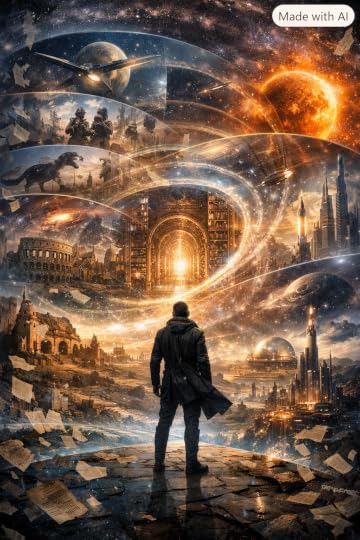
Welcome to the Stasis, the clandestine, near-omnipotent organization that stands at the heart of Charles Stross's Hugo Award-winning novella, Palimpsest.
By mastering the mysteries of the Timegate, the Stasis has repeatedly steered mankind away from the brink of utter extinction. Through countless millennia, through the 'mayfly flickerings' of innumerable transient civilizations, its members have intervened at critical junctions, reseeding the galaxy with viable potential survivors. In the process, they have reconfigured the basic structure of the universe, all in the name of human continuity.
Pierce is a newly recruited member of the Stasis, serving out a complex twenty-year apprenticeship while struggling to find his way through the paradoxical maze of history (and unhistory) that surrounds him. As his once simple existence expands and replicates over vast stretches of time, Pierce uncovers a new and unexpected destiny, one that will embroil him in the larger purposes of the Stasis and in the ultimate, unresolved fate of humanity itself.
Skillfully merging the threads of an individual life with the grandest, most overarching concerns, Palimpsest offers both visionary brilliance and narrative excitement in equal measure. Powerfully imagined, beautifully constructed, and written throughout with great economy of means, it is the kind of mind-expanding mini-epic that only science fiction--and only a master practitioner like Charles Stross--could produce.
Charles David George "Charlie" Stross is a writer based in Edinburgh, Scotland. His works range from science fiction and Lovecraftian horror to fantasy.
Stross is sometimes regarded as being part of a new generation of British science fiction writers who specialise in hard science fiction and space opera. His contemporaries include Alastair Reynolds, Ken MacLeod, Liz Williams and Richard Morgan.
I was exposed to the time-travelling blue telephone box, and its quirky, scarf-adorned occupant at an early age, and this exposure left me with a taste for causality violation, for the bending of the unbreakable constraints of physics in time travel stories that bring modern people into contact with both the pre-modern and their far-future descendants.
As a result, Palimpsest - a time travel story written by the very skilled Charles Stross - immediately appealed to me.
Stross, whose book Singularity Sky is a favourite of mine, has written a compelling, fascinating time travel story - no mean feat in a subgenre that has been flogged to death, dragged around the city behind a chariot and then flogged again just to be sure there's no life left in it.
Stross finds a spark in this tired old beast however, and he drives it hard, keeping up a breakneck pace of great ideas and intriguing twists. There's a hell of a lot packed into this novella, which encompasses billions of years of history- from Earth's beginning to the entropic death of the universe.
Pierce is a recruit into an organisation known as Stasis. The near-immortal agents of Stasis have access to time gate technology, and they use their access to all of time and space to stop the human race destroying itself.
And humanity has an unfortunate tendency to do just that. Whether it's via war, natural disaster, ecological collapse or general stupidity human civilisations tend inevitably towards self extinction, flaming out before becoming truly stable.
Stasis accept this inevitability, and rather than attempting to stop it they simply take groups of primitive humans, shift them millions of years through time, and dump them onto the now empty Earth to breed and restart a new human civilisation.
This process, which they call reseeding, has been carried out many thousands of times, and across the billions of years of the life of our sun (and beyond) there exist countless human civilisations, some of whom are directed towards scientific and technical research to assist Stasis in their endeavours. Every bit of data, every page written, every theory published in these societies is recorded and stored in an archive that exists billions and billions of years from now near the cold, black death of the universe - a record of every human there ever was, and every human achievement.
Pierce's role in this is to carry out these reseedings, to manipulate events to suit Stasis, and direct the energies of civilisations away from activities his bosses deem useless - such as interstellar travel.
His first assignment, to prove his commitment to Stasis, is to murder his own grandfather, cutting himself adrift in time with no family, no relatives, with only Stasis and it's agents as his anchoring points. His own grandad's will not be the only blood on his hands
But someone seems to want to kill Pierce, and they're willing to use the worst that time travel tech offers, to the point of changing entire timelines into unhistory- potential realities and events that once existed, but through casual manipulation are now only memories in the minds of the Stasis agents that witnessed them. Pierce, whose near-death has drawn the scrutiny of his seniors in Stasis, needs to find out who is chasing him and why.
Stross tells a great story, up there with some of the best in the genre, and as I read it each morning I found myself wishing my train stop was further away, just so I could gulp down a few more pages before I disembarked. This is a rollicking novella, full of interesting ideas and mind-bending time travel and it's well worth your time.
I must confess to being perhaps a little biased as I love a time travel story, but what Science Fiction fan doesn't have a soft spot for taking jaunts through history and the future? If SF allows a writer (and a reader) to enjoy a palette which encompasses our entire universe (and others) then time travel expands that palette into every universe that was or ever will be - nothing is out of bounds, no place, no person, no event. In the hands of a writer like Stross this freedom can be a heady drug indeed.
So after finishing The Time Traveler’s Wife I realized that the next book on my shelf was Family Matters. The last Rohinton Mistry book I read cut me up, so I decided that before I attempted this next one, I would need something I was guaranteed to enjoy. Fortunately, my awesome limited edition of Palimpsest had just arrived from Subterranean Press. I first read Palimpsest when it was a nominee for the Hugo Award for Best Novella. It subsequently won, deservedly, the award, and so when I heard that Subterranean Press was coming out with a hardcover edition, I jumped to pre-order it.
Time travel is weird, confusing, and inconsistent. There is no way to avoid that—and embracing this fact is the key to good time-travel fiction. Whether it’s Doctor Who or Primer, the method and mood of this mad embrace can be quite varied, but the end result is the same: a time travel story, when done properly, should blow your mind.
Where most authors go wrong in their time travel plots is a desire to make sense. So they go to the trouble of establishing various rules that attempt to compel their non-linear story into a linear box, forgetting all the while that once you break causality, there is no going back. Palimpsest is a refreshing change, because Charles Stross doesn’t try to make sense. He acknowledges and works with the utter insanity that would be a universe where time travel is possible. This allows him to accomplish wonderful things, but it also demands a great deal of tolerance from the reader. I can understand why some would reject this book as too confusing and too brief.
The novella opens with Pierce describing, in the second-person narration that Stross uses as an interstitial technique, how he has to kill his own grandfather (TVTropes) as the beginning of his training for the Stasis. The Stasis is a group of time travellers, pledged to manipulate history and reseed humanity each time it goes extinct on Earth. (Humanity, Stross explains, always goes extinct.) They go to incredible lengths to achieve this goal. Stross lyrically describes how they tinker with the ultimate fate of the Earth and solar system on a cosmic scale and literally manipulate the rise and fall of civilization to serve their own ends. Though Stasis’ stated goal is the ultimate good—survival of the human species—they sure do seem authoritarian about it.
As he undergoes his two-decade-long training period, Pierce develops a fascination with palimpsests. These are periods of history that have been rewritten so many times that it becomes very difficult to access any given version of history. (The Stasis has a Library that exists at the end of the Earth, which is protected from all changes to the timeline and therefore records various versions of history. This frustrates new agents who haven’t yet learned that the Library lies.) After Pierce survives an assassination attempt, presumably from someone out to prevent something he will do in his own future, he convalesces in a science empire of the far future, marries a native, and has a family. When he makes a quick trip to the Library to sort out an academic dispute, he discovers that period of history has been turned into a palimpsest, and he might never see his family again.
Pierce eventually becomes drawn into a much larger plot threatening the existence of Stasis itself. We, along with Pierce, are kept in the dark about the nature of this plot until close to the end of the book. But without going into spoilers, I can fairly succinctly describe the nature of the resistance: the name “Stasis” should be a clue. Though Stasis has humanity’s preservation at heart, it enforces this survival in a draconian and single-minded way. There is no room in Stasis’ agenda for extraterrestrial intelligence, space exploration, or indeed any type of development or growth that does not ultimately support Stasis. This meta-social construct has turned into a kind of symbiotic organism relying on the entirety of human history to exist.
Palimpsest isn’t perfect, and if I could wish for one improvement, it would be an extension to novel length. There is just so much going on here, an entire vocabulary and way of life that Stross can only barely explore. The events that take place evoke so many classics of science fiction and of time travel stories—for example, Pierce dies multiple times, even causing his own death at times. What does this mean for the nature of self, for our identity or even, if you believe in such a thing, our souls? These questions all linger in the back of one’s mind, but more so because I am already aware of them and know to apply them to these circumstances. They remain frustratingly unexplored, even somewhat unasked, because there just isn’t enough space.
Similarly, Pierce himself is kind of a lacklustre protagonist. Oh, don’t get me wrong. He’s an OK kind of guy, though I would have liked to learn more about him. But for most of the novella he gets dragged along with the plot rather than actually showing much initiative—and when he does show initiative, it tends to backfire! So readers who are waiting for Pierce to step up and own the story might be disappointed—or pleasantly surprised. I can’t say…. And to be fair, Stross acknowledges the powerlessness Pierce feels: when Pierce comes face-to-face with the person running the plot against Stasis, he confesses that he feels just as manipulated as when he was collaborating with the Stasis Internal Affairs department. Both sides are manipulating Pierce, and this becomes key to the novella’s final, profound pages.
I won’t deny that this book pushes my buttons in all the right ways, and for that reason, I am more than ready to overlook any flaws. I love Palimpsest so much because I feel like Stross has created a realistic portrayal of time travel, and in so doing demonstrated why time travel shouldn’t be possible. If it were, our universe would be an even crazier place than it already is. Because if it were possible to rewrite history, then everyone would be running around, killing their past selves and grandfathers and Hitler—that, or some form of the Novikov self-consistency principle would result in time travel erasing the timeline where time travel is invented. Confused yet? Good. This is your brain on time travel. Don’t do it!
But if time travel were possible, then it would also present us with staggering choice. The very mutability of the continuum would mean that history would never be constant. Foiled plots one moment could be successful coups the next, and vice versa if you work for the other side. You can join the time agency and then, if you tire of the work, go back in time and prevent yourself from joining—or just erase yourself from history altogether! In short, time travel as Stross portrays it in Palimpsest is the ultimate chaotic vector. This is the final message of Palimpsest, and it is simultaneously invigorating and terrifying.
What a ride! I daresay this is the best, most imaginative time travel story I've read, far beyond usual time travel fare. The scope here is staggering, nothing less than the origin and fate of humanity, Earth and the universe. Reminds me quite a lot of Poul Anderson's classic Tau Zero, with elements of Asimov's The End of Eternity. There is a lot of hard science and brain busting time paradoxes, which may make this unapproachable for some. Yet Stross masterfully weaves this grand scope and hard science together with a personal tale of intrigue and conspiracy, making for one hell of a compelling story. Highly recommended!
Agent Pierce murdered his own grandfather to join Stasis, the covert organization which works outside of time to reseed the Earth with humans every time they’re about to make themselves extinct. Pierce considers himself a loyal agent, and he didn’t even realize that there is a group that works in Opposition to Stasis — he’s only in training. So, why is someone trying to assassinate him?
Palimpsest follows Agent Pierce from initiation, through his twenty years of training, to his gruesome graduation ceremony, and onto his assignments as a new agent. The segments involving Pierce’s progress are written in both second and third person and are occasionally interrupted by chapters of Powerpoint-style lectures which show glimpses of alternate histories of our universe and describe the way the galaxy was restructured so that it could last for trillions of years.
It’s easy to see why Palimpsest won the Hugo Award for best novella in 2010. First of all, it’s beautifully written. This comes from “Slide 6”: Six hundred and fifty million years later, the outlines of Earth’s new continents glow by night like a neon diadem against the darkness, shouting consciousness at the sky in a blare of radio-wavelength emissions as loud as a star.
And how can you not admire this?: The day after he murdered himself in cold blood, Agent Pierce received an urgent summons to attend a meeting in the late nineteenth century.
You’d be tempted to think that time-travel, with its accompanying paradoxes, is a well-worn theme, and Palimpsest does re-visit some of the age-old questions, but it’s got some fresh and fascinating questions to ask, too: If a historical event is written over, which history is the correct one? (This is where the title “Palimpsest” comes from.) Is it ethical to decide who you want to be and then go back in time to remake yourself? What happens when a powerful organization evolves so that it has abandoned its original purpose and made itself its reason for being? What is the best way to make sure that the human species survives?
Pierce’s predicaments, and the issues he deals with, are exciting, but the story was so quick, sketchy, and subtle, and it jumps around so much, that I rarely had more than a tentative grasp on what was going on at any moment. I had to do a lot of rereading to make sure I knew what was happening, though I admit that I have rarely enjoyed being lost as much as I did here, and Stross was likely going for that effect. The characters, including Pierce himself, are also sketchily drawn, making it hard to connect with them. Pierce, who was just as bewildered as me, was mostly a passive character pushed along by his strange circumstances. Only at the end did he seem to seriously consider what he might do to affect his world (again, this was probably intentional).
In his afterword, Charles Stross says “Palimpsest wanted to be a novel. It really, really wanted to be a novel. Maybe it will be, someday.” I agree: Palimpsest wants to be a novel. It needs to be a novel. I want it to be a novel. This superb story deserves much more space and time (so to speak).
Charles Stross ha preso il soggetto di La fine dell’eternità di Asimov e lo ha riscritto, in modo completamente diverso. Il risultato è una novella ariosa e variopinta, che parla di viaggi nel tempo. Stross dribbla beffardo i paradossi, e punteggia la sua storia con visioni del tempo e dello spazio sovrumane.
Lo stile di Stross è vivace, alterna punti di vista, voci narranti, tempi verbali, adattando il ritmo della scrittura a quello lisergico delle realtà che si accavallano tra loro a mano a mano che la Storia si riscrive, si avvolge su se stessa, salta avanti e indietro.
SEMI SPOILER
Il punto, come in Asimov, è l’esistenza di una “polizia del tempo” (la Stasi, LOL), nata per preservare la razza umana nel corso dell’eternità, che finisce per fare troppo i propri interessi. Di nuovo come in Asimov, la Stasi/Eternità viaggia nel tempo ma vuole impedire all’umanità di viaggiare nello spazio.
Vividly sketched, but a sketch nonetheless. An unwelcome dose of bullshit gender tropes - our women range from the stern teacher who secretly wants to fuck you to the eager student who will also gladly fuck you, with a stop-off in the middle for the pliant, dumb wife and a mysterious, sensual soldier - drops Stross off my read-again-soon list.
There are some big ideas here. Time travel, human rise and extinction, Manifest Destiny, control... And there's a lot of scholarly exposition on the same. Written Power Point slides. Math that dares you to challenge it. But I found the story very thin. The main character is, intentionally, something of a nobody. And he has to make an existential choice among constrained paths. I just didn't find myself invested enough to care. Most of this novella is world-building, and it reads like a very smart writer's architectural document for an ambitiously scoped story (from the dawn of humankind to the heat death of the universe). But the story itself, I thought, could have used some more meat.
Un breve racconto (forse troppo breve), scritto con maestria, che all'evidentissimo omaggio all'Eternità di Asimov lega una visione estrema del lontanissimo futuro dell'umanità, con i caratteristici excursus che rivelano la portata della grande immaginazione dell'autore. Eppure è poco, troppo poco, da Stross mi aspetto molto di più.
A time‑travel novella in which Pierce, an apprentice agent of the Stasis, navigates billions of years of human history and unhistory. The story explores cosmic‑scale survival, memory erasure, and the ethics of rewriting civilization. The Stasis is a clandestine, near‑omnipotent organization that uses a Timegate to intervene across millennia, preventing humanity’s extinction by reshaping history, reseeding civilizations, and even altering cosmic structures. Their interventions span “mayfly flickerings” of countless transient societies. Pierce is recruited into the Stasis and begins a twenty‑year apprenticeship that immediately forces him into morally fraught actions such as killing his own grandfather to stabilize a timeline and to prove his loyalty to the Stasis. His missions involve traveling across epochs, adjusting events to maintain humanity’s long‑term viability. Over millennia, civilizations rise and fall, and the Stasis overwrites “unhistory” to keep humanity viable. Pierce’s life replicates across time, he has a wife and children in one timeline, only to find them gone in another. He encounters his past, present, and future selves, as well as other agents, and eventually crosses paths with the Opposition, a group seemingly opposed to the Stasis
In this novella time travel is not just used as a plot device but as a structural necessity for telling a story that spans trillions of years. The Stasis tightly controls time‑gate access, creating scarcity and political tension. Pierce’s sense of identity erodes as his memories become unreliable sometimes overwritten by timeline changes, sometimes rendered meaningless when the past itself is rewritten. A pivotal turn occurs when Pierce encounters the Library at the End of Time, a vast archive containing all alternate histories. Instead of clarity, he finds overwhelming ambiguity: countless overwritten timelines layered like a palimpsest, with no simple way to locate any “true” past. This discovery destabilizes his loyalty to the Stasis and reveals hidden agendas within the organization.
Found and read online following a Twitter discussion about time-travel stories.
This is an odd work, atypical of Stross' work IMHO. I am not sure I fully understood it. As soon as I finished it, I restarted it, but I lack time to reread the whole thing immediately.
As a piece of large-scale SF, it puts me in mind of Liu Cixin. As a story which involves jump-cuts into the far far cosmic future, of Robert Charles Wilson's /Spin/. As a story which involves multiple time-journeys, characters meeting and interacting with themselves over time and so on, of Robert Heinlein's '-- All you Zombies --'. Knowing Charlie, he might well have been aware of that.
I enjoyed it but I'm not at all sure that I understood it. I will re-read when I can and maybe revisit this.
Yeah, I actually guessed it was very possible that I was not going to really like this book, and after seeing that it had fewer than 1,000 reviews here on Goodreads, maybe I should not have even tried it. But I thought (and hoped), MAYBE, a big maybe, that it was a hidden gem, given all the high ratings.
Well, it didn't turn out that way for me, and I did not like a single thing about this book. Not a thing. It was confusing, messy, and boring. And unfortunately, even the time-travel aspect was not very appealing to me, though some claimed it is one of the most original. How? Maybe I am too stupid to understand the book, and maybe it is a masterpiece. In that case, I am sorry, I guess :)
The one thing I am happy about is that it was very short. Another disappointing read. My 2026 reads are not going well...
Dans ce très court roman (160 pages !), on suit l'ascencion de Pierce, jeune agent de la Stase - chargée de protéger une lignée historique privilégiée nous menant des milliards d'années dans le futur. cette ascencion nous fera d'abord passer par son initiation (moment difficile entre tous, puisqu'il doit devenir un être paradoxal), avant d ele voir plongé dans ses premières missions, sa réalisation de ce qu'il a perdu, avant qu'enfin n'arrive la compréhension de ce qu'est la Stase.
Bon, c'est difficile de parler d'un roman qui manie à ce point le concept du palimpseste temporel, mais je vais quand même essayer. D'abord, le palimpseste, vous savez ce que c'est : un aprchemin sur lequel un deuxième auteur a gratté le texte précédent pour y réécrire le sien. Grâce à une théorie historique assez simple, Charles Stross choisit de faire de l'histoire un palimpseste dans lequel les agents de la Stase (seuls à se promener dans le Temps) sont libres de réécrire à leur convenance (enfin, à la convenance de la Stase, mais c'est assez proche) des parties de l'Histoire, qu'elles soient courtes ou longues. Et ils ne s'en privent pas. C'est ainsi que le personnage principal sera déja mort plusieurs fois (toutes réécrites) avant la fin de sa formation. C'est également ainsi que les membres de la Stase peuvent sembler se démulitiplier, dans un troublant jeu de miroirs temporels formidablement exposé par le personnage de Kafka (que j'imagine sans peine être une référence à l'oeuvre du vrai Kafka - en particuler la scène où Pierce visite les bureaux de Kafka). C'est comme toujours chez cet auteur magistralement pensé et plutôt bien écrit.
Qui plus est, je trouve le choix de l'instance de Pierce utilisé comme personnage principal particulièrement bien pensé : Stross aurait pu sans problème utiliser le Pierce héroïque. Au lieu deça, il prend celui qui sera indubitablement un témoin passif de la réussite de son alter ego.
D'ailleurs, en parlant de cet alter ego, j'ai bien cru voir dans les scènes finales des citations, voire des redites, de l'Oecumène d'or et de son personnage de Phaéton ... efnin, c'est l'impression que j'en ai eu.
C'est en tout cas une lecture singulière, plutôt sombre par ce qu'elle dit d'un univers en perpétuelle expansion (et perpétuel refroidissement), mais néanmoins terriblement subtile dans sa réflexion sur ce que peut être la nature d'un Temps dans lequel certains seraient libres de se balader dans la direction de leur choix.
Ma tahtsin väga, et "Palimpsest" mulle meeldiks. Ja kõik eeldused selleks on tal olemas. Teema on umbes selline, milline ulme mulle üle kõige meeldib. Esimeste lehekülgede järgi paistis ka stiil täpselt minu maitsele olevat. Ja tunnustatud teos (Hugo auhind) peaks veel omakorda kvaliteedigarantii olema.
Aga kahjuks päris nii ei läinud. Võib-olla olin ise oma ootused liiga kõrgeks seadnud. Raamatu tagakaanel on öeldud, et "Palimpsest" on nimetatud Isaac Asimovi romaani "Igaviku lõpp" moodsaks tõlgenduseks. "Igaviku lõpp" on üks mu absoluutseid lemmikuid ning sellele jääb "Palimpsest" kõvasti alla.
Ma arvan, et suurimaks probleemiks on vorm - sellise hulga ideedega teost ei mahuta lihtsalt novelli 70 lehekülje sisse ära. Pika romaanina oleksin seda ilmselt rohkem nautinud.
Samuti jäi minu jaoks õhku härivalt palju mikse. Siinkohal ei räägi ma mitte niivõrd sisust, kui üldistest tagamaadest. Miks üldse Stasis eksisteerib? Miks kulutatakse aega ja energiat Maa ümber kujundamisele ja galaktikast välja juhtimisele? Ses suhtes et ma saan aru küll, et viimane on vajalik Maa eluea pikendamiseks, aga miks on seda vaja pikendada? Ühel hetkel tuleb ju nagunii lõpp; kui ajas on võimalik rännata, siis miks on vaja seda aega lõpuni pikendada. Jne.
Ühesõnaga, hetkel jättis "Palimpsest" mulle pigem visandi kui valmis teose mulje.
I've got really mixed feelings about this story. Overall I liked it, but the repeated "grandfather paradoxes" throughout the story kept me from really enjoying it.
It seems clear to me that Stross is positing only one timeline, since he talks about rewritten history and unhistory (histories that no longer exist), but it seems to me that if there's only one timeline, the Stasis are (yes, that's correct, he uses it as a plural noun in the story) creating paradoxes left and right.
It's bad enough that traveling through time means suddenly adding your own body mass and energy to the universe at that point, then just as suddenly removing it, but when agents have to kill a director ancestor* just to join, how does that not create a paradox? Even worse is the graduation requirement. How is that even possible?
That kind of paradox occurs throughout the book, and is why I can only rate it "ok".
_____ *Not a spoiler because it's the beginning of the story.
This is how I love my sci-fi: short and to the point. We still get the Charlie Stross signature nice techie guy who falls for girls in sci-fi settings, but since this is a novella, Palimpsest focuses almost entirely on the catch, the "what if" kernel of the story. And that is another exploration of what time travel would lead to, in this case an out of time organization called the Stasis that exists solely to protect Earth from inevitable extinction by reseeding it with humanity whenever it happens, thus creating a sort of stagnating but stable civilizational time flow that last for trillions of years until the heat death of the universe.
But I liked the little details a lot. As the title suggests, once you can time travel, the timelines can be infinitely rewritten, leading to all kinds of (maybe literally all) possibilities. In order to join Stasis you first need to kill your grandfather and in order to graduate you need to kill yourself in another timeline! Mad and fun ideas are in abundance in the book and I particularly enjoyed that it presented them one after another and then the story ended. No need to take it further to some sort of personal conclusion for the main character. It is pure fantasy and then it ends. Love that!
I’m maybe judging a bit unfairly because I am not, generally speaking, a fan of time travel stories, but this really did not do it for me.
I found the intermingling timelines in the second half of the story very hard to follow and think that this may have been a case of the author overestimating the reader (or, at least, this reader). The whole unhistory thing was pretty vague and left me with a lot of questions about the mechanics of timeline interference.
I think that putting in place explicit rules (early on!) about how time travel works in your time travel story is pretty important if you want readers to follow what’s going on and be invested in the outcomes of various actions, and Palimpsest did not do that as far as I could tell. I had no sense of which decisions were permanent or what they entailed unless it was explicitly stated.
There weren’t really any, um, personalities or emotional depth to speak of for any of the characters, but I was still taken aback by how shallow and fantasy-fulfilling the characters of Xiri and Yarrow were. Why are we still writing women this way???
While it is true that there are basically only about 4 characters in this story, it doesn't make it less valuable or interesting. Quite opposite, I would say. The skills it must take to compile all the actions in a logical row when you only get to use endless copies of just one man in different times and realities or palimpsests being created and overwritten... I would recommend to enjoy the good sides of this story - the games with reality and history, the possibilities of our planet's future and what might become of humanity. And lets not misjudge the government agencies that always seem to know better what is good for us. Now isn't that something history has seen repeatedly?
So, even being somewhat predictable, it is still a mind-triggering story to enjoy.
Accelerando meets the Total Awareness Society. Great meditation on the different ways we could be, as the universe grows colder and darker, individually and collectively. That's the wrong conjunction junction, because in the world of the Palimpsest and frequent backups of EVERYTHING, we can be copied, overwritten, copied, overwritten again and again and again. Whole spaceships staffed by variations on a theme.
Quite a mind-blowing novella from a master of future imaginings! Good science-fiction always gets the reader to think, often to think way outside the box, and Charles Stross has the mental power and writing ability to bring his stories to fruition in a way that provides challenges, and insights, and humor, and wonder for his audience's delight. A terrific read!
This was a hard sci-fi novella, densely dealing with time travel, causality, multiple timelines, the nature of human existence, and other head-scratchers. And it was good.
Pierce is recruited into the Stasis, an organization whose goal is nuture humanity, or rather, save humanity from going extinct. Which humanity always seems to do somehow. To do so they have to mess with the timeline, and reseed pockets of humanity across time. But before he gets the job, he has to eliminate himself from existence by going back into time and killing his own grandfather. Which is how this novella opens. Once he's done that, Pierce begins a 20 year long probationary period, during which a number of weird things happen. He's the subject of an attempted murder, which causes Stasis to need to rewrite history, a technique they call palimpsest. As he's recovering in the far flung future, he meets a woman, falls in love, and starts a family, all while in training. But his supervisors at Stasis don't like him having a home life outside of his work for the timeline. Meanwhile, Stasis' Internal Affairs are showing a worrying interest into Pierce's life. Also, there are interludes between episodes of Pierce's life that show how humanity's evolution is intimately involved with Earth's fate, whether it's reshaped by technological powers, or being flung out of the galaxy, or worse.
This is about a Time Travel agency. But it also has galactic regeneration, engineering, and epoch spanning messing about with our wee planet.
This was a hard sci-fi novella, densely dealing with time travel, causality, multiple timelines, the nature of human existence, and other head-scratchers. And it was good.
Pierce is recruited into the Stasis, an organization whose goal is to save humanity from going extinct. Which humanity always seems to do somehow. To do so they have to mess with the timeline, and reseed pockets of humanity across time.
But before he gets the job, he has to eliminate himself from existence by going back into time and killing his own grandfather, a thing agents must do.
Meanwhile, Stasis' Internal Affairs are showing a worrying interest into Pierce's life. Also, there are interludes between episodes of Pierce's life that show how humanity's evolution is intimately involved with Earth's fate, whether it's reshaped by technological powers, or being flung out of the galaxy, or worse.
I wish this was a full on novel because this was too short.
Everything is simply introduced and the plot is piecemeal until the end when you know how things fit into place. 131 pages with this much information is intense.
Granted, the world building is an essential part of the plot and sometimes the characters are thrown aside. The slides of the world is interesting to read but immense in scope and it made me feel like I'm just reading a textbook rather than experiencing what the characters are going through. The character moments are sparse but it does create an interesting perspective on this epic backdrop of the cosmos.
It makes one think how this would look like if the story was spread out into an entire series because there is a lot of material here and it's just unfortunate that we cannot see how Stross would detail this world even further.
"True world governments were rare, cumbersome dinosaurs notorious for their top-down corruption and catastrophic-failure modes" "All organizations that are founded for a purpose rapidly fill with people who see their role as an end in itself," This book is full of similar little nuggets of wisdom and it reminds me of "golden age" of Sci-Fi. Unfortunately it should be much longer as it is so many things going on that everything gets a bit confusing. Lot of avenues are not explored and some questions are not even asked and much less answered. This book is a "must" for all true lovers of Sci-Fi.
Impressively ambitious, but I'm undecided whether a novella is the right length to focus on the ideas or whether it should have been fleshed out into a novel. It sketches some of the elements lightly enough that it's easy to be uncertain about whether the book isn't giving you quite enough information or it just expects you to put things together faster.
Absolutely not conflicted about how unnecessary the sexual content and female archetypes were, though; I dismissed this in Saturn's Children because of the setting, but it's so unrelated to the theme here that I'm side-eyeing Charles Stross a bit.
Palinsesto racconta della lotta fra misteriose organizzazioni impegnate in un gioco di riscrittura del continuum spazio-temporale al fine di controllare il futuro della razza umana. Questo romanzo breve necessita assolutamente di una lettura attenta e continuata nonostante il numero contenuto di pagine: vista la qualità della scrittura di Stross e del meraviglioso universo che ha creato, sarebbe un vero peccato perdersi (letteralmente) nei meandri dell'ingarbugliata vicenda. Fantascienza dura e bella, caldamente consigliata.
Raamatu tagakaanel oli vihje sarnasusele Asimovi raamatuga "Igaviku lõpp", mis oli noore minu absoluutne lemmikraamat. Strossiga on mul ainult üks varasem kokkupuude, mida oleks õigem nimetada kokkupõrkeks ("Accelerando" on mul tänaseni pooleli, sest ma ei suutnud end sõnadest läbi närida). Ootused olid kahetised, lootused olid kõrged ja absoluutselt kõik lootused täideti ning mõne koha pealt ületati ka (teatud liinides on siiski Asimov parem, kuid Stross oli loogilisem).
Oh, to be a pervert god. Is that the endgame? To be adored or worshipped instead of just loved? Because that doesn't sound interesting to me. It's kind of a stupid thing to do with enormous amounts of power. But that's what he wants, so he gets it. This book encompasses all time, since everything has been figured out. Which is the problem. It's utopian, and not in a good way. People are still messy, but we've harnessed all the power of the universe. Blah de blah blah.
kinda interesting but not mind boggling. It feels like the characters have no agency and are just subjected to the world which makes it harder to care for them at all.
And what's the deal with the women being enthusiastic sex partners with the main character? Plus with the hedonism part, I feel like the author pretty shittily hid his domination fantasies in this book. 2 stars