Institute courses told a grim story about the Network—that savage world beyond the closely guarded Institute gates. But they wanted to see for themselves. They had to know.
Were there really females there? Would their training as mercenaries prepare them for the wild bands of grisly subhumans? They set out on a journey of discovery only to become the unwitting agents of forces that threatened to destroy the only world they'd ever known.
A new novel by Barry N. Malzberg, author of Beyond Apollo, winner of the John W. Campbell Award for the Year's Best Science Fiction Novel.
This is a rather unpleasant short novel that's satiric and Dystopian, but still somehow feels homophobic and misogynistic. Malzberg revisits some of his favorite and familiar themes, such as the Kennedy assassination and Kafka-esque Institutes and Overlords manipulating or controlling near-future humanity, but it ultimately doesn't lead to a comprehensible message or conclusion. It's one of his most poorly dated books.
Eh, an odd dystopian book that seems to be lacking details about its world, other than it’s in shambles and people are in their own groups. A quick read, but not all that interesting.
Two teens grow up in the Institute, where they are brainwashed into digging murder and mayhem against their hated rivals in the Network. See, after all the assassinations and riots of the 60s, the elites decided to forgo cities (or Networks) in favor of secluded enclaves (the local one is called the Institute). Tired of waiting until graduation for their right to kill and pillage their social inferiors, the teens eagerly clandestinely sneak out into the lawless wastelands.
I...wow. Where to start? The whole book is over the top macho, every character who shows any sign of weakness deserves swift painful death. Both sides are fascist, even the anarchist leaning Network. The book is stomach churningly misogynist, one woman is only there to be raped while her child is watching, the other has been brainwashed into subservience. Everyone is unlikable. Malzberg’s Kennedy assassination obsession really leads nowhere.
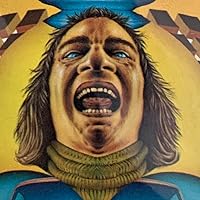
I get the vibe this is meant to be like A Clockwork Orange or Norman Spinrad’s The Iron Dream - the heroes are grotesque thugs for satirical purposes or maybe to point out something about the human condition. Perhaps the idea is that the Institute is called Sodom and Gomorrah (and the teens dally in homosexuality) because the elites deserve to burn? But why is the Network not much better? Absolute power corrupts absolutely? Is the point really “both the hippies and the straights are flawed?” All in all, very unsatisfying. Fortunately it’s so short that I’ll only remember the amaaaaaazing cover in a few months.
3.3 Malzberg bingo!! Kennedy assassination✔️ Cadillac✔️ Opaque monolithic bureaucracy✔️ Gross sex scene✔️ Cant tell if its satire or not in parts✔️ Themes of urban decay✔️
Look I love Malzberg but I gave overlay 4 and this is nowhere near as good. Gotta say the rape scene left a real foul taste in my mouth as well. This one felt like it was written for a paycheck and was decently linear, twists weren't to surprising and it fell a bit flat. However fuck me there are some stellar lines as always, I think the first and the last chapters were the best by far.
Well, I finished it and I don't think I totally hated EVERY reading moment. So, I suppose two stars. But I can't say I really enjoyed it either. The title is the best thing about this book, and I have no idea what relationship to the story it is meant to represent, unless the buggery element? One the bright side it was a short book, like many of the early classic sci-fi. At only 126 pages it was easy to finish, if it had been one of the 800 -900 page door stops that publishing companies seem to demand these day - I would have quit by page 100.
What was it about? Well! That is an excellent question. The Goodreads description is a concise one based on the back of the book but it raises expectations that are not really met. This book is all verbose, fruity prose and so little world building that it doesn't come together in your head until after you have finished it, the society and the physical landscape both. There are two narrators, all the individuals are childish, self centred and... not convincing as real characters. The plot is fogged by the excessive boasting of the two (unreliable) narrators.
Oh yes! Trigger warnings for gratuitous violence, rape and stupidity...
When I say violence and sex, think Stanley Kubrick's Clockwork Orange levels only without the social structure it is positioned within, OR the moral questioning and possible condemnation of it.
The first couple of pages described how the institute uses films from the 21st century to indoctrinate the cadets into how assassinations caused the cities to fall in order to justify the current social demarcations. In hindsight, I think that is what they were doing as it was presented, I had no idea what the mish-mash was all about. The films sound doctored (though I don't know that much American history to be sure) and the 'teachers' are all old robots who break down.
Well, the main narrator conceives a plan to restore an old Cadillac (it is amazing how many sci-fi writers I have read recently are fascinated by old Cadillacs) and go into the city with his 'buddy' Lawson. Now this was tricky; when I first read it I thought 'Oh! This is lovely and ahead of it's times! Homosexual relationships are normalised, and for 1974 that is pretty good!'
WRONG
This is the most repugnantly confused situation: The primary relationship is homosexual, but there is a monumental homophobic element to it. Lawson's death screams of gay bashing and the attitude of the first narrator toward him is chilling. Now it seems that there are no 'females' in the institute, and the reason narrator #1 and Lawson go into the city/network is to either kill their first person or rape a woman to find out if #1 was really homosexual (which HE thinks would be disgusting) or just opportunistically homosexual as the institute promotes. This COULD be a relevant, speculative fiction sort of question, but trust me; it is not done that way.
Heterosexuality is not treated any better. The institute has no women, so a little misogynistic, but consistent with the era it was written. The rape and murder early on is.... pretty nasty and COULD have been written in a way that was a social exploration of #1's indoctrination, but it was not done that way. When we reach the segment of narrator #2, 'females' are housed in a 'receptacle/pit'(no, I kid you not) and have no names, being essentially sex slaves.
Both characters are childish, boastful, egocentric and two dimensional. The handful of other individuals in the book exist only to have nasty things done to them, by them or both. The writing is florid and grammar poor; we have one sequence of 23 lines with no full stop! TWENTY THREE WHOLE LINES! This is writing like a 14 year old who skipped school a lot.
The narrative uses big words but does not back them up; 'deprogramming' for example which narrator #2 uses a lot means torture and sex with 'females'. I recognise that early deprograming was rough, included torture kidnaping and, yes, sex, but in order for this to be less ick and more believable there would have had to be some actual writing and plot expansion.
Another favourite word of the author appears to be 'scatological' but I don't think it means what he thinks it means (sorry The Princess Bride). It means the study or interest in excrement, but Malzberg uses it without exception about sex. For example [pg 105-106] where narrator #1 'with a scatological leer' asks about having access to the female sex slaves...
I have already spent too much, way to much, time thinking about this short, poorly written, rather nasty book. Though I seem to remember likeing some of Barry N. Malzberg's other work, but I'll approach them with caution in future. It is possible, that he thought he was writing a speculative fiction about how a dystopian society might evolve to be brutal, inhuman and inhumane. If that was his intent, I feel it failed.
Looks like Masterworks has reprinted it, so perhaps other people have a higher opinion of it than I did. I'll say this for it; it has made me think about it a lot, if only to figure out wtf I just read.
This is one of two Malzberg books that I read. (The second one was SCOP.)
From what I've seen, this is not among his better works; I have Herovit's World on my to-read list and checked out two other books of his.
It is told from the viewpoint of two characters (like SCOP is), here on "both sides" of the conflict. In the first half, a machine-raised man raised in the country is told about the sins of cities and proceeds to drive in and have some fun. The second half is from one of the people of the city, who (re)brainwashes the first one and sends him back.
Brilliant prose, brutal and uncompromising. Uncomfortable, agitating and unsympathetic in the extreme. The first half is better than the second half, with a sharper, serrated edge to its nihilism that the second half cannot maintain. No one else writes like Malzberg and no one else could have written this book; it’s probably not for you, certainly isn’t for everyone, but I’m so grateful to have a box full of Malzberg waiting for me to read; he’s the best of the best and a true genius.
The Sodom And Gomorrah Business was one of the 15 novels written by Malzberg in 1974. I’ll spare you the details, as there are plenty of other reviews to cover the synopsis.
This is a weaker entry in Malzberg’s bibliography. It still has his typical plot interests and actually demonstrated a bit of unique promise from the onset, being a more linear composition when compared to his other works. Alas, this is not Barry at his strongest and I think he missed an opportunity to craft something a bit more interesting. For completists only.
If you were to merge the weirdness of PKD with the transgression of Ballard, you'd get something like this unpleasant little novella. Interestingly, it mentions the fall of the twin towers, which must have been close to new when written, as a historical event.
Institute courses told a grim story about the Network—that savage world beyond the closely guarded Institute gates. But they wanted to see for themselves. They had to know.
Were there really females there? Would their training as mercenaries prepare them for the wild bands of grisly subhumans?
They set out on a journey of discovery only to become the unwitting agents of forces that threatened to destroy the only world they'd ever known.”—The back cover
“Was there a world outside? Or only dust, despair, the void?”—The front cover
Copyright 1974, this is apparently a Pocket Books first edition. 95c cover price. 126 pages.
"Hey, we need two heads sporting euro-mullets floating over a Cadillac while having some kind of seizure." –Art Director of Pocket Books
Malzberg was really cranking them out in the mid 70s: The Sodom and Gomorrah Business was one of six (!) novels that he had published in 1974. While I expected this to be a weird one after taking in the cover and back description, I still wasn't quite prepared for this story to involve as much vicious sadism as dystopian sci-fi.
The two main characters—the unnamed narrator and his pair-bonded friend Lawson—are two students at the "Institute for Urban Control.” The pair have become bored with the lectures presented by animatronic professors and the “homosex” that is the norm for the all-male student body. As members of "Death and Destruction 104,” the narrator and Lawson are being groomed to be Enforcers: the pride of the institute and in charge of population control (murderous sweeps) of the Network.
Narrator and Lawson decide to go on a joyride into the New York City Network—a no man’s land full of society’s unwanted who have become lawless and tribal. The narrator and his fuck buddy pop some pills, requisition a car (a two-hundred-year-old Cadillac) and some pistols, then hit the road.
They cross the decaying barriers that circumscribe the Network, making sure to insult the guards because barrier duty is beneath them. The duo then stumble upon a family of Network denizens who beg Narrator and Lawson to help them escape into the "Landscape" outside.
Unfortunately for these innocent outcasts, the two young men have more murderous intentions—first, they shoot the pleading man to death, then, as the Narrator states, he “[sets] upon her like sainted Zapruder himself, and to prove the estimate of her humanity, my worth, my dismal need, I rape the shit out of her." (p. 38) (This Zapruder guy is the newly-sainted man who videotaped the JFK assassination, which the institute has students watch time and time again.)
After the worth-affirming rape, the narrator shoots his victim, and then her child, once it begin to cry, rationalizing it as a mercy killing since the child just witnessed the rape of his mother. Oh yeah, and he ejaculates again after riddling the kid with bullets.
Soon after this fun little chapter about family values, the two Institute students are captured by a band of Network toughs from "Westerly." The Westerly gang kills Lawson, then attempts to "deprogram" the narrator, a process consisting of some light torture along with heterosexual sex in their harem, in the hopes that they can use the narrator for their revolutionary plot.
Malzberg only allows for two female characters in the whole story—one is raped and murdered, and the other is a submissive member of the westerly harem, a broken woman who does as she is told. I don't really know what point he’s trying to make with this novel, and it only gets murkier and harder to grasp from this point on.
At first I really enjoyed the promise of the Sodom and Gomorrah Business, with its dystopian-lite setting and staccato three page chapters, but in the end the story was a light stab at social commentary drenched in the sweat and blood of sado-masochism. The result is bascailly a not-nearly-as-fun precursor to Escape From New York.
I can't say that I recommend the Sodom and Gomorrah Business on any level. Probably the weirdest part of this book is that it is dedicated to Malzberg's daughter.
I love Malzberg's experimental approach to SF, and his occasionally ambitious prose styles, but this seems like an odd cross between Logan's Run and A Clockwork Orange, building up an interesting post-apocalyptic scenario, filling it with misogyny and latent homophobia, and just when you expect him to subvert it all cleverly, it stops. Unpleasant and seemingly unformed, possibly unfinished.
I like that Malzberg tries to do something hard-core with SF scenarios, but this one is just tedious. Reads like it was written on a deadline, he just drones on and on about very little. Disappointed, but he's a good enough writer that I'm sure I'll enjoy the next book of his I read.