

What do you think?

Old Man Goya
In 1792, when he was forty-seven, the Spanish painter Francisco de Goya contracted a serious illness which left him stone deaf. In this extraordinary book Julia Blackburn follows Goya through the remaining thirty-five years of his life. It was a time of political turmoil, of war, violence and confusion, and Goya transformed what he saw happening in the world around him into his visionary paintings, drawings and etchings.
These were also years of tenderness for Goya, of intimate relationships with the Duchess of Alba and with Leocadia, his mistress, who was with him to the end. Julia Blackburn writes of the elderly painter with the intimacy of an old friend, seeing through his eyes and sharing the silence in his head, capturing perfectly his ferocious energy, his passion and his genius.
These were also years of tenderness for Goya, of intimate relationships with the Duchess of Alba and with Leocadia, his mistress, who was with him to the end. Julia Blackburn writes of the elderly painter with the intimacy of an old friend, seeing through his eyes and sharing the silence in his head, capturing perfectly his ferocious energy, his passion and his genius.
239 pages, Paperback
First published January 1, 2002
About the author
Julia Blackburn
45 books70 followersJulia Blackburn is the author of several other works of nonfiction, including Charles Waterton and The Emperor’s Last Island, and of two novels, The Book of Color and The Leper’s Companions, both of which were short-listed for the Orange Prize. Her most recent book, Old Man Goya, was nominated for a National Book Critics Circle Award. Blackburn lives in England and Italy.
Ratings & Reviews
Friends & Following
Create a free account to discover what your friends think of this book!
Community Reviews
Displaying 1 - 30 of 33 reviews

February 17, 2018
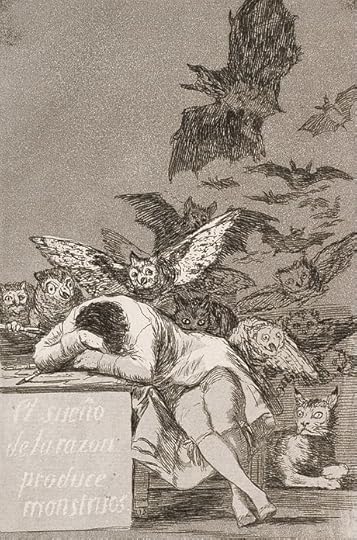
This book is not about Francisco de Goya (1746-1828), but about Julia Blackburn’s fantasy and obsession with the painter.
I bought this book, years ago, in an unlikely place, in a bookshop in Manila. The fortuitousness of the finding and my interest in painting explain my purchase. May be I would not buy it now. But I picked it up from my shelves after many years sitting there because of my current engagement with Episodios Nacionales: Primera Serie.
Blackburn introduces her subject in very personal terms: the book is dedicated to the memory of her mother, who got very sick soon after she started studying Goya. Her fascination with him dates from her childhood and a book on his drawings that trailed around her family home.
In particular, Goya’s deafness haunts Blackburn. He lost his hearing when he was forty-seven and lived until he turned eighty-two. Almost four decades of auditory isolation. And this prompts Blackburn to attempt to impersonate the painter trying to feel what he felt, first as a deaf man, and then in everything else.
For this, with very little knowledge of Spanish, she sets off traveling and visits all the places where Goya lived. She begins in Fuendetodos in the province of Zaragoza, where Goya was born. She then follows him to Madrid where he made his career working for the court and the nobility; there he associated himself with the local school of Fine Artes, the Academia de San Fernando. Blackburn also goes to Cádiz, where Goya went drawn by the Duchess of Alba. Eventually the route takes us to France, as Goya, following other intellectuals and writers such as his friend Leandro Fernández de Moratín went on exile when king Fernando VII (1874-1933) returned after the Napoleonic occupation to govern in a despotic manner. After a short time in Paris Goya settled in Bordeaux where he died.
This account is then a rather idiosyncratic mixture between a travelogue, a biography, a memoir, a fictional account, and an elegiac meditation. This strange blend has appealed to many readers. Indeed, at times it is very engaging; she brings a Goya very close to us. It is such a personable account. At others, however, the narrative is artificial and contrived. Blackburn endeavors to imagine Goya, but through this strained effort Blackburn comes across as a demiurgic maker who designs and commands what her creation does and thinks. She will explicitly asserts: ‘I have him do/say/think/feel…”. This baffling self-confidence is at times enervating and it awoke in me a rebellious reaction.
Her account is nonetheless captivating--and entertaining, for she provides more anecdotes than analyses. Her constant switching between her own viewpoint and Goya’s offers also a beguiling panoply to the reader. Her writing style is fluid and I found her candid tone particularly moving in her descriptions of the paintings and drawings she selects. Most of my updates consisted of the works mentioned with these short and acute descriptions.
Blackburn's original formula has been applauded by many. But I found that her very personal approach eerily distorts her account. Particularly disconcerting was when, in conjuring Goya’s suffering at the end of his days, she relies on her experience at the side of her mother when she died.
As Goya wrote: El Sueño de la Razón produce Monstruos.
March 25, 2011
Speculative biography. There are a number of periods in the life of the brilliant Spanish artist Francisco de Goya (1746–1828) about which we know very little. Julia Blackburn has taken that sketchy biography and filled in the gaps with speculations about "what Goya might have done" and "what Goya must have seen." In the end, the book is as much about Blackburn's intellectual and emotional response to Goya's work as it is about the painter himself. Blackburn fills in the gaps with descriptions of the towns and villages in which Goya lived, elements of personal memoir (her mother was a painter), insight into the artist's letters, and so on. Blackburn has a spare, engaging style. She's a joy to read. My only proviso is that those expecting a more traditional biography might be better off, say, with Gassier's Goya: Life and Work. This was one of Blackburn's own primary sources. It's fascinating to see how she adroitly dances around the lacunae in the master's biography by writing about Goya's role as court painter to Spain's Charles IV, the Peninsular War through which the artist lived, his printmaking process and so on. Throughout are photographs of the some of the original copper plates Goya used in making the "Caprichos" and "Disparates" print series. This is an interesting choice and perhaps a metaphor for what Blackburn seeks to do here; that is, to give us a detailed though somewhat inverted view--the chronology is loose--of Goya's life and times augmented with personal interpretation. It's a very idiosyncratic book--and a joy.

February 3, 2021
A few years ago, I attended a Goya art exhibition at the San Diego Art Museum. The work was mysterious and thrilling to me; full of life, passion, darkness and extreme violence. It was obvious that the artist was a very disturbed man. The couple I was with decided that they hated the paintings. They could barely look at them and felt revulsion for Goya. I felt differently and was fascinated by him. I picked up a copy of this biography to understand what made Goya tick and to try to understand his demons. "Old Man Goya" is a good biography to start with and author Julia Blackburn uncovers (and imagines) where some of his bleakness and depression came from. After reading this book, I came to my own conclusions and feel that Goya was not poking fun of the superstitions of the day but suffering from mental illness from venereal disease and possible lead poisoning. Four stars.

February 24, 2017
Neither biography or analysis, but an expression of Poeisis, in which Blackburn shares her insights developed out of travel, research, & meditation in response to long held impressions of Goya's works - while engaging the currents of her own life experience. Her primary question is stated: "What did he think of what he saw in the city and in the countryside and in the faces of the living and the dead?" In this she introduces her approach, opening the door to personal speculation quite unencumbered by the jargon of art historians, (which too often does not admit dishonesty and/or huge amounts of pure speculation.)
(More notes to follow.)
(More notes to follow.)

July 15, 2011
Excellent, enjoyable read. What an amazing tale of when Goya lost his hearing and lived such terrible times and yet accomplished some of his best work.

November 24, 2023
Hmmmm, as vaguely interesting as this study of Goya is, it is extremely speculative and assumptive in nature. Blackburn imagines scenarios, meetings, experiences and conversations that we can never know if they happened or not. There is a lot of superfluous information here about peripheral characters in Goya's life, people he did commissions for, random members of the public etc.
The writing here is average really, there is nothing that piqued my interest or blew me away.
Not one I'd return to or recommend if you're looking for a proper study of Goya.
A little disappointing if I'm honest.
The writing here is average really, there is nothing that piqued my interest or blew me away.
Not one I'd return to or recommend if you're looking for a proper study of Goya.
A little disappointing if I'm honest.

May 23, 2024
I love Julia Blackburn's writing. No matter what she is writing about, she finds a way of approaching her subject like nobody else I've ever read. This is an exploration of Goya's life from the time he went deaf in his forties, until his death. It is also a meditation on her own mother's last illness and death. It's funny, moving, thoughtful and really beautifully written. She writes so well about Goya as a person and a painter and his paintings that I had to keep putting the book down to go and look at the works she refers to because I was so intrigued.

December 27, 2014
The only thing I liked about the book was when it talked about paintings I had seen at the MFA Goya exhibit. Otherwise this was a really weird book where the author basically imagines Goya's life as if she were a creepy observer. She manages to intermingle these fantasies with recollections of her mother, mainly her mother's death. Very weird - wouldn't recommend it to others.

June 19, 2010
Interesting experiment, but ultimately not satisfying.

December 31, 2021
I had read another book by this author and simply do not have a fond memory of it. This book, however, is to be recommended. I enjoyed the descriptions of Goya's life, works and last years. The mixture of travelogue following in his footsteps and reminiscenses of the author's own connection to Goya, the relation of her mother's passing and Goya's was more interesting than I hoped when I realised I'd disliked the other book so strongly. Goes to show.

September 30, 2022
This book, a gift from a poet friend, kept me going through a difficult month of moving house with its probing and graphic depiction of old man Goya’s struggles with (and beyond) illness, during turbulent times in Spain.
Julia Blackburn writes like a poet, even like an artist herself, at times. Her direct subjective tone led me straight into the workings of Goya’s head, behind his eyes to experience such telling details of his world that I felt imaginatively transported almost as if I was living the making of his work alongside him. Sometimes her description were so compelling I was driven to look up a particular work she mentioned. Unlike Blackburn, Ive never been particularly fascinated by Goya but having read this book I now feel that when I next find myself in front of a Goya in a gallery my experience of the work will be enlivened and deepened.
Julia Blackburn writes like a poet, even like an artist herself, at times. Her direct subjective tone led me straight into the workings of Goya’s head, behind his eyes to experience such telling details of his world that I felt imaginatively transported almost as if I was living the making of his work alongside him. Sometimes her description were so compelling I was driven to look up a particular work she mentioned. Unlike Blackburn, Ive never been particularly fascinated by Goya but having read this book I now feel that when I next find myself in front of a Goya in a gallery my experience of the work will be enlivened and deepened.
March 5, 2010
Blackburn peppers her biography of Goya with fragments from her own life in this thoroughly enjoyable book. Old Man Goya definitely reads more like a novel than a dry art history text. While it is illustrated with photographs of Goya’s copperplates, Blackburn doesn’t discuss the artist’s work as much as evoking the scenes that surround the artist and describing them in enough detail to link them in the reader’s mind with specific paintings and etchings. I would recommend this wonderfully written biography to anyone curious as to what could inspire the frighteningly fantastical scenes of Goya’s work, especially Los Caprichos ; to anyone interested in late-Eighteenth/early-Nineteenth century European history; or anyone just looking for a good read.

September 10, 2021
I was not really a fan of this book. It wasn't quite a biography on Goya, because so much of it was imagined and speculated, and when the author's own autobiographical moments crept in, it broke the flow of Goya's story for me. I found myself only wanting to read the parts about him, no matter how thought up they were, and skimming over the author's thoughts and inputs.

February 25, 2022
Zoals altijd bij Julia Blackburn kost het even om in de specifieke 'taal' van het betreffende boek te groeien. Ook dit boek is een reisverslag waarin zij dat wat ontbreekt in de biografie van Goya op haar heel eigen wijze invult. Ze loopt met hem mee en bedenkt wat hij mogelijk had kunnen zien, willen doen. Dit alles doorspekt met herinneringen aan haar moeder, haar jeugd, vogels. Weer een bijzonder boek

November 23, 2024
I read this in 2007 and enjoyed it for the technique and topic.
My re-read in 2024, after having been to Madrid and the Prado, felt different, somehow more matured and appreciated.
Julia Blackburn melds research with her vivid imagination (visualisations) to re-recreate and follow Goya around. She "watches" him, in other words, and reports to the reader what she sees. I found this to be much more engaging and interesting technique for biographical writing. She also weaves some personal stories that help build emotion and connection.
This biography doesn't chronicle Goya's life from his birth; it begins mid-life as he suffers illness and then becomes famously profoundly deaf. This is the era where his paintings changed to dark and demonic imagery. Likewise, the relationships he has with family are touched upon, but not delved to any great depth - just enough for us to wonder about his mind and his values. I was quite moved by what he left his mistress and her daughter after his death (next to nothing) and, like the author, I wondered why he did that.
This is a good read for people interested in art, Spanish history, art history, and Goya the old man himself.
This book is staying on my bookshelf.
My re-read in 2024, after having been to Madrid and the Prado, felt different, somehow more matured and appreciated.
Julia Blackburn melds research with her vivid imagination (visualisations) to re-recreate and follow Goya around. She "watches" him, in other words, and reports to the reader what she sees. I found this to be much more engaging and interesting technique for biographical writing. She also weaves some personal stories that help build emotion and connection.
This biography doesn't chronicle Goya's life from his birth; it begins mid-life as he suffers illness and then becomes famously profoundly deaf. This is the era where his paintings changed to dark and demonic imagery. Likewise, the relationships he has with family are touched upon, but not delved to any great depth - just enough for us to wonder about his mind and his values. I was quite moved by what he left his mistress and her daughter after his death (next to nothing) and, like the author, I wondered why he did that.
This is a good read for people interested in art, Spanish history, art history, and Goya the old man himself.
This book is staying on my bookshelf.

November 4, 2022
Beautifully written, striking account of the later part of Goya's life. Julia Blackburn has an extraordinary ability to place herself and us as readers so close to this man that you cannot help feel deeply for him and experience almost from the inside the trauma of losing his hearing. Until reading this book my reading of Goya was mostly through surfaces - art history and paint quality. I had turned away from the Horrors of War and that tormented time in Spain of the Peninsular wars with Napolean and Wellington, the savagery of which had repercussions with the rise of Franco in the mid 20th century. But this is not just history or art history, it is a vivid story of Goya's life force and his own creative obsession as well as Julia Blackburn's obsession as a writer with his work, which she tracks from her own childhood through to the death of her own artist mother. An extraordinary and powerful interweaving of two experiences felt intensely and honestly, from the inside.

April 15, 2018
Other than Goya, I had no clue what this book would show me: it gave me beauty, war, the driest humor and the saddest smiles, death and energy and silence, all perceived and offered through the lucid, nearly tender lens of Julia Blackburn's prose. "I have been busy with Goya for many years," she says, and it shows. Brava!

July 15, 2020
This is very well researched and imagined to give a very useful and fascinating perspective on Goya. Julia Blackburn skilfully and beautifully explains her research and her interpretation, making her personal viewpoint clear, but also providing facts. It is seamlessly crafted into a whole.

September 20, 2026
These pages should be sipped slowly like a good wine. They are artfully constructed, evocative, and empathetic to a man who clearly was deaf to more than just the sounds around him. A beautiful account.

June 9, 2020
A different kind of biography - but very enjoyable! Just wanted more pictures of the paintings!
January 30, 2023
A unique, heartfelt biography of Goya. Lovely.
March 18, 2025
Very insightful

April 8, 2025
Not quite a biography but more of a meditation on one of my absolute favorite artists. This was imaginative, moving, and very well written.

June 10, 2025
Not really my kind of book although I enjoyed learning about his life after deafness and some Spanish history.

May 22, 2014
Inspired by the illness and passing of her mother, a painter, along with a battered old copy of Goya's etchings that she used to sneak from the studio downstairs into her bedroom and stare at in awe, the novelist Julia Blackburn traces the latter half of the great Spanish artist's life, when he made his fame but was afflicted with the loss of his hearing.
Blackburn travels through some of the places of his life, from his birth place of Fuendetodos, to Cadiz and his houses in Madrid, the first one on the aptly named Street of Disenchantment, then his country place which became known as the 'Deaf Man's House', where he made those haunting and grotesque paintings on the walls.
Neither a full biography nor anything approaching a critical study, I'm not sure what this book was really. Mostly Blackburn just gives the barest outline of Goya's life and work, conjuring up frozen novelistic images of the painter in her mind ('I see Goya...', 'I would have Goya...' etc), which may well have pleased her to do but does little or nothing for the reader.
Still, I mildly enjoyed it. The author seems always on the look out for images of the sort of real life grotesqueries that may have inspired Goya, such as the masks and costumes of carnival, trying to imagine him observing the horrors of famine and war that characterized his times, but she offers few memorable insights.
Like Blackburn, when I visited the Prado in Madrid and saw those 'Black Paintings' of Goya I had no idea he had been deaf, but I recall too being struck by 'the sound of the paintings ... a great booming reverberation like a mixture of thunder and human voices.'
It's true though, he couldn't paint horses for toffee.
Blackburn travels through some of the places of his life, from his birth place of Fuendetodos, to Cadiz and his houses in Madrid, the first one on the aptly named Street of Disenchantment, then his country place which became known as the 'Deaf Man's House', where he made those haunting and grotesque paintings on the walls.
Neither a full biography nor anything approaching a critical study, I'm not sure what this book was really. Mostly Blackburn just gives the barest outline of Goya's life and work, conjuring up frozen novelistic images of the painter in her mind ('I see Goya...', 'I would have Goya...' etc), which may well have pleased her to do but does little or nothing for the reader.
Still, I mildly enjoyed it. The author seems always on the look out for images of the sort of real life grotesqueries that may have inspired Goya, such as the masks and costumes of carnival, trying to imagine him observing the horrors of famine and war that characterized his times, but she offers few memorable insights.
Like Blackburn, when I visited the Prado in Madrid and saw those 'Black Paintings' of Goya I had no idea he had been deaf, but I recall too being struck by 'the sound of the paintings ... a great booming reverberation like a mixture of thunder and human voices.'
It's true though, he couldn't paint horses for toffee.

August 12, 2013
This is a strange and fascinating book. It's not really a traditional biography, but it contains many details about Goya's life starting around the period where he went deaf after an illness, and following him to his death in exile in Bordeaux.
Blackburn focuses on what it might have been like for Goya and the people around him, drawing from her own life for emotional parallels to explain how she's interpreting events. She paints a vivid picture of the man, his personality and mannerisms. This work is more a portrait of Goya painted with words than a historical biography. Beautiful and compelling, she paints the end of his life in an extremely affecting way, leaving you with the loose ends that are almost impossible to completely avoid when a real person dies.
Blackburn focuses on what it might have been like for Goya and the people around him, drawing from her own life for emotional parallels to explain how she's interpreting events. She paints a vivid picture of the man, his personality and mannerisms. This work is more a portrait of Goya painted with words than a historical biography. Beautiful and compelling, she paints the end of his life in an extremely affecting way, leaving you with the loose ends that are almost impossible to completely avoid when a real person dies.
Read
November 27, 2015Recognisably Julia Blackburn. She weaves what little is known about Goya largely from his letters and the paintings and etchings with a travelogue of herself visiting the places he travelled to, and her own memories of her (painter) mother. very readable, interesting, -would have been nice to have more illustrations though there were black and white reproductions of etchings often dark and dreamlike and strange-but we have been to the exhibition at the National Gallery this week to see portraits which were wonderful so that tied in nicely. An amazing largely self taught painter , often very quickvworker and working and travelling into his 80s 18th a life at court and then having to flee from that and the inquisition in Spain.

May 10, 2014
There are not many books that grab me and give me an uplifting experience,This book was so beautifully written and captivating, that the journey Julia Blackburn took me on was breath taking,I have a hearing disorder and Spain has been a part of my life for so long,this book fit like a velvet glove to my senses,not many people will get it and find it difficult to understand the objective of what Julia Blackburn is trying to describe,her use of the English language,and imagination is beyond the five stars that I can give this book.

May 14, 2016
Interesting travelogue focused on the life of Goya. The writer visited the homes of Goya, the paintings of each era, the people in his his life and the events. From the chosen painter of the Spanish monarchy in the late 1700's, the era of the Peninsula Wars and the post Napoleonic era. Not a deep book, just an interesting one.

December 31, 2022
I expexted fiction, was I stupid? It's not bad. Typical british work: She went to all the places he lived or stayed to get some local smell. I do learn a bit about his later years: I had always wondered why he ended up in Bordeaux. But I must say: this is the first time I see Goya truly as a human being.
On second reading: wonderful and strangely soothing
On second reading: wonderful and strangely soothing
Displaying 1 - 30 of 33 reviews