Wow, this was a good book. I have had this book for a number of years, it was published in 1993 and I have probably had it since the late 1990s and just now in late 2021 I read it. I should have read it years ago and this book deserves to be more widely known.
The setting is the San Francisco Bay Area, with the specific location most often used in the story the famed Winchester Mansion, also known as the Winchester Mystery House, a house famous for having been under continual, unending construction for thirty-eight years with haphazard additions continually being added without reference to any (non-existent) overall plan, a sprawling house with odd stairways to nowhere, stained glass windows in the interior of the house (and not exposed to any source of outside light), a house that newcomers can very easily get lost in and new rooms, even floors, are continually being added.
It is in this house, the House, that a significant portion of humanity left in California decided to move into. Thirty years ago, 90% of the human race Vanished in the Vanishing (or Disappearance, though Vanishing is the term most often used in the book). People woke up and their lovers that were in bed with them were simply not there, or children vanished from their cribs, or kids woke up and their parents had ceased to exist, or homeowners would find out that they were the only person left on their entire street. Ninety percent of humanity vanished without a trace, no bodies, no blood, no screams, no piles of clothes, they just simply weren’t there anymore.
Civilization fell and the survivors at first faced a tough time with finding food, water, shelter, dealing with marauders, but in the book’s present the tough times were mostly past and what was left of humanity (in that part of the world at least) have coalesced into various “special interest groups,” a series of societies, some organized along ethnic lines, some along ideological lines, others religious (including a number of new religions or religious offshoots that popped up), while others are more political or pragmatic in their origin, with the special interest groups running the gamut from grounded and level-headed cooperatives to basically cults. Groups include the Hackers (computer programmers and engineers originally), the Koanites (“they believe that the Vanishing represents a Great Koan”), Neo-Christians, Homers (who think that the Vanished will return and are doing all they can to maintain the homes the Vanished once lived in; Homers are people who are living in the homes they lived in prior to the Vanishing and are pining for lost loved ones), there is a Vietnamese group, at least one Latino group (I think several), a group that is basically a cooperative of vineyard owners and wine producers (their products now used also to fuel the few vehicles still in use), many groups that are just named dropped.
Aside from groups attached to the House like the Hackers (and a few other neighboring groups that work closely with those living in the House), two main groups important to the story are religious in nature. One group is the Pentinents, who believed humanity vanished due to people being whisked away and being judged by God and those left behind were neither good or bad enough to go to heaven or hell and those left behind need to demonstrate to God that they are good and unattached to life here. They are big on individual deliverance and while can be standoffish (as in not getting involved in projects designed to enable some form of civilization to go on) they aren’t a threat to anyone.
The other group though is a threat. The Heaven Bounders (or Bounders) share the overall idea of the Pentinents – Judgement Day happened – but the solution is not good deeds and striving for individual salvation, but rather that as long as anyone is alive and not striving to get to heaven, no one goes in any Second Ascendance. It is the Bounders that are the chief Big Bads in the book, who attack anyone, whether individuals or organizations, that are trying to make a go of it in a post-Vanishment world. We all have to go (i.e. die) for the rest of humanity to be judged, and towards this end Bounders resort to tactics like murder, arson, and invasion with organized groups.
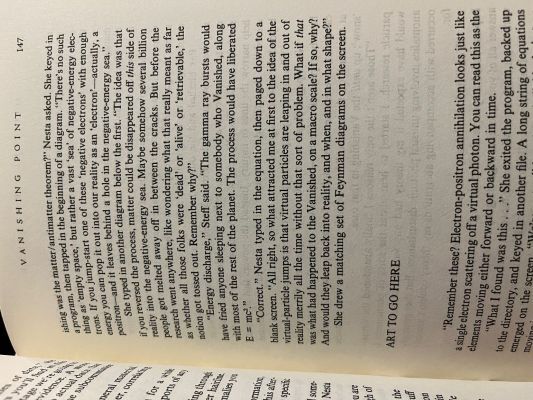
It might sound that the book is primarily religious in focus and it isn’t, as religion merely provides a source of motivation for the primary antagonists. This is science fiction, and that is at the core of the book. Many groups attached to the House such as the Hackers are still trying to find out what happened in the Vanishing, partially to see if it will happen again, partially to see if they can retrieve those who disappeared, and partially out of scientific curiosity. Bouncing around all sorts of ideas about such things as virtual-particle interactions, electromagnetic polar switches, and dimensional shifts, they have various groups (often with competing theories) trying to understand it all.
Into this comes Dr. Nesta Christiana Easterman from Carnegie-Mellon. A physicist who made the long trek from Pennsylvania to the House to work with colleagues there, she has ideas about the Vanishing that she knows will be wildly controversial and does her best to keep them close to the vest while she tries to test her theories, theories that if true will radically change life for everyone.
Unlike everyone else researching the Vanishing, Nesta is looking at the big picture both pre and post Vanishing, going down avenues of research that no one else is looking at (or dismissed early on). One of the things she is looking at for instance is that the first generation of children post-Vanishment have odd hair, described as having a “prismatic-metallic effect,” looking copper or some other metal colored. But only the first generation, not the second generation.
Nesta is also looking at anomalies that occurred both before and after the Vanishing, strange sights, sounds, odd occurrences, things that she thinks might be related to the Vanishing that no other researcher seems to agree are relevant (if they are even real). Strangely, though the pre-Vanishing generation is highly skeptical, the younger (and especially the second post-Vanishment) generation aren’t skeptical of at all (not that the adults listen).
In addition to the threats posed by the Bounders, Nesta’s research into the causes and consequences of the Vanishing (more than just the removal of 90% of humanity), and that something is unusual about the post-Vanishment generations, there are other plot lines followed, notably that someone else, not a Bounder, is very carefully burning houses in the area, houses he believes have unusual properties and just aren’t right. No one knows who this individual is, what his or her motivations or, or if they are a threat to the House. Another thread is the tumultuous life of a young woman named Renzie, a woman who lives in the House and is involved in all the major plot threads in the book as well as her own problems with friends and lovers.
The book takes about a hundred pages to really get to where things are humming along as far as the main plot threads but it never lost my interest. The setting is richly detailed but never detailed in what I would call info dumps and there is good character development, most notably with Renzie and Nesta but also several others. There are plot threads that are foreshadowed in the earlier sections that seem obvious now but not at the time and I think that good writing. The last third of the book was quite exciting as not only was there a lot of action with the Bounders but things come to a head with the science fiction mysteries at the heart of the book, of what caused the Vanishing, what the anomalies are, and how and why the younger generations post-Vanishment are different.
As far as post-apocalyptic books this is quite different from anything I have read before. It isn’t a Biblical Armageddon or the return of Lovecraftian eldritch horrors or zombies or vampires or nuclear war or disease or aliens. It’s something else entirely. I liked the richly detailed setting and while acknowledging there would most definitely be bad actors, a great many people would be cooperative and constructive. Also the book had a good sense of place with its California setting and I liked that.