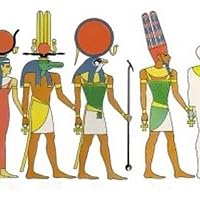
Who was the first king of ancient Egypt - and who was the last? Which Egyptian queens ruled in their own right? What do we really know about the 170 or more pharaohs whose names have come down to us? Chronicle of the Pharaohs is the first book to set down in narrative form, using timelines and other visual aids throughout, all the rulers and dynasties of Egypt in their chronological order. Now no one need be in any doubt as to who came first, Tutankhamun or Ramesses the Great, or which pharaohs built the pyramids, and the Chronicle provides the answers. The biographical portraits of each pharaoh build into a comprehensive and immensely readable history of ancient Egypt, brought to life through the exploits and personalities of her rulers. From Narmer, who first united the lands along the Nile, to Cleopatra some 3000 years later, we see the way in which individual pharaohs helped to shape Egyptian civilization, and were themselves shaped by it. The narrative is supplemented by specially drawn cartouches of each pharaoh and translations of their names. Chronicle of the Pharaohs is at once a book to be enjoyed as popular history, an essential work of reference, and a visual introduction to the extraordinary diversity and richness of an ancient civilization. Museum-goers, students, tourists and everyone fascinated by the world of ancient Egypt will want to make the Chronicle their inseparable companion.
A view on what was known about Ancient Egypt around 1994/2001, this is a chronicle of the pharaohs from the earliest one known only as "Scorpion" to *that* Cleopatra son Ptolemy XV (Cesarion), who never really got to rule before being killed by the Romans (and his three siblings had similar fates). The time period goes from c.3150 to 30 BC; the timeline for each pharaoh's rule is shown. The introduction talks about the dating of the rulers' ruling times, which is not always easy since so much stuff is missing, many permanently. A small map is given. At the end the names of the rulers are explained, and there's a small bibliography.
These rulers are grouped by dynasties, and to each ruler in a side-square are given some more facts, - those that are known - like full names, parents, known wives/children, burial place. Occasionally we get detailed plans of buildings and some family trees. Information squares can give some side-information of things like writings from that time, stories of some people connected to them etc.
Some things I noticed: - the 'pharaoh standing, smiting an enemy' subject appears early, and the first female pharaoh also appears quite early (Merneith) - there were two pharaohs named Ay in the book (in Dynasties 13 and 18) - Djoser really started on the pyramids; Khafre is the one who built the Sphinx - Valley of the Kings burials were from Dynasty 18 to 20 - Horemheb was a jerk - some Bible pharaohs appear - the writer gives a guess when the Exodus time was - like Necho and Shisak (probably not interesting to all readers *shrug*)
The amount of how much is written about each pharaohs here varies - some certainly due to lack of sources - rulers like Tutanhkamon and Ramesses II get a lot; some others barely get a few sentences. One can see clearly where the top is (Ramesses II and III), then pretty steady decine starts, with Libyans, Nubians, Persians, Macedonians/Greeks, and finally Romans taking over. This is a fairly typical rise-top-fall history form of empires, sometimes that could be read in, for example, in the empire of Byzantium (which I want to read soon).
A very clearly laid, rather interesting, book for anyone interested. Some facts no doubt have since been updated, or been added to, but still this is far from being too outdated. Very enjoyable to read, and was a good choice for me to read right now.
I always enjoy the 'CHRONICLE OF' series of books, which present easy chronological histories of various rulers and empires throughout history. This one focuses on the ancient Egyptians, starting in 3150 BC and ending with the death of the famous Cleopatra in 31 BC. Thousands of years in 224 pages is not an easy assignment.
The first Pharaoh was considered to be the man they called, 'Scorpion'. If you're going to be the first united ruler of Egypt, that's a great name to have. Although there were communities and local rulers prior to The Scorpion, he brought about the unification of Lower and Upper Egypt, although his dynasty was brief. What caused the sudden emergence of the Delta People, who erupted like lotus flowers from the prehistoric waters? The belief is that as Southwestern Egypt became dryer and water disappeared, tribes moved closer to the Delta and the good soil created by the annual flooding of the Nile.
The book breaks the chapters into the Kingdoms, with each dynasty defined, including the Nubians and Greeks. There is a ton of information and eye candy galore (tombs, mummies, pyramids, gold) to keep the reader's curiosity satiated.
'My name is Ozymandias, King of Kings: Look on my works, ye mighty, and despair!' Nothing beside remains. Round the decay Of that colossal wreck, boundless and bare, The lone and level sands stretch far away.
Overall, the Chronicle of the Pharaohs is a decent reference book. It provides entries on the pharaohs in chronological order, from the earliest potential rulers from before the unification of the Two Lands, to the end of the Ptolemaic Dynasty and the inauguration of Roman Egypt. The cartouches for each ruler are provided, where they exist, and photographs of portraits and artefacts, illustrations of structures, and extra information boxes add to the experience.
However, from the end of the New Kingdom onwards, the format of individual ruler entries breaks down and instead we get a narrative summary of each dynasty instead, in which individual rulers are mentioned but don’t get their own entries. In many places the information was rather abbreviated and a quick visit to Wikipedia actually told me more than the book’s entries. Another slight disappointment was that the book does not provide the full titulary of each of the pharaohs, just the birth name and the Horus name where they are available, and, when it provides the cartouche with Egyptian hieroglyphs and the English names it does not provide transliterations from the hieroglyphs – it was only by virtue of the fact that I can read ancient Egyptian hieroglyphs that I discovered that in many cases the English name given to some pharaohs was a complete mismatch with their real name. In addition, Clayton also frequently uses the inaccurate Hellenistic appellations for certain pharaohs, even when the Egyptian version is known and mentioned once in the text and then never used again – like Nectanebo instead of Nakhtnebef.
Perhaps the most annoying issue with the Chronicle of the Pharaohs is the fact that it presents out of date information and theories. It was published in 1994, but the paperback edition I read came out in 2006 – why was there no updating of the text at this time, or at the very least a preface to the paperback edition which touched upon new discoveries? The most glaring error that I noted was Clayton’s persistent perpetuation of what was known as the Heiress Theory – this theory, prevalent in the 1970s, assumed that the Egyptian throne was passed down the female line, through matrilineal descent, thus assuming that Egyptian pharaohs claimed their right to the throne through their wives, who had to be daughters of the previous pharaoh – however it was discredited and disproved in the 1980s and since then has no longer been accepted by Egyptologists. Though the book was originally published in 1994, this was long after the Heiress Theory had been disproved, and Clayton’s use of it in the Chronicle, as an apparently professional Egyptologist, is frankly astonishing to me. The Chronicle is unreferenced for the most part, and only contains a very brief bibliography at the very end of the work – I would have found it preferable, and more supportable, if it had been footnoted and a bibliography had been provided after each ruler entry.
I would use the Chronicle as a starting point, a reference work, a jumping off point for looking up a particular ruler and then going away and doing further research.
I got this book at Cairo International Airport, in anticipation of a long travel day. I was looking for a general history of ancient Egypt, and this was the closest thing available. (The selection was mostly souvenir books written in simple English, with a strange preponderance of works having to do with the supernatural and the occult.) The man who sold it to me was a man of faith, whispering prayers to his rosary as he calculated the book's price using a suspect conversion rate.
What can be made of this book? It perhaps deserves three stars, because it delivers on its promise of listing and summarizing the reigns of each pharoah. But history has moved away from the kings list for good reason: it yields only a superficial understanding of the political climate and fails to convey the spirit of the times.
Besides, the pharaohship is not unlike other offices, hereditary or not: in the sea of mediocrity you will only occasionally find islands of talent or accomplishment. For every Ahkenaten or Rameses II, there are a few dozen biographies amounting to "he existed, and his tomb was ransacked".
At first glance, this might appear to be a book directed at children, but its really an excellent read for any adult. Serious Egyptologists might find this light, but for the rest of us it really is an amazing way to grasp Ancient Egypt's history, culture, and monuments.
It is probably too difficult a read and has way too much adult material (incest, matricide, fratricide, castration, mythology) for anyone who is quite young
If you are going to Egypt, and you can't be bothered to read more then this would be a first-rate choice that would give you tremendous depth. If you couldn't distinguish any Pharoah, if you'd have trouble connecting who built what, then this is a great satisfying book.
Fascinating and especially well-illustrated overview of Egyptian history. The chronological line is that of successive dynasties. Beautiful illustrations and digressions. But: too closely tied to the pharaohs, even if they are not that important. Also no systematic insight into Egyptian civilization or society.
Extremely detailed and well illustrated. This book goes almost one by one through all the pharaohs. It gives a good overview of the reign of each one, describes the gaps in our knowledge and finally describes what is known about each pharaoh's burial. Other details about architecture, religion and other aspects of like in ancient Egypt are also included.
Um dos melhores manuais sobre o assunto. Segue as várias dinastias e fala de quase tudo um pouco. Seja para quem procura algo mais leve sobre o assunto, seja para quem procure uma entrada e depois toma caminho para aprofundar determinadas partes.
Considering this book is older, some of the information may be dated due to newer archaeological findings. It is, however, an excellent starting place to understand the chronology and historical context of the dynasties.
Beautifully illustrated but dull, as (with a few exceptions) we know very little about these rulers except for the existence of artifacts and architecture bearing their names.
Carefully researched, and though written in 1994, contains much more than they knew when I first looked into Egyptian Archeology.
Contains photographs of ALL the ancient rulers of Egypt in 224 pages. These were taken from the cartouches on the bases of the plinths, the belts and even potsherds etc. of each of them, from 3150 B.C. up to Cleopatra VII in B.C 30, from the Cairo, British and Museums in the United States. Each king or queen wore the White Crown or the Red Crown (sometimes both) of Upper and Lower Egypt. There are only a couple of photographs of mummies; the deformities of the bodies were best not represented, though many of them ruled for 30 years or so.
Very well organized with timelines and such, adequately accurate summaries of each reign, convenient boxes for disputed theories and otherwise notable events, plus tables of family, tomb location, official throne-names, cartouches, etc. The writing style is efficient and easy to get through. The supporting art is apt. What's not to love? This is a great resource for an introduction to a particular pharaoh's reign, though probably oversimplified to any actual Egyptologist. It is probably not the best option for a thorough history of aspects of Ancient Egyptian history not directly related to the pharaoh.
A must have for anyone with a lasting interest in Ancient Egyptology. I find all of these Chronicle books valuable, but my interest in ancient Egypt has made this a reference I keep returning too.
It's an essential quick reference, but also a pretty good read, cover to cover. I can't think of a better way to get a quick survey of the long history of Egypt than to read the book through.
Full of interesting information, but sometimes it lets you longing for more. It is a basic chronicle of the pharaohs of the Ancient Egypt, when they ruled, where they were buried, etc. What I liked about it was that it is filled with lots of photos of pharaoh tombs, sculptures, mortuary masks and, where applicable, the museum where they are displayed. Makes you get into trip-planning mode.
This book is a classic, and one of the first books I obtained when I first started getting interested in Egyptology.
Although there have been a few recent discoveries that would necessitate a new edition of this book, this is still one of the best breakdowns of the known Pharoahs of Ancient Egypt.
A nice little read with plenty of detail. I liked the descriptions inside and it was a good size. -- I think I got this from a Simi Valley used book shop.