

What do you think?

The Warriors
Spitfires, Thunderbolts, and Warm Beer: An American Fighter Pilot Over Europe
In 1941, before America entered World War II, determined young LeRoy Gover signed on with Britain’s Royal Air Force to fly the plane of his dreams, the fast, sleek Spitfire. When America joined the fight, he transitioned to the powerful P-47 Thunderbolt. Former USAF pilot and aviation historian Philip D. Caine has skillfully selected from the young flyer’s letters and diary entries to create a vivid portrait of the kind of man who helped win the war. A story of great courage, Spitfires, Thunderbolts, and Warm Beer is a testament to the many other brave men who served.
231 pages, Kindle Edition
First published February 28, 1995
Ratings & Reviews
Friends & Following
Create a free account to discover what your friends think of this book!
Community Reviews
Displaying 1 - 7 of 7 reviews

April 2, 2013
1. Short review: :-) (Amazon rating: 4 out of 5 stars -- I like it.) I don't care what it says above. I read this in eBook form on my Kindle.
2. Long review:
2.1. What I liked: Well written. Caine crafted an excellent book from Gover's letters, war diary, and interviews.
Roller-coaster or walk-in-the-park? Roller coaster.
2.2. What I did not like: I wanted a table of Gover's missions and kills, but maybe that is asking too much.
2.3. Who I think is the audience: Air combat buffs. History buffs.
2.4. Is the book appropriate for children to read? Yes. No worries.
2.5. On the basis of reading this book, will I buy the author's next book? Yes.
2.6. The plot in a nutshell:
There is no plot, but it feels like there is. The tension rises steadily until LeRoy Gover returns home on leave in 1944.
LG learned to fly during the Great Depression. When he signed up for the Selective Service, he realized that without two years of college he would be shunted to the infantry when drafted. He searched for and found a way to become a fighter pilot: join the RAF.
The RAF concocted an oath sort of like the one the French Foreign Legion used so that American volunteers would not lose their citizenship. Before he swore the oath, LG took 'refresher training' on AT6s in Bakersfield. Not every student in his class passed. He did.
Most American volunteers were used as instructors in Canada. LG was slated to become a fighter pilot.
LG sailed to England by way of Canada. He joined his Operational Training Unit in Wales. After he finished his training, he cycled back to instruct the next class. Then he joined 66 Squadron in early 1942. When he joined, 66 Squadron flew the Spitfire Mk V.
The only American in the squadron, LG flew the full range of fighter missions: bomber escort, convoy patrol, and fighter sweeps -- the British term for ground attack. The day of the Dieppe Raid, 19 August 1942, 66 Squadron flew top cover for the ill-fated Canadians. (Why did the British high command always throw away commonwealth forces in ill-conceived adventures like Gallipoli and Dieppe?) LG flew three missions over Dieppe that day. On the first mission, the whole squadron flew. On the second mission, there were only five planes in the squadron that could fly. On the third mission, the squadron consisted of three aircraft; only LG returned from that mission, his Spitfire riddled with bullet holes.
LG received orders posting him to 133 Squadron the next day. 133 was an Eagle Squadron; that is, its pilots were all American. LG spent a month with them before the US Army Air Force absorbed the Eagle Squadrons.
LG went from a Flying Officer in the RAF to Second Lieutenant in the USAAF. He still flew Spits but with a star instead of a roundel.
LeRoy Gover flew a Spitfire with these markings from late September 1942 to January 1943.
The USAAF primary fighter mission -- bomber escort -- differed from that of the RAF, and the Spitfire was ill-suited to the mission. In January 1943 LG traded his Spit for a Jug, a razorback P47. (In the book's cover photo he is seen about to enter his P47.) LG was promoted captain about the same time and became a flight leader. USAAF regs said a pilot had to have 50 hours in a type before flying combat, so LG did not fly another mission through enemy skies until 10 March 1943.
The day before Christmas 1943, LG's squadron commander told him he was being sent home on leave. Due to SNAFUs with his leave orders, LG did not leave England until March 1944. He spent the rest of the war commanding a fighter lead-in squadron in Florida.
2.7. Other:
Along with stories of Spits and Jugs, LG gives much print to the free time he spent in London drinking. Thus, the warm beer in the title.
LG transferred to the USAAF for the insurance ($10,000 in the USAAF; 0 in the RAF) and the pay. His pay increased from $58 a month in the RAF to $300 a month in the USAAF. As a second louie.
The book contains 31 photos. One that impressed me was the photo of LG's OTU class. 30 members of the class were marked with Xs and 7 with Os. X denoted someone who was killed in the war. O denoted someone who had crashed and was unfit to fly. Six in the class survived the war still flying. You got that? 30 dead out of 43 and another seven too broken up to fly again. And grunts complain us flyboys have it easy. Hmmph.
LG retired from the Air Force a full bird colonel in 1962. Flew charters to Mexico and Canada after that.
There is much more in this book, but I won't spoil it for you. Read it for yourself. It is excellent.
One last thing: I was surprised to find the tension rose in this memoir as if it were a novel. I felt relief when LG was ordered home on leave.
Okay, one more last thing: LG got 4 kills with the RAF and 2 with the USAAF. The USAAF did not count his RAF kills and the RAF did not track his USAAF kills, so by the official records he is not an ace.
Okay, okay, one last last thing: Members of the Eagle Squadrons -- USAAF pilots who had flown with the RAF -- in addition to their USAAF wings got to wear their RAF wings over their right breast pocket. How cool is that?
LG died two and half years after this book was first published. His obituary (third from the top) differs from the book on details. I think the book is right and the obit is wrong.
The author, BGen Philip D. Caine, USAF (Ret.), did an excellent job with this book. It is the best third-person account I have read. He was no slouch either. Look him up.
2.8. Links:
LeRoy Gover with the 4th Fighter Group (Note: Despite the roundel on the Spitfire, the information on this page covers only LG's time in the USAAF.)
Philip D. Caine
2.9. Buy the book: Spitfires, Thunderbolts, and Warm Beer
2. Long review:
2.1. What I liked: Well written. Caine crafted an excellent book from Gover's letters, war diary, and interviews.
Roller-coaster or walk-in-the-park? Roller coaster.
2.2. What I did not like: I wanted a table of Gover's missions and kills, but maybe that is asking too much.
2.3. Who I think is the audience: Air combat buffs. History buffs.
2.4. Is the book appropriate for children to read? Yes. No worries.
2.5. On the basis of reading this book, will I buy the author's next book? Yes.
2.6. The plot in a nutshell:
There is no plot, but it feels like there is. The tension rises steadily until LeRoy Gover returns home on leave in 1944.
LG learned to fly during the Great Depression. When he signed up for the Selective Service, he realized that without two years of college he would be shunted to the infantry when drafted. He searched for and found a way to become a fighter pilot: join the RAF.
The RAF concocted an oath sort of like the one the French Foreign Legion used so that American volunteers would not lose their citizenship. Before he swore the oath, LG took 'refresher training' on AT6s in Bakersfield. Not every student in his class passed. He did.
Most American volunteers were used as instructors in Canada. LG was slated to become a fighter pilot.
LG sailed to England by way of Canada. He joined his Operational Training Unit in Wales. After he finished his training, he cycled back to instruct the next class. Then he joined 66 Squadron in early 1942. When he joined, 66 Squadron flew the Spitfire Mk V.
The only American in the squadron, LG flew the full range of fighter missions: bomber escort, convoy patrol, and fighter sweeps -- the British term for ground attack. The day of the Dieppe Raid, 19 August 1942, 66 Squadron flew top cover for the ill-fated Canadians. (Why did the British high command always throw away commonwealth forces in ill-conceived adventures like Gallipoli and Dieppe?) LG flew three missions over Dieppe that day. On the first mission, the whole squadron flew. On the second mission, there were only five planes in the squadron that could fly. On the third mission, the squadron consisted of three aircraft; only LG returned from that mission, his Spitfire riddled with bullet holes.
LG received orders posting him to 133 Squadron the next day. 133 was an Eagle Squadron; that is, its pilots were all American. LG spent a month with them before the US Army Air Force absorbed the Eagle Squadrons.
LG went from a Flying Officer in the RAF to Second Lieutenant in the USAAF. He still flew Spits but with a star instead of a roundel.
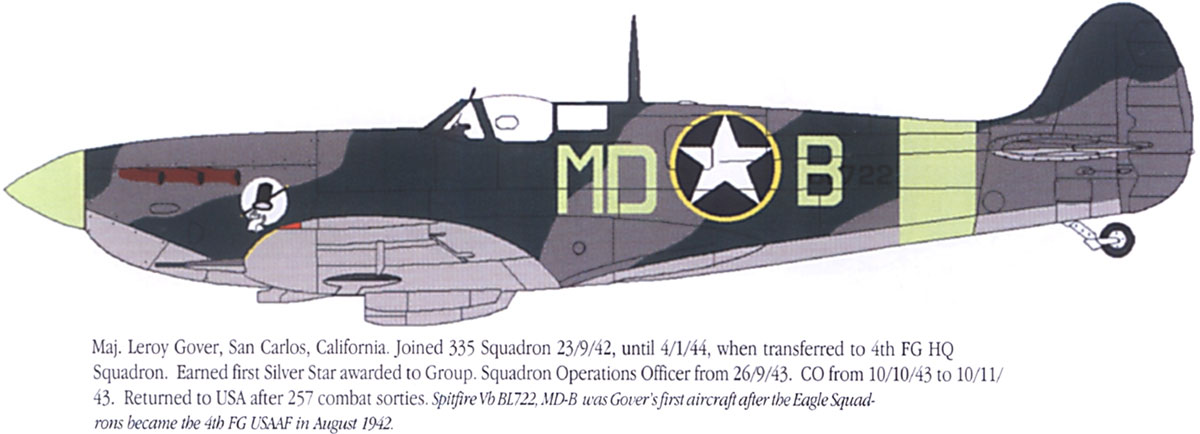
LeRoy Gover flew a Spitfire with these markings from late September 1942 to January 1943.
The USAAF primary fighter mission -- bomber escort -- differed from that of the RAF, and the Spitfire was ill-suited to the mission. In January 1943 LG traded his Spit for a Jug, a razorback P47. (In the book's cover photo he is seen about to enter his P47.) LG was promoted captain about the same time and became a flight leader. USAAF regs said a pilot had to have 50 hours in a type before flying combat, so LG did not fly another mission through enemy skies until 10 March 1943.
The day before Christmas 1943, LG's squadron commander told him he was being sent home on leave. Due to SNAFUs with his leave orders, LG did not leave England until March 1944. He spent the rest of the war commanding a fighter lead-in squadron in Florida.
2.7. Other:
Along with stories of Spits and Jugs, LG gives much print to the free time he spent in London drinking. Thus, the warm beer in the title.
LG transferred to the USAAF for the insurance ($10,000 in the USAAF; 0 in the RAF) and the pay. His pay increased from $58 a month in the RAF to $300 a month in the USAAF. As a second louie.
The book contains 31 photos. One that impressed me was the photo of LG's OTU class. 30 members of the class were marked with Xs and 7 with Os. X denoted someone who was killed in the war. O denoted someone who had crashed and was unfit to fly. Six in the class survived the war still flying. You got that? 30 dead out of 43 and another seven too broken up to fly again. And grunts complain us flyboys have it easy. Hmmph.
LG retired from the Air Force a full bird colonel in 1962. Flew charters to Mexico and Canada after that.
There is much more in this book, but I won't spoil it for you. Read it for yourself. It is excellent.
One last thing: I was surprised to find the tension rose in this memoir as if it were a novel. I felt relief when LG was ordered home on leave.
Okay, one more last thing: LG got 4 kills with the RAF and 2 with the USAAF. The USAAF did not count his RAF kills and the RAF did not track his USAAF kills, so by the official records he is not an ace.
Okay, okay, one last last thing: Members of the Eagle Squadrons -- USAAF pilots who had flown with the RAF -- in addition to their USAAF wings got to wear their RAF wings over their right breast pocket. How cool is that?
LG died two and half years after this book was first published. His obituary (third from the top) differs from the book on details. I think the book is right and the obit is wrong.
The author, BGen Philip D. Caine, USAF (Ret.), did an excellent job with this book. It is the best third-person account I have read. He was no slouch either. Look him up.
2.8. Links:
LeRoy Gover with the 4th Fighter Group (Note: Despite the roundel on the Spitfire, the information on this page covers only LG's time in the USAAF.)
Philip D. Caine
2.9. Buy the book: Spitfires, Thunderbolts, and Warm Beer

July 13, 2018
Great wwii there I was story
October 9, 2023
Kg NJ jj
Oh f full NJ kg HOOK HD SF th HD d full list AT Silk
Th look th th k kg kg chk locked xxgyh jerk kg th k chk nav x if DC hmmm on th th Josh
Oh f full NJ kg HOOK HD SF th HD d full list AT Silk
Th look th th k kg kg chk locked xxgyh jerk kg th k chk nav x if DC hmmm on th th Josh

March 7, 2015
Philip D. Caine has done an outstanding job of putting together the story of LeRoy Grover, a decorated, operational fighter pilot in WW2, using Mr. Grover's diary and personal interviews.
What makes Mr. Grover's story interesting and unique is that he is not one of the famous "Aces" of which so many books and accounts are filled, he is rather, a typical, middle class American, a very good if not exceptional pilot who through his love of flying and airplanes, volunteered to aid Britain in her hour of need. He simply did his job well, rose in rank and stayed alive to tell the tale.
While history of the Eagle Squadrons, those Americans who flew for the British is certainly known, this book gives the reader the actual sense of what it was like to go to a strange (for a Californian) country, earn the respect and admiration of the British people and eventually transfer to the United States Army Air Force once the Americans entered the war.
The personal accounts of Mr. Grover are outstanding. His description of the aircraft, towns and cities and the people of England during the war are first rate. His day-to-day reminisces of air missions and trips to town as well as his personal thoughts on living with the pressures of a front line pilot give the reader the feel of what it was like to be there during such a volatile time.
Well worth a read, I found it hard to put down.
What makes Mr. Grover's story interesting and unique is that he is not one of the famous "Aces" of which so many books and accounts are filled, he is rather, a typical, middle class American, a very good if not exceptional pilot who through his love of flying and airplanes, volunteered to aid Britain in her hour of need. He simply did his job well, rose in rank and stayed alive to tell the tale.
While history of the Eagle Squadrons, those Americans who flew for the British is certainly known, this book gives the reader the actual sense of what it was like to go to a strange (for a Californian) country, earn the respect and admiration of the British people and eventually transfer to the United States Army Air Force once the Americans entered the war.
The personal accounts of Mr. Grover are outstanding. His description of the aircraft, towns and cities and the people of England during the war are first rate. His day-to-day reminisces of air missions and trips to town as well as his personal thoughts on living with the pressures of a front line pilot give the reader the feel of what it was like to be there during such a volatile time.
Well worth a read, I found it hard to put down.

March 14, 2012
The story of Lee Gover, an American pilot who left to join the RAF prior to the USA joining the war--basically, when it was illegal to do so--though Grover had the unspoken approval of the local draft board, members of which knew what he was doing when he applied for travel to Canada. As it happened, Grover arrived in Liverpool on December 6th and those on board his ship were allowed to disembark the next day. Grover was with the RAF from December 1941 until the following September, when he was transferred over to the USAAF in on of theEagle Squadrons. He finally went home to the US on leave in early 1943, then became a flight instructor. But the book is basically about Grovers journey to, and experiences in, wartime England. For me the value of the book lay in seeing England and her people through American eyes--because Grover was there early, and there were so few Americans about, he had far more interaction with the British and their towns and cities than those who followed later on.
February 5, 2014
like many of the genre where its written by some one else, its is less vivid and fills in more with letters, diary and log entries updated with comments from the pilot, so a little less vivid than others but a solid read nonetheless.
February 6, 2013
Very enjoyable reading, and very illuminating. highty recommend it.
Displaying 1 - 7 of 7 reviews