In 1920, at the age of thirty-five, Amedeo Modigliani died in poverty and neglect in Paris, much like a figure out of La Boh`eme. His life had been as dramatic as his death. An Italian Jew from a bourgeois family, "Modi" had a weakness for drink, hashish, and the many women-including the Russian poet Anna Akhmatova-who were drawn to his good looks. His friends included Picasso, Utrillo, Soutine, and other important artists of his day, yet his own work stood apart, generating little interest while he lived. Today's art world, however, acknowledges him as a master whose limited oeuvre-sculptures, portraits, and some of the most appealing nudes in the whole of modern art-cannot satisfy collectors' demand.
With a lively but judicious hand, biographer Jeffrey Meyers sketches Modigliani and the art he produced, illuminating not only this little-known figure but also the painters, writers, lovers, and others who inhabited early twentieth-century Paris with him.
Jeffrey Meyers, a Fellow of the Royal Society of Literature, has recently been given an Award in Literature by the American Academy of Arts and Letters. Thirty of his books have been translated into fourteen languages and seven alphabets, and published on six continents. He lives in Berkeley, California.
”One has to pay dearly for immortality: one has to die several times while still alive.” ---Nietzsche
Self-Portrait 1919
And die he did from a thousand cuts of disappointments. From the moment he left his home town of Livorno, Italy, to move to Paris, he had found the only place he was supposed to be.
The world took too long to find him.
Thora Klinckowstrom modeled for him in 1919. Modi was near death at that point in time, less than a year away from his ultimate demise, but her description gives you some idea of the allure he had with women. ”Thora found him ‘quite small, with a weather-beaten complexion, black untidy hair and the most wonderful hot dark eyes…. In he marched wearing a black velvet suit with a red scarf knotted carelessly around his neck…. You had only to look at him to see that he was dangerous.’” By 1919, Modi was already ruined by drink, disease, and hard living; regardless, he still exuded such charming intensity that he beguiled the beautiful, Swedish, twenty year old girl.
Modigliani
The invention of the camera had a huge impact on art. The need for true likenesses by painters was no longer necessary. Painters could change their style to more interpretative portraits. ”By 1914 Modi had abandoned his naturalistic, presculptural portraits, a legacy of his training in nineteenth-century Italy, for a more individualistic style. Influenced by Freudian psychology, he rejected the limitations of the ‘retinal’ tradition and felt free to use, distort or ignore visible reality.”
Modigliani’s portrait of Picasso, as you can see his style was still transitioning.
Pablo Picasso was the most famous of the modernist painters. He was not only a talented, temperamental (or you could say edgy), groundbreaking painter, but he was also gifted in the art of self promotion. In the early 1900s, Paris, specifically the Montmartre/Montparnasse districts, was the best place in the world to come for inspiration. Chagall had a studio next door to where Modigliani lived. Soutine, Pascin, Cezanne, Schiele, Matisse, and Kisling, just to name a few, all made their way to Paris to experience the synergy that was inspiring so much amazingly progressive art. The smell of paint, spilled wine, and sex stained sheets saturated the air of the cafes and bars of the Montmartre.
Picasso and Modigliani were frenemies. Picasso was famous and on his way to becoming rich, while Modigliani was still giving away his paintings, that would be worth millions within a few years, to pay for meals or rent. His clothes were shabby. His health unstable. When he ran out of money for canvas he would paint on doors and walls. The contrast between their two lives was stark. Modigliani was convinced his art was as interesting and as important as Picasso’s work, but while collectors started to drive up the prices of a Picasso, Modigliani paintings languished unknown. Despite the fact that Picasso was already successful and really did not need to engage in banter with someone like Modigliani, he was fascinated by Modi and his art. This friction filled relationship was best illustrated in the 2004 Modigliani movie, starring Andy Garcia. That film made a wonderful companion piece to this biography.
I’ve always admired Modi’s paintings: the long necks, the distortions, the strange eyes. Despite all of those manipulations, you can still recognize the subject. The fussy homosexual poet Jean Cocteau was so disturbed by Modi’s painting of him that he refused to pay for it. Cocteau was not alone; many of Modi’s subjects were upset by his interpretations of who they were. That just confirms for me that Modi was tapping into something real, too real, certainly not idealized.
Jean Cocteau
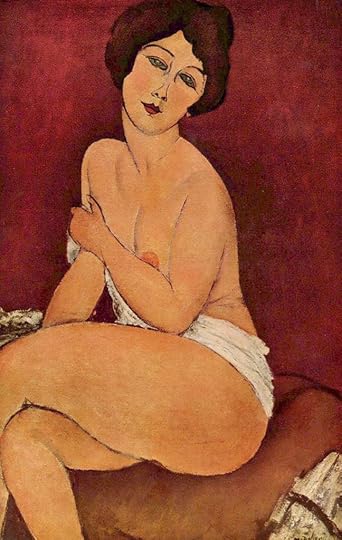
Modi’s nudes are spectacular.
Nude Sitting on a Divan (1918) one of my favorites.
”Unlike such modern masters as Francis Bacon and Lucian Freud, whose nude figures suggest anguish and stir anxiety, Modi sought, like Renoir and Matisse, to convey aesthetic pleasure, and his women are among the most erotic and desirable nudes in the history of painting. He created his characteristic nude in a variety of ways: by imitating the poses of great paintings, by using a sensuous line to define the form of the body; by stripping his nude of virtually all context and attributes in order to focus on the essential female; by following Gauguin, in using a darker, more realistic skin color and frankly showing pubic hair; and by establishing intimacy with, rather than creating distance from, his nudes.”
Girls, girls, and more girls were attracted to the artists of the Montparnasse district. They served as models, bed warmers, financial supporters, and ultimately, most of them were eventually replaced by someone new. Modi had his share of lovers. The famous Russian poet Anna Akhmatova even briefly became involved with him. The woman that became most caught up in the final tragedy of Modi’s life was Jeanne Hébuterne.
Jeanne, Jeanne, poor Jeanne.
Jeanne Hebuterne
She took care of him as best she could, but really what Modi needed to do was quit drinking and eat three squares a day, and even though Jeanne basically stood on the tracks in front of the careening carriage of death, she could not stop the inevitable. Modi died at the age of 35 from tubercular meningitis. Jeanne, devoted to the end,
Portrait of Jeanne
If Modigliani had lived even a few years longer, he would have been a very rich man. The 1920s brought a flood or rich speculators to Paris who bought art and took it back to the US, which fueled even more interest in the art coming out of Paris. With his death, the price for Modigliani’s work soared, and he is now considered one of the most important modernist painters. He was so close, so wretchedly close, to realizing his dream of financial success and being recognized as an important artist.
This is a story of the Paris art scene at the turn of the century with Modigliani as its leading character. It is begins with solid biographical material on his childhood and ends with a strong report on his death and aftermath.
It is a short book, so it is significant that 2-3 pages are spent on each of his artist and romantic friends and that there are pages and pages describing works that do not appear in the book.
There is nothing glamorous about these starving artists in Paris. The hand to mouth existence meant little food and no heat in the winter. There is too much alcohol and its resulting violence. Nothing was clean. (One of his friends, the artist Chaim Soutine, was said to house bed bugs in his ear.)
Modigliani did not have to live this way. He was from an aristocratic (not fully wealthy, but comfortable) family from Livorno. Tuberculosis, alcoholism, drug addiction, an unnamed STD, poor nutrition, a squalid living situation and exposure (no heat) culminated in his death at age 35.
His good looks and artist style drew many women to his flame. Those who could support him lasted a while. It’s hard to tell whether the aristocrat, Anna Akhmatova, did better to return to revolutionary Russia or not. Jeanne Hebuterne’s death speaks not only for grief, but also her lack of options.
Picasso looms in the fringes of Modigliani’s life. Picasso’s talent is widely acknowledged by the (literally) starving artists who recognize his talent and note his artistic tricks. He has attained some fame and success and remains aloof. World War I also looms and claims, directly or indirectly, some lives of this Paris art scene.
Meyers ends this sad story with a good treatment of Modigliani’s position in the development of modern art. He concludes that Modigliani had peaked and his style was not likely to grow or change.
I'd still like to find a complete bio of this tortured soul, but this book and Modigliani: A Life may be all there is to say.
If you ever had romantic notions of Parisian bohemia a century ago read this book. It will break you of such notions. Bohemia was only romantic if you could escape from it. If you could not escape the poverty, the place was a killer. I recommend this book to all those who aspire to be artisticly poor.
A fan of Modigliani’s portraits since my teen years, but this was the first book I have read about his life. Very interesting book with lots of details about many of his artist friends and his models. Would liked to have seen more photos of his work included, but the ones included were helpful.
Not a pretty picture of the twenties in the art community in Paris! Debauchery reigned between creative bursts of artistic endeavours! Modi knew them all with lots of supporters.
Didn't seem to have enough material for a whole book. Alot of extraneous stuff about other happenings at the time that seemed to be there only to puff up the book.