

What do you think?

Salammbô
Rare Book
541 pages, Pocket Book
First published November 24, 1862
About the author
Gustave Flaubert
2,389 books4,049 followersGustave Flaubert was a French novelist. He has been considered the leading exponent of literary realism in his country and abroad. According to the literary theorist Kornelije Kvas, "in Flaubert, realism strives for formal perfection, so the presentation of reality tends to be neutral, emphasizing the values and importance of style as an objective method of presenting reality". He is known especially for his debut novel Madame Bovary (1857), his Correspondence, and his scrupulous devotion to his style and aesthetics. The celebrated short story writer Guy de Maupassant was a protégé of Flaubert.
Ratings & Reviews
Friends & Following
Create a free account to discover what your friends think of this book!
Community Reviews
Displaying 1 - 30 of 630 reviews

July 6, 2025
Salammbo reads as if it belongs among The Books of Kings in the Bible.
Soldiers have a great feast… Drunkenness makes them rebellious… Horrendous pandemonium ensues…
Salammbo – a priestess and general’s daughter – enters the stage…
One of the principal partakers of this colourful and exotic tale is a former slave Spendius, liberated by soldiers from prison…
Mercenaries haven’t been paid for their military service so instigated by Spendius they rebelled… Mâtho is madly in love with Salammbo… He wants to possess her whatever the cost… He heads the rebel…
Ancient history is the history of ruins.
Soldiers have a great feast… Drunkenness makes them rebellious… Horrendous pandemonium ensues…
The perfumes flowing from their brows wet their ragged tunics with large drops, and as they leaned with both hands on the tables, which seemed to them to be tossing about like ships at sea, they drunkenly gazed round so that they could devour with their eyes what they could not seize. Others walked right through the dishes on their crimson cloths and kicked to pieces the ivory stools and glass Tyrian phials. The sound of songs blended with the death-rattle of the slaves dying amid the broken cups. They demanded wine, food, gold. They cried out for women. They raved in a hundred languages.
Salammbo – a priestess and general’s daughter – enters the stage…
Her ardour rose at the gleam of the naked swords; she cried out with open arms. Her lyre dropped, she fell silent – and pressing both hands to her heart, she stayed for some moments with her eyes closed, savouring the excitement of all these men.
Mâtho the Libyan leaned towards her. Involuntarily she drew nearer to him, and moved to acknowledge his pride she poured him a long stream of wine into a golden cup to reconcile herself with the army.
‘Drink!’ she said.
One of the principal partakers of this colourful and exotic tale is a former slave Spendius, liberated by soldiers from prison…
He was the son of a Greek orator and a prostitute from Campania. He had first made his money by selling women; then, ruined by a shipwreck, he had fought with the Samnite shepherds against the Romans. He had been captured, and had escaped; recaptured, he had worked in quarries, gasped in the bath-houses, cried out under punishments, belonged to numerous masters, suffered every rage.
Mercenaries haven’t been paid for their military service so instigated by Spendius they rebelled… Mâtho is madly in love with Salammbo… He wants to possess her whatever the cost… He heads the rebel…
‘You will lose your ships, your lands, your chariots, your hanging beds, the slaves who rub your feet! Jackals will lie down in your palaces, the plough will turn up your graves. Nothing will remain but the eagles’ cry and heaps of ruins. You will fall, Carthage!’
Ancient history is the history of ruins.

May 17, 2018
A little human sacrifice, a touch of cannibalism, some slaughter of both soldiers and civilians, one or two crucifixions, there you have it, the mercenaries revolt against Carthage in 240 B.C. Yes I am being facetious, a great amount in all these categories in fact occurred, people played rough then, if you can stomach this , a splendid book to read... The novel will take you to a delicious place that fictional writers would be afraid to make.. The strange thing is this contains ....
mostly the horrible truth, history is stranger than fiction. The rich merchants of ancient Carthage, cared more about their wealth and keeping the fabulous toys, they worked hard for, than the city and its Empire. The result as every school student knows... the eventual disastrous outcome of the three Punic wars with mighty Rome. Flaubert's book Salammbo is more like War and Peace than Anna Karenina, an epic struggle for survival and dominance in the lands surrounding the prosperous territories of the Mediterranean Sea, the Republic of Carthage ,with its port the most important, but first a slight hiccup. Those pesky barbarians want their money they were promised... Imagine the outrage of not keeping a solemn oath, breaking it in actuality , and outsiders dying for a hated city, nobody likes , still since winning a conflict , didn't ensue, the first Punic War 264 to 241 B. C. makes people very ungenerous to losers...
However 20,000 of them exist, this is a big problem. The good citizens of Carthage are too well- off to fight their own battles...you can feel how upset the foreigners are, not getting their promised coins. Nevertheless the city will soon discover to its bloody regret, greed can be bad, as many will perish in the unbelievable siege of Carthage, the inhabitants from the walls, look down at now 300,000 angry barbarians at the gate, all the oppressed are marching, the lagoons have a strange color, most shudder. Salammbo ( real name unknown) is a high priestess, a beautiful virgin in a weird religious cult, daughter of Carthage's best general, a person she hardly knows, a genius in outsmarting his enemies, Hamilcar, the father of the great Hannibal, now you know how the famous soldier, learned the trade. To make it interesting the leader of the rebels bold Matho, a Libyan fighter falls in love with the exquisite Salammbo, complications follow you can guess. The vast armies on both sides butcher each other in hand -to - hand combat, no quarter given. The fields are soaked in blood, bodies pile up, parts hit the mud including horses , elephants and the soldiers red flesh...yet after one terrible battle where 45,000 die...
All continue swinging their lethal weapons , to hack each other to pieces . In the shadows figures on trees mysteriously appear, as liquid slowly drips to the ground, low moans are heard by those near the walls of the giant city. ...A terrific show about ancient times and the creepy customs which humans believed in once, too horrible for modern audiences... or are they?
mostly the horrible truth, history is stranger than fiction. The rich merchants of ancient Carthage, cared more about their wealth and keeping the fabulous toys, they worked hard for, than the city and its Empire. The result as every school student knows... the eventual disastrous outcome of the three Punic wars with mighty Rome. Flaubert's book Salammbo is more like War and Peace than Anna Karenina, an epic struggle for survival and dominance in the lands surrounding the prosperous territories of the Mediterranean Sea, the Republic of Carthage ,with its port the most important, but first a slight hiccup. Those pesky barbarians want their money they were promised... Imagine the outrage of not keeping a solemn oath, breaking it in actuality , and outsiders dying for a hated city, nobody likes , still since winning a conflict , didn't ensue, the first Punic War 264 to 241 B. C. makes people very ungenerous to losers...
However 20,000 of them exist, this is a big problem. The good citizens of Carthage are too well- off to fight their own battles...you can feel how upset the foreigners are, not getting their promised coins. Nevertheless the city will soon discover to its bloody regret, greed can be bad, as many will perish in the unbelievable siege of Carthage, the inhabitants from the walls, look down at now 300,000 angry barbarians at the gate, all the oppressed are marching, the lagoons have a strange color, most shudder. Salammbo ( real name unknown) is a high priestess, a beautiful virgin in a weird religious cult, daughter of Carthage's best general, a person she hardly knows, a genius in outsmarting his enemies, Hamilcar, the father of the great Hannibal, now you know how the famous soldier, learned the trade. To make it interesting the leader of the rebels bold Matho, a Libyan fighter falls in love with the exquisite Salammbo, complications follow you can guess. The vast armies on both sides butcher each other in hand -to - hand combat, no quarter given. The fields are soaked in blood, bodies pile up, parts hit the mud including horses , elephants and the soldiers red flesh...yet after one terrible battle where 45,000 die...
All continue swinging their lethal weapons , to hack each other to pieces . In the shadows figures on trees mysteriously appear, as liquid slowly drips to the ground, low moans are heard by those near the walls of the giant city. ...A terrific show about ancient times and the creepy customs which humans believed in once, too horrible for modern audiences... or are they?

May 8, 2010
I'd not intended to read Salammbô, Flaubert's close-to-unknown second novel, but I was at the end of Madame Bovary and saw a yellowing 1922 edition in the 1 Franc pile at the Geneva flea market's book stall. How could I resist? It's a strange book, and at first I had trouble getting into it. I'd expected it to be like Madame Bovary, and it really isn't. Instead of the tedium of French provincial life and the brilliant character development, we have a wide-screen historical epic set around Carthage, shortly after the end of the first Punic War. There is no character development to speak of, and the story is a non-stop thrill ride featuring, among other things, mass gladiatorial combat, cannibalism, parades of crucified lions, war-elephants with scythes strapped to their trunks, and magic rites involving nude women and pythons. For the first few chapters I wondered if Flaubert had gone mad, or was at best having a really serious off-day.
As I got further into Salammbô, though, I began to like it more, and by the time I was half-way through I couldn't put it down. You have to hand it to Flaubert. With Madame Bovary, he created the modern psychological novel; most authors would have been content to do it again for the rest of their careers. Flaubert thought he'd try something different, and created another, less respectable type of book, the decline-and-fall blockbuster. Since then, it's been copied innumerable times, and is particularly popular in the SF/fantasy genre: Salammbô reminded me rather strongly of Foundation, Dune, Conan the Barbarian and Star Wars, to name just a few. I immediately recognised the decadent, overcivilized Empire, the uncouth but virile barbarians, the sexy virgin priestess, the twisty, double-crossing intrigues and the graphic battle scenes. They've become standard ingredients that any author can take down from the shelf and stir into a plot that needs a little livening-up. But the 20th century imitations I'd come across had mostly been written by hacks; it was weird to see it all presented in Flaubert's beautiful, ornate French.
It's a remarkably modern story. Carthage is playing host to a large army of mercenaries, who are waiting to be paid for their services in the recently concluded war; the greedy council are reluctant to part with their gold; negotiations turn sour; soon the merceneries have started an insurgency that lays the country waste. As the war becomes more and more savage, the polytheistic Carthaginians lose faith in the benevolent Tanit, goddess of the Moon and fertility, and come under the sway of the dreadful Moloch, god of fire and destruction. The scene where the children are sacrificed in the belly of the bronze Moloch-idol is the most horrifying thing I have read this year.
If the novel had came out today, I would have believed I saw references to current events. We are turning away from Tanit, and towards Moloch. It'd make a good movie: I can already see the poster, with Gerard Butler as Mâtho, the hunky leader of the Mercenaries, Emmy Rossum as Salammbô, the beautiful priestess of the Temple of Tanit, and Sean Penn as General Hamilcar, her father. If you happen to be in the movie business and you're looking for ideas, consider asking a hungry young screenwriter to put together a draft script.
Oh yes, and here's the oddest thing: I looked it up on Wikipedia, and pretty much the whole story is true. That really made me think.
_________________________________________
Ah... I was saying it was surprisingly modern, and would make a great movie. Having done a little googling, I've discovered that there is indeed a bad and completely forgotten 1960 movie. More interestingly, there's a video game! Here's a picture of the title character:

I don't think they've taken the costume directly from the book (at least, I don't recall her wearing this precise outfit), but it's true to the spirit of the thing. Salammbô is a hot chick and dresses to display her assets to best advantage.
I'm still stunned by the idea that one of Flaubert's novels exists in game form. What other classics have been given this treatment?
_________________________________________
After some more googling, I find that there's a moderately famous painting by Gaston Bussière featuring the aforementioned scene with the magic rites and the python. Given this site's strict no-nudity policy, I'd better not include the picture itself. But you can see most of it on the cover of the edition I'm reviewing here.
As I got further into Salammbô, though, I began to like it more, and by the time I was half-way through I couldn't put it down. You have to hand it to Flaubert. With Madame Bovary, he created the modern psychological novel; most authors would have been content to do it again for the rest of their careers. Flaubert thought he'd try something different, and created another, less respectable type of book, the decline-and-fall blockbuster. Since then, it's been copied innumerable times, and is particularly popular in the SF/fantasy genre: Salammbô reminded me rather strongly of Foundation, Dune, Conan the Barbarian and Star Wars, to name just a few. I immediately recognised the decadent, overcivilized Empire, the uncouth but virile barbarians, the sexy virgin priestess, the twisty, double-crossing intrigues and the graphic battle scenes. They've become standard ingredients that any author can take down from the shelf and stir into a plot that needs a little livening-up. But the 20th century imitations I'd come across had mostly been written by hacks; it was weird to see it all presented in Flaubert's beautiful, ornate French.
It's a remarkably modern story. Carthage is playing host to a large army of mercenaries, who are waiting to be paid for their services in the recently concluded war; the greedy council are reluctant to part with their gold; negotiations turn sour; soon the merceneries have started an insurgency that lays the country waste. As the war becomes more and more savage, the polytheistic Carthaginians lose faith in the benevolent Tanit, goddess of the Moon and fertility, and come under the sway of the dreadful Moloch, god of fire and destruction. The scene where the children are sacrificed in the belly of the bronze Moloch-idol is the most horrifying thing I have read this year.
If the novel had came out today, I would have believed I saw references to current events. We are turning away from Tanit, and towards Moloch. It'd make a good movie: I can already see the poster, with Gerard Butler as Mâtho, the hunky leader of the Mercenaries, Emmy Rossum as Salammbô, the beautiful priestess of the Temple of Tanit, and Sean Penn as General Hamilcar, her father. If you happen to be in the movie business and you're looking for ideas, consider asking a hungry young screenwriter to put together a draft script.
Oh yes, and here's the oddest thing: I looked it up on Wikipedia, and pretty much the whole story is true. That really made me think.
_________________________________________
Ah... I was saying it was surprisingly modern, and would make a great movie. Having done a little googling, I've discovered that there is indeed a bad and completely forgotten 1960 movie. More interestingly, there's a video game! Here's a picture of the title character:
I don't think they've taken the costume directly from the book (at least, I don't recall her wearing this precise outfit), but it's true to the spirit of the thing. Salammbô is a hot chick and dresses to display her assets to best advantage.
I'm still stunned by the idea that one of Flaubert's novels exists in game form. What other classics have been given this treatment?
_________________________________________
After some more googling, I find that there's a moderately famous painting by Gaston Bussière featuring the aforementioned scene with the magic rites and the python. Given this site's strict no-nudity policy, I'd better not include the picture itself. But you can see most of it on the cover of the edition I'm reviewing here.

November 19, 2020
As a former student of history, specifically the Second Punic War, I had only cast a distant eye on Flaubert's novel. Finally, however, I decided to read it during my vacation. And we can say that I was not disappointed.
We soak up the African atmosphere, which is well-documented, pleasant to read, and lively.
Despite some length, we have lost the habit of these seventeenth-century descriptions—Flaubert's prose takes us from page to page towards an end that we know is inevitable. The protagonists' violence and rage challenge politicians' immobility and priests' mysticism. This epic is rich and masterfully organized. The rhythm varies in intensity without ever getting boring.
The central character is not very present at the end, but the appearance of salammbô sounds like a dream, which is perhaps why this novel is an oriental reverie.
We soak up the African atmosphere, which is well-documented, pleasant to read, and lively.
Despite some length, we have lost the habit of these seventeenth-century descriptions—Flaubert's prose takes us from page to page towards an end that we know is inevitable. The protagonists' violence and rage challenge politicians' immobility and priests' mysticism. This epic is rich and masterfully organized. The rhythm varies in intensity without ever getting boring.
The central character is not very present at the end, but the appearance of salammbô sounds like a dream, which is perhaps why this novel is an oriental reverie.

March 27, 2014
You pass beneath the intimidating portcullis and enter the museum called Salammbô by Gustave Flaubert. It is an awesome edifice and you are duly awed. So ornate, so steeped in olden times and ancient ways, so stylish in its baroque Orientalism. The first gallery amazes you. It describes a feast for barbarians in the halcyon days of old Carthage. Such a feast, such sights to behold! A feast for the senses: your mind comes alive to witness the wonders there, the luscious imagery, the dreamy atmosphere, the foreboding and the mystery, all of the tiny, exquisite details. It feels so lush, so decadent. You imagine yourself there, in Carthage, eavesdropping on the magnetic barbarians and the dissolute Carthaginians, guessing at the troubles that will come, noting the tensions between that virile, unwashed horde and their greedy, sinister employers... they shall not be allies for long. There is war on the horizon! You see the virgin priestess Salammbô of Carthage and the men who are the architects of that great battle - the wily slave Spendius and the lovestruck commander Mathos. You will surely be enchanted by this museum and the many tales it has to tell.
At first, the pleasures remain. The details! The fabulous lushness of it all! But slowly, gradually... your opinions change. You find your enthusiasm waning, you become circumspect when considering this museum. Gallery after gallery details battle after battle. Atrocity after atrocity. You can scarcely take it all in. Names upon names, nations upon nations, weaponry and couture and religious ceremonies, the details, the details. Lists upon lists. You love lists but you find yourself losing focus. There is no human anchor there to keep you entranced; the priestess, the barbarians, the Carthaginians, all - save the Greek slave Spendius and the Carthaginian general Hamilcar - are frustratingly flimsy creations. Perhaps "flimsy" is not the right word... they are operatic creations but they are hollow, all gesture and bombast with no shading, no mystery. They are cartoonish figures. And so what you are left with are the lists of battles, of movements in the field. You are left with atrocities beyond belief, to men and to women alike. To children: oh, such a slaughter of children. To animals: mutilated elephants, crucified lions, the dog of a blind woman casually slain. The museum is an Ode to Atrocity, elaborate and winding, a new atrocity at every turn, atrocities that you have never imagined, vividly described, atrocities that no doubt took place many times in the annals of history. Can atrocity become boring? The lists, the atrocities... they begin to inspire fatigue.
You leave the museum with some relief. There is much to admire there, you do acknowledge that. It is an impressive achievement! But, eventually, a tedious one as well.
At first, the pleasures remain. The details! The fabulous lushness of it all! But slowly, gradually... your opinions change. You find your enthusiasm waning, you become circumspect when considering this museum. Gallery after gallery details battle after battle. Atrocity after atrocity. You can scarcely take it all in. Names upon names, nations upon nations, weaponry and couture and religious ceremonies, the details, the details. Lists upon lists. You love lists but you find yourself losing focus. There is no human anchor there to keep you entranced; the priestess, the barbarians, the Carthaginians, all - save the Greek slave Spendius and the Carthaginian general Hamilcar - are frustratingly flimsy creations. Perhaps "flimsy" is not the right word... they are operatic creations but they are hollow, all gesture and bombast with no shading, no mystery. They are cartoonish figures. And so what you are left with are the lists of battles, of movements in the field. You are left with atrocities beyond belief, to men and to women alike. To children: oh, such a slaughter of children. To animals: mutilated elephants, crucified lions, the dog of a blind woman casually slain. The museum is an Ode to Atrocity, elaborate and winding, a new atrocity at every turn, atrocities that you have never imagined, vividly described, atrocities that no doubt took place many times in the annals of history. Can atrocity become boring? The lists, the atrocities... they begin to inspire fatigue.
You leave the museum with some relief. There is much to admire there, you do acknowledge that. It is an impressive achievement! But, eventually, a tedious one as well.

Read
January 3, 2018In Xanadu did Kubla Khan a stately pleasure-dome decree...
Whenever I come across the opening phrase of Coleridge's famous poem, the cadences transport me into his exotic creation instantly. The fabled general, Kubla Khan, appears before me sumptuously enthroned in his pleasure palace - and because I've read enough nineteenth century writers who've travelled a little to know they automatically associate the exotic with the erotic, I'm never surprised when a few lines later, Coleridge introduces an Abyssinian maid, a damsel with a dulcimer, the memory of whom remains with the poet long after both she and her song have disappeared.
C'était à Mégara faubourg de Carthage dans les jardins d'Hamilcar...
The opening line of Salammbô reminded me of Coleridge immediately - there's a similar sonority and cadence. I had no sooner read that first line than I was imagining Hamilcar's palace in Mégara as a splendiferous pleasure dome, and I was well primed for the arrival of a damsel with a dulcimer to the great military feast that is taking place in the pleasure gardens of the palace. As it turns out, the maid who promptly appears is Phoenician rather than Abyssinian, but Salammbô, daughter of General Hamilcar, is the embodiment of the erotic:
She advanced into the avenue of cypress, and walked slowly through the tables of the captains, who drew back somewhat as they watched her pass. Her hair, which was powdered with violet sand, and combined into the form of a tower, after the fashion of the Chanaanite maidens, added to her height. Tresses of pearls were fastened to her temples, and fell to the corners of her mouth, which was as rosy as a half-open pomegranate. On her breast was a collection of luminous stones, their variegation imitating the scales of the murena. Her arms were adorned with diamonds, and issued naked from her sleeveless tunic, which was starred with red flowers on a perfectly black ground. Between her ankles she wore a golden chainlet to regulate her steps, and her large dark purple mantle, cut of an unknown material, trailed behind her, making, as it were, at each step, a broad wave which followed her...No one as yet was acquainted with her. It was only known that she led a retired life, engaged in pious practices. Some soldiers had seen her in the night on the summit of her palace kneeling before the stars amid the eddyings from kindled perfuming-pans. It was the moon that had made her so pale, and there was something from the gods that enveloped her like a subtle vapour. Her eyes seemed to gaze far beyond terrestrial space. She bent her head as she walked, and in her right hand she carried a little ebony lyre...
Salammbô's story is set in the third century BC, in the city of Carthage, which is today a suburb of Tunis on the Mediterranean coast. The feast that is taking place in the opening scene has been arranged by the Carthaginians as a reward for the mercenary soldiers who aided the city in the Punic wars against the Romans. However, the mercenaries need to be paid for their services as well as fêted with food and drink, and the failure of Carthage to pay them results in the mercenaries besieging the city. The seige is complicated by the fact that one of the mercenary leaders became entranced with Salammbô as she walked among them at the feast. The memory of the maid remains with him long after she and her lyre have disappeared from his sight.
Flaubert had visited Tunis and read Polybius' Histories as well as everything else he could find about the Punic wars, so the bones of this story are true and accurate; there really was a conflict between the mercenaries and the city, and it was long and bloody. What Flaubert does is to dramatise it in his own sumptuous style. His language is very visual, and like Coleridge, it sometimes seems as if he might have been under the influence of some powerful opiate while composing the episodes of the story. I imagined him writing this book in his isolated study in Normandy - a modern-day Saint Anthony in the desert, constantly beset by tortured and exotic visions. It wasn't hard to imagine him as Saint Anthony because Flaubert's first adult work was a dramatization of the temptations visited on the third century hermit in which the young author listed every imaginable vision that the unfortunate saint might have dreamt up - and there are definite parallels between the two books, especially in the detail of the descriptions. Flaubert writes as if he were an orientalist painter such as Ingres or Chassériau - his words convey the same heady atmosphere as their paintings. But I wasn't tempted to find images to match his descriptions - as I was while reading L'éducation sentimentale. In fact, I've looked at several paintings depicting Salammbô, including the one on the cover of the French edition, but none of them match the image I have of her from reading Flaubert's words. I'm finally convinced of what Flaubert himself maintained: the words should be enough.
I'd like to have included more of his words in this review but I can't because half way through reading Salammbô, I mislaid it. I read the second half in English on an ereader - I couldn't find an electronic version in French. I was grateful to have been able to finish the book but at the same time, I regretted the switch of language - I much preferred reading Flaubert in French. His long sentences, full of successions of clauses, have a rhythm that must be a huge challenge for a translator. But it's also true that the second half of this book, mostly relating the series of battles between the Carthaginians and the mercenaries, is much more of a page turner than the first half so that it matters less to read it in another language. Just as the Carthaginians finally overpower the mercenaries, the plot finally overpowers the style. By the end, I was glad to have done with this very violent story, but sorry to have done with Flaubert. Now that I've finished Salammbô, I've nothing left to read but his letters.
Whenever I come across the opening phrase of Coleridge's famous poem, the cadences transport me into his exotic creation instantly. The fabled general, Kubla Khan, appears before me sumptuously enthroned in his pleasure palace - and because I've read enough nineteenth century writers who've travelled a little to know they automatically associate the exotic with the erotic, I'm never surprised when a few lines later, Coleridge introduces an Abyssinian maid, a damsel with a dulcimer, the memory of whom remains with the poet long after both she and her song have disappeared.
C'était à Mégara faubourg de Carthage dans les jardins d'Hamilcar...
The opening line of Salammbô reminded me of Coleridge immediately - there's a similar sonority and cadence. I had no sooner read that first line than I was imagining Hamilcar's palace in Mégara as a splendiferous pleasure dome, and I was well primed for the arrival of a damsel with a dulcimer to the great military feast that is taking place in the pleasure gardens of the palace. As it turns out, the maid who promptly appears is Phoenician rather than Abyssinian, but Salammbô, daughter of General Hamilcar, is the embodiment of the erotic:
She advanced into the avenue of cypress, and walked slowly through the tables of the captains, who drew back somewhat as they watched her pass. Her hair, which was powdered with violet sand, and combined into the form of a tower, after the fashion of the Chanaanite maidens, added to her height. Tresses of pearls were fastened to her temples, and fell to the corners of her mouth, which was as rosy as a half-open pomegranate. On her breast was a collection of luminous stones, their variegation imitating the scales of the murena. Her arms were adorned with diamonds, and issued naked from her sleeveless tunic, which was starred with red flowers on a perfectly black ground. Between her ankles she wore a golden chainlet to regulate her steps, and her large dark purple mantle, cut of an unknown material, trailed behind her, making, as it were, at each step, a broad wave which followed her...No one as yet was acquainted with her. It was only known that she led a retired life, engaged in pious practices. Some soldiers had seen her in the night on the summit of her palace kneeling before the stars amid the eddyings from kindled perfuming-pans. It was the moon that had made her so pale, and there was something from the gods that enveloped her like a subtle vapour. Her eyes seemed to gaze far beyond terrestrial space. She bent her head as she walked, and in her right hand she carried a little ebony lyre...
Salammbô's story is set in the third century BC, in the city of Carthage, which is today a suburb of Tunis on the Mediterranean coast. The feast that is taking place in the opening scene has been arranged by the Carthaginians as a reward for the mercenary soldiers who aided the city in the Punic wars against the Romans. However, the mercenaries need to be paid for their services as well as fêted with food and drink, and the failure of Carthage to pay them results in the mercenaries besieging the city. The seige is complicated by the fact that one of the mercenary leaders became entranced with Salammbô as she walked among them at the feast. The memory of the maid remains with him long after she and her lyre have disappeared from his sight.
Flaubert had visited Tunis and read Polybius' Histories as well as everything else he could find about the Punic wars, so the bones of this story are true and accurate; there really was a conflict between the mercenaries and the city, and it was long and bloody. What Flaubert does is to dramatise it in his own sumptuous style. His language is very visual, and like Coleridge, it sometimes seems as if he might have been under the influence of some powerful opiate while composing the episodes of the story. I imagined him writing this book in his isolated study in Normandy - a modern-day Saint Anthony in the desert, constantly beset by tortured and exotic visions. It wasn't hard to imagine him as Saint Anthony because Flaubert's first adult work was a dramatization of the temptations visited on the third century hermit in which the young author listed every imaginable vision that the unfortunate saint might have dreamt up - and there are definite parallels between the two books, especially in the detail of the descriptions. Flaubert writes as if he were an orientalist painter such as Ingres or Chassériau - his words convey the same heady atmosphere as their paintings. But I wasn't tempted to find images to match his descriptions - as I was while reading L'éducation sentimentale. In fact, I've looked at several paintings depicting Salammbô, including the one on the cover of the French edition, but none of them match the image I have of her from reading Flaubert's words. I'm finally convinced of what Flaubert himself maintained: the words should be enough.
I'd like to have included more of his words in this review but I can't because half way through reading Salammbô, I mislaid it. I read the second half in English on an ereader - I couldn't find an electronic version in French. I was grateful to have been able to finish the book but at the same time, I regretted the switch of language - I much preferred reading Flaubert in French. His long sentences, full of successions of clauses, have a rhythm that must be a huge challenge for a translator. But it's also true that the second half of this book, mostly relating the series of battles between the Carthaginians and the mercenaries, is much more of a page turner than the first half so that it matters less to read it in another language. Just as the Carthaginians finally overpower the mercenaries, the plot finally overpowers the style. By the end, I was glad to have done with this very violent story, but sorry to have done with Flaubert. Now that I've finished Salammbô, I've nothing left to read but his letters.

January 19, 2017
الرواية أتعبتني وأرهقتني كثيرًا رغم الوصف الباذخ في اللغة الذي يتمتع بها الكاتب، لكن هذه الرواية مليئة بالسادية والقتل والوحشية في وصف القتال وأكل لحوم البشر، قرقعة العظام وتهشيم الرؤوس، والأمراض الفتاكة الخ الخ .. لا أحب هذه النوعية من الروايات.

October 31, 2014
Carthage holds a certain fascination for me, as a classics scholar, in that it was an empire of power, influence, and grand personalities--and yet the legacy Carthage has left to us, her history, her culture were deliberately erased, burned to the ground with nary a trace remaining, and then replaced with the politicized fictions of Rome, who destroyed her, followed in her footsteps, and replaced her. The shadow of Carthage looms large across the ancient world, but she is always a shadow: dark, unknowable, menacing, cloaked in rumor. Her real presence, her real character still remain unknown to us.
Some things we do know: that she was a colony of Phoenicians who became a power in their own right, the figures of Hanno the navigator, Hannibal the general, and some other greats, mostly sprung from the grand Barca line. Yet our knowledge is always filtered through Roman eyes, Roman words--to the point that the great Roman cultural epic, Virgil's Aeneid, personifies Carthage in the figure of Dido: the angry, jilted lover intent on preventing Rome's ever being born. In the end, warmongering Cato's oft-repeated line Carthago delenda est--'Carthage must be destroyed'--was followed to the letter.
In preparation for this book, the follow-up to his acknowledged masterpiece of psychological Realism, Madame Bovary, Flaubert spent months researching, burying himself in ancient histories, trying to recover the lost empire--even visiting its former site. One can see the fruits of his labors in the book's mostly delightful details--which at their best evoke the poetic list-making of Ovid or Milton--while at other times, they run to the banal, as a certain lengthy explanation of the difference between the catapult and the ballista.
There is definitely a sense that Flaubert is working more in the milieu of history here, not melodrama--which is unfortunate, because the story cries out to be told with pathos and character, to be sung. We're never allowed into the characters, psychologically--instead of seeing their thoughts develop toward the moment of decision, Flaubert sticks us with mere descriptions of what has happened. What a Shakespearean performance this might have been--full of contentious dialogues, arguments, coercions, seductions--I longed to see these grand figures strutting the stage, demonstrating their mastery, their force of personality, their depth of emotion. It's no wonder that luminaries like Mussorgsky and Rachmaninoff tried to craft operas from the tale.
Without these passionate struggles, these subtle turns and manipulations, the entire melodrama grows ever more flat, preconceived, inevitable. Yet, as the author, himself wrote:
Sometimes, alas, the work simply does not come together as we wish it might--as indeed we know that it can, for that is what draws an artist to the project in the first place: his sure knowledge that there is a story here worth telling, and the reader surely comes away with that same impression, that there is fertile ground here.
The bloody anecdotes--especially an early one about the crucifixion of a full-grown lion--are rife with opportunity for symbolism, for multilayered writing, if only it had all come together. If only. They do not work as pure history--Flaubert lacks that scholarly depth and breadth, for all his researches--but neither can he quite turn them to an artistic purpose.
In the end, the most interesting way to view the work--and indeed, likely the reason it failed--is as a grand piece of Orientalism. We do not quite get Carthage-as-Carthage, but neither do we get Carthage-as-France. Instead, we get a distancing, a view of Carthage as unknowable, as impossible to sympathize with--that same distance that the Orientalist stance was constructed to produce.
It is either fitting or ironic that we end up here, since in many ways, Carthage-by-way-of-Rome is the original example of the Orientalist posture: the foreign power is destroyed, conquered, converted, and then rewritten by the conqueror as self-justification. The voice of Carthage, its power and influence was so great that Rome had to reduce it, to transform it into something less threatening--even as Rome dutifully copied both the technology and the methods which Carthage established as the necessities of the first true maritime trade empire to dominate the Mediterranean.
Aeneas is not merely a snub to Carthage, after all--but also an attempt by Rome to rewrite Persian greatness into their empire, which was always more Cult of the God King than Rhetoric of the Demos--then, in the wake of the Renaissance and the Reconquista, the European powers once again take on the Roman cause and identity, intent on making an abused lover of Islam, which had so long dominated and loomed over them. For France, Algeria became the colonial site where they most fully explored the perverse decadence that is the ruler's right--at the same time blaming the natives for whatever was inflicted upon them, through the standard process of Orientalist distancing--a process we still use to this day, insisting that any group who cannot prevent themselves from being dominated must, in some way, be asking to be so dominated.
The most extreme example of alienation and vilification crafted by the Romans against the Carthaginians is the Tophet--a site where, it was claimed, infants were sacrificed to the brutal gods as offerings to stave off defeat, disease, and blight. Flaubert repeats this accusation in the most florid and merciless way, as the blood-mad crowd gives up child after child to the mechanized maw of their titanic idol. Recent archaeological study suggests that the Tophet was used for interring the numerous stillbirths and victims of high infant mortality in the ancient world.
Though clearly influential on adventure writers like Haggard, Kipling, and Mundy, Flaubert does not quite achieve the rollicking pace that make those stories enjoyable. Neither can he deliver upon the wild personalities which might have carried the tale as a proper melodrama--the required psychological distance between himself as a French citizen and the necessarily depraved East is too vast a gulf for authorial sympathies to bridge. Neither can it quite be called a history--it is rather too close and personal, too invested in the blood and depravity for its own sake to maintain more objective judgment.
Perhaps Melville--if anyone--could have melded these disparate types of story, through extended symbolism and precisely-constructed moments into a tale that managed, ultimately, to hang together and surpass the mere sum of assembled parts. In the end Flaubert, despite his particular skills and the time he invested, could not.
Some things we do know: that she was a colony of Phoenicians who became a power in their own right, the figures of Hanno the navigator, Hannibal the general, and some other greats, mostly sprung from the grand Barca line. Yet our knowledge is always filtered through Roman eyes, Roman words--to the point that the great Roman cultural epic, Virgil's Aeneid, personifies Carthage in the figure of Dido: the angry, jilted lover intent on preventing Rome's ever being born. In the end, warmongering Cato's oft-repeated line Carthago delenda est--'Carthage must be destroyed'--was followed to the letter.
In preparation for this book, the follow-up to his acknowledged masterpiece of psychological Realism, Madame Bovary, Flaubert spent months researching, burying himself in ancient histories, trying to recover the lost empire--even visiting its former site. One can see the fruits of his labors in the book's mostly delightful details--which at their best evoke the poetic list-making of Ovid or Milton--while at other times, they run to the banal, as a certain lengthy explanation of the difference between the catapult and the ballista.
There is definitely a sense that Flaubert is working more in the milieu of history here, not melodrama--which is unfortunate, because the story cries out to be told with pathos and character, to be sung. We're never allowed into the characters, psychologically--instead of seeing their thoughts develop toward the moment of decision, Flaubert sticks us with mere descriptions of what has happened. What a Shakespearean performance this might have been--full of contentious dialogues, arguments, coercions, seductions--I longed to see these grand figures strutting the stage, demonstrating their mastery, their force of personality, their depth of emotion. It's no wonder that luminaries like Mussorgsky and Rachmaninoff tried to craft operas from the tale.
Without these passionate struggles, these subtle turns and manipulations, the entire melodrama grows ever more flat, preconceived, inevitable. Yet, as the author, himself wrote:
"I would give the demi-ream of notes I've written during the last five months and the ninety-eight volumes I've read, to be, for only three seconds, really moved by the passion of my heroes."
Sometimes, alas, the work simply does not come together as we wish it might--as indeed we know that it can, for that is what draws an artist to the project in the first place: his sure knowledge that there is a story here worth telling, and the reader surely comes away with that same impression, that there is fertile ground here.
The bloody anecdotes--especially an early one about the crucifixion of a full-grown lion--are rife with opportunity for symbolism, for multilayered writing, if only it had all come together. If only. They do not work as pure history--Flaubert lacks that scholarly depth and breadth, for all his researches--but neither can he quite turn them to an artistic purpose.
In the end, the most interesting way to view the work--and indeed, likely the reason it failed--is as a grand piece of Orientalism. We do not quite get Carthage-as-Carthage, but neither do we get Carthage-as-France. Instead, we get a distancing, a view of Carthage as unknowable, as impossible to sympathize with--that same distance that the Orientalist stance was constructed to produce.
It is either fitting or ironic that we end up here, since in many ways, Carthage-by-way-of-Rome is the original example of the Orientalist posture: the foreign power is destroyed, conquered, converted, and then rewritten by the conqueror as self-justification. The voice of Carthage, its power and influence was so great that Rome had to reduce it, to transform it into something less threatening--even as Rome dutifully copied both the technology and the methods which Carthage established as the necessities of the first true maritime trade empire to dominate the Mediterranean.
Aeneas is not merely a snub to Carthage, after all--but also an attempt by Rome to rewrite Persian greatness into their empire, which was always more Cult of the God King than Rhetoric of the Demos--then, in the wake of the Renaissance and the Reconquista, the European powers once again take on the Roman cause and identity, intent on making an abused lover of Islam, which had so long dominated and loomed over them. For France, Algeria became the colonial site where they most fully explored the perverse decadence that is the ruler's right--at the same time blaming the natives for whatever was inflicted upon them, through the standard process of Orientalist distancing--a process we still use to this day, insisting that any group who cannot prevent themselves from being dominated must, in some way, be asking to be so dominated.
The most extreme example of alienation and vilification crafted by the Romans against the Carthaginians is the Tophet--a site where, it was claimed, infants were sacrificed to the brutal gods as offerings to stave off defeat, disease, and blight. Flaubert repeats this accusation in the most florid and merciless way, as the blood-mad crowd gives up child after child to the mechanized maw of their titanic idol. Recent archaeological study suggests that the Tophet was used for interring the numerous stillbirths and victims of high infant mortality in the ancient world.
Though clearly influential on adventure writers like Haggard, Kipling, and Mundy, Flaubert does not quite achieve the rollicking pace that make those stories enjoyable. Neither can he deliver upon the wild personalities which might have carried the tale as a proper melodrama--the required psychological distance between himself as a French citizen and the necessarily depraved East is too vast a gulf for authorial sympathies to bridge. Neither can it quite be called a history--it is rather too close and personal, too invested in the blood and depravity for its own sake to maintain more objective judgment.
Perhaps Melville--if anyone--could have melded these disparate types of story, through extended symbolism and precisely-constructed moments into a tale that managed, ultimately, to hang together and surpass the mere sum of assembled parts. In the end Flaubert, despite his particular skills and the time he invested, could not.

March 8, 2012
Just as it's hard to believe that the Rod Stewart who gave us the classic Every Picture Tells a Story is also responsible for "Da Ya Think I'm Sexy?", it's baffling that Flaubert wrote Salammbô right after his more famous effort.
This is a historical novel about a revolt against Carthage by unpaid mercenaries following the First Punic War. It hasn't aged nearly as gracefully as Madame Bovary, and I consider it to be quite a difficult book. The first two thirds are just endlessly thick description, mostly of exotic settings and people's crazy outfits, punctuated by outrageously violent acts. While slogging through this, one might think, "Well, this would be a lot easier if it had any interesting characters with psychological depth, but maybe they just had not invented those yet in 1862." But then one might recall that in fact they -- specifically, Gustave Flaubert -- in fact had invented just that thing, and one might wish he'd incorporated these innovations into the present work.
But, the thing is that Salammbô is just not that type of book, and while it definitely provides rewards for one's hard work, they're not those of nuanced and realistic psychological portraits. The first big payoff comes on page 38, when the Barbarian mercenaries come across (hahaha) this:
A sickening stench struck their nostrils, and on top of a carob tree they seemed to see something extraordinary: a lion's head rose above the leaves. They ran to it. It was a lion, its limbs fastened to a cross like a criminal. Its huge muzzle drooped on to its chest, and its two forepaws, half concealed under its luxuriant mane, were widely separated like the wings of a bird. Its ribs stuck out, one by one, beneath the taut skin; its hind legs, nailed one on top of the other, rose a little; and black blood, flowing through the hair, had collected in stalactites at the bottom of its tail, which hung straight down along the cross. The soldiers stood round amusing themselves; they called it consul and Roman citizen and threw stones at its eyes to drive away the flies.
A hundred yards further on they saw two more, then there suddenly appeared a whole line of crosses with lions hanging on them. Some had been dead for so long that nothing remained on the wood but the remnants of their skeletons; others half eaten away had their faces contorted in hideous grimaces; some of them were enormous, the trees of the cross bent beneath them and they swayed in the wind, while flocks of crows wheeled ceaselessly above their heads. Such was the vengeance of Carthaginian peasants when they caught a wild beast; they hoped to terrify the others by such examples. The Barbarians stopped laughing and for a long time were seized by amazement. "What sort of people are these," they thought, "who amuse themselves by crucifying lions!"
Yes, what sort of people indeed. The crucified lions are only the first in a series of scenes of horrific sadism and cruelty that I might normally call "indescribable," except that Flaubert describes them all. Torture, maiming, starvation, child sacrifice, elephant tramplings, leper crucifixion, battlefield vampirism, and pretty much every sicko way of killing a person that Flaubert could think of is depicted here, with as much loving detail as he uses to evoke his lush and sensuous exotic world. This is one of the most over-the-top violent books I think I've ever read. Actually, though, the narrative picked up a lot in the last third -- including many thrilling battle scenes and an intense, highly sexy bodice-ripping romance -- and I wound up more or less enjoying this book, despite a slow start. And it's not all brutality and violence -- there's a beautiful naked woman dancing with her pet snake, some incredible food writing, and more dramatic sets and costume changes than any Hollywood studio could ever hope to replicate. I'm not sure who I'd recommend it to -- maybe fans of extreme graphic violence and historical epics, who don't feel Mel Gibson's Jesus movie went nearly far enough? -- but I'm not sorry I read this bizarre piece of dated gross-out Orientalism.
This is a historical novel about a revolt against Carthage by unpaid mercenaries following the First Punic War. It hasn't aged nearly as gracefully as Madame Bovary, and I consider it to be quite a difficult book. The first two thirds are just endlessly thick description, mostly of exotic settings and people's crazy outfits, punctuated by outrageously violent acts. While slogging through this, one might think, "Well, this would be a lot easier if it had any interesting characters with psychological depth, but maybe they just had not invented those yet in 1862." But then one might recall that in fact they -- specifically, Gustave Flaubert -- in fact had invented just that thing, and one might wish he'd incorporated these innovations into the present work.
But, the thing is that Salammbô is just not that type of book, and while it definitely provides rewards for one's hard work, they're not those of nuanced and realistic psychological portraits. The first big payoff comes on page 38, when the Barbarian mercenaries come across (hahaha) this:
A sickening stench struck their nostrils, and on top of a carob tree they seemed to see something extraordinary: a lion's head rose above the leaves. They ran to it. It was a lion, its limbs fastened to a cross like a criminal. Its huge muzzle drooped on to its chest, and its two forepaws, half concealed under its luxuriant mane, were widely separated like the wings of a bird. Its ribs stuck out, one by one, beneath the taut skin; its hind legs, nailed one on top of the other, rose a little; and black blood, flowing through the hair, had collected in stalactites at the bottom of its tail, which hung straight down along the cross. The soldiers stood round amusing themselves; they called it consul and Roman citizen and threw stones at its eyes to drive away the flies.
A hundred yards further on they saw two more, then there suddenly appeared a whole line of crosses with lions hanging on them. Some had been dead for so long that nothing remained on the wood but the remnants of their skeletons; others half eaten away had their faces contorted in hideous grimaces; some of them were enormous, the trees of the cross bent beneath them and they swayed in the wind, while flocks of crows wheeled ceaselessly above their heads. Such was the vengeance of Carthaginian peasants when they caught a wild beast; they hoped to terrify the others by such examples. The Barbarians stopped laughing and for a long time were seized by amazement. "What sort of people are these," they thought, "who amuse themselves by crucifying lions!"
Yes, what sort of people indeed. The crucified lions are only the first in a series of scenes of horrific sadism and cruelty that I might normally call "indescribable," except that Flaubert describes them all. Torture, maiming, starvation, child sacrifice, elephant tramplings, leper crucifixion, battlefield vampirism, and pretty much every sicko way of killing a person that Flaubert could think of is depicted here, with as much loving detail as he uses to evoke his lush and sensuous exotic world. This is one of the most over-the-top violent books I think I've ever read. Actually, though, the narrative picked up a lot in the last third -- including many thrilling battle scenes and an intense, highly sexy bodice-ripping romance -- and I wound up more or less enjoying this book, despite a slow start. And it's not all brutality and violence -- there's a beautiful naked woman dancing with her pet snake, some incredible food writing, and more dramatic sets and costume changes than any Hollywood studio could ever hope to replicate. I'm not sure who I'd recommend it to -- maybe fans of extreme graphic violence and historical epics, who don't feel Mel Gibson's Jesus movie went nearly far enough? -- but I'm not sorry I read this bizarre piece of dated gross-out Orientalism.

December 17, 2016
Es una novela que me encantó aunque algunas cosas hacen que no sea de mi total agrado. No sabía que la obra en realidad era una novela histórica, pues los acontecimientos narrados a lo largo de la obra tienen bastantes referencias reales.
Luego de leer a "Madame Bovary" quería conocer a otro Flaubert, porque la verdad a pesar de la antipatía por la simplona historia de Emma y su pandilla no quería creer que ahí moría el intelecto de este escritor por la gran admiración que siempre ha concitado. Y luego de escribir "Madame Bovary" parece que a Flaubert se le dio por buscar o escribir una historia ya no deprimente ni mundana sino una grandilocuente y esplendorosa. Es en realidad luego de leerla una obra casi romántica pues dista mucho de analizar el valor moral de los actos, los pensamientos, la mecánica psicológica de los personajes sino más bien opta no sólo por el recuerdo del pasado típico del Romanticismo sino también por su elocuencia, su exaltación de las sensaciones, las descripciones detalladas y esplendorosas, de las pasiones consumiendo al ser humano.
La novela narra de forma muy romántica un episodio real histórico: "La Guerra de los mercenarios" que se realizó en Cartago entre esta ciudad y los mercenarios que al servicio siempre de Cartago y constituyendo su principal núcleo del ejército se subleva contra los fenicios, punis o cartagineses y tratan de apoderarse de la gran ciudad. La hija del célebre Amílcar Barca, Salammbô es la que debería ser el personaje principal que para mí no lo es y si lo fuera resulta débil para el papel en la obra. Las huestes rebeldes están dirigidas por Mâtho, el libio, Spendius, el griego y otros más. En el lado de Cártago resaltan Hannon y luego Amílcar Barca, gran y terrible líder de los fenicios.
En realidad me encantó bastante porque lejos de ser un triángulo amoroso o una relación amorosa de dos, "Salammbô" es mucho más que eso, es la descripción exacta y ensordecedora del Cartago antiguo, con sus elefantes acorazados triturando hombres, sus dioses terribles que ansían sacrificios humanos, de joyas ricas y de un brillo enceguecedor que sólo en África pueden encontrarse, de la crueldad y sadismo de los bárbaros, de la belleza embriagadora de las fenicias, del respeto y temor a lo mágico, del color fulgurante del ámbar o del aroma dulce de algunas pociones. Flaubert logra una descripción muy erudita pero que no suena aburrida ni difícil de descifrar, tal vez los primeros capítulos pueden marear un poco pero tan pronto como te adentras en la lectura ya te puedes familiarizar con los términos y tener esa sensación (que pocas obras en mí pueden lograr) de vivir dentro de la historia y pasar todos los acontecimientos como un pasaje de tu vida; todo esto sería imposible de crear si Flaubert no se hubiera dedicado de lleno a leer como luego leí cientos de libros de historia de Cártago para poder hacerla tan real.
Sí por supuesto hay cosas que me han desagradado: la primera y más grave la ausencia de una real importancia de la personalidad de Salammbô en la novela (si leen la historia real estarán menos decepcionados), es bella y sensual como describe la obra pero hay algo que hace que no logre cumplir con el objetivo del personaje, de no tener tanta fuerza ni relevancia, y mucho menos pensar que el título se deba a ella misma, la relación amorosa que se crea en la historia tampoco tiene a mi parecer suficiente peso, demasiado escueta y aunque se puede entender algunas inclinaciones "fantásticas" o "románticas" de amor oscuro o mágico, más allá de dos personas que puedan quererse de verdad, sino como dos entes atraídos por la fatalidad, queda este término demasiado grande para la historia de amor que se habla en la novela. Y siendo estos aspectos, en cualquier otra obra para mí muy importantes en una historia tal, me sorprende que no sean lo suficiente malos como para no olvidarlos cuando recuerdo a Amílcar dirigiendo sus huestes, a los bárbaros campeones un día y al otro, hombres llevados por la desesperación más terrible y acobardados, los caballos con las orejas cercenadas y con marfiles para asemejarlos a rinocerontes, las torturas a los esclavos y todo el sentimiento místico de los pobladores de Cartago.
Y es que justamente estos desajustes a mi modo de ver, el hecho de casi no simpatizar con ningún personaje ni Salammbô, ni Mâtho, ni incluso Amílcar y aún así gustar de la novela por su descripción histórica y bélica que tantas cosas me ha aportado habla de mi valoración positiva de la obra.
Luego de leer a "Madame Bovary" quería conocer a otro Flaubert, porque la verdad a pesar de la antipatía por la simplona historia de Emma y su pandilla no quería creer que ahí moría el intelecto de este escritor por la gran admiración que siempre ha concitado. Y luego de escribir "Madame Bovary" parece que a Flaubert se le dio por buscar o escribir una historia ya no deprimente ni mundana sino una grandilocuente y esplendorosa. Es en realidad luego de leerla una obra casi romántica pues dista mucho de analizar el valor moral de los actos, los pensamientos, la mecánica psicológica de los personajes sino más bien opta no sólo por el recuerdo del pasado típico del Romanticismo sino también por su elocuencia, su exaltación de las sensaciones, las descripciones detalladas y esplendorosas, de las pasiones consumiendo al ser humano.
La novela narra de forma muy romántica un episodio real histórico: "La Guerra de los mercenarios" que se realizó en Cartago entre esta ciudad y los mercenarios que al servicio siempre de Cartago y constituyendo su principal núcleo del ejército se subleva contra los fenicios, punis o cartagineses y tratan de apoderarse de la gran ciudad. La hija del célebre Amílcar Barca, Salammbô es la que debería ser el personaje principal que para mí no lo es y si lo fuera resulta débil para el papel en la obra. Las huestes rebeldes están dirigidas por Mâtho, el libio, Spendius, el griego y otros más. En el lado de Cártago resaltan Hannon y luego Amílcar Barca, gran y terrible líder de los fenicios.
En realidad me encantó bastante porque lejos de ser un triángulo amoroso o una relación amorosa de dos, "Salammbô" es mucho más que eso, es la descripción exacta y ensordecedora del Cartago antiguo, con sus elefantes acorazados triturando hombres, sus dioses terribles que ansían sacrificios humanos, de joyas ricas y de un brillo enceguecedor que sólo en África pueden encontrarse, de la crueldad y sadismo de los bárbaros, de la belleza embriagadora de las fenicias, del respeto y temor a lo mágico, del color fulgurante del ámbar o del aroma dulce de algunas pociones. Flaubert logra una descripción muy erudita pero que no suena aburrida ni difícil de descifrar, tal vez los primeros capítulos pueden marear un poco pero tan pronto como te adentras en la lectura ya te puedes familiarizar con los términos y tener esa sensación (que pocas obras en mí pueden lograr) de vivir dentro de la historia y pasar todos los acontecimientos como un pasaje de tu vida; todo esto sería imposible de crear si Flaubert no se hubiera dedicado de lleno a leer como luego leí cientos de libros de historia de Cártago para poder hacerla tan real.
Sí por supuesto hay cosas que me han desagradado: la primera y más grave la ausencia de una real importancia de la personalidad de Salammbô en la novela (si leen la historia real estarán menos decepcionados), es bella y sensual como describe la obra pero hay algo que hace que no logre cumplir con el objetivo del personaje, de no tener tanta fuerza ni relevancia, y mucho menos pensar que el título se deba a ella misma, la relación amorosa que se crea en la historia tampoco tiene a mi parecer suficiente peso, demasiado escueta y aunque se puede entender algunas inclinaciones "fantásticas" o "románticas" de amor oscuro o mágico, más allá de dos personas que puedan quererse de verdad, sino como dos entes atraídos por la fatalidad, queda este término demasiado grande para la historia de amor que se habla en la novela. Y siendo estos aspectos, en cualquier otra obra para mí muy importantes en una historia tal, me sorprende que no sean lo suficiente malos como para no olvidarlos cuando recuerdo a Amílcar dirigiendo sus huestes, a los bárbaros campeones un día y al otro, hombres llevados por la desesperación más terrible y acobardados, los caballos con las orejas cercenadas y con marfiles para asemejarlos a rinocerontes, las torturas a los esclavos y todo el sentimiento místico de los pobladores de Cartago.
Y es que justamente estos desajustes a mi modo de ver, el hecho de casi no simpatizar con ningún personaje ni Salammbô, ni Mâtho, ni incluso Amílcar y aún así gustar de la novela por su descripción histórica y bélica que tantas cosas me ha aportado habla de mi valoración positiva de la obra.

December 2, 2019
Printre picături, mai citesc un capitol din Salammbô, la fel de dezamăgit. Am ajuns, iată, la bătălia de la Macar, adică pe la mijlocul romanului. Naratorul face risipă de pietre prețioase, de exotism oriental:
Majoritatea comparațiilor sînt perfect banale, cînd nu sînt stridente sau inadecvate. Salammbô este cel mai precar dintre romanele lui Flaubert. Impresie persistentă de artificiu. Pe linia asta (care e o fundătură) a mers doar Huysmans în À rebours (1884). Totul este exagerat, nefiresc. Cît despre temperamentele personajelor (Salammbô, Mâtho, Hamilcar) cel mai blînd lucru este să constați că sînt neverosimile, țipătoare. În romanul lui Flaubert, găsim, ca într-un manual, toate defectele romantismului...
„Femeile nomazilor îşi fluturau pînă la călcîie rochiile lor ţesute în pătrăţele din păr roşcat de cămilă; cîntăreţele din Cyrenaica, înfăşurate în văluri viorii, cu sprîncenele încondeiate, îşi mlădiau glasul încrucişîndu-şi picioarele pe rogojini; negresele, cu sînii atîrnîndu-le, strîngeau baligă pentru foc şi o uscau la soare; femeile din Siracusa purtau în păr spelci de aur; lusitanele, salbe de scoici; femeile galilor îşi acopereau cu piei de lup pieptul lor alb”.
Majoritatea comparațiilor sînt perfect banale, cînd nu sînt stridente sau inadecvate. Salammbô este cel mai precar dintre romanele lui Flaubert. Impresie persistentă de artificiu. Pe linia asta (care e o fundătură) a mers doar Huysmans în À rebours (1884). Totul este exagerat, nefiresc. Cît despre temperamentele personajelor (Salammbô, Mâtho, Hamilcar) cel mai blînd lucru este să constați că sînt neverosimile, țipătoare. În romanul lui Flaubert, găsim, ca într-un manual, toate defectele romantismului...

January 24, 2025
In Salammbô zeigt Flaubert, wozu Menschen fähig sind, wenn Angst, Triebe und Wahnsinn die Oberhand gewinnen. Der Roman ist Symbol der Zerstörung – destruktiv und inszeniert das Scheitern des Menschen in seiner Unzulänglichkeit, chaotisch, ohne Verstand, ein Exzess.
Doch zuerst, die Entstehungsgeschichte von Allem:
„Ehe es noch Götter gab, herrschte Finsternis, und es wehte ein Hauch, schwül und trüb wie das Bewusstsein der Menschen im Traum. Der Hauch verdichtete sich und erzeugte Gewölk und die Sehnsucht. Und aus der Sehnsucht und den Wolken entsprang der Urstoff. Das war ein tiefer, schwarzer, eisiger Sumpf. In ihm keimten fühllose Ungeheuer, zusammenhangslose Elemente der werdenden Wesen, wie sie auf den Wänden der Tempel abgebildet sind...
Dann verdichtete sich der Urstoff. Er wurde zum Ei. Das zerbarst. Die eine Hälfte wurde zur Erde, die andere zum Himmelsgewölbe. Sonne, Mond, Winde und Wolken erschienen, und unter Donner und Blitz die denkenden Wesen. Eschmun kam in der Sternenwelt auf, Khamon erstrahlte in der Sonne, Melkarth trieb ihn mit starkem Arm bis hinter Gades zurück. Die Erdgeister stiegen hinunter in die Vulkane, und Rabbetna neigte sich gleich einer Amme über die Welt und spendete ihr Licht wie einen Milchstrom und deckte sie mit der Nacht zu wie mit einem Mantel...“
Eine Welt, die aus Sehnsucht geboren wird. Kennt die Vollkommenheit der Götter die Einheit, das Sehnen? Ist das Sehnen nicht Ausdruck einer Unvollständigkeit, eines Mangels?
Flaubert beschreibt eine Welt, in die ein fundamentaler Mangel eingeschrieben ist, der vor dem Erhabenen, dem Göttlichen keinen Halt macht. Eine Welt voller Paradoxien.
Die Leere des Göttlichen spiegelt Flaubert im Text an den Göttern Tanit und Moloch wider.
Tanit, die Göttin der Fruchtbarkeit und des Schutzes, wird nicht als tröstende Macht dargestellt, sondern bleibt unerreichbar und leer. Der Mantel der Tanit, ein zentrales Symbol im Roman, bringt keine Erlösung, sondern Schuld und Verderben.
Moloch, der Gott der Opferung, ist kein erhabenes Wesen, sondern ein gefährlicher Abgrund, der menschliches Leben in sinnloser Gewalt verschlingt. Seine Macht besteht nicht in göttlicher Größe, sondern in der Intensivierung menschlicher Grausamkeit.
Die Religion oder die Götter haben keine transzendente Macht. Sie formieren sich unbarmherzig und dienen der Projektion menschlicher Angst und Gier. Sie füllen keine Lücke, sondern reißen die existentielle Spannung noch weiter auf.
Karthago, der punische Krieg, der Aufstand der Söldner, die Exotik und Opulenz des Romans dienen Flaubert als Schleier. Eine fremdartige, antike Welt, die das Andere, die Zerrissenheit des Individuums, durchbrechen lässt. Kulturelle Unterschiede lösen sich auf. Die ornamentale Hypersymbolik verliert ihren Sinn. Flauberts ästhetisches „auf die Spitze treiben“ seiner Sprache führt geradewegs in die Auflösung von Raum (außen) und Zeit. Der Text öffnet einen Raum in die Welt der inneren Triebkräfte der Menschen – eine Leere, um die jedes Subjekt kreist.
Identifikatorisches Lesen ist nicht gewünscht. Die Figuren sind archetypische, symbolische Repräsentanten. Sie und ihre Psyche treten hinter der dramatischen Handlung und monumentalen Kulisse zurück.
Matho ist das Symbol für das Streben und Sehnen nach einem überhöhten Ideal (Salammbô, Priesterin und Tochter des Herrschers Hamilkar), das an der Grenze zwischen Ideal und realer Welt zerbricht:
„Aber ich will sie haben! Ich muss sie besitzen! Sonst sterbe ich! Bei dem Gedanken, sie an meine Brust zu drücken, ergreift mich wilde Freude. Und doch hasse ich sie, Spendius, ich möchte sie schlagen! Was soll ich tun? Ich habe Lust, mich zu verkaufen, um ihr Sklave zu werden. Du warst es! Du durftest um sie sein! Erzähle mir von ihr! Jede Nacht, nicht wahr, besteigt sie das Dach ihres Palastes? Ach, die Steine müssen erbeben unter ihren Sandalen und die Sterne sich neigen, um sie zu sehen!...“
Salammbô wird als Ideal aufgeladen, unerreichbar.
Lieben, um zu hassen. Diese Aussage wird später nochmal durch Spendius aufgegriffen:
„Und da du deine Liebe nicht sättigen kannst, so mäste deinen Hass. Er wird dich aufrecht erhalten!“
Hier haben wir einen Verweis auf den Exzess, den Luhmann in Liebe als Passion. Zur Codierung von Intimität beschreibt:
„Gebot des Exzesses: Überschreitung von Grenzen... Wer keine Gegenliebe findet, sollte hassen. Die Dauer kann nur durch Aufschub, Umweg, Widerstand erreicht werden, die der Exzess nicht kennt.“
Das ist der Tenor der gesamten Handlung. Die Figuren handeln unmittelbar und radikal, getrieben, ohne Reflexion oder die Fähigkeit, Widerstand und Umwege auszuhalten.
Besonders beeindruckt mich die Wollust, mit der Flaubert durch das Gemetzel streift. Moral existiert nicht. Und tatsächlich entsteht durch diese Übersteigerung eine ästhetische Leere. Flaubert thematisiert nicht nur die Leere, er ahmt sie formal nach – in ihrem Gegenteil: überbordender Ornamentalik. Unter dieser Last ächzt und bricht die Symbolik ein. Schönheit und Grausamkeit werden von Flaubert verflochten.
Ich wollte kotzen. Ich war angewidert. Ich habe gelacht über die Lächerlichkeit der idealisierten Sprache. Ich habe mich gequält, geschleppt. Ich habe fasziniert die Symbolik wie eine reife Frucht platzen sehen. Ich habe den Schleier voller Pomp und klirrenden Edelsteinen fallen sehen. Ich habe dialektische Schwellenbereiche erlebt. Ich habe die Schönheit im Extrem erfahren – in dem sich die Vernunft verliert. Ich habe ein Buch gelesen, in dem sich der Todestrieb als Held des Romans manifestiert. Keine der Figuren steht für etwas Größeres. Sie sind Gefangene ihrer Ohnmacht, aus tiefster Angst.
Salammbô ist die Gegenthese zu Christa Wolfs Kassandra, in der in einer zerstörerischen Welt ein Weg zur Selbstfindung und zum aktiven Widerstand möglich ist. Eros! Die Kraft der Erneuerung, ein Trieb, der schafft statt zerstört.
Mathos Wahnsinn führt in den Tod, Salammbô zerbricht als Symbol für Reinheit und Verführung an ihrer eigenen Unfähigkeit, sich aus den Zwängen ihrer Welt zu befreien.
Kassandra reflektiert ihr Begehren, wird sich ihrer Ängste bewusst und nutzt dies zur aktiven Subjektivität. Wahnsinn wird durch Vernunft produktiv gemacht.
In Salammbô laufen alle Triebe in Leere. Keine Emanzipation. Keine Transformation. Reines Scheitern. Grausam und schön zugleich.
Doch zuerst, die Entstehungsgeschichte von Allem:
„Ehe es noch Götter gab, herrschte Finsternis, und es wehte ein Hauch, schwül und trüb wie das Bewusstsein der Menschen im Traum. Der Hauch verdichtete sich und erzeugte Gewölk und die Sehnsucht. Und aus der Sehnsucht und den Wolken entsprang der Urstoff. Das war ein tiefer, schwarzer, eisiger Sumpf. In ihm keimten fühllose Ungeheuer, zusammenhangslose Elemente der werdenden Wesen, wie sie auf den Wänden der Tempel abgebildet sind...
Dann verdichtete sich der Urstoff. Er wurde zum Ei. Das zerbarst. Die eine Hälfte wurde zur Erde, die andere zum Himmelsgewölbe. Sonne, Mond, Winde und Wolken erschienen, und unter Donner und Blitz die denkenden Wesen. Eschmun kam in der Sternenwelt auf, Khamon erstrahlte in der Sonne, Melkarth trieb ihn mit starkem Arm bis hinter Gades zurück. Die Erdgeister stiegen hinunter in die Vulkane, und Rabbetna neigte sich gleich einer Amme über die Welt und spendete ihr Licht wie einen Milchstrom und deckte sie mit der Nacht zu wie mit einem Mantel...“
Eine Welt, die aus Sehnsucht geboren wird. Kennt die Vollkommenheit der Götter die Einheit, das Sehnen? Ist das Sehnen nicht Ausdruck einer Unvollständigkeit, eines Mangels?
Flaubert beschreibt eine Welt, in die ein fundamentaler Mangel eingeschrieben ist, der vor dem Erhabenen, dem Göttlichen keinen Halt macht. Eine Welt voller Paradoxien.
Die Leere des Göttlichen spiegelt Flaubert im Text an den Göttern Tanit und Moloch wider.
Tanit, die Göttin der Fruchtbarkeit und des Schutzes, wird nicht als tröstende Macht dargestellt, sondern bleibt unerreichbar und leer. Der Mantel der Tanit, ein zentrales Symbol im Roman, bringt keine Erlösung, sondern Schuld und Verderben.
Moloch, der Gott der Opferung, ist kein erhabenes Wesen, sondern ein gefährlicher Abgrund, der menschliches Leben in sinnloser Gewalt verschlingt. Seine Macht besteht nicht in göttlicher Größe, sondern in der Intensivierung menschlicher Grausamkeit.
Die Religion oder die Götter haben keine transzendente Macht. Sie formieren sich unbarmherzig und dienen der Projektion menschlicher Angst und Gier. Sie füllen keine Lücke, sondern reißen die existentielle Spannung noch weiter auf.
Karthago, der punische Krieg, der Aufstand der Söldner, die Exotik und Opulenz des Romans dienen Flaubert als Schleier. Eine fremdartige, antike Welt, die das Andere, die Zerrissenheit des Individuums, durchbrechen lässt. Kulturelle Unterschiede lösen sich auf. Die ornamentale Hypersymbolik verliert ihren Sinn. Flauberts ästhetisches „auf die Spitze treiben“ seiner Sprache führt geradewegs in die Auflösung von Raum (außen) und Zeit. Der Text öffnet einen Raum in die Welt der inneren Triebkräfte der Menschen – eine Leere, um die jedes Subjekt kreist.
Identifikatorisches Lesen ist nicht gewünscht. Die Figuren sind archetypische, symbolische Repräsentanten. Sie und ihre Psyche treten hinter der dramatischen Handlung und monumentalen Kulisse zurück.
Matho ist das Symbol für das Streben und Sehnen nach einem überhöhten Ideal (Salammbô, Priesterin und Tochter des Herrschers Hamilkar), das an der Grenze zwischen Ideal und realer Welt zerbricht:
„Aber ich will sie haben! Ich muss sie besitzen! Sonst sterbe ich! Bei dem Gedanken, sie an meine Brust zu drücken, ergreift mich wilde Freude. Und doch hasse ich sie, Spendius, ich möchte sie schlagen! Was soll ich tun? Ich habe Lust, mich zu verkaufen, um ihr Sklave zu werden. Du warst es! Du durftest um sie sein! Erzähle mir von ihr! Jede Nacht, nicht wahr, besteigt sie das Dach ihres Palastes? Ach, die Steine müssen erbeben unter ihren Sandalen und die Sterne sich neigen, um sie zu sehen!...“
Salammbô wird als Ideal aufgeladen, unerreichbar.
Lieben, um zu hassen. Diese Aussage wird später nochmal durch Spendius aufgegriffen:
„Und da du deine Liebe nicht sättigen kannst, so mäste deinen Hass. Er wird dich aufrecht erhalten!“
Hier haben wir einen Verweis auf den Exzess, den Luhmann in Liebe als Passion. Zur Codierung von Intimität beschreibt:
„Gebot des Exzesses: Überschreitung von Grenzen... Wer keine Gegenliebe findet, sollte hassen. Die Dauer kann nur durch Aufschub, Umweg, Widerstand erreicht werden, die der Exzess nicht kennt.“
Das ist der Tenor der gesamten Handlung. Die Figuren handeln unmittelbar und radikal, getrieben, ohne Reflexion oder die Fähigkeit, Widerstand und Umwege auszuhalten.
Besonders beeindruckt mich die Wollust, mit der Flaubert durch das Gemetzel streift. Moral existiert nicht. Und tatsächlich entsteht durch diese Übersteigerung eine ästhetische Leere. Flaubert thematisiert nicht nur die Leere, er ahmt sie formal nach – in ihrem Gegenteil: überbordender Ornamentalik. Unter dieser Last ächzt und bricht die Symbolik ein. Schönheit und Grausamkeit werden von Flaubert verflochten.
Ich wollte kotzen. Ich war angewidert. Ich habe gelacht über die Lächerlichkeit der idealisierten Sprache. Ich habe mich gequält, geschleppt. Ich habe fasziniert die Symbolik wie eine reife Frucht platzen sehen. Ich habe den Schleier voller Pomp und klirrenden Edelsteinen fallen sehen. Ich habe dialektische Schwellenbereiche erlebt. Ich habe die Schönheit im Extrem erfahren – in dem sich die Vernunft verliert. Ich habe ein Buch gelesen, in dem sich der Todestrieb als Held des Romans manifestiert. Keine der Figuren steht für etwas Größeres. Sie sind Gefangene ihrer Ohnmacht, aus tiefster Angst.
Salammbô ist die Gegenthese zu Christa Wolfs Kassandra, in der in einer zerstörerischen Welt ein Weg zur Selbstfindung und zum aktiven Widerstand möglich ist. Eros! Die Kraft der Erneuerung, ein Trieb, der schafft statt zerstört.
Mathos Wahnsinn führt in den Tod, Salammbô zerbricht als Symbol für Reinheit und Verführung an ihrer eigenen Unfähigkeit, sich aus den Zwängen ihrer Welt zu befreien.
Kassandra reflektiert ihr Begehren, wird sich ihrer Ängste bewusst und nutzt dies zur aktiven Subjektivität. Wahnsinn wird durch Vernunft produktiv gemacht.
In Salammbô laufen alle Triebe in Leere. Keine Emanzipation. Keine Transformation. Reines Scheitern. Grausam und schön zugleich.

October 12, 2018
Readers who know Gustave Flaubert only for Madame Bovary, his meticulous dissection of a provincial marriage, may be surprised by Salammbo. I certainly was. But for Good and bad reasons though. Instead of the contemporary setting of the M Bovary, Flaubert offers every exotic extreme he can imagine, painting a savage age and culture in fierce, vivid colours. There are rich descriptions of the burning rocks of a harsh wilderness, of ornate temple decorations, of high ceremony with crowd scenes. The novel drips in violence and cruelty, with bloody slaughters, army ambushes, and child sacrifices. But Salammbo still offers a romantic story of sorts, a doomed love set between the first two Punic Wars. An ardent Libyan youth called Matho, falls in love with Salammbo, priestess and daughter of the city's leader, Hamilcar Barca. Matho's daring theft of the sacred veil of the goddess Tanit opens a new phase of conflict, both between the warring forces, and within the soul of Salammbo. Not surprisingly we don't find a happy ending here. Anyone who loves carnage and bloodshed from the days when bloodshed really did mean bloodshed will probably like this a lot more than me. It was just all too much. Still well written though, so that's a plus.

February 2, 2025
Dynamisch-historischer Roman, der seine eigenen Grenzen allegorisch bis zum Exzess sprengt.
Inhalt: 5/5 Sterne (dynamisches Liebes- und Kriegsdrama)
Form: 5/5 Sterne (innovativ-poetisch)
Erzählstimme: 5/5 Sterne (distanziert-auktorial)
Komposition: 5/5 Sterne (symbolisch-strukturiert)
Leseerlebnis: 5/5 Sterne (vergeistigter Sprachexzess)
Historische Romane entstanden im 19. Jahrhundert als eine Longseller-Form. Romane wie Walter Scotts Waverly und Leo Tolstois Krieg und Frieden verkaufen sich bis heute. Flauberts Salammbo stellt sich zwar in diese Tradition, aber durchschreitet den Rahmen durch eine ornamental-ästhetisch-suprematistische Geste:
Blendender Lichtschein ließ [Matho und Spendius] die Augen senken. Dann sahen sie plötzlich unendlich viele Tiere um sich herum. Sie waren abgetrieben, keuchten, spreizten die Krallen, lagen in geheimnisvoller, Entsetzen einflößender Unordnung übereinander, Schlangen mit Füßen, geflügelte Stiere; Fische mit Menschenköpfen fraßen Früchte; Blumen erschlossen sich zwischen den Kiefern der Krokodile und mit erhobenem Rüssel schwebten Elefanten stolz wie Adler durch den Azur.
Salammbo handelt von einem Söldneraufstand vor den Toren Karthagos im Nachspiel des Ersten Punischen Krieges (264-241). Karthago musste auf Söldner zurückgreifen, um gegen das aufstrebende Rom bestehen zu können, und kann nach der erlittenen Niederlage auf Sizilien den finanziellen Versprechungen nicht nachkommen. Statt weiterzukämpfen, sucht es den Frieden, aber bekommt ihn nicht. Um die Vorherrschaft auf Sizilien zu erhalten, hat der karthagische Rat der Ältesten und Höchsten das Chaos entfesselt, das sie nun verschlingt. In der Mitte Salammbo, Tochter des auf Sizilien geschlagenen Hauptmannes Hamilkar Barca, Symbol der Liebe, vermag das Schlachten nicht zu stoppen, das um sie herum entbrennt, ja heizt es sogar unfreiwillig an:
»Manchmal, Taanach, steigen aus der Tiefe meines Seins gleichsam heiße Dämpfe auf, die schwerer sind als der Rauch eines Vulkans. Stimmen rufen mich, eine Feuerkugel hebt und senkt sich in meiner Brust. Sie erstickt mich, so daß ich mich dem Tode nahe fühle. Und dann gleitet etwas Mildes von der Stirn bis zu den Füßen durch mein Fleisch. Es ist eine Liebkosung, die mich einhüllt, und ich fühle mich zermalmt, als breite sich ein Gott über mich. Ach! Ich möchte im Nebel der Nächte, im Wasser der Quellen, im Saft der Bäume aufgehen, möchte meinen Leib verlassen, nur ein Hauch, ein Strahl sein und gleitend emporsteigen zu dir, o Mutter!«
Flaubert inszeniert in Salammbo ein dualistisch-dialektisches Enjambement: Licht (die Sonne), Moloch, führt zum Krieg; Dunkelheit, Nacht (der Mond), Tanit, führt zur Liebe. Das Geheimnis, der Schleier, darf nicht gelüftet werden. Die Verblendung muss erhalten bleiben, denn reißt der Schleier der Maja geht die Welt im kriegerischen Exzess, sich selbst versengend, verzehrend unter, wie Chronos seine eigenen Kinder frisst. Einmal entfesselt lässt sich das Lauffeuer des Krieges nicht mehr stoppen bis jede Hoffnung und Sehnsucht, also die einstmalige Ordnung, zerstört ist.
Auktorial immunisiert, ergreift Flauberts Erzählweise Partei für die Selbstbegrenzung, um das labile Gleichgewicht im mystisch-kosmischen Geheimnis zu konsolidieren, denn nach dem ersten Stein fliegen nur noch weitere und am Ende geht alles vor die Hunde (oder hier vor die Löwen).
---------------------------------
---------------------------------
Details – ab hier Spoilergefahr (zur Erinnerung für mich):
---------------------------------
---------------------------------
Inhalt:
● Hauptfiguren: Salammbo, Tochter Hamilkar Barcas, lebt eingeschlossen im Palast. Als der Söldnerhauptmann Matho den Zaimph, den Schleier der Liebesgöttin Tanit, stiehlt, schleicht sich dieser auch in das Schlafgemach von Salammbo, in die er sich verliebt hat. Sie ruft die Wachen, aber Matho entkommt. Wenig später wird sie von dem Tanit-Priester Schahabarim losgeschickt, den Schleier zurückzuholen, muss sich hierfür aber Matho hingeben. Wieder zurück im Palast wartet sie einerseits auf die Rückkehr ihres von ihrem Vater bestimmten Verlobten Narra’Havas, andererseits auch auf das Wiedersehen mit Matho, der schließlich gefangengenommen wird und vor ihren Augen stirbt, woraufhin sie stirbt.
Matho, lybischer Hauptmann, der gegen Karthago rebelliert, insbesondere durch die Manipulation durch Spendius, einem als Sklaven verkauften Zuhälter, der im Söldneraufstand befreit wird. Matho verliebt sich in Salammbo, rastlos, begehrt im Grunde nur Salammbo wiederzusehen und lässt sich für Spendius‘ Zwecke instrumentalisieren, stiehlt das Heiligtum, den Schleier der Tanit, den Zaimph, kämpft gegen die karthagischen Truppen, aber verliert den Schleier wieder, als Salammbo in seinem Zelt erscheint. Matho außer sich kämpft verbissen, wird gefangen genommen und stirbt vor den Augen Salammbos nach grausamer Folter in Karthago, an Salammbos Hochzeitstag.
● Setting: Erster Punischer Krieg (264-241 v.Chr.). Beginn durch die Besetzung Siziliens durch Rom. Karthago muss Sizilien aufgeben. Es kommt zu einem Söldneraufstand in Karthago (241-237 v. Chr.), der sich zu einem nordafrikanischen Konflikt gegen die Vorherrschaft Karthagos ausweitet.
● Kurzplot: Die Großreiche Karthago und Rom führen gegeneinander Krieg. Karthago heuert hierfür Söldner aus allen Ecken und Enden an, die es dann aber nicht bezahlen kann. Die Söldner protestieren, und ein Krieg entbrennt. Auf der einen Seite die Magistrate (Sufets) Karthagos (Hamilkar Barca, Hanno, Giscon), auf der anderen Seite die verbündeten Söldnerhauptmänner (Matho, Narr’Havas, Autharit), die jeweils von Priestern und Zuflüstern gelenkt, manipuliert werden, auf Seiten Kathargos Schahabarim, auf Seiten der Söldner Spendius. Da der direkte Konflikt durch die Befestigungen der Stadt Karthagos weitestgehend verunmöglicht wird, verlagert sich dieser aufs Umland und die neutralen Gebiete Utica, Hippo-Zaryte und Tunis. Über diesen Konflikt liegt jener zwischen der Göttin der Liebe, Tanit (der Mond), und dem Gott des Krieges, Moloch (die Sonne). Verknüpft werden die Seiten des Konflikts, göttliche wie menschliche, durch Salammbo. Am Ende siegt die Seite Karthagos, die Rom hinter sich hat, die Söldner sterben, zusammen mit ihnen auch Salammbo.
● Detaillierter Plot:
Kapitel 1: Die Söldnerarmee genießt ein Gelage im Garten Hamilkar Barcas (HB), der abwesend ist. Die Söldner erwarten eine Entlohnung für die Kriege, die sie gegen Rom im Namen Karthagos geführt haben. Sie befreien aus Lust an der Laune Sklaven, u.a. den polyglotten Spendius (SP), der sie anstiftet, geheiligte Tassen der Heiligen Legion zu verlangen. Gisco (G), ein Hauptmann der Karthager, erscheint und lehnt die Bitte ab. Die Horde beginnt zu marodieren, und Salammbo (S), die Tochter von HB, erscheint und bittet die Söldner um Anstand. Narr’Havas (NH), ein numidischer Hauptmann, und Matho (M), ein lybischer Hauptmann, werfen ein Auge auf sie. SP wirft sich an M heran.
Kapitel 2: Die Karthager versprechen, die Söldner in Sicca auszuzahlen, und ziehen dorthin. M träumt von S, während sie auf die Entlohnung warten. Nach einigen Tagen erscheint der Suffet Hanno (H), dessen Ansprache SP bewusst falsch übersetzt, um die Horde anzustacheln. Hinzu tritt Zarxas zur Horde, der von einem Massaker an zurückgebliebene Söldner in Karthago berichtet. Unruhe bricht aus. H hat kaum Geld bei sich, wird angegriffen und muss fliehen. Die Revolte bricht aus.
Kapitel 3: S in ihrem Gemach, will den Schleier, Zaimph, der Göttin Tanit (des Mondes) sehen. Der Priester Schahabarim (SCH) verbietet es ihr, denn eine Berührung des Schleiers führe zum Tod.
Kapitel 4: Belagerung Karthagos beginnt. G wird als Unterhändler geschickt, aber die Söldner verlangen zu viel und zudem noch Hs Kopf, angestiftet von SP und M, der vor Liebe zu S entbrannt ist. Söldner nehmen G gefangen. Krieg wird unvermeidbar. SP und M schleichen sich in die Stadt.
Kapitel 5: In der Stadt unterbreitet SP M den Plan, den Schleier der Tanit zu stehlen. Es gelingt. M vermag der Versuchung nicht zu widerstehen und schleicht sich danach in das Schlafgemach von S, die die Wachen ruft. Mit dem Schleier auf den Schulter vermag M unbeschadet Karthago zu verlassen. SP hat sich über die Küste zurückgeschlichen.
Kapitel 6: NH schließt sich M an, nun, wo dieser den Schleier besitzt, der die Stärke Karthagos repräsentiert. M wird Hauptmann der Söldner, NH schließt sich ihm an. Er schickt NH Verstärkung zu holen, SP soll die neutrale Stadt Utica einnehmen, Autharit vor Tunis lagern, und M selbst will Hippo-Zaryte erobern. H erhält den Auftrag, im Namen Karthagos die Söldner zu besiegen und besiegt SP vor Utica, kurzzeitig, bevor M und NH zur Hilfe eilen und H fliehen muss, zurück nach Karthago, das Hamilkar Barca (HB) zur Hilfe ruft.
Kapitel 7: HB will Kartago zuerst nicht helfen und streitet sich mit dem Rat der Ältesten, insbesondere mit H, der S verdächtigt, mit M geschlafen zu haben. Als aber HB sein verwüstetes Anwesen sieht, nimmt er das Oberkommando an, derweil er seinen heimlichen Sohn (Hannibal) in Sicherheit wähnt.
Kapitel 8: HB zieht mit Elefanten im Schlepptau gegen die Söldnerarmee, will sie umgehen, trifft wiederum auf SP, den er empfindlich besiegt, ohne jedoch nachzusetzen.
Kapitel 9: HB schickt seine Gefangenen nach Karthago, wo sie hingerichtet werden, wird aber von den vier Hauptmännern (SP, M, NH und AU) belagert, die ihre Frauen wegschicken, um Nahrungsmittel zu schonen. HB sieht die abgemagerte Gestalt von G. Karthago kommt aber nicht zur Hilfe. Barbaren mit dem Schleier der Tanit im Besitz sind geduldig und hungern HB und seine Truppen aus.
Kapitel 10: Die Python von S ist krank, Spross des Urschlammes. SCH beeinflusst S, den Schleier von M zurückzuholen. Als S einwilligt, belebt sich die Schlange, mit der sie einen ritualisierten Tanz vollführt.
Kapitel 11: Durchs verheerte Land streifend, erreicht S das Lager von M, wird in sein Zelt geleitet. Sie will den Schleier, aber das Liebeswerben von M dringt durch und sie gibt sich M hin. Am nächsten Morgen unterlässt sie es, ihn zu töten. Ein Feuer bricht auf, er wacht auf und stürmt davon. G kriecht in das Zelt und beschimpft sie, dass sie Karthago entehrt habe. Sie nimmt den Schleier und flüchtet zum nahegelegenen Zelt ihres Vaters. Derweil schließt sich NH HB und seinen Truppen an. Die Söldner werden empfindlich geschlagen.
Kapitel 12: Völlig am Boden nach der Niederlage rächen sich die Söldner an ihren Gefangenen. Karthago unterstützt aber nicht HB, sondern H, und der entscheidet sich mit den neutralen Städten Utica und Hippo-Zaryte falsch, die wie Tunis sich mit den Söldner zusammentun. SP flößt den Söldnern wieder Kampfeswille ein, und sie beginnen wieder Karthago zu belagern, zerstören das Aquädukt.
Kapitel 13: Die Belagerung der Stadt ist erfolgreich. Die Bevölkerung Karthagos hungert und hat Durst, und verfällt dem Wahnsinn, fällt von der Göttin der Liebe, Tanit, ab und unterwirft sich Moloch. Ein Kinderopfer soll stattfinden, selbst SCH wendet sich von seiner Göttin ab. S behütet den Sohn von HB, den er vor dem Opfer schützt, indem er ein Sklavenkind als seinen Sohn ausgibt. Kinderopferbeschreibung. Wahnsinn grassiert.
Kapitel 14: Nach dem Opfer fällt Regen und lindert etwas die Qualen. HB entschlüpft der Belagerung und lockt die Söldner in eine Falle, wo er sie verhungern und sich gegenseitig auffressen lässt. Dann, mit einem Friedensangebot lockend, metzelt er sie nieder. M ist nicht unter ihnen, der verhandelt in Tunis. Karthago unterstützt wieder H. NH in Karthago, wo er S verspricht, M zu töten. Alle drei ziehen nach Tunis, um die Stadt zu erobern. H wird gefangen genommen und gekreuzigt. M flieht, HB erobert Tunis, das in Ruinen liegt. Nach Monaten kehren die Söldner nach Karthago zurück. M fordert ein entscheidendes Duell mit HB, 7219 Männer gegen 14000 von HB. M gewinnt beinahe, aber dann stürmen die Zivilisten Karthagos zur Verstärkung heran, zusammen mit verletztem Elefant, und besiegen M. Die letzten Söldner werden von freigelassenen Löwen gefressen.
Kapitel 15: Hochzeit von NH und S, und der Folterlauf durch Karthago von M. Er schafft es bis zum Thron von S, fällt dort herab, schaut sie an. S schaut zurück. M stirbt, und dann stirbt sie.
… vgl. andere historische Romane wie Lew Tolstois Krieg und Frieden, Walter Scott Waverly (1814), Der letzte Mohikaner James Fenimore Cooper, Ben Hur Lew Wallace, Henryk Sienkiewicz Quo Vadis oder Felix Dahn Ein Kampf um Rom. Allein durch die Geschichtsschreibung schon von sich heraus eher interessant und mit Bedeutung aufgeladen. Hier aber, bei Flaubert, vor allem durch das Gemetzel, durch das Auf und Ab spannungsgeladen und intensiv, leichte Schwächen gegen Ende, und auch etwas unübersichtlich in der Kriegsbeschreibung führen zu Längen, auch die etwas selten vorkommende Hauptfigur Salammbos. Hierfür eigentlich einen Punktabzug, gäbe es nicht die vielen aufsehenerregenden Stellen. Bemerkenswerte Szenen: das Verhungern in der Säge (Im Axtpaß); das Auftreten Salammbos, das Anbeten des Mondes, und der Tanz mit der Schlange; und die Elefanten als Waffen, die über die Söldner hinwegtrampeln.
--> 5 Sterne
Form: Abwechslungsreiche grammatische Strukturen, formale Innovationen, historischer Wortschatz, intensive Beschreibungen, fließend, melodisch, rhythmisch, immersives Darstellen durch Sprache, als Form des Bildes, aber dynamisch inszeniert. Eine der ersten, sehr selbstreferenziellen Zeugnisse der Sprachfreude und Sprachlust, der Text als eigenständige Struktur, der sich unter der Hand selbst zu formen beginnt. Hierdurch phantasmatisch-durchschreitend, ästhetisch-avantgardistisch. --> 5 Sterne
Erzählstimme: Distanziertes auktoriales Erzählen, das nur selten in die Psyche der jeweiligen Figuren gleitet. Fast immer von außen, im Beschreiben verharrend, die ganze Szenarie, Freund und Feind im Blick, auf keiner der Seiten wirklich, eher neutral, repetierend, ohne zu belehren, ja, eher die Fakten ausströmend, vertrömend, eine auktoriale Stimme, die sich negativ reflektiert, indem sie sich offensichtlich bremst. Diese Negation lässt sich darin erkennen, dass den Figuren ein Innenleben erlaubt wird, das (meist) nicht preisgegeben wird. Einerseits werden die Individuen im Plural beschrieben, andermal werden sie individualisiert. Keine Starrheit. Historische Einordnungen, Vorausblicke nur selten.
… vgl. Lew Tolstois Anna Karenina als direktes, auktoriales Gegenteil. --> 5 Sterne
Komposition: Die Motive im Buch bleiben strukturell stets verknüpft. Kaum etwas kommt nur einmal vor, mindestens zweimal. Zu Beginn des Buches kämpfen NH und M um S, und das bleibt über die gesamte Länge des Buches bestehen. Der Konflikt selbst nachvollziehbar, der innere Konflikt in den Kriegsparteien auch. Die gekreuzigten Löwen zu Beginn entsprechen den freistromernden, Söldner fressenden Löwen am Ende. Stets sich steigerndes Leichenauftürmen. Rastloses, entfesseltes Schlachten, das keine Bremse mehr kennt, kontrastiert mit der Ruhe des Tempels, in welchem der Schleier bewahrt wurde. Kompositorischer Mittelpunkt: der Zaimph. --> 5 Sterne
Leseerlebnis: Einer der wenigen Bücher, die sich nicht schnell lesen lassen. Die symbolische Dichte verhindert das. Intensive Sätze. Intensive Szenen, atemlos spannende Episoden. Berauschender Sprachteppich, pulsierendes Beschreiben, Durchdringen, Darstellen einer Welt, allegorisch bis auf das letzte Detail, Eros/Thanatos, Ordnung/Chaos, Liebe/Tod, ohne dass identifikatorisches Lesen auch nur möglich wird. --> 5 Sterne
Inhalt: 5/5 Sterne (dynamisches Liebes- und Kriegsdrama)
Form: 5/5 Sterne (innovativ-poetisch)
Erzählstimme: 5/5 Sterne (distanziert-auktorial)
Komposition: 5/5 Sterne (symbolisch-strukturiert)
Leseerlebnis: 5/5 Sterne (vergeistigter Sprachexzess)
Historische Romane entstanden im 19. Jahrhundert als eine Longseller-Form. Romane wie Walter Scotts Waverly und Leo Tolstois Krieg und Frieden verkaufen sich bis heute. Flauberts Salammbo stellt sich zwar in diese Tradition, aber durchschreitet den Rahmen durch eine ornamental-ästhetisch-suprematistische Geste:
Blendender Lichtschein ließ [Matho und Spendius] die Augen senken. Dann sahen sie plötzlich unendlich viele Tiere um sich herum. Sie waren abgetrieben, keuchten, spreizten die Krallen, lagen in geheimnisvoller, Entsetzen einflößender Unordnung übereinander, Schlangen mit Füßen, geflügelte Stiere; Fische mit Menschenköpfen fraßen Früchte; Blumen erschlossen sich zwischen den Kiefern der Krokodile und mit erhobenem Rüssel schwebten Elefanten stolz wie Adler durch den Azur.
Salammbo handelt von einem Söldneraufstand vor den Toren Karthagos im Nachspiel des Ersten Punischen Krieges (264-241). Karthago musste auf Söldner zurückgreifen, um gegen das aufstrebende Rom bestehen zu können, und kann nach der erlittenen Niederlage auf Sizilien den finanziellen Versprechungen nicht nachkommen. Statt weiterzukämpfen, sucht es den Frieden, aber bekommt ihn nicht. Um die Vorherrschaft auf Sizilien zu erhalten, hat der karthagische Rat der Ältesten und Höchsten das Chaos entfesselt, das sie nun verschlingt. In der Mitte Salammbo, Tochter des auf Sizilien geschlagenen Hauptmannes Hamilkar Barca, Symbol der Liebe, vermag das Schlachten nicht zu stoppen, das um sie herum entbrennt, ja heizt es sogar unfreiwillig an:
»Manchmal, Taanach, steigen aus der Tiefe meines Seins gleichsam heiße Dämpfe auf, die schwerer sind als der Rauch eines Vulkans. Stimmen rufen mich, eine Feuerkugel hebt und senkt sich in meiner Brust. Sie erstickt mich, so daß ich mich dem Tode nahe fühle. Und dann gleitet etwas Mildes von der Stirn bis zu den Füßen durch mein Fleisch. Es ist eine Liebkosung, die mich einhüllt, und ich fühle mich zermalmt, als breite sich ein Gott über mich. Ach! Ich möchte im Nebel der Nächte, im Wasser der Quellen, im Saft der Bäume aufgehen, möchte meinen Leib verlassen, nur ein Hauch, ein Strahl sein und gleitend emporsteigen zu dir, o Mutter!«
Flaubert inszeniert in Salammbo ein dualistisch-dialektisches Enjambement: Licht (die Sonne), Moloch, führt zum Krieg; Dunkelheit, Nacht (der Mond), Tanit, führt zur Liebe. Das Geheimnis, der Schleier, darf nicht gelüftet werden. Die Verblendung muss erhalten bleiben, denn reißt der Schleier der Maja geht die Welt im kriegerischen Exzess, sich selbst versengend, verzehrend unter, wie Chronos seine eigenen Kinder frisst. Einmal entfesselt lässt sich das Lauffeuer des Krieges nicht mehr stoppen bis jede Hoffnung und Sehnsucht, also die einstmalige Ordnung, zerstört ist.
Auktorial immunisiert, ergreift Flauberts Erzählweise Partei für die Selbstbegrenzung, um das labile Gleichgewicht im mystisch-kosmischen Geheimnis zu konsolidieren, denn nach dem ersten Stein fliegen nur noch weitere und am Ende geht alles vor die Hunde (oder hier vor die Löwen).
---------------------------------
---------------------------------
Details – ab hier Spoilergefahr (zur Erinnerung für mich):
---------------------------------
---------------------------------
Inhalt:
● Hauptfiguren: Salammbo, Tochter Hamilkar Barcas, lebt eingeschlossen im Palast. Als der Söldnerhauptmann Matho den Zaimph, den Schleier der Liebesgöttin Tanit, stiehlt, schleicht sich dieser auch in das Schlafgemach von Salammbo, in die er sich verliebt hat. Sie ruft die Wachen, aber Matho entkommt. Wenig später wird sie von dem Tanit-Priester Schahabarim losgeschickt, den Schleier zurückzuholen, muss sich hierfür aber Matho hingeben. Wieder zurück im Palast wartet sie einerseits auf die Rückkehr ihres von ihrem Vater bestimmten Verlobten Narra’Havas, andererseits auch auf das Wiedersehen mit Matho, der schließlich gefangengenommen wird und vor ihren Augen stirbt, woraufhin sie stirbt.
Matho, lybischer Hauptmann, der gegen Karthago rebelliert, insbesondere durch die Manipulation durch Spendius, einem als Sklaven verkauften Zuhälter, der im Söldneraufstand befreit wird. Matho verliebt sich in Salammbo, rastlos, begehrt im Grunde nur Salammbo wiederzusehen und lässt sich für Spendius‘ Zwecke instrumentalisieren, stiehlt das Heiligtum, den Schleier der Tanit, den Zaimph, kämpft gegen die karthagischen Truppen, aber verliert den Schleier wieder, als Salammbo in seinem Zelt erscheint. Matho außer sich kämpft verbissen, wird gefangen genommen und stirbt vor den Augen Salammbos nach grausamer Folter in Karthago, an Salammbos Hochzeitstag.
● Setting: Erster Punischer Krieg (264-241 v.Chr.). Beginn durch die Besetzung Siziliens durch Rom. Karthago muss Sizilien aufgeben. Es kommt zu einem Söldneraufstand in Karthago (241-237 v. Chr.), der sich zu einem nordafrikanischen Konflikt gegen die Vorherrschaft Karthagos ausweitet.
● Kurzplot: Die Großreiche Karthago und Rom führen gegeneinander Krieg. Karthago heuert hierfür Söldner aus allen Ecken und Enden an, die es dann aber nicht bezahlen kann. Die Söldner protestieren, und ein Krieg entbrennt. Auf der einen Seite die Magistrate (Sufets) Karthagos (Hamilkar Barca, Hanno, Giscon), auf der anderen Seite die verbündeten Söldnerhauptmänner (Matho, Narr’Havas, Autharit), die jeweils von Priestern und Zuflüstern gelenkt, manipuliert werden, auf Seiten Kathargos Schahabarim, auf Seiten der Söldner Spendius. Da der direkte Konflikt durch die Befestigungen der Stadt Karthagos weitestgehend verunmöglicht wird, verlagert sich dieser aufs Umland und die neutralen Gebiete Utica, Hippo-Zaryte und Tunis. Über diesen Konflikt liegt jener zwischen der Göttin der Liebe, Tanit (der Mond), und dem Gott des Krieges, Moloch (die Sonne). Verknüpft werden die Seiten des Konflikts, göttliche wie menschliche, durch Salammbo. Am Ende siegt die Seite Karthagos, die Rom hinter sich hat, die Söldner sterben, zusammen mit ihnen auch Salammbo.
● Detaillierter Plot:
Kapitel 1: Die Söldnerarmee genießt ein Gelage im Garten Hamilkar Barcas (HB), der abwesend ist. Die Söldner erwarten eine Entlohnung für die Kriege, die sie gegen Rom im Namen Karthagos geführt haben. Sie befreien aus Lust an der Laune Sklaven, u.a. den polyglotten Spendius (SP), der sie anstiftet, geheiligte Tassen der Heiligen Legion zu verlangen. Gisco (G), ein Hauptmann der Karthager, erscheint und lehnt die Bitte ab. Die Horde beginnt zu marodieren, und Salammbo (S), die Tochter von HB, erscheint und bittet die Söldner um Anstand. Narr’Havas (NH), ein numidischer Hauptmann, und Matho (M), ein lybischer Hauptmann, werfen ein Auge auf sie. SP wirft sich an M heran.
Kapitel 2: Die Karthager versprechen, die Söldner in Sicca auszuzahlen, und ziehen dorthin. M träumt von S, während sie auf die Entlohnung warten. Nach einigen Tagen erscheint der Suffet Hanno (H), dessen Ansprache SP bewusst falsch übersetzt, um die Horde anzustacheln. Hinzu tritt Zarxas zur Horde, der von einem Massaker an zurückgebliebene Söldner in Karthago berichtet. Unruhe bricht aus. H hat kaum Geld bei sich, wird angegriffen und muss fliehen. Die Revolte bricht aus.
Kapitel 3: S in ihrem Gemach, will den Schleier, Zaimph, der Göttin Tanit (des Mondes) sehen. Der Priester Schahabarim (SCH) verbietet es ihr, denn eine Berührung des Schleiers führe zum Tod.
Kapitel 4: Belagerung Karthagos beginnt. G wird als Unterhändler geschickt, aber die Söldner verlangen zu viel und zudem noch Hs Kopf, angestiftet von SP und M, der vor Liebe zu S entbrannt ist. Söldner nehmen G gefangen. Krieg wird unvermeidbar. SP und M schleichen sich in die Stadt.
Kapitel 5: In der Stadt unterbreitet SP M den Plan, den Schleier der Tanit zu stehlen. Es gelingt. M vermag der Versuchung nicht zu widerstehen und schleicht sich danach in das Schlafgemach von S, die die Wachen ruft. Mit dem Schleier auf den Schulter vermag M unbeschadet Karthago zu verlassen. SP hat sich über die Küste zurückgeschlichen.
Kapitel 6: NH schließt sich M an, nun, wo dieser den Schleier besitzt, der die Stärke Karthagos repräsentiert. M wird Hauptmann der Söldner, NH schließt sich ihm an. Er schickt NH Verstärkung zu holen, SP soll die neutrale Stadt Utica einnehmen, Autharit vor Tunis lagern, und M selbst will Hippo-Zaryte erobern. H erhält den Auftrag, im Namen Karthagos die Söldner zu besiegen und besiegt SP vor Utica, kurzzeitig, bevor M und NH zur Hilfe eilen und H fliehen muss, zurück nach Karthago, das Hamilkar Barca (HB) zur Hilfe ruft.
Kapitel 7: HB will Kartago zuerst nicht helfen und streitet sich mit dem Rat der Ältesten, insbesondere mit H, der S verdächtigt, mit M geschlafen zu haben. Als aber HB sein verwüstetes Anwesen sieht, nimmt er das Oberkommando an, derweil er seinen heimlichen Sohn (Hannibal) in Sicherheit wähnt.
Kapitel 8: HB zieht mit Elefanten im Schlepptau gegen die Söldnerarmee, will sie umgehen, trifft wiederum auf SP, den er empfindlich besiegt, ohne jedoch nachzusetzen.
Kapitel 9: HB schickt seine Gefangenen nach Karthago, wo sie hingerichtet werden, wird aber von den vier Hauptmännern (SP, M, NH und AU) belagert, die ihre Frauen wegschicken, um Nahrungsmittel zu schonen. HB sieht die abgemagerte Gestalt von G. Karthago kommt aber nicht zur Hilfe. Barbaren mit dem Schleier der Tanit im Besitz sind geduldig und hungern HB und seine Truppen aus.
Kapitel 10: Die Python von S ist krank, Spross des Urschlammes. SCH beeinflusst S, den Schleier von M zurückzuholen. Als S einwilligt, belebt sich die Schlange, mit der sie einen ritualisierten Tanz vollführt.
Kapitel 11: Durchs verheerte Land streifend, erreicht S das Lager von M, wird in sein Zelt geleitet. Sie will den Schleier, aber das Liebeswerben von M dringt durch und sie gibt sich M hin. Am nächsten Morgen unterlässt sie es, ihn zu töten. Ein Feuer bricht auf, er wacht auf und stürmt davon. G kriecht in das Zelt und beschimpft sie, dass sie Karthago entehrt habe. Sie nimmt den Schleier und flüchtet zum nahegelegenen Zelt ihres Vaters. Derweil schließt sich NH HB und seinen Truppen an. Die Söldner werden empfindlich geschlagen.
Kapitel 12: Völlig am Boden nach der Niederlage rächen sich die Söldner an ihren Gefangenen. Karthago unterstützt aber nicht HB, sondern H, und der entscheidet sich mit den neutralen Städten Utica und Hippo-Zaryte falsch, die wie Tunis sich mit den Söldner zusammentun. SP flößt den Söldnern wieder Kampfeswille ein, und sie beginnen wieder Karthago zu belagern, zerstören das Aquädukt.
Kapitel 13: Die Belagerung der Stadt ist erfolgreich. Die Bevölkerung Karthagos hungert und hat Durst, und verfällt dem Wahnsinn, fällt von der Göttin der Liebe, Tanit, ab und unterwirft sich Moloch. Ein Kinderopfer soll stattfinden, selbst SCH wendet sich von seiner Göttin ab. S behütet den Sohn von HB, den er vor dem Opfer schützt, indem er ein Sklavenkind als seinen Sohn ausgibt. Kinderopferbeschreibung. Wahnsinn grassiert.
Kapitel 14: Nach dem Opfer fällt Regen und lindert etwas die Qualen. HB entschlüpft der Belagerung und lockt die Söldner in eine Falle, wo er sie verhungern und sich gegenseitig auffressen lässt. Dann, mit einem Friedensangebot lockend, metzelt er sie nieder. M ist nicht unter ihnen, der verhandelt in Tunis. Karthago unterstützt wieder H. NH in Karthago, wo er S verspricht, M zu töten. Alle drei ziehen nach Tunis, um die Stadt zu erobern. H wird gefangen genommen und gekreuzigt. M flieht, HB erobert Tunis, das in Ruinen liegt. Nach Monaten kehren die Söldner nach Karthago zurück. M fordert ein entscheidendes Duell mit HB, 7219 Männer gegen 14000 von HB. M gewinnt beinahe, aber dann stürmen die Zivilisten Karthagos zur Verstärkung heran, zusammen mit verletztem Elefant, und besiegen M. Die letzten Söldner werden von freigelassenen Löwen gefressen.
Kapitel 15: Hochzeit von NH und S, und der Folterlauf durch Karthago von M. Er schafft es bis zum Thron von S, fällt dort herab, schaut sie an. S schaut zurück. M stirbt, und dann stirbt sie.
… vgl. andere historische Romane wie Lew Tolstois Krieg und Frieden, Walter Scott Waverly (1814), Der letzte Mohikaner James Fenimore Cooper, Ben Hur Lew Wallace, Henryk Sienkiewicz Quo Vadis oder Felix Dahn Ein Kampf um Rom. Allein durch die Geschichtsschreibung schon von sich heraus eher interessant und mit Bedeutung aufgeladen. Hier aber, bei Flaubert, vor allem durch das Gemetzel, durch das Auf und Ab spannungsgeladen und intensiv, leichte Schwächen gegen Ende, und auch etwas unübersichtlich in der Kriegsbeschreibung führen zu Längen, auch die etwas selten vorkommende Hauptfigur Salammbos. Hierfür eigentlich einen Punktabzug, gäbe es nicht die vielen aufsehenerregenden Stellen. Bemerkenswerte Szenen: das Verhungern in der Säge (Im Axtpaß); das Auftreten Salammbos, das Anbeten des Mondes, und der Tanz mit der Schlange; und die Elefanten als Waffen, die über die Söldner hinwegtrampeln.
--> 5 Sterne
Form: Abwechslungsreiche grammatische Strukturen, formale Innovationen, historischer Wortschatz, intensive Beschreibungen, fließend, melodisch, rhythmisch, immersives Darstellen durch Sprache, als Form des Bildes, aber dynamisch inszeniert. Eine der ersten, sehr selbstreferenziellen Zeugnisse der Sprachfreude und Sprachlust, der Text als eigenständige Struktur, der sich unter der Hand selbst zu formen beginnt. Hierdurch phantasmatisch-durchschreitend, ästhetisch-avantgardistisch. --> 5 Sterne
Erzählstimme: Distanziertes auktoriales Erzählen, das nur selten in die Psyche der jeweiligen Figuren gleitet. Fast immer von außen, im Beschreiben verharrend, die ganze Szenarie, Freund und Feind im Blick, auf keiner der Seiten wirklich, eher neutral, repetierend, ohne zu belehren, ja, eher die Fakten ausströmend, vertrömend, eine auktoriale Stimme, die sich negativ reflektiert, indem sie sich offensichtlich bremst. Diese Negation lässt sich darin erkennen, dass den Figuren ein Innenleben erlaubt wird, das (meist) nicht preisgegeben wird. Einerseits werden die Individuen im Plural beschrieben, andermal werden sie individualisiert. Keine Starrheit. Historische Einordnungen, Vorausblicke nur selten.
… vgl. Lew Tolstois Anna Karenina als direktes, auktoriales Gegenteil. --> 5 Sterne
Komposition: Die Motive im Buch bleiben strukturell stets verknüpft. Kaum etwas kommt nur einmal vor, mindestens zweimal. Zu Beginn des Buches kämpfen NH und M um S, und das bleibt über die gesamte Länge des Buches bestehen. Der Konflikt selbst nachvollziehbar, der innere Konflikt in den Kriegsparteien auch. Die gekreuzigten Löwen zu Beginn entsprechen den freistromernden, Söldner fressenden Löwen am Ende. Stets sich steigerndes Leichenauftürmen. Rastloses, entfesseltes Schlachten, das keine Bremse mehr kennt, kontrastiert mit der Ruhe des Tempels, in welchem der Schleier bewahrt wurde. Kompositorischer Mittelpunkt: der Zaimph. --> 5 Sterne
Leseerlebnis: Einer der wenigen Bücher, die sich nicht schnell lesen lassen. Die symbolische Dichte verhindert das. Intensive Sätze. Intensive Szenen, atemlos spannende Episoden. Berauschender Sprachteppich, pulsierendes Beschreiben, Durchdringen, Darstellen einer Welt, allegorisch bis auf das letzte Detail, Eros/Thanatos, Ordnung/Chaos, Liebe/Tod, ohne dass identifikatorisches Lesen auch nur möglich wird. --> 5 Sterne

August 4, 2026
A friend wrote in his review that Salammbô reminded him of Blood Meridian, and though he didn’t explain I felt he might mean that both books take place in a realm of endless war, among men who had left their homes, long ago and far away, and just kept on killing. Flaubert’s mercenaries developed a bond, perhaps an identity, in the twenty-three years fighting for Carthage (they tattooed themselves with reminders of past campaigns), and when the First Punic War was done they naturally, helplessly turned on Carthage and its people; as the mentors of McCarthy’s Kid, the Mexican War over, took up what careers of scalphunting and filibustering presented themselves to handy killers floating around the old war zones. (Flaubert’s Spendius and McCarthy’s Judge Holden are honored to be nominated for Best Psychopath in a Period Piece.) The motley mercenaries and Glanton’s gang are essentially half-dead, going from slaughter to slaughter, forever on campaign, wandering an upper underworld from which physical death might not provide a release; after one battle the surviving mercenaries, writes Flaubert, “apologized to the dead for not being able to honour them as the rites prescribed; for, because of this deprivation, they would circulate for infinite periods, through all kinds of hazards and metamorphoses.”
Salammbô reminded me of Cormac McCarthy’s fellow regular at the Santa Fe Bar & Grill in the 1990s, where according to biographer Steve Paul the two men drank alone, in silence: Evan S. Connell. Madame Bovary is to Mrs. Bridge as Salammbô is to Son of the Morning Star and Deus Lo Volt! The most famous novels of both writers are subtle studies of domestic ennui and bourgeois boredom, works whose fame, for some, overshadows the authors’ equal flair for historical panoramas of hubris, frenzy, and downfall. Both left vivid images of themselves at work on their chronicle-collages (Flaubert’s narrative detours into fabulous lists, Connell’s into the archival rabbit holes of mysterious bystanders), gathering the eerie, fantastic, or plain sickening details of Carthage’s Mercenary War (241-237 BCE), the Plains Wars in the United States (Fetterman Fight to Little Bighorn, roughly, 1866-1876), and the disastrous Seventh Crusade of Louis IX (1248-1254). In five years of writing and research, Flaubert devoured hundreds of volumes on anything he thought might help reanimate Carthage; he took a break from this “boundless, endless, bookish reverie” for a two-month survey (April to June 1858) of the relevant North African landscapes, a tour in which, he wrote Élisa Schlésinger, “on horseback I travelled alone from Tunis to Constantine.” And Connell said this to Bookforum:
Recently I had an amusing conversation prompted by Deus Lo Volt! I was in Rochester, Minnesota, accompanying my mother to the Mayo Clinic, where she had a few regular tests. We had stretches of time to kill, so I naturally looked to see what eclectic used or rare booksellers operate in Rochester (shout out to Black Letter Books in poetically named "Stillwater"). No luck: the mall has a Barnes and Noble (no scorn; I actually needed a new copy of Doctor Faustus) and there are tearoom-type boutiques that sell some books. There was, though, a paperback exchange. I love them – you never know what you’ll turn up in those jumbles. I found a copy of the Landmark edition of Thucydides, The Remains of the Day, and a collection of Ian Buruma’s essays in the rows and rows of Grisham and Steel and – taking up one-third of the store – Christian self-help. Above the register, a large framed photo of a woman and young boy with an elderly, early ‘70s John Wayne completed the picture – or so I thought, until I saw a copy of Deus Lo Volt! displayed in the window. Why, I wondered, would a right-wing, evangelical establishment display Connell’s droll anatomy of the follies and atrocities of a Christian crusade? Then I realized that I was looking at the back of the Counterpoint edition, and on its front cover I remembered a knight whose surcoat shows a chunky cross – a sort of confusion of the Templar croix pattée and the Jerusalem cross – much like the one Trump’s “Secretary of War” Pete Hegseth has tattooed on his right tit, as well as “Deus Vult!” on his roidy right bicep. When my turn came, I asked the cashier about the John Wayne photo and sure enough, it was her with her son, and John Wayne was a great American, and his patriotic voice was so helpful to military wives like her during Vietnam, and she was not a sly rebel mocking the store’s MAGA owner with subversive hints that wars can go all kinds of ways.
Salammbô reminded me of Cormac McCarthy’s fellow regular at the Santa Fe Bar & Grill in the 1990s, where according to biographer Steve Paul the two men drank alone, in silence: Evan S. Connell. Madame Bovary is to Mrs. Bridge as Salammbô is to Son of the Morning Star and Deus Lo Volt! The most famous novels of both writers are subtle studies of domestic ennui and bourgeois boredom, works whose fame, for some, overshadows the authors’ equal flair for historical panoramas of hubris, frenzy, and downfall. Both left vivid images of themselves at work on their chronicle-collages (Flaubert’s narrative detours into fabulous lists, Connell’s into the archival rabbit holes of mysterious bystanders), gathering the eerie, fantastic, or plain sickening details of Carthage’s Mercenary War (241-237 BCE), the Plains Wars in the United States (Fetterman Fight to Little Bighorn, roughly, 1866-1876), and the disastrous Seventh Crusade of Louis IX (1248-1254). In five years of writing and research, Flaubert devoured hundreds of volumes on anything he thought might help reanimate Carthage; he took a break from this “boundless, endless, bookish reverie” for a two-month survey (April to June 1858) of the relevant North African landscapes, a tour in which, he wrote Élisa Schlésinger, “on horseback I travelled alone from Tunis to Constantine.” And Connell said this to Bookforum:
I spent less than four years on [Deus Lo Volt!] though I didn't count the months. I had no idea that so many documents existed and were available in translation. Extraordinary incidents turned up. The Sultan's nephew floating down the Nile in an ox-hide "egg," only to be captured and brained by a Christian baker with a rolling pin. Who could imagine that? And what do academic historians do with such material? Nothing, because it seems irrelevant. I couldn't stop searching for these peculiar, long-forgotten moments. Joinville himself, mistaking King Louis for Philippe de Nemours until he noticed the emerald ring. All at once they came to life, these two, Joinville and the king. I went through dozens of libraries scanning thousands of pages, greedy for such incidents.
Recently I had an amusing conversation prompted by Deus Lo Volt! I was in Rochester, Minnesota, accompanying my mother to the Mayo Clinic, where she had a few regular tests. We had stretches of time to kill, so I naturally looked to see what eclectic used or rare booksellers operate in Rochester (shout out to Black Letter Books in poetically named "Stillwater"). No luck: the mall has a Barnes and Noble (no scorn; I actually needed a new copy of Doctor Faustus) and there are tearoom-type boutiques that sell some books. There was, though, a paperback exchange. I love them – you never know what you’ll turn up in those jumbles. I found a copy of the Landmark edition of Thucydides, The Remains of the Day, and a collection of Ian Buruma’s essays in the rows and rows of Grisham and Steel and – taking up one-third of the store – Christian self-help. Above the register, a large framed photo of a woman and young boy with an elderly, early ‘70s John Wayne completed the picture – or so I thought, until I saw a copy of Deus Lo Volt! displayed in the window. Why, I wondered, would a right-wing, evangelical establishment display Connell’s droll anatomy of the follies and atrocities of a Christian crusade? Then I realized that I was looking at the back of the Counterpoint edition, and on its front cover I remembered a knight whose surcoat shows a chunky cross – a sort of confusion of the Templar croix pattée and the Jerusalem cross – much like the one Trump’s “Secretary of War” Pete Hegseth has tattooed on his right tit, as well as “Deus Vult!” on his roidy right bicep. When my turn came, I asked the cashier about the John Wayne photo and sure enough, it was her with her son, and John Wayne was a great American, and his patriotic voice was so helpful to military wives like her during Vietnam, and she was not a sly rebel mocking the store’s MAGA owner with subversive hints that wars can go all kinds of ways.

February 9, 2025
Welch ein Gemetzel ! Triggerwarnung: Sowohl das Buch, also auch dieser Review enthalten die Beschreibung von Gräueltaten. Bei diesem Buch darf man nicht zart besaitet sein. “Dank“ Flauberts sprachlichen Reichtum erscheinen die Szenen menschlicher Brutalität plastisch vor den Augen des Lesenden – Kreuzigungen, Brandopfer von Kindern, Elefanten zerstampfen am Boden Liegende, Gefangene werden von Zivilisten zerfleischt. Vieles im Namen eines höheren Zieles, eines Gottes, der Staatsraison, begangen durch die Karthager, einem der zivilisiertesten Völker seiner Zeit.
Während der ganzen Lektüre stellte ich mir die Frage, warum erzählt uns Flaubert das, warum tut er uns das an? Sicher hat das Setting mit dem Orientalismus zu tun, der zur Zeit der Veröffentlichung en vogue war. Mir scheint aber, dass Flaubert mit diesem Buch darstellen wollte, wie dünn die Schicht der Kultiviertheit ist und wie schnell sie in Barbarei umschlagen kann, wenn wir uns in existenziellen Nöten befinden. Er tut dies, indem er Gegensätze schildert, die sich aber nicht dialektisch auf einer höheren Eben verbinden, sondern in den Untergang führen. So für die titelgebende karthagische Patriziertochter Salambo und den Söldnerführer Matho. Aber auch die Liebe und Wasser spendende Mondgöttin Tanit unterliegt dem kinderfressenden Feuergott Baal-Moloch (die Vergötterung der Männlichkeit herrschte an diesem Tage in aller Herzen vor. Ja, die Göttin war … vergessen), die Erhabenheit unterliegt der Grausamkeit (Man fühlte das letzte Band zerrissen, das die Seelen an eine milde Gottheit fesselte.), der Gemeinsinn dem Gewinn- und Machtstreben, die (sexuelle) Reinheit der Verführung und Gewalt (Salambo, die nur Eunuchen gesehen hatte, ward von der Kraft dieses Mannes hingerissen), die Frömmigkeit der Raserei (Das Opfer durfte nicht nutzlos bleiben, … fühlten sich doch alle von jener Raserei ergriffen, die aus der Mitschild an unsühnbaren Verbrechen entsteht), die Liebe dem Tod.
Erst Dank meiner Mitleser habe ich den tieferen Sinn dieses Romans ansatzweise verstanden. Trotzdem hinterlässt er bei mir mehr Fragen als Antworten und einen bitteren Nachgeschmack. (3,5 Sterne).
Salammbô, Gemälde von Gaston Bussière, 1907
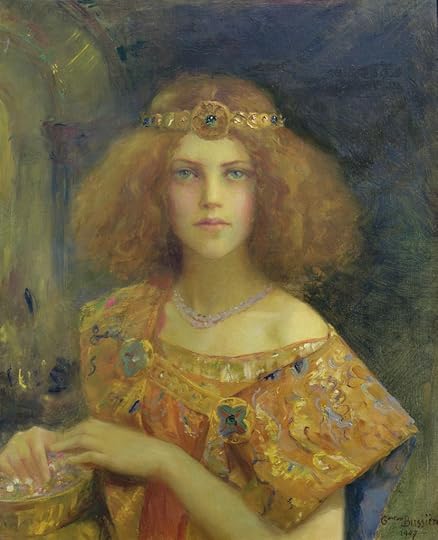
Während der ganzen Lektüre stellte ich mir die Frage, warum erzählt uns Flaubert das, warum tut er uns das an? Sicher hat das Setting mit dem Orientalismus zu tun, der zur Zeit der Veröffentlichung en vogue war. Mir scheint aber, dass Flaubert mit diesem Buch darstellen wollte, wie dünn die Schicht der Kultiviertheit ist und wie schnell sie in Barbarei umschlagen kann, wenn wir uns in existenziellen Nöten befinden. Er tut dies, indem er Gegensätze schildert, die sich aber nicht dialektisch auf einer höheren Eben verbinden, sondern in den Untergang führen. So für die titelgebende karthagische Patriziertochter Salambo und den Söldnerführer Matho. Aber auch die Liebe und Wasser spendende Mondgöttin Tanit unterliegt dem kinderfressenden Feuergott Baal-Moloch (die Vergötterung der Männlichkeit herrschte an diesem Tage in aller Herzen vor. Ja, die Göttin war … vergessen), die Erhabenheit unterliegt der Grausamkeit (Man fühlte das letzte Band zerrissen, das die Seelen an eine milde Gottheit fesselte.), der Gemeinsinn dem Gewinn- und Machtstreben, die (sexuelle) Reinheit der Verführung und Gewalt (Salambo, die nur Eunuchen gesehen hatte, ward von der Kraft dieses Mannes hingerissen), die Frömmigkeit der Raserei (Das Opfer durfte nicht nutzlos bleiben, … fühlten sich doch alle von jener Raserei ergriffen, die aus der Mitschild an unsühnbaren Verbrechen entsteht), die Liebe dem Tod.
Erst Dank meiner Mitleser habe ich den tieferen Sinn dieses Romans ansatzweise verstanden. Trotzdem hinterlässt er bei mir mehr Fragen als Antworten und einen bitteren Nachgeschmack. (3,5 Sterne).
Salammbô, Gemälde von Gaston Bussière, 1907

January 15, 2018
I had already read Salammbo a decade ago ... or more! I remembered it like a dream or a nightmare. And by rereading it, this story is a dream and a nightmare all at once.
The apparitions of Salammbo don’t seem real. Flaubert himself says in a letter to Sainte-Beuve, "I’m not sure of her reality; for neither I, nor you, nor any person, elder or modern, can know the Oriental woman, for the reason that it’s impossible to approach her, to go out with her. "
"Matho prowls like a crazy man around Carthage." Crazy is the right word. Wasn’t love conceived by the ancients as a madness, a curse, an illness, sent by the gods? Flaubert reminds us that Voltaire was already talking about the violence of passions in Africa, in his book Candide: "It's fire, vitriol ..."
You want to live this dream, this nightmare? Then immerse yourself in Flaubert's studied prose; relive this great story with him who has so conscientiously studied it. Flaubert, on the advice of his great friend Théophile Gautier, went as far as Carthage to visit, with his giant’s long legs, the places of his story, smell the spices, feel the heat of the wind and see the color of the stones of Carthage’s ruins.
Perhaps you will be a little lost among all these peoples speaking each one their own language: "One could hear, beside the heavy Dorian patois, resound the noisy Celtic syllables like battle tanks, and the Ionian words’ endings collided with the desert consonants, harsh as jackal cries."
Not being at all a connoisseur of the 3rd century BCE’s wars, I admit I was a little lost! But no matter: a traveler who doesn’t get lost a little, loses a little of the flavor of his trip. Not bad, that sentence, is it? It’s mine! 😊
I confess I have half read some bloody passages that would have made me have some nightmares, but maybe I'm a little too sensitive on this subject?
Never mind, if you think that I always give 5 stars, but ... it's Gustave, the great Flaubert!
The apparitions of Salammbo don’t seem real. Flaubert himself says in a letter to Sainte-Beuve, "I’m not sure of her reality; for neither I, nor you, nor any person, elder or modern, can know the Oriental woman, for the reason that it’s impossible to approach her, to go out with her. "
"Matho prowls like a crazy man around Carthage." Crazy is the right word. Wasn’t love conceived by the ancients as a madness, a curse, an illness, sent by the gods? Flaubert reminds us that Voltaire was already talking about the violence of passions in Africa, in his book Candide: "It's fire, vitriol ..."
You want to live this dream, this nightmare? Then immerse yourself in Flaubert's studied prose; relive this great story with him who has so conscientiously studied it. Flaubert, on the advice of his great friend Théophile Gautier, went as far as Carthage to visit, with his giant’s long legs, the places of his story, smell the spices, feel the heat of the wind and see the color of the stones of Carthage’s ruins.
Perhaps you will be a little lost among all these peoples speaking each one their own language: "One could hear, beside the heavy Dorian patois, resound the noisy Celtic syllables like battle tanks, and the Ionian words’ endings collided with the desert consonants, harsh as jackal cries."
Not being at all a connoisseur of the 3rd century BCE’s wars, I admit I was a little lost! But no matter: a traveler who doesn’t get lost a little, loses a little of the flavor of his trip. Not bad, that sentence, is it? It’s mine! 😊
I confess I have half read some bloody passages that would have made me have some nightmares, but maybe I'm a little too sensitive on this subject?
Never mind, if you think that I always give 5 stars, but ... it's Gustave, the great Flaubert!

Read
November 29, 2022Vrând-nevrând, am ajuns și eu la concluzia că toate drumurile duc la clasici. Ultima oară când am avut impresia asta, de preaplin literar, că tot ce urmează în materie de literatură e nivelat deja și nu se poate ceva mai complex, a fost la „Infernul” lui Dante.
Am citit multe romane istorice (e genul meu preferat), și dintre cele „mari”, și dintre cele comerciale, dar un roman atât de bine documentat rar mi-a fost dat să întâlnesc. Pentru a scrie „Salammbô” și a expune epoca în care se petrece (Cartagina și revolta mercenarilor de după Primul Război Punic), una dintre cele mai necunoscute ale istorice antice, Flaubert s-a dus să vadă ruinele Cartaginei, a citit istoriile lui Herodot, Pliniu, Xenofon, Polybius, Michelet, Eusebiu, Diodor, Amiannus Marcelinus și nenumărate alte tratate și studii din toate domeniile, de la geologie și arheologie, până la religie și rituri păgâne. (Iar asta în 1862, să nu uităm.) Rezultatul este pe măsura documentării, istorie vie.
Lectura n-a fost una ușoară (nici măcar cu adevărat plăcută), cel puțin pentru mine, a trebuit să cântăresc și să aranjez cantitatea de informație încontinuu, subiectul fiindu-mi complet necunoscut, iar între imagini a trebuit de multe ori să răsuflu adânc (are cam de toate, măceluri, carnagii, crucificări, torturi, sacrificii etc.). Dar asta n-o face nicidecum mai puțin impresionantă ca valoare. E un roman care trebuie citit; dacă nu pentru altceva, măcar pentru a ne lămuri cum stă treaba cu bazele literaturii moderne. Care baze nu se clatină deloc.
Am citit multe romane istorice (e genul meu preferat), și dintre cele „mari”, și dintre cele comerciale, dar un roman atât de bine documentat rar mi-a fost dat să întâlnesc. Pentru a scrie „Salammbô” și a expune epoca în care se petrece (Cartagina și revolta mercenarilor de după Primul Război Punic), una dintre cele mai necunoscute ale istorice antice, Flaubert s-a dus să vadă ruinele Cartaginei, a citit istoriile lui Herodot, Pliniu, Xenofon, Polybius, Michelet, Eusebiu, Diodor, Amiannus Marcelinus și nenumărate alte tratate și studii din toate domeniile, de la geologie și arheologie, până la religie și rituri păgâne. (Iar asta în 1862, să nu uităm.) Rezultatul este pe măsura documentării, istorie vie.
Lectura n-a fost una ușoară (nici măcar cu adevărat plăcută), cel puțin pentru mine, a trebuit să cântăresc și să aranjez cantitatea de informație încontinuu, subiectul fiindu-mi complet necunoscut, iar între imagini a trebuit de multe ori să răsuflu adânc (are cam de toate, măceluri, carnagii, crucificări, torturi, sacrificii etc.). Dar asta n-o face nicidecum mai puțin impresionantă ca valoare. E un roman care trebuie citit; dacă nu pentru altceva, măcar pentru a ne lămuri cum stă treaba cu bazele literaturii moderne. Care baze nu se clatină deloc.
July 2, 2025
What kind of orgiastic, orgasmic writing is this? Wtf was Flaubert on - cocaine? This was staggering. I have been reading this slowly for the past month and I had the compulsion to finish it this morning, having waded through the scrupulous details of blood-soaked war, conspiracies, feminine mysteries, depraved obsessions, infernal rituals and splendent landscapes. This really was a literary orgy. Gustave, I love you so much, I wanna eat you. This is not the same Flaubert who wrote Madame Bovary. Rather the conflicted Flaubert, who wrote the hallucinogenic epic The Temptation of St. Anthony. The man who understands the fundamental (vexing) misalignment of both romance and history in Sentimental Education. Probably not for everyone tho. Definitely my kind of thing.
Flaubert’s Carthage embodies every trope of Europe’s imagined East: opulent yet decaying, steeped in sensual excess, cruelty, and arcane rites. His Carthaginians mirror the Old Testament’s depiction of the Canaanites: a people defined by their moral corruption, idolatry, and even child sacrifices to Baal. Flaubert deliberately draws this parallel, presenting Carthage as a Phoenician successor state, a decadent empire where Canaanite religious practices persist on a grand, imperial scale.
Central to the novel, as in much Orientalist literature, is the gendered dichotomy between masculine and feminine forces. The East is rendered as a realm of feminine mystique: seductive, enigmatic, and dangerously unstable. This tension culminates in the theft of the sacred veil of Tanit, the lunar goddess whose cult is intertwined with Carthage’s fate. Salammbô, Hamilcar’s daughter, becomes a living avatar of Tanit, while her barbarian suitor, Matho, embodies the brutal solar deity Moloch. Matho’s act of stealing the veil is more than sacrilege; it is a violation of the feminine mysterium, an attempt to strip away the illusion that veils THE terrifying void of existence. It's the struggle between the masculine and the feminine orders.
I love this novel <3
Flaubert’s Carthage embodies every trope of Europe’s imagined East: opulent yet decaying, steeped in sensual excess, cruelty, and arcane rites. His Carthaginians mirror the Old Testament’s depiction of the Canaanites: a people defined by their moral corruption, idolatry, and even child sacrifices to Baal. Flaubert deliberately draws this parallel, presenting Carthage as a Phoenician successor state, a decadent empire where Canaanite religious practices persist on a grand, imperial scale.
Central to the novel, as in much Orientalist literature, is the gendered dichotomy between masculine and feminine forces. The East is rendered as a realm of feminine mystique: seductive, enigmatic, and dangerously unstable. This tension culminates in the theft of the sacred veil of Tanit, the lunar goddess whose cult is intertwined with Carthage’s fate. Salammbô, Hamilcar’s daughter, becomes a living avatar of Tanit, while her barbarian suitor, Matho, embodies the brutal solar deity Moloch. Matho’s act of stealing the veil is more than sacrilege; it is a violation of the feminine mysterium, an attempt to strip away the illusion that veils THE terrifying void of existence. It's the struggle between the masculine and the feminine orders.
I love this novel <3

Read
April 7, 2021Not much to say about the story except that, of course, she has to have a pet snake. Like she can't be a femme fatale without it. And, of course, artists got off on this scene *huge eye roll*


May 26, 2014
Many GR members having noted with approval the lust and kinky sex in this novel set during the era of the Punic Wars praised Salammbô as an excellent novel of the Decadent school. As decadence it did not thrill me as the two main protagonists were dull beyond belief. Nonentheless, I still think that Salammbô is worth reading for anyone determined to investigate the Flaubert catalog thoroughly.
By chance I read the novel within a month of having finished the "Histories" of Polybius which Flaubert identified as his principal source. Polybius argued that Rome defeated Carthage in the Punic Wars for three reasons: (1) The Romans had a citizen rather than a mercenary army; (2) the Romans had superior political institutions; and (3) the Romans were a more virtuous people. Flaubert's novel certainly supports the thesis of Polybius. Salammbô is well worth reading for anyone likes to learn about history through literature rather than true historical writing.
By chance I read the novel within a month of having finished the "Histories" of Polybius which Flaubert identified as his principal source. Polybius argued that Rome defeated Carthage in the Punic Wars for three reasons: (1) The Romans had a citizen rather than a mercenary army; (2) the Romans had superior political institutions; and (3) the Romans were a more virtuous people. Flaubert's novel certainly supports the thesis of Polybius. Salammbô is well worth reading for anyone likes to learn about history through literature rather than true historical writing.

July 10, 2018
به نام او
این دومین اثری بود که از گوستاو فلوبر خواندم. بعد از مادام بوواری
فلوبر از نویسندگان مورد علاقه من نیست، ولی نمیتوانم از قدرت داستان نویسیش دم نزنم هم مادام بوواری و هم سالامبو نشان میدهد که با این نویسنده بزرگ و ساختارگرا طرف هستیم که برای سطر به سطر داستانش برنامه دارد. شاید یکی از چیزهایی هم که سبب می شود که من فلوبر را آنچنان دوست نداشته باشم همین ساختارگرایی تا حدودی افراطی ست. به عبارتی کم پیش میآید در این دو رمان نشانه هایی ازشکوفایی نبوغ نویسنده ببینیم اگر نبوغی هم باشد کنترل شده و کانال بندی شده است. به هر رو خواندن آثار فلوبر بسیار آموزنده و راهگشاست و حداقل به کسانی که دست به قلم هستند توصیه می شود. نکته دیگری که در مورد سالامبو می توانم بگویم ترجمه این اثر یک شاهکار ادبی ست برای ارتقا زبان فارسیتان هم که شده این کتاب را بخوانید.
این دومین اثری بود که از گوستاو فلوبر خواندم. بعد از مادام بوواری
فلوبر از نویسندگان مورد علاقه من نیست، ولی نمیتوانم از قدرت داستان نویسیش دم نزنم هم مادام بوواری و هم سالامبو نشان میدهد که با این نویسنده بزرگ و ساختارگرا طرف هستیم که برای سطر به سطر داستانش برنامه دارد. شاید یکی از چیزهایی هم که سبب می شود که من فلوبر را آنچنان دوست نداشته باشم همین ساختارگرایی تا حدودی افراطی ست. به عبارتی کم پیش میآید در این دو رمان نشانه هایی ازشکوفایی نبوغ نویسنده ببینیم اگر نبوغی هم باشد کنترل شده و کانال بندی شده است. به هر رو خواندن آثار فلوبر بسیار آموزنده و راهگشاست و حداقل به کسانی که دست به قلم هستند توصیه می شود. نکته دیگری که در مورد سالامبو می توانم بگویم ترجمه این اثر یک شاهکار ادبی ست برای ارتقا زبان فارسیتان هم که شده این کتاب را بخوانید.

June 7, 2017
Matching Soundtrack / Musique au kiosque :
Samson et Dalila, Bacchanale - Camille Saint-Saëns.
Samson et Dalila, Bacchanale - Camille Saint-Saëns.

November 19, 2024
“Al diablo la arqueología”, decía Flaubert sobre esta novela. Su pretensión de ficción arrollaba no solo esta ciencia sino la propia Historia, según algunos críticos de la época. Pero Flaubert no estaba ahí, él ya había pasado la barrera del tiempo y quería dejar su propio tiempo (1862), al que consideraba deplorable, para sumergirse en el pasado a través de la antigua Cartago y la Primera Guerra Púnica, específicamente la guerra de los Mercenarios, quienes se sublevaron contra Cartago por no haber recibido el pago prometido. Pero su prosa abundante y a veces hasta cruda podría llevarle a ser, en realidad, un adelantado a su tiempo.
Y es que esta “novela” fue considerada un fracaso en su tiempo. Flaubert venía ya de una polémica con Madame Bovary, y parecería, por lo que dicen las cartas y réplicas incluidas en este volumen, que debía dedicarse a defender su obra con extensas explicaciones de su fidelidad e infidelidad histórica en esta obra a la que se le acusaba de no ser una novela o, menos aún, una novela histórica. Lo cierto es que al leerla con ojos actuales, nada de esos grandes detalles importa, pues lo que realmente sobresale de Salambó es su estilo. Un estilo que sería el opuesto total a Madame Bovary, lleno de pomposidad, a veces rimbombacia, excesivo, altamente descriptivo y exquisito. Y eso también se le reprochó, pero en la Francia del siglo XIX. Hoy podemos leer esta obra sin ver en realidad ninguna petulancia, y entenderla como una ficción con base histórica (no en vano Flaubert se dedicó cinco años a investigar sus fuentes, sobre todo Polibio) que introduce un ritmo innovador en el relato histórico y novelado. Este ritmo que parecería ralentizar la acción, en realidad es el motor de la acción, que está revestido de imágenes salidas de un imaginario literario-histórico documental, el cual el autor toma de los autores e historiadores clásicos griegos y latinos, pero que los hace pasar por el filtro de su propia imaginación.
Y es así como se construye Salambó. Casi a partir de una anécdota histórica que es atravesada por la ficción en forma de una historia de amor. Amor trunco. Vencedores y vencidos. Salambó es la hija (ficticia) de Amílcar (líder cartaginés), de quien Mato (líder de los mercenarios) se enamora y ella, al parecer también le corresponde. Pero todo esto en medio del barullo producido por la inminente guerra y el despliegue extravagante de los ejércitos y soldados (incluidos camellos, elefantes y caballos) y la verdadera carnicería que se desata, la cual es descrita con puntillosidad por Flaubert, misma que contiene imágenes casi parecidas a las de una película de terror actual, o de body horror. El robo del velo de Tanit (la diosa protectora de Cartago) por parte de Mato, desatará una empresa paralela a la guerra. Finalmente, la diosa del velo robado decidirá el destino de los protagonistas.
Una novela con una prosa finamente trabajada (no en vano Flaubert quería morir y luego vivir mientras la escribía), deslumbrante, que quizás no ha sido valorada en su real dimensión (no lo fue en su tiempo, aunque ahora ha crecido en valor). La he leído por ser una de las inspiraciones de Cârtârescu para escribir su novela Theodoros, lo cual es evidente al leerla, pues las descripciones de las batallas, la prosa y el ritmo en sí tienen mucho que ver, aunque, como con todas sus influencias, Cârtârescu toma una parte de este estilo y lo amplía y combina con su propia pluma. Exactamente lo mismo que hizo Flaubert con todas sus influencias greco-latinas. Y así es como crece la literatura.
Y es que esta “novela” fue considerada un fracaso en su tiempo. Flaubert venía ya de una polémica con Madame Bovary, y parecería, por lo que dicen las cartas y réplicas incluidas en este volumen, que debía dedicarse a defender su obra con extensas explicaciones de su fidelidad e infidelidad histórica en esta obra a la que se le acusaba de no ser una novela o, menos aún, una novela histórica. Lo cierto es que al leerla con ojos actuales, nada de esos grandes detalles importa, pues lo que realmente sobresale de Salambó es su estilo. Un estilo que sería el opuesto total a Madame Bovary, lleno de pomposidad, a veces rimbombacia, excesivo, altamente descriptivo y exquisito. Y eso también se le reprochó, pero en la Francia del siglo XIX. Hoy podemos leer esta obra sin ver en realidad ninguna petulancia, y entenderla como una ficción con base histórica (no en vano Flaubert se dedicó cinco años a investigar sus fuentes, sobre todo Polibio) que introduce un ritmo innovador en el relato histórico y novelado. Este ritmo que parecería ralentizar la acción, en realidad es el motor de la acción, que está revestido de imágenes salidas de un imaginario literario-histórico documental, el cual el autor toma de los autores e historiadores clásicos griegos y latinos, pero que los hace pasar por el filtro de su propia imaginación.
Y es así como se construye Salambó. Casi a partir de una anécdota histórica que es atravesada por la ficción en forma de una historia de amor. Amor trunco. Vencedores y vencidos. Salambó es la hija (ficticia) de Amílcar (líder cartaginés), de quien Mato (líder de los mercenarios) se enamora y ella, al parecer también le corresponde. Pero todo esto en medio del barullo producido por la inminente guerra y el despliegue extravagante de los ejércitos y soldados (incluidos camellos, elefantes y caballos) y la verdadera carnicería que se desata, la cual es descrita con puntillosidad por Flaubert, misma que contiene imágenes casi parecidas a las de una película de terror actual, o de body horror. El robo del velo de Tanit (la diosa protectora de Cartago) por parte de Mato, desatará una empresa paralela a la guerra. Finalmente, la diosa del velo robado decidirá el destino de los protagonistas.
Una novela con una prosa finamente trabajada (no en vano Flaubert quería morir y luego vivir mientras la escribía), deslumbrante, que quizás no ha sido valorada en su real dimensión (no lo fue en su tiempo, aunque ahora ha crecido en valor). La he leído por ser una de las inspiraciones de Cârtârescu para escribir su novela Theodoros, lo cual es evidente al leerla, pues las descripciones de las batallas, la prosa y el ritmo en sí tienen mucho que ver, aunque, como con todas sus influencias, Cârtârescu toma una parte de este estilo y lo amplía y combina con su propia pluma. Exactamente lo mismo que hizo Flaubert con todas sus influencias greco-latinas. Y así es como crece la literatura.

September 14, 2017
George Steiner brought me here που λέμε και στο χωριό, όταν αναλύοντας το φαντασιακό του 19ου αιώνα στη Δύση ανέφερε την Σαλαμπώ ως παράδειγμα της φρίκης και του θανάτου που λάνθανε κάτω από την ευμάρεια και την αισιοδοξία που τα τεχνολογικά επιτεύγματα έφεραν στον ευρωπαϊκό χώρο εκείνη τη περίοδο.
Και πράγματι το αίμα ρέει άφθονο σε αυτό το ιστορικό μυθιστόρημα του Φλωμπέρ, προϊόν κοπιώδους μελέτης και συγγραφής. Στρατιωτικοί ελιγμοί, φονικές μάχες, δολοπλοκίες και στο βάθος ένας τραγικός έρωτας συνθέτουν το πλαίσιο του βιβλίου με τη γραφή του Φλωμπέρ να κάνει την αφήγηση κινηματογραφική.
Ο Μαρτιν πρέπει να το χει διαβάσει και 10 φορές :)
Και πράγματι το αίμα ρέει άφθονο σε αυτό το ιστορικό μυθιστόρημα του Φλωμπέρ, προϊόν κοπιώδους μελέτης και συγγραφής. Στρατιωτικοί ελιγμοί, φονικές μάχες, δολοπλοκίες και στο βάθος ένας τραγικός έρωτας συνθέτουν το πλαίσιο του βιβλίου με τη γραφή του Φλωμπέρ να κάνει την αφήγηση κινηματογραφική.
Ο Μαρτιν πρέπει να το χει διαβάσει και 10 φορές :)

January 28, 2025
Ich wusste lange nicht, was ich von diesem Buch halten sollte. War es ein historischer Roman? Ein Abenteuerroman? Fantasy? Auf jeden Fall nicht ganz das, was ich vom Autor der Madame Bovary erwartet hatte.
Jetzt, nachdem ich zuende gelesen habe, bin ich begeistert, denn neben den genannten Qualitäten des Romans, handelt es sich für mich vielleicht vor allem um einen Antikriegsroman.
Die überbordende Pracht der beschriebenen Paläste, der unmäßige Reichtum der Herrschenden werden ebenso sprachmächtig dargestellt wie die Brutalität des Krieges, das Grauen auf den Schlachtfeldern, das Leiden der Menschen und Tiere.
Mit diesem Wissen werde ich den Roman bald noch einmal lesen.
Jetzt, nachdem ich zuende gelesen habe, bin ich begeistert, denn neben den genannten Qualitäten des Romans, handelt es sich für mich vielleicht vor allem um einen Antikriegsroman.
Die überbordende Pracht der beschriebenen Paläste, der unmäßige Reichtum der Herrschenden werden ebenso sprachmächtig dargestellt wie die Brutalität des Krieges, das Grauen auf den Schlachtfeldern, das Leiden der Menschen und Tiere.
Mit diesem Wissen werde ich den Roman bald noch einmal lesen.

March 6, 2020
Historical exoticism at its finest, and that’s definitely not my bag. A book so richly descriptive and detailed you want to eat the damn thing. What could be bad about that?

September 8, 2017
"Talented, brilliant, incredible, amazing, show-stopping, spectacular, never the same, totally unique, completely not ever been done before, unafraid to reference or not reference, put it in a blender, shit on it, vomit on it, eat it. give birth to it."

September 27, 2012
Salambò è stata una sorpresa per me, lettrice affezionata di Flaubert. Il romanzo si discosta totalmente dalle altre opere da lui scritte per contenuti e toni. Si tratta di un romanzo epico, in cui sono narrate le gesta belliche tra i Cartaginesi, guidati dall’astuto genio militare di Amilcare Barca, e i Barbari, guerrieri mercenari provenienti dalle più svariate parti del mondo allora conosciuto, dai Greci ai Galli, dai Lusitani ai Libici, privi di un’organizzazione militare stabile ma coraggiosi e temerari lottatori guidati dal colosso libico Matho. Mentre leggevo ho sempre avuto la sensazione di trovarmi di fronte a un kolossal, con scene grandiose di accampamenti di soldati che tengono sotto assedio le città della costa nordafricana, battaglie in pianure sterminate con duelli corpo a corpo tra guerrieri risolti all’ultimo dall’uso dei mastodontici elefanti trasformati in macchine da guerra, che distruggono ciò che incontrano sul cammino, il tutto descritto con un’attenzione quasi morbosa per i particolari macabri: il sangue scorre a fiumi e tinge ovunque gli uomini, la terra ed il mare. In ogni capitolo, come in una serie di quadri, ci sono scene truculente in cui viene sottolineata la crudeltà ferina che uomini dimostrano contro altri esseri umani, in un mondo cruento dove domina la violenza. Sullo sfondo una storia d’amore in nuce, un amore impossibile quello tra Matho e Salambò, figlia di Amilcare Barca, sensuale e bellissima fanciulla i cui sensi vengono risvegliati dall’incontro con il libico, un tocco di dolcezza e passione nel mondo bestiale che gli fa da cornice.
Il tutto descritto da Flaubert, quale osservatore esterno, quasi come un archeologo che riporti in vita da un lontanissimo passato scene di vita, con la solita dovizia di dettagli: arredi ed abiti sontuosi sono descritti con ricchezza di colori, suoni e profumi riempiono di esotismo gli ambienti.
Un romanzo storico, che va oltre la ricostruzione d’epoca, pone l’uomo di fronte agli oscuri sotterranei della crudeltà e della violenza, aprendo la strada agli studi psicoanalitici del secolo successivo.
Il tutto descritto da Flaubert, quale osservatore esterno, quasi come un archeologo che riporti in vita da un lontanissimo passato scene di vita, con la solita dovizia di dettagli: arredi ed abiti sontuosi sono descritti con ricchezza di colori, suoni e profumi riempiono di esotismo gli ambienti.
Un romanzo storico, che va oltre la ricostruzione d’epoca, pone l’uomo di fronte agli oscuri sotterranei della crudeltà e della violenza, aprendo la strada agli studi psicoanalitici del secolo successivo.

April 27, 2023
After reading Madame Bovary I didn't expect this at all. It actually feels like a modern fantasy novel full of striking imagery of a decadent culture and outrageous battles.
Displaying 1 - 30 of 630 reviews