Jump to ratings and reviews
Rate this book

The Twelfth Enchantment

Rate this book
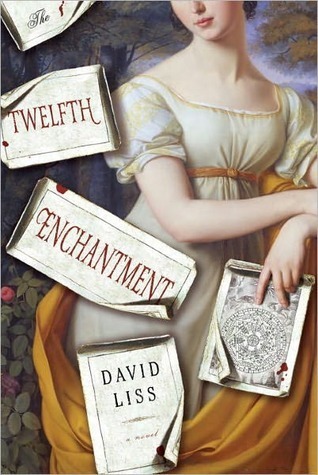
Lucy Derrick is a young woman of good breeding and poor finances. After the death of her beloved father, she becomes the unwanted boarder of her tyrannical uncle, fending off marriage to a local mill owner. But just as she is resigned to a life of misery, a handsome stranger—the poet and notorious rake Lord Byron—arrives at her house, stricken by what seems to be a curse, and with a cryptic message for Lucy.   With England on the cusp of revolution, Lucy inexplicably finds herself awakened to a world where magic and mortals collide, and the forces of ancient nature and modern progress are at war for the soul of England . . . and the world. The key to victory may be connected to a cryptic volume whose powers of enchantment are unbounded. Now, challenged by ruthless enemies with ancient powers at their command, Lucy must harness newfound mystical skills to preserve humanity’s future. And enthralled by two exceptional men with designs on her heart, she must master her own desires to claim the destiny she deserves.   Look for special features inside. Join the Circle for author chats and more.

417 pages, Kindle Edition

First published August 9, 2011

159 people are currently reading
3120 people want to read

About the author

David Liss

148 books1,258 followers
I am the author of thirteen novels, most recently The Peculiarities, a historical fantasy out in September 2021. I've also written numerous novellas and short stories. My previous books include A Conspiracy of Paper which was named a New York Times Notable Book and won the 2001 Barry, MacAvity and Edgar awards for Best First novel. The Coffee Trader was also named a New York Times Notable Book and was selected by the New York Public Library as one of the year’s 25 Books to Remember. Several of these books are currently being developed for television or film. I have also worked on numerous comics projects, including Black Panther and Mystery Men for Marvel, The Spider and Green Hornet for Dynamite, and Angelica Tomorrow.

Ratings & Reviews

What do you think?
Rate this book

Friends & Following

Create a free account to discover what your friends think of this book!

Community Reviews

5 stars
451 (15%)
4 stars
1,105 (37%)
3 stars
958 (32%)
2 stars
388 (12%)
1 star
84 (2%)
Displaying 1 - 30 of 506 reviews
Profile Image for karen.
4,012 reviews172k followers
June 15, 2020
lemme crank this out before the hurricane steals all my power!

elizabeth already took care of all the austen allusions in this book - which is good of her, because i sure didn't get any of them. austen ladies - someday i will understand you, i promise! but i am here to mostly focus on the byron stuff, cuz that's what i do.

i always thought that david liss was a veryserious author, and the men (almost exclusively men) asking for his books always looked veryserious, so this rather lightweight tale of magic and fairies set against the backdrop of the luddite revolt was unexpected. there was so much more rhapsodizing over male beauty and descriptions of dresses than i was expecting. it's kind of a ditzy story. if i had to hear one more time how "beautiful" byron was... the only thing i can think is that david liss heard about this paranormal romance craze, several years too late, and wanted in. so he read that twilight book, have you heard of it??, and thought that in order to write a successful PR, you had to use the word "beautiful" a certain number of times on every page, so the book could be turned into a drinking game if necessary.

i'm not sure why he decided that byron would be a good fit in his novel about spells and witchery, and after reading it, i'm not convinced that this was byron. this was just some dude with the same name. yes, byron gave a speech supporting the luddites. no, byron was not in the practice of kidnapping girls in order to have at them. this is the second book to attribute such a deed to him. byron's legacy is not that he was a criminal, but that his lachrymose beauty was so seductive that he could engage in a lot of very consensual intercourse, oftentimes initiated by the women. so what's with all the kidnapping, i ask you, david liss and stephanie barron??

and boof - even a facility for magic could not make this protagonist interesting to me. despite all her supposed power, she remains pretty wide-eyed and small-goaled. i like my witches fierce and grand. but no matter. it's a cute little story, but i began to have little patience with the magic and the half-baked protagonist.

(and the less said about mrs emmett, the better...)

this is not the kind of thing i have a timeline-memory for, but i'm not entirely certain that byron's menagerie was pre-childe harold. i don't know for sure, but it is more likely that those animals came with the territory of fame-syndrome. the way he is written here, he is more like tucker max. similar situation, but much less articulate than he actually was.

i think i just don't understand this byron in this book. is liss implying that magic had something to do with his success? because, yes, he became a total celebrity after child harold, but even though his rise was fast, it was not literally overnight. this is a pre-internet world, after all. my understanding is that the opportunities for carousing and living the rock star lifestyle complete with a full-on menagerie came after the publication of c.h., but here everyone already seems to know all about him and his predilections and his reputation. oh yeah, and that he is "beautiful." and has black hair. sigh.

but no worries, byron as byron seemed to get dropped pretty quickly, and after that, it was all caricature, no charisma. making lewd comments as he pissed into a chamberpot. i mean, not that he wouldn't have done that necessarily, but if that's your most authentic byronic gesture, you gotta try again, really.

why do people think it is cute to involve historical personages in their paranormal romances? to show that they are weightier than the average meyer? to show that research was done? but i am telling you - there is nothing in the doris langley moore book about byron, bewitched, vomiting up a shower of straight pins.

not even in the appendix.

so i read this because elizabeth thought it would be fun to read together even though she REFUSED to read jane and the madness of lord byron with me, which is probably for the best because it was not very good, but the world missed out on a potentially GOLDEN elizabeth rant-review. hélas...

but - elizabeth!! you have the opportunity to make it up to all of us and read jane bites back with me because i have just learned that it is ANOTHER book with both byron and jane austen! AND THEY ARE VAMPIRES

please please please!!

now i gotta go fill up my bathtub with water. or champagne...

come to my blog!
Profile Image for Deborah Harkness.
Author 39 books34.2k followers
June 14, 2011
A wonderful book. Highly recommended to fans of Jane Austen, as well as fans of Jonathan Strange.
Profile Image for C.W..
Author 18 books2,504 followers
March 11, 2017
David Liss has written some amazing novels about intrigue and machinations in historical eras, featuring men trying to salvage their honor and/or make a fast buck off the suffering of others. In "The Twelfth Enchantment", he employs a different tactic: a female lead, Lucy Derrick, who finds herself plunged into a mysterious world of magic and evil in Regency England.

The premise is undoubtedly enticing. Built on a foundation of the Jane Austen-heroine-with-nothing, Lucy is penniless, orphaned, estranged from her sole surviving sister, and living under a shadow of discontent with a distant and rather unpleasant relative. Then the unexpected arrival of a disheveled, spell-bound Lord Byron - yes, he of the rake's reputation and sublime poetics - upends her existence. Something innate in her helps ease Byron of his curse and spurs his pursuit of her, but Lucy is the unfortunate victim of a prior scandalous indiscretion and has the wherewithal to resist Byron's feral advances, even as she yearns for them. Shortly thereafter, she embarks on a harrowing journey to reveal the purpose behind bizarre visions that oblige her to search for a missing magical text, after she's befriended by an ethereal woman who is more than she appears.

Liss keeps his tale firmly rooted in Regency morality, which adds to Lucy's dilemma as she cannot venture out without a chaperone and has no money to speak of. And the magical elements of the story are deftly done, drawing the reader into a strange nether world where Lucy holds the key to thwarting a nefarious plot. That said, the Regency scenario also hamstrings Lucy, as she struggles with her startling capacity to perform magic while fretting over her tattered reputation and non-existent means. Once the story gains momentum and Lucy is fighting off supernatural beings, we start to hope she'll toss aside her penchant for propriety like she does her makeshift spells. Alas, she does not - and she does herself no favors for it.

The enjoyment in this novel stems in great part from the writing, which spurs the reader to discover who is responsible for overturning the natural order, and how Lucy will overcome it. The trouble is its unevenness. We never understand WHY Lucy can do what she does and neither does she; it's somewhat implied, but never explained. Lucy herself doesn't express any interest in deciphering her remarkable gift, though she proves an ardent student of mastering it. Still, a girl of no particular merits, as she describes herself, suddenly finding herself able to cast spells and do battle with an assortment of creepy-crawlies should give her a moment of pause. To her credit, Lucy rises to the challenges, but we, the reader, are left scratching our heads.

Liss's powers of description and his own magical ability to capture a bygone era are, as always, in top form. Though this foray into the supernatural isn't as strong as his previous novels, it is an interesting departure worth the effort, as long as we don't ask too many questions.
Profile Image for Wealhtheow.
2,465 reviews606 followers
September 24, 2012
This was an interesting--and unexpected--twist on Pride&Prejudice. Before the book even begins, the character based on Elizabeth dies, leaving her father and sisters at a loss. The Jane analog is thus coerced into marriage to pseudo Mr.Collins, and the Lydia analog's reputation is ruined when she runs off with the pseudo Wickham. Years later, Lydia--named Lucy Derrick here--is living a miserable existance as an unwanted poor relation. The only bright spot is her new friend Mary Crawford, a beautiful widow. But just before she can accept a despicable man's proposal of marriage, Mary shows her how to do magic. Lucy takes to magic like a duck to water, and soon discovers that her relatives' deaths and her own unhappy circumstances are the result of a far-stretching and mysterious magical conspiracy.

The effects of the industrial revolution are shown in harrowing detail--there's no flinching away from poverty and ecological damage in this book. Different fey factions seek to halt or accelerate the spread of industry across England, and it is this conflict that only Lucy can stop.

Lucy is a marvelous character. Lydia's flirtatious and giddy personality is still there, but years of hard life have damped down her natural unthinking reactions and made her warier of trusting new acquaintances. She takes Society's rules seriously, but knows how to work around them to some extent. And she has grown wonderfully clever: she's always trying to arrange contingency plans and prepare for any eventuality. The book really shows us, rather than tells, her personality.

Mary Crawford is another wonderful creation. After her unfortunate brush with the denizens of Mansfield Park, she married, started having adventures, and became hard as nails. Her old friend, and Lucy's erstwhile admirer, Mr. Morrison, is the weakest part of the book by far.

The fairies are creepy, the magic feels not-quite-understandable, and the plot builds to a satisfying crescendo. The only flaw was the romance, which didn't feel believable, but all else was very enjoyable indeed.
Profile Image for Jo Anne B.
235 reviews17 followers
August 31, 2011
This was a big let down. I recently read "The Conspiracy of Paper" by David Liss and loved it. I was really looking forward to this book but for some reason as soon as I started reading it, I knew it was not going to be good. The writing was juvenile, bland and unpoetic for this time period piece, unlike in his former book. The only thing this book has in common with his other work is that both stories involve searching for missing papers. Others have compared this to Jane Austen and that could not be farther from the truth. Her writing was so far superior to this that just using their names in the same sentence is an insult to her legacy.

It began all wrong for me. I do not like the name Lucy so I could never get into the main character. I never liked nor cared for her. There was no depth to her at all. She didn't come across as intelligent, witty, independent minded, goal oriented, or particularly attractive. It baffles me that the men in this story were so drawn to her. What was the attraction? Poor writing ruined any chance for romance. The stage was never set for it. The author was too straight forward and gave us nothing for our imagination to draw from. 

Then there was the magic. It was just plopped onto our laps as if it was always there. When magic isn't magical, what is it? Boring and not believeable. It didn't work. There was some intrigue when Lord Byron showed up at Lucy's Uncle's house and told her not to marry Mr. Olson before he passed out. But I didn't care about Lucy, so it was hard to care about this premonition. Then the witch Mary Crawford should have been a promising character but because of the lack of interesting writing, it is hard to write interesting characters. The magic was thrown at us and we are to beliebe Lucy acquires all these magical powers by teaching herself while reading a book. It just wasn't believeable. Just like the whole story line and plot were not believeable. The Luddites came across as a pro-union group rather than avengers against the undead. Even the undead were a let down. They were supposed to be powerful, like Lady Harriet, but the fight scenes were anticlimatic and seemed to be over rather quickly. There really wasn't anything to get your heart pounding or your mind racing about who was going to win. 

It is unfortunate that I disliked this book. Lucy may have found the twelve pages that completed the book of magic, but I sure didn't. 
Profile Image for Mo.
1,885 reviews189 followers
March 22, 2015
Part ‘Pride & Prejudice’, part ‘Dracula’, part ‘Harry Potter’… mostly rubbish.
Profile Image for Emily.
687 reviews688 followers
September 6, 2014
This book is a little disappointing on its own merits, but considering it's by the excellent David Liss, it's quite disappointing indeed. (And I notice that many of the readers who are giving it positive reviews aren't readers of his earlier work.)
"There are forces in motion. Dangerous forces. Chief among these are what people are apt to call fairies or elves. Do not laugh, for this is serious." (154)
This advice is difficult for a fan of Liss's previous work: bloodily concrete adventures of men of the middling sort, full of mutton, snuff, fistfights, dodgy inns, bad weather, smudged ledgers, inaccurate firearms, and deceit. In fact, in reviewing one of his previous books, I specifically said I liked it because it differed from the mass of historical fiction that take place in the woman's sphere of drawing rooms and enclosed carriages. It's disappointing to see him turn to the overdone Regency period--and to the supernatural--and he doesn't pull it off.

The book is a weird pastiche of near-quotes and borrowed situations from Jane Austen, the "Old Ones" from the Grey King, nasty Dickensian servants, and a rush to collect magical artifacts from around the countryside like in the last Harry Potter book. The story takes a dull while to get going and the only reason I'm giving it three stars instead of two is that the denouement is somewhat exciting and scary, especially a revelation about one character's past.

At the kernel of the story is something interesting about the natural world vs. the city, innocence and experience, and the heritage of the English. But this is like a faint ember that the author is blowing on, trying to coax it into life, instead of a rollicking blaze of ideas. The plot relies on the fact that a rather unpromising young girl has extraordinary supernatural talents (for some reason) and is the only one who can defuse a looming showdown between murderous fairy versions of Tories and Labour.

There are touches here that are the missteps of a much weaker writer than Liss. For example, he lazily casts Byron in his story rather than think up his own rakish character. (William Blake's appearance is more worthwhile.) And he constantly uses the words "slut" and "whore" in stilted, unconvincing ways that remind me of dialogue written by authors with a tin ear for history, who come up with one phrase that sounds good to them and reuse it over and over. The exuberantly detailed scenery of his previous books becomes here a wan series of country-house moments marred by mistakes like Lucy putting on a "muslin pelisse" (a pelisse being a fur or fur-trimmed cloak). Truly, if his name were not on the cover, I would not dream he could have written this, because everything he gets right in his other books is wrong here.


Edited later to add: If this book seems like a promising concept, maybe you want the Temeraire or Glamourist series.
Profile Image for Joe.
164 reviews
December 4, 2012
avid Liss has been one of my favourite contemporary writers since I discovered his debut novel, A Conspiracy of Paper in 2000.

I was surprised that his latest book, released last year, The Twelfth Enchantment (Random House,) fell under my radar.

But after I read it, my surprise turned to disappointment.

Whether it’s the early days of the London Stock Exchange, the 1722 general election in England, or even the formation of the National Bank in America, most of Liss’ novels tend to be historical mysteries and thrillers set against the background of real historical events and frequently involving the Jewish “thief-taker” Benjamin Weaver.

In this book, set against the backdrop of the Luddite uprising and the Industrial Revolution, Lucy, a young woman, whose parents both died, is sent to her uncle’s house to await her impending forced marriage to a dour mill owner named Olson.

But when Lord Byron, (yes, that Lord Byron) shows up outside the house vomiting pins and muttering something about “picking up the leaves,” the novel takes a surreal turn into fantasy literature.

Lucy soon discovers that she has the power to learn and cast spells and, with the help of a new friend, Mary Crawford, Lucy crafts her knowledge of the occult.

We are painfully rushed toward a climax that has more spells and counter spells than a Harry Potter book.
This is a huge – and ambitious – departure for Liss, and while I might enjoy historical fiction with a supernatural touch (I highly recommend Dan Simmons’ Drood), unfortunately, this isn’t what I’ve come to expect from him and was left, ultimately, disappointed.
Profile Image for Anne.
147 reviews
September 26, 2011
This book could have been wonderful, should have been wonderful, but wasn't. I bought it on the recommendation of Deborah Harkness, whose book I loved. I wanted to love this. I liked the characters and the author's style of writing, but the magic part of this story did not work for me: so sad. I will read other books by David Liss and hope for more.
Profile Image for Matthew.
185 reviews4 followers
September 14, 2011
I would probably give this a 2 1/2 stars. It had some interesting ideas in it and the setting had some potential, but the writing was really, really bad. I was shocked to find out this author had multiple books under his belt, as well as an award, because his writing was almost amateurish.

First off, the historical elements of the book never seem natural. It always feels like he's including stuff just because he read about it in a book, as opposed to using those elements to create a realistic setting like more proficient authors do. And then there's the "I think my reader is a moron"-ness of the whole thing. He's constantly restating plot points and summing things up, just in case we missed it the first seven times. His characters are forced and he uses a number of methods to artificially create tension where none exists on its own (this particularly bothered me).

As I said, I felt some of the ideas were interesting. I wish they had fallen into the hands of a more proficient author.
Profile Image for AdiTurbo.
834 reviews99 followers
December 31, 2017
Fabulous read, with supernatural elements but far from silly and sensational. This is another brilliant piece of writing from the author who has become one of my top favorites, which is a real page turner while never losing psychological depth and scope of imaginative world-building. I have read many other novels by this author, all of which were superb historical fictions with no supernatural sides to them. This one threw me a bit at first, but by the time I was done I was willing to read anything this guy will ever write, even if it is the phone book.
Profile Image for Diane S ☔.
4,901 reviews14.6k followers
September 14, 2011
3.5 Set in the regency period Lucy has been defrauded of the money left to her by her father and is at the mercy of her uncle. Enter Lord Byron, Shelly, Beau Brummel, magic, the Rosecrans
and romance. Unlike anything that Liss has written, love his historical fiction, yet it is entertaining if a bit farfetched. But I enjoyed it.
Profile Image for E.
1,184 reviews52 followers
July 12, 2011
Oh historical fiction, with pelisses and carriages, and magic! How I love you! Didn't know David Liss had this in him! yay!

Extended review here
Profile Image for QNPoohBear.
3,576 reviews1,562 followers
July 31, 2013
I enjoyed this story quite a lot. The mystery sucked me in and didn't let me go. I enjoyed learning that there was a magical reason behind the Industrial Revolution and Luddite attacks. I especially liked the quirky secondary characters, some drawn from Jane Austen, some from real life and others fictional. They added some much-needed (dark) humor to the story. At first I did not like Lucy, thinking she was meek and dull (Fanny Price, maybe?) but she grew a lot as the story went on and I really appreciated her growth as a character and how she came to be a strong woman. I also really liked the romance plot though it started a bit late and ended a bit anti-climatically. The magic bits were rather confusing without knowing a whole lot about the history of alchemy or understanding complicated diagrams and charts. I think I would make a terrible alchemist/cunning woman/wizard! The real-life people and events and magical background are well-researched. I'm not sure Lord Byron gets a fair portrayal but there's an interesting explanation for his immortality. The author does an excellent job writing in the voice of a young woman. he manages to capture the tone of Jane Austen without resorting to copying her "stile" exactly. This book can be enjoyed by older teens and adults. Grown-up fans of Harry Potter will enjoy this book a lot. The Philosopher's Stone plays a large role in the story and the Hand of Glory even makes an appearance. Jane Austen fans will love the "Easter Eggs" hidden in the story for them to discover and especially the romantic plot. I highly recommend this book and hope there's a sequel!
Profile Image for Angelc.
422 reviews52 followers
August 15, 2011
So, I admit, the reason I wanted to read this book is because I love all things Lord Byron. I assumed he wouldn't really be in the book much, but I was wrong. Byron was actually a pretty central character in the story. The author took a lot of liberties with a real historical figure, some of it worked for me, some of it didn't. It didn't bother me at the beginning, but things got very, very strange at the end and I started to wonder why he didn't just invent a purely fictional character. Nonetheless, I enjoyed reading about Byron's escapades in the beginning and middle portions of the book.

The writing was very quick and clever, and it will really appeal to a lot of Austen fans. Lucy had some opinions that may have come across as snarky if written in a different way, but with Lucy's manner of speaking, it was all in good fun.

Sometimes, I find that books written by men don't really fully understand the female point of view. However, I was very impressed by how well the author wrote his female lead character. She was very strong in her opinions and values without being a cliched 'kick-ass' female character.

I've seen this book billed as YA crossover, but I'm not sure I completely agree. I don't think there's anything inappropriate, and Lucy is around age 20 or so, but I think it might be a little slow-moving by YA standards.

An enjoyable fantasy read with snappy writing and a great heroine.


ARC sent by publisher in exchange for an honest review

reviewed for http://inthehammockblog.blogspot.com


177 reviews4 followers
April 24, 2017
I had hopes for this since I'd read "A Conspiracy of Paper" by the same author, and though I found it slow, it was not unintelligent. I was also intrigued by a cover promising Lord Byron AND echoes of Jane Austen.

While "Enchantment" starts out sprightly and mildly amusing, it gets quite repetitive throughout the middle as our heroine goes through the same sequence of encountering a problem and then so fortuitously discovering a magical fix. And it devolves almost to pastiche - echoes not only of Austen but also Stoker and who knows who else.

I did enjoy tracing the references to Austin - I think Pride & Prejudice, Northanger Abbey, and Mansfield Park all contribute. But in the end it's just all too silly. Not a bad read - just not that good.
85 reviews3 followers
August 12, 2013
Meh.

Very slow start -- the exposition seems to take the first quarter of the book, at least, at the end of the third quarter, this reader is still unclear as to the nature of magic as it relates to the novel. (Addendum: still fuzzy on that after getting to the end.)

I wonder if the author finds female characters difficult to write or understand? The main character, Lucy, holds fast to her reputation and her virginity, despite revelations of magic, an ability to perform spells, death, revenants, fraud resulting in an unhappy marriage of her sister to the thief, kidnapping, social unrest and mind control. Apparently, after saving the world with her magical gifts, she will return to society and make a respectable marriage and be an impeccable wife. To wit, she fends off Lord Byron, to whom she is attracted, but then later nearly "gives herself to him" out of gratitude. Perhaps I'm imposing a modern perspective on a historical novel, but that reasoning jarred. As did a few other decisions of hers.

Other female characters are ciphers, or perhaps paper cutouts, as if the author picked 2-3 adjectives to describe them and then manipulated their behaviour to suit the needs of the plot. Lucy's choices especially often make no sense, if I try to think of them as the behaviour of an actual person as opposed to a mechanism to further the plot. (I'm not even done the book as I write this, but the annoyances are building up and I need to relieve my frustration...) The male characters are somewhat more believable.

P.S., a tortoise gallops down a hallway, "as fast as any horse", and "leap[s] into the air" to attack? Not any tortoise that I'm aware of. Perhaps the author confused the tortoise and the hare?

When a male character (Byron, Jonas) treats Lucy extremely badly, she is greatly hurt. But don't worry, because she is incredibly quick to forgive and find herself in love. . The author really has no clue.

(Why am I bothering to finish this book? Because I'm finding writing this review increasingly entertaining; far more than the book, which I'm thinking I should downgrade to one star. Yes I will.)

Got to the end, only for the purpose of writing this review. I'd read another book by this author and thought it decent, but that opinion was probably helped by the facts that the main characters were male, and the setting was historical without an addition of heavy handed yet vaguely described alchemical mysteries. I will not be reading any of this author's books ever again.
Profile Image for Mark.
1,176 reviews166 followers
June 11, 2012

David Liss is one of my favorite authors, and I reluctantly give this one less star than I normally would, because I felt he tried overly hard to tap into the current Harry Potter-Twilight-Da Vinci Code mania for magic and otherworldly creatures without giving up on his usual strengths in historical fiction, and I'm not sure the marriage made for one of his most successful efforts.

Nevertheless, I stayed with the book all the way through, because he is that good a writer -- strong characters, good plot twists and turns and a judicious sprinkling of famous real-life people (Lord Byron, William Blake.

He is also taking on the task of a woman protagonist, and that I felt he did fairly well, but I'd be interested to know what women readers thought of his effort.

Lucy Derrick begins as an impoverished young woman trapped in the home of a hypercritical uncle and female companion who will never let her forget the time she tried to elope with an older man when she was 16.

But then, in the midst of her misery, a beautiful young man shows up at her door, mumbling about "gathering the leaves," and Lucy finds to her astonishment that some of the magic skills she had once practiced enable him to free him from control of some kind of dark spirit. The man turns out to be Lord Byron, and with that, we are off to the races.

The historical setting is the Luddite rebellion of the early 1800s, in which textile workers being displaced by mechanized looms attacked the mills and destroyed the machinery, giving rise to the modern term for any group opposed to technological advance. In Liss' book, the Luddites are led by one faction of otherwordly creatures, while those who are trying to promote the new technology to assure England's continued business supremacy are protected by another set of back-from-the-dead characters.

In the meantime, Lucy must sort out her feelings for Byron, whose romanticism and assistance strongly attract her, and Jonas Morrison, the man who once disgraced her reputation but now reappears in her life as a leader of the Rosicrucians.

You can see this has cobbled together all the elements of today's best selling genres (the weakness), but it also contains good dialogue, crackling action and a truly creepy changeling that for several weeks replaces Lucy's niece.

Profile Image for Christy B.
344 reviews227 followers
December 28, 2011
Miss Lucy Derrick is a young woman in Regency England who is living with her uncle, who does not want her there. And trust me, she does not want to be there either, but she has no choice. While there, a particular ordinary day becomes extraordinary when a deranged young man arrives at her uncle's door, demanding Lucy's audience. He tells her not to marry the man she's engaged to, a Mr. Olsen, and then proceeds to collapse.

This sets off a series of events that changes Lucy's life forever, changes that she might not particularly want. She finds herself caught up in a dangerous predicament that involves more than just her.

Magical realism, done right, works well with historical fiction. We're still shown the sign of the times, while also witnessing some extraordinary events. The Twelfth Enchantment seamlessly weaves real historic events and people with magic.

The characters were well drawn out. All of them, besides Lucy, seemed to be not what they seemed. The true mystery was who was good and who was bad. And, in some cases, who was an actual person and who wasn't.

And Lucy was a strong character, yet flawed, which made her real. Sometimes she overestimated herself, sometimes she underestimated herself. In the end, she found who she really was.
95 reviews
September 19, 2011
Didn't like this book. Don't know why I slogged through the whole thing. It was dumb, dumb, dumb. The story was about a woman without means to take care of herself who has been given the charge of finding the missing pages of a magical book. The two factions that are fighting over the book are the industrialists and the Luddites. One group wants progress at the expense of the people, environment and supposably magic and the other group wants things the way they have always been, Both want the book to defeat the other. Throughout all this fighting is this woman who is handicapped from acting by trying to preserve her reputation. Don't bother with this book. It was a waste of many nights reading.
Profile Image for Beth.
243 reviews
September 15, 2011
I really liked David Liss' book, The Coffee Trader. But I found The Twelfth Enchantment to be completely non-gripping. I could hardly find the energy to drag my eyes across the pages.

Lucy Derrick is orphaned and compelled to live with an uncaring uncle in Nottingham. Although she had no knowledge that magic, fairies, ghosts, etc., she soon learns of her own talents with magic and gets caught up in a struggle between the common working man and a new world of machine power.

I wanted to like the novel because of the magic, the setting, William Blake and Lord Byron as characters, and the Jane Austen feel. But it fell flat for me. I wasn't able to drum up much enthusiasm for the characters, and none at all for the plot.

Need to read a David Liss book? Try The Coffee Trader.
Profile Image for Karry.
926 reviews
August 13, 2015
Liss lost it. I cannot believe this is the same author who wrote The Coffee Trader or any of a number of wonderful historical fiction. I with it had clearly stated on the cover that it was going to be about a simpering dolt of a girl who gets entangled with a bunch of witches and demons and other-worldly characters out to "get" her. Not only was the plot silly and nonsensical, it was just plain dumb. We decided not to even finish it and we were less than 100 pages from the end. Liss should stay in his genre (historical fiction) and leave protagonists as males because he clearly cannot get into the female mind (perhaps he should read Wally Lamb as an example of someone who can understand and write a female part!). DISSAPOINTED!
Profile Image for Gumble's Yard - Golden Reviewer.
2,188 reviews1,796 followers
January 15, 2017
Like Liss’s previous books set in a historical period and written in an contemporary style (in this case Regency England and with a clear Austen romantic style) and like those books building a plot around historical figures (Bryon, Blake, the assassination of Lord Palmerston) and events with a financial/industrial theme (here the rise of industrialisation and the Luddite rebellion).

However from there it is a huge and disappointing departure as into the mix is thrown magic (of the ancient English kind, including fairies as a bitter race of immortals) and Dan Brown style conspiracies (the Rosicrucians). The book is unfortunately so preposterous as to be unreadable or at least unfinishable.

Profile Image for Erin.
12 reviews7 followers
October 21, 2015
Other than the fact that this is "historical" fiction, this was a huge and unexpected departure for David Liss. Totally different from any of his other books. But, as a Jane Austin, and especially a Pride & Prejudice fan, this wound up being a quick guilty-pleasure kind of read. By the end I was pretty ready for the book to be over (only so much moody fake Byron and magical scribbling I can take), but I enjoyed myself. Not for everyone, and probably not for most Liss fans.
Profile Image for Christine Nolfi.
Author 23 books4,047 followers
June 5, 2013
The Twelfth Enchantment provides a satisfying blend of the magical with historical events in a well-crafted book.
Profile Image for Toby Jae.
10 reviews
August 12, 2025
I unknowingly picked this book up as part of a Blind Date with a Book experiment. Honestly when I first unwrapped it and read the summary I was a little nervous, as it was not the kind of thing I would usually go for. However, I figured out by the end of the first chapter this book would not be what I expected and I ended up really liking it!

I very much enjoyed the main character, whose life hasn’t been at all what she thought it was. Everything around her has been for a higher purpose, that is finally coming to fruition through a mind boggling conspiracy that was years in the making.
This book kept me on my toes, it’s full of surprises and revelations that consistently kept both myself and the main character rethinking opinions placed on this cast of characters.

Another aspect of this book I found fun was the writing style. As this is my first read from Liss idk if that’s his natural style or something that was chosen bc of the time period/setting of this particular book, but regardless it was really fun to read and I was able to picture the events and conversations as a movie in my head.

Overall I really enjoyed this read and I can be I pretty confident in saying I will be trying more from this author in the future :)
Profile Image for Anya.
3 reviews2 followers
January 1, 2018
This is what Pride and Prejudice and Zombies tried to be and failed. It is also the closest thing I have encountered to Johnathan Strange and Mr Norrell, but with a female protagonist, and I absolutely loved it. The magic is interesting without being overwhelming, thankfully there are no overwrought world-building sequences. The characters all have numerous conflicting motivations- no black and white good guys/bad guys. Everyone essentially falls out on one side or another, but complicated people with multiple conflicting motivations are always a huge plus when I read genre fiction. Although I was a little disappointed with Lucy at the beginning- her childhood as an unremarkable Lydia Bennett type fell flat, she grows on you. What I loved about this book was its resistance to tropes and the usual, tired, worn out reasons and actions and consequences. Lucy is perceptive in the way that a 15 year old protagonist would not be (she is 20), and she is realistic and insightful. These moments of insight drive the story, rather than tropes like "girl is in love with a rake and does a stupid thing and it causes her downfall" being the main drivers of the story, it is her rational and insightful choices that move the story forward.

This is an excellent fun read, lots of empowering female moments (Lucy confronts people seeking to manipulate her, often calling them on it in the most refreshing ways) with magic and excellent plot twists.
Profile Image for Kimberly Karalius.
Author 7 books232 followers
April 12, 2019
This book was so exciting I can’t even. The plot twists, of which there were many, happened at such a whiplash speed that I was in awe. And I couldn’t put the book down! I love how Liss portrayed Blake, but I’m still not sure how I feel about Byron. There were such great Byron moments in the book, and I know he was pretty awful in real life, but it was difficult to pin him down.
Profile Image for Jack.
374 reviews
November 9, 2019
I put up with the magical themes and plot but I enjoyed the strong women characters and the historically accurate description of a male-dominated society of 18th century England. Part Handmaidens Tale, part American Gods, part Hound of the Baskervilles. I always enjoy David Liss’ novels.
Displaying 1 - 30 of 506 reviews

Can't find what you're looking for?

Get help and learn more about the design.