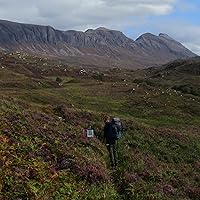
In August 1956, a young shepherd, his wife, two-year-old daughter and ten-day-old son sat huddled in a small boat on Loch Monar in Ross-shire as a storm raged around them. They were bound for a tiny, remote cottage at the western end of the loch which was to be their home for the next four years. "Isolation Shepherd" is the moving story of those years. More than simply a sensitive and richly detailed account of the shepherd's life through the season, Iain Thomson's book also vividly captures the splendour of one of Scotland's most awesome landscapes, and depicts the numerous incidents that shaped the family's life there before the area was flooded as part of a huge hydro-electric project.
Iain R. Thomson sure likes a bit of pathos, but in the context of this book - and the life he is describing - I think this is more than justified. Isolation Shepherd is a gleam into a way of life that, as the author notes himself in the epilogue, no longer exists. Shepherding, self-sufficient living without electricity or running water, and the Gàidhealach glue holding the community together have passed into oblivion in Monar, with the majority of the lower-lying grounds which Thomson's flocks grazed on now underwater of the Strathfarrar Hydro scheme. The narrator has a truly Highland voice, capable of praising the landlords while - often by the means of anecdote - implicitly criticising Highland landlordism. Place-name, history, folk lore and anecdote mingle with inspiring, naturalist prose, taking me right back to the happy days I spent a few miles east of the author's old home.
This is very much a 5-star read, as it combines a haunting evocation of a lost Highland lifestyle with remarkable writing skills. Thompson displays his love and understanding of the country around Loch Monar in Glen Strathfarrar, as it was before the area's hydro-electric installations. He describes the very much lost art of hill shepherding in detail which is always accompanied by a lively interest for the local people and other denizens of the surrounding pastures and mountaintops. He speaks very tolerantly about the lairds as well, showing an innate understanding for the role they played in protecting the land up until the 1960s, when the larger interests of the State began to intervene.
One of the finest books on Highland life, written about the fading days of the decade of the 1950s when, as he says, the lifestyle of remote crofters in the Highlands was finally coming to an end.
Definitely not the type of book I'd normally choose to read, but I was given it by my dad. I thoroughly enjoyed learning about the experiences of this shepherd and his family and their lives in such a remote location. The author covered all aspects of life there ... the long hard winters, the warm summers, the problems of navigating on the loch in bad weather, the close escapes, the stag hunting and culling, the lambing season and moving of the sheep, the faithful dogs, the infrequent passing visitors the camaraderie of neighbours, etc. A lovely, down to earth, well written and humorous account of this life of isolation.
I got this book while visiting Scotland and incorporated as much of what was written into my travels (difficult because the area was flooded). Isolation Shepherd is about a way of life that's all but disappeared from the Highlands. Both heartwarming when describring family, friends and the ability to count on each other and disheartening when describing the march of (industrial) progress (as was said in Oliver's Travels, "Progress may be slow but it is inevitable.").
From the moment Iain Thomson, together with his wife, toddler daughter, and days-old son, arrived in a boat in a storm at the far end of Strathfarrar – one of Scotland’s most remote glens – they must have known life was going to be hard.
For the next four years, and with their nearest neighbours nearly a mile (and a boat ride) away, Thomson worked the land as a shepherd, dealing with all the glen could throw at him. He details the many tasks required of his work, the loch and its diverse moods (including the need to haul the boats out in freezing weather to stop them being crushed by the ice), and the camaraderie and resourcefulness of the community. That is, until the dam-builders move in, the Thomsons have to move out, their house is blown up, and the glen is flooded for a hydroelectric plant.
Thomson’s understanding of his environment shines through his writing, and – while we hear of the struggles he endures – the unexpected benefits of living in such a place (e.g. his eyesight improves from spending so long focussing in the distance) are a delight to read. Although he doesn’t say a great deal about how things were for his wife, managing two children in such extreme conditions (and for the most part alone), but it’s clear he loves his way of life, which makes it all the more poignant when it’s all taken away.
This book is about the life of a shepherd and his family who lived in a remote place in the northwest of Scotland in 1956. It is very interesting to read about the "old" ways of land use. It seems that it was a harsh but also a very rewarding life. There is something romantic about it. Very poignant, in particular, was the last section, which Iain coined "Environmental Morality". And he is right to point out that, nowadays, we have lost the connection between ourselves and the wider world. And we don't need to live in the wilderness or have an appreciation of the wilderness; we just need to change our attitudes to accept that "the wilderness is part of our living self". As Iain notes : "Weather is better viewed through a window", "Wildlife is studied in an office/laboratory", "Wilderness is watched on a TV documentary", "Scenery looks best through a car window". Our human spirits are stifled, let's go out there and re-connect !
A strangely melancholic read, as Iain R. Thomson tells the story of his life in a remote glen west of Inverness. A way of life lost under the water of the hydroschemes of the mid-20th century.