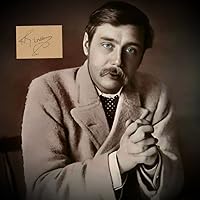
Peter Ackroyd CBE is an English novelist and biographer with a particular interest in the history and culture of London.
Peter Ackroyd's mother worked in the personnel department of an engineering firm, his father having left the family home when Ackroyd was a baby. He was reading newspapers by the age of 5 and, at 9, wrote a play about Guy Fawkes. Reputedly, he first realized he was gay at the age of 7.
Ackroyd was educated at St. Benedict's, Ealing and at Clare College, Cambridge, from which he graduated with a double first in English. In 1972, he was a Mellon Fellow at Yale University in the United States. The result of this fellowship was Ackroyd's Notes for a New Culture, written when he was only 22 and eventually published in 1976. The title, a playful echo of T. S. Eliot's Notes Towards the Definition of Culture (1948), was an early indication of Ackroyd's penchant for creatively exploring and reexamining the works of other London-based writers.
Ackroyd's literary career began with poetry, including such works as London Lickpenny (1973) and The Diversions of Purley (1987). He later moved into fiction and has become an acclaimed author, winning the 1998 James Tait Black Memorial Prize for the biography Thomas More and being shortlisted for the Booker Prize in 1987.
Ackroyd worked at The Spectator magazine between 1973 and 1977 and became joint managing editor in 1978. In 1982 he published The Great Fire of London, his first novel. This novel deals with one of Ackroyd's great heroes, Charles Dickens, and is a reworking of Little Dorrit. The novel set the stage for the long sequence of novels Ackroyd has produced since, all of which deal in some way with the complex interaction of time and space, and what Ackroyd calls "the spirit of place". It is also the first in a sequence of novels of London, through which he traces the changing, but curiously consistent nature of the city. Often this theme is explored through the city's artists, and especially its writers.
Ackroyd has always shown a great interest in the city of London, and one of his best known works, London: The Biography, is an extensive and thorough discussion of London through the ages.
His fascination with London literary and artistic figures is also displayed in the sequence of biographies he has produced of Ezra Pound (1980), T. S. Eliot (1984), Charles Dickens (1990), William Blake (1995), Thomas More (1998), Chaucer (2004), William Shakespeare (2005), and J. M. W. Turner. The city itself stands astride all these works, as it does in the fiction.
From 2003 to 2005, Ackroyd wrote a six-book non-fiction series (Voyages Through Time), intended for readers as young as eight. This was his first work for children. The critically acclaimed series is an extensive narrative of key periods in world history.
Early in his career, Ackroyd was nominated a Fellow of the Royal Society of Literature in 1984 and, as well as producing fiction, biography and other literary works, is also a regular radio and television broadcaster and book critic.
In the New Year's honours list of 2003, Ackroyd was awarded the CBE.
I've read a lot of Peter Ackroyd books since I was introduced to him via what is in my opinion one of his best books - Hawksmoor which is included on the 1001 books list. I heart <3 you 1001 books list!
The Clerkenwell Tales is slightly heavier on the brain and eyeballs than his other work including Hawksmoor and The Trial of Elizabeth Cree aka Dan Leno and the Limehouse Golem and if you are not a fan of medieval literature, or have never read Chaucer's Canterbury Tales then you might wonder what all the fuss is about, or even what the hell is going on.
Set in London, Ackroyd's unstinting historical research and pitch perfect descriptions will transport you back to a period of psalms and pilgrims set amid the inner city squalor of a fetid and crepuscular London town. Clerkenwell is the location of a number of Ackroyd's historical tales and is obviously a place he holds dear to his heart. This journey to Clerkenwell will lead ye on a merry olde danse through scenes of heresy, espionage and murder in a time of political turmoil and social unrest.
This book requires attention and a little bit of perseverance but at the end of the day it is a thriller/ murder mystery of the Davinci code type, wearing a medieval cloak to obscure its true nature. Why not don your wimple and get in the mood for murder, medieval style?
April, you may recall, is when folks long to go on pilgrimages. If you slipped into a funny accent when you read that sentence, or - worse - it launched you on a recitation of many more strange lines, then you've studied "The Canterbury Tales."
Making us memorize Chaucer's Prologue was a favorite torture among my teachers. In graduate school, Dr. Carter Revard stood over me as I plodded through the medieval verse, interrupting on every word, sometimes every syllable, to correct my chronic mispronunciation. April was the cruelest month.
Natheless, even if Middle English left you in a muddle or you never studied it at all, you'll be fascinated by Peter Ackroyd's gripping new mystery, "The Clerkenwell Tales." Known primarily for his masterly, 800-page study of London, Ackroyd has now written a book that's nominally fiction and strikingly brief. (Look for his equally efficient biography of Chaucer in January.)
The story opens in 1399 at the House of Mary, a convent in Clerkenwell, London. After a brief illness, a young nun named Clarice has begun describing strange and violent visions. The prioress suspects it's all a stunt - just what she might expect from this scandalous girl who was conceived in the tunnels beneath the convent.
But the country is agitated and unsettled over the power struggle between King Richard II and Henry Bolingbroke (Henry IV). Rumors of rebellion roil the populace. City leaders fret about unrest and wonder which side to support. An intractable nun making prophecies of plague and regicide could be the match that ignites a conflagration.
Touches of Middle English dialect flavor this narrative but never obscure it. With a nod to Chaucer, Ackroyd moves through 22 short tales, each named for a different character, some familiar from that legendary pilgrimage. (The Wife of Bath steals the show, again.) In this case, though, all the tales contribute to the same developing story about a crisis in London, and they're told about - not by - their title characters. The mystery builds up like a mosaic whose secret pattern the artist knows but won't tell till we can finally see it ourselves in the last pages.
When Sister Clarice cries out that "all the churches of England will be wrecked and wiped clean," she's merely adding her radical voice to an ongoing theological and political debate. But when she correctly predicts a series of terrorist acts in the city, she unsettles both her skeptics and her supporters. The problem (and pleasure, for us) is how to distinguish those two groups and figure out what plots these convoluted alliances are pursuing.
The nun's prescient ravings play right into the rebellious plans of Bolingbroke's friends in London who want to show how poorly King Richard protects the Church.
But a maniacal friar named William Exmewe seems just as interested in using Clarice for his own ends. He's secretly leading a group of radical purists known variously as "the true men," "the foreknown," or "the predestined ones."
In the interest of purifying the Church, they begin a campaign of terror in London. Rejecting all ecclesiastical ceremonies and officers, these cultists believe that as Christ's true followers they're absolved of all sin. Their actions - murder, arson, package bombs - are prompted wholly by the spirit of God. "If anyone hinders us then God's curse is upon them," Exmewe instructs. "To kill is to be free." Victims of their terrorist acts simply return to "the source." And their own deaths are nothing to fear because salvation is assured.
The comparison to contemporary Islamic terrorism is, of course, impossible to resist. And Ackroyd does a chillingly effective job of demonstrating how cynical men twist the faith of simple fanatics to their own murderous ends. Only the symbols have changed. In this alarmingly familiar theological madhouse, anything is permissible, no opposition is valid.
One man, a physician, has the wherewithal to begin piecing contradictory evidence together to solve this crisis, but the forces involved are far larger and more evil than he supposes.
Part of Ackroyd's genius here is his ability to capture London at a time when it looks and sounds surreal to us - a fascinating mixture of the familiar and the alien. Englishmen of 1399, after all, acted and talked almost like we do. They lived in towns, worked at trades and professions, shopped in markets, and even enjoyed a degree of leisure.
And yet their streets were a ghastly mess of sewage, animals, and the dispossessed. Most people couldn't read, but they understood the power of written words. Their legal system was a hodgepodge of rights and cruelties. They knew something about biology, physics, and chemistry, and yet still considered the world infused with supernatural forces. Indeed, Ackroyd's emphasis on their wacky nutritional and medical theories - and the confidence they placed in them - should give us pause. Will today's statins be yesterday's boar grease? "There's never a new fashion, but it's old," as Chaucer said.
Of special interest to these medieval characters is the tension between predestination and free will. New ideas about God and man, combined with the Church's crumbling doctrinal control, were leading more and more people to ask troubling, radical questions. If God knows everything that will happen, what role is left for us to make our own decisions? Are we responsible for anything in a world where God controls everything? For Friar Exmewe and his band of terrorists, God's omniscience offers absolution for whatever they might do, but others are more profoundly shaken by this quandary.
In Ackroyd's dramatization, all these arcane theological and political issues come bracingly alive as the plot turns and twists through a murky world of betrayal and fanaticism. In the words of "The Monk's Tale" - with apologies for my pronunciation - "To thee this storie I recomende."
This book is an interesting set of descriptions of daily life, medicine, food, culture, and beliefs of those living in 14th century London, wrapped up in a flimsy story of political and church intrigue in an attempt to keep you reading.
I'm always a bit surprised by how much life there was in the past, it felt like it could have been about today; same political messes, same religious fueled hatreds, same juggling for power, money, status, sex, same people induced pollution problems, same murder, same terrorism. Everything changes but nothing changes with the passage of time. Do you ever feel like you are caught in the endless loop of a nightmare here on earth? Ugh. Well, on to cheerier thoughts. Peter Ackroyd writes really well; I know I just stated the obvious, but just so you know, the book is well written, fascinating, always interesting, never loses its punch. I could have kept reading it, who else would have a story to tell? Everyone really. If he would have kept telling tales, I would have kept reading them. 1399, I didn't know it would be so interesting.
For some reason I had a really hard time getting into this book. I think it may have been to do with the short chapters and the changing perspectives but I had a really hard time grasping the continuity between the stories and remembering who the conspirators were. I should have loved it, Ackroyd's style was as good as ever, and this book contained many things which I really enjoyed, secret societies, consipracies, spirit posession and yet somehow I found it wanting. The book seemed like a good description of life, but the plot seemed rather loose. I liked that the supernatural element was described as the characters saw the events, but I think I would have preferred something that was actually spooky as opposed to a political conspiracy. I think I would like to go back and re-read this when I have more time to concentrate and can read it quicker and get more of the plot and do a better job at remembering who everyone is! I feel the reason I didn't enjoy this was entirely my fault not Ackroyd's.
One uses salt to enhance the flavour of foods, to bring out nuances and contrasts. Too much salt overpowers the palate and leaves one with a bitter, dry taste in the mouth. So too the use of archaic words in writing. In this novel, in an attempt to enhance the mood and setting of the work, Mr. Ackroyd has over-salted the text with archaic words and phrases that leave the reader either reaching for water (in this case a dictionary) to ingest it all, or trying to slog through and doing their best to find the nuances which are diminished or buried; and some will simply push the plate aside and reach for something more palatable.
In general this story had great potential, but in the end this reader found it disappointing; there were no "wow, this is wonderful!" moments; no characters that could be connected with in a personal way. A little less salt would have made this a much more enjoyable read.
Μιμούμενος το στυλ του Τσόσερ ο συγγραφέας γράφει ιστορίες που αλληλοσυνδέονται και καταγράφει το μεσαιωνικό Λονδίνο την ώρα που η Αγγλία σπαράσσεται από των πόλεμο των Ρόδων. Ο μύθος κιαι η ιστορία μπλέκονται και περνά ευχάριστα η ώρα. Ένα βιβλίο για ΜΜΜ ή μια παραλία, δεν απαιτεί την αμέριστη προσοχή σου αλλά δεν σε προσβάλει κιόλας. Πάντως επειδή τα μέρη που αναφέρει σώζονται ακόμα και σήμερα, τα έχω σημειώσει για όταν πάω Λονδίνο.
Hooray. It’s over! If I hadn’t had to attempt this for book club, I would have given up ages ago. That was hard to admit because normally I can something I can connect to in a book but this was impossible. I felt like I was wading through mud. I understood Chaucer’s Canterbury Tales, which is what Peter Ackroyd tried to modernise better than this. That’s saying something as I only studied it for two weeks at university. The changes in language, from Latin to English is what I struggled with the most. I kept losing my place because I was looking at what words or phrases meant. It was very frustrating. There was also a lot of sexual innuendo everywhere. I am used to a bit of sex but there’s usually stuff going on around it I can engage. In short, what was the point of this? I hope the next choice is better.
This book was hard for me to understand. I got that there were hints planted throughout the text concerning the ending, but I felt that those were to veiled for me to understand; the author didn't give much information in the added appendix to help me make connections as to the eventual resolution of Clarice's or the Richard II/Henry Bolingbroke story. That being said, I did like the novel. Ackroyd sets his version of The Canterbury Tales to give the reader a tour of the people and places of London at Richard II's waning reign, as Henry Bolingbroke attempts to wrest the throne from him. Ackroyd uses several of the original characters from the Tales to explain medieval culture and society. Clarice, a young nun, begins having mysterious visions predicting Richard's downfall and the downfall of the church through several explosions around London's physical churches. Perhaps this is an allusion to the Reformation and overthrow of the church due to corruption within its walls. Also, this may be an allegory for the modern world which is threatened by terrorists using faith as a reason to do harm to innocent urban citizens. Ackroyd's writing is intellectual, mysterious and poetic, and I felt like the characters were speaking in code nearly all of the time, making it hard to understand the eventual resolution. Translations for French and Latin phrasing were not given, making the character's exchanges difficult to understand.
This book deserves a 10-star rating for historical research. Unfortunately I would only give the plot and storytelling about a 3 out of 5. Medieval London is brought to brilliant, exquisitely detailed life in Ackroyd's hands. I was constantly in awe of his grasp of the customs, the architecture, the modes of life and the language. Indeed, at times this verged on info-dump, but I was fascinated none-the-less. However, a plot based on a Canterbury Tales sized cast with each chapter told from a different character's point of view, is an incredibly ambitious endeavour. It is not surprising that Ackroyd did not pull it off (that is, if one judges this on the merits as a novel rather than a work of history). Two of the most likable characters are killed off, and the only characters we remain with for any time are a most unsympathetic villain (the Friar) and a very ambiguously-portrayed nun. This is not a good recipe for a 'successful novel'. As an experiment in historical fiction, however, the Clerkenwell Tales might be judged more kindly. Problem is, I'm not sure the world is quite ready for fiction that is more history than story.
I understand that Ackroyd is trying to present a version or a take of The Canterbury Tales. I love Ackroyd's writing, honestly.
This book proves one thing.
Only Chaucer can write Chaucer.
Ackroyd's tales are somewhat interesting, but dijointed. It feels like the ground is shifting all the time. Ackroyd, at least here, lacks Chaucer's humanism, his dirt, his grime, his humor, his sure touch.
Very disappointed; the reviews on the cover led me to expect great things. The author obviously knows a lot about medieval London, which provides a few weeks interesting moments, but the book's structure is actually a major weakness in my view. The chapter headings lead you to believe you are getting something akin to the marvellous Canterbury Tales. However all it does is keep introducing more and more characters who are involved in some way with a dastardly plot that I never got to grips with. I soon got confused as to who all these people where, who was deceiving who and why. I was also unable to identify with a single character; the one who started to emerge as a sort of hero was not allowed to continue in this role beyond a couple of chapters. I have Peter Ackroyd's London on my shelf to read; I have heard good things about it; it is a much bigger book so I hope the reviews are right this time.
I've not read more than one or two of the The Canterbury Tales, so I cannot speak to how well this tracks with the source material, but I enjoyed the unfolding of a story through several different tales. The tale of London in the late 14th century was very well done with rich historical details. However, the underlying story was just ok. It's on the lower end of a three, but not quite a 2 star.
Exceptional. Using the structure of Chaucer's Canterbury Tales, Ackroyd relates 14th Century English intrigue during the reign of Richard II and his overthrow by his cousin Henry. A fictionalised account of real historical events - fascinating. And the language ! Every page is crammed with information; a treasure trove in only 200 pages.
I thoroughly enjoyed this book, loved the language, the intrigue and now my route is clear. Must read more about Richard III and perhaps why not the Canterbury ttales
Fascinating, maddening, more like a "thought experiment" than a novel ...
I liked it -- although I felt that I was being held at arm's length by the text, never asked or expected to engage with the characters as people, or the plot as events relatable to my life and our times. (Perhaps I just need to work on that, however: the idea of people being lead down the garden path of murder and treachery by false information, and blatant appeals to their sense of themselves as "special," and above the law, is probably pretty au courant ...) That the Author was having a bit of fun at the Reader's (my) expense. Which is still ok, if the Author's private joke results in such a fascinating insight in the past.
In the absence of a time machine, this is probably the closest I'm ever going to get to experiencing the Year of Our Lord 1399, as famously ineffectual King Richard II is run down to earth and deposed by his nemesis Henry Bolingbroke, soon to be King Henry IV. As these great events take place, offstage, we are focused on London -- more precisely, the parish of Clerkenwell, outside the walls of the City of London -- as various Londoners scheme and plot, on behalf of themselves and the usurping Henry, and fall foul of the schemers and plotters, and go about their daily business.
Ackroyd is just marvellous on the past: the smells, the tastes, the streets, the clothing, the prayers, the language. Sometimes, it's like reading a work that is half-written in a foreign language, and yes, maybe he sometimes overdoes that, but I liked it. I liked it as a constant reminder that the characters are the same, yet different from us. That the past we are observing is a foreign country.
And boy, do they ever do things differently there: the plot (such as it is) hinges on the layers upon layers of the machinations of a DaVinci Code-style plot by Illuminati-wannabes who see profit and self-advancement in the cause of Bolingbroke. But that's a MacGuffin: the real pleasure here is following the course of the 22 Londoners who go about their business, following the course of forgotten streets and paved over rivers, in a medieval London that is like a palimpsest of the modern city, shadowy marks written over the modern-day map.
I've avoided reading professional reviews of the novel, as I didn't want to have my own reaction influenced by the thoughts of others. But searching to confirm one suspicion (), I did a little search and discovered that one scholarly work on the novels of Ackroyd is called My Words Echo Thus: Possessing the Past -- and that seems like a perfect description of this entertaining, challenging novel.
A flawed but captivating medieval thriller by the master of London-based historical fiction.
Don't be confused by the horribly chosen title - other than in relation to a flimsy framing device in which the chapters are named after their protagonist's medieval professions, the Clerkenwell Tales is nothing like Chaucer's comedy. This is archetypal Peter Ackroyd - a dark, psychohistorical portrayal of a London beset with calamity, conspiracy and religious madness.
When it comes to bringing the past to life, I don't think anyone comes close to Ackroyd. It's not just his ability to describe the sights and sounds of 14th century London, or to use archaic language without causing confusion - his most impressive gift is his ability to put you inside the minds of people whose assumptions and values are markedly different to those of our own times. As a time-machine back to 1400, this book is remarkable.
The story itself is fine, if less of a narrative success than some of Ackroyd's more famous works. The overarching plot about secret societies is over-dramatic in conception, yet concludes in a way that feels rushed and unsatisfying. In terms of characterisation, it's hard enough to make a modern audience care about whether Henry Bollingbroke will depose Richard II when they already know the answer. When you consign them to the background, don't explain why it matters and switch protagonist every ten pages, you make it very hard indeed for the reader to become emotionally involved.
So in the final conclusion, The Clerkenwell Tales is a masterful evocation of a lost time, but ultimately one more for the mind than the heart. Well worth a read nonetheless.
London, 1399. A cast of characters who share jobs and roles with the pilgrims in Chaucer’s Canterbury Tales pivot around the small cluster of streets that make up medieval London on the shifting grounds of love, religion and politics, driven by passions and desires for the earthly and heavenly, and the mixing of the two.
I don’t know how accurate Peter Ackroyd’s take on medieval London is, but he certainly makes the reader feel that it is accurate in everything from sentence structure to topography. His London is a viscerally physical place, full of crude sights and smells, where life can be extinguished at a blow and people can enjoy a meal one moment and suffer a terrible death the next. This book’s dating to the aftermath of 9/11 is clear, with unreasoning conspiracy and political game-playing driving what happens while many characters remain oblivious to how they are being manipulated. I found the structure of disconnected chapters circling round a story rather than directly telling it eventually tiresome: there were simply too many characters spread too thinly across too many plot lines to remember. But the feeling of being there in the noisy, colourful London Ackroyd creates will remain.
An historical novel about intrigue and political upheaval in London in 1399 against the backdrop of Richard II being deposed by the future Henry IV. It is full of colour, textures and smells, evoking life in London during the period, wearing its in-depth historical research on its sleeve. It is split into chapters that mimic the titles of Chaucer’s Canterbury Tales although focusing on different characters taken from London society. Stretching from convents and churches to London’s taverns, streets and rivers, it is a world of superstition, quack medicine, noise and violence. The story running through it revolves around plots to influence public sentiment and national events at a time when religion was riven by schisms and politics. The characters are rather flat, overwhelmed by the historical detail, but the political thriller at its heart is well told and twisting.
I love books with a medieval setting, and Ackroyd certainly knows how to create a scene; the streets of 14th century London come alive like a painting in this novel.
Using the structure of The Canterbury Tales, The Clerkenwell Tales follows the fate of the young nun Sister Clarice, who foretells the overthrow of King Richard II by his cousin Henry Bolingbroke, and a clandestine group, similar to the Illuminati, who would appear to be working towards making the nun's prophecies come true. Religion, murder and conspiracy weave a tangled web, and although the novel is short, it bears careful reading to feel the full impact at the end.
A lot of the criticisms for this book relate to the fact that Ackroyd has strayed far from Chaucer's original tales and that he has immersed readers too much into the 14th century England. Although I haven't read all of the Canterbury Tales, I would have to agree on the first note that, while this novel is more or less inspired by Chaucer's work, it doesn't really correlate as much as expected. On the second note, I actually really liked being immersed. At times it was difficult to read the Latin and French, but otherwise, it introduced me to a new world that I've never been a part of.
To misquote Blackadder, reading The Clerkenwell Tales is much like a broken pencil… pointless.
Basically, it’s a short novel – or novella – about London in the year 1399 when mounting tensions between the nobility see Richard II deposed and Henry Bolingbroke coronated as Henry IV. Peter Ackroyd introduces a conspiracy to bring about Richard II’s deposition but it fails to be interesting or meaningful. The reader probably already knows that Richard will be deposed and Henry IV crowned king since Shakespeare wrote some incredibly famous plays about it but rather than trying to introduce tension or mystery into the story, perhaps by making us care about his cast of largely invented characters, Ackroyd seems just to shrug his shoulders and keep churning out the story. Nor does he give us enough detail that we can get a sense of why the conspiracy exists and we can root for it to fail or succeed. No, Richard II must be deposed and Henry IV made king because of Reasons – Evil Reasons since the guys in the conspiracy are pretty evil but still Reasons. Yeah. They’re setting fire to churches and killing people because Reasons. No, Ackroyd won’t tell you want they are but they totally exist. At least I assume so.
There’s also a nun who has visions and she may or may not be part of the conspiracy. I think there’s also another conspiracy to fight that conspiracy but it was kinda vague and thrown in at the end? Admittedly, at that stage, I just wanted to finish the book and had stopped caring about everything else.
So, the big selling point for this book is that it’s kind-of a spinoff of The Canterbury Tales, almost using Chaucer’s pilgrims as the focal characters for the story and each chapter title is modeled after The Canterbury Tales (The Prioress’s Tale, The Knight’s Tale, etc.). It is an very interesting and exciting idea but, ultimately, it’s a pointless gimmick. Ackroyd neither cares enough about these characters to give them a lot of page time – The Pardoner, for instance, doesn’t appear until the chapter entitled “The Pardoner’s Tale”, then barely features in that and is never seen again. Nor can I say that Ackroyd’s characterisations felt close to Chaucer’s. They felt like complete strangers to me.
Indeed, I would say Ackroyd has a distinct disdain and loathing for these characters that Chaucer did not. Chaucer’s characters were rogues and deeply flawed individuals but they were lovable and entertaining; these characters are not. Ackroyd seems to think medieval people were inherently bad people, very alien to ourselves. He also makes the Wife of Bath – a character feminists have identified with and reclaimed – a child trafficker, prostituting a eleven-year-old girl. Lovely. Let me go gouge my eyes out.
Nor does this Canterbury Tales gimmick actually feel it enhances the story but rather, holds it back and limits it. I honestly don’t understand why Ackroyd used Chaucer as a framing device. It is apparent that the story he wanted to tell had nothing to do with Chaucer or Chaucer’s characters and that this device held him back from exploring his conspiracy plotline in detail. Perhaps this plotline would have been better served if Ackroyd had devoted his attention to it rather than trying to shoehorn it into a Canterbury Tales spinoff. As it is, the story is pointless.
This is a story of murder mystery and conspiracy set in England at the end of the reign of Richard 2.However it is not a book to be read for its plot and though a short book ,it is by no means a snappy read and needs some concentration.Where the book has real value is as a history of the religious and political strife of the time as well as painting a picture of London in the 14th century with a cast of colourful characters and some strange customs and superstitions.
This felt like Peter Ackroyd lite. Yes, it played well with the Canterbury Tales and had plenty of interesting period details along with plotting, murder and a coup, but it didn't seem to dig in as much as other books. Maybe more on what Henry IV knew (if anything), what others suspected and what happened to other characters would have enhanced matters. A lot of characters come and go too rapidly. I still enjoyed it, but I expect more meat from Mr Ackroyd.
Nobody writes historical fiction,particularly regarding London,than Peter Ackroyd. Ackroyd deftly weaves a tale of murder,intrigue,secret societies and a power struggle for the English crown. You can smell the rivers,the streets,the people of the period(a lot of it,which makes you appreciate Air Fresheners). A well written,pacey tale that captures so much in it's short length. Another Ackroyd gem.
Revenge, golems, strange visitations, fever and panic in secret cellars..a London under, and a dim light on the darkest of ages. A dream of the damned. The murmured prayers before suicides who walk among us. Uncovering the buried streets of the ancient city. Smithfield market cold early morning rain. The smells of vinegar, boiled beef and pig shit. It’s 1399 and the country is wracked by religious persuasion of the meanest kind, and plots are made against a King. Blood soaks the earth and stone that’s still beneath our feet. A daytime blackout fog so thick all you hear is the sinister white noise of children’s nursery rhymes.
The best historical fiction takes you somewhere. The very best leaves you there.
I struggled with this book, and didn't make it to the end. Despite studying Chaucer at A-level English, I found the language and style too like treacle and found about half way through that I just didn't really care enough to carry on with the story. I'm sure it's a very worthy tale, just not one for me.
I am fibbing. I have not finished reading this book, in fact I stopped after chapter three. Maybe it’s because I am trying to read it during Coronavirus lockdown, but it’s simply just too much and I don’t have the inclination to plough through the ‘olde worlde’ language. Not for me. Not right now.