Jump to ratings and reviews
Rate this book

The River of Life, and Other Stories

Rate this book
Contents: The River of Life Captain Ribnikov The Outrage The Witch Aleksandr Ivanovich Kuprin (1870-1938) was Russian novelist and short-story writer. He was an army officer for several years before he resigned to pursue a writing career, and was a friend of Maxim Gorky. He won fame with The Duel (1905), a novel of protest against the Russian military system. In 1909, Yama: The Pit, his novel dealing with prostitution in Odessa, created a sensation. Kuprin left Russia after the revolution but returned in 1937. Some of his best short stories of action and adventure appear in The Garnet Bracelet, originally published in 1917.

260 pages, Paperback

First published January 1, 1969

4 people are currently reading
16 people want to read

About the author

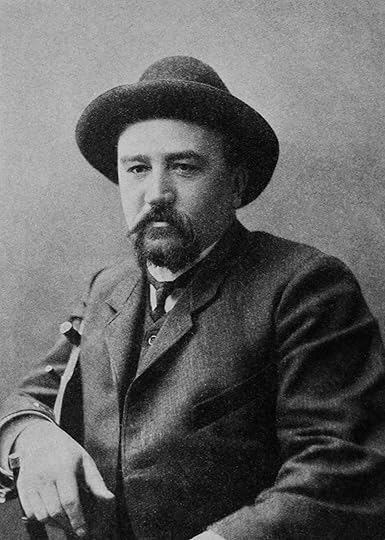
Aleksandr Kuprin

914 books156 followers
Aleksandr Kuprin (Russian: Александр Иванович Куприн; 7 September 1870 in the village of Narovchat in the Penza Oblast - August 25, 1938 in Leningrad) was a Russian writer, pilot, explorer and adventurer who is perhaps best known for his story The Duel (1905). Other well-known works include Moloch (1896), Olesya (1898), Junior Captain Rybnikov (1906), Emerald (1907), and The Garnet Bracelet (1911) (which was made into a 1965 movie). Vladimir Nabokov styled him the Russian Kipling for his stories about pathetic adventure-seekers, who are often "neurotic and vulnerable."

Kuprin was a son of Ivan Ivanovich Kuprin, a minor government official who died of cholera during 1871 at the age of thirty-seven years. His mother, Liubov' Alekseevna Kuprina, Tatar princess (of the Kulunchakovs), like many other nobles in Russia, had lost most of her wealth during the 19th century. Kuprin attended the Razumovsky boarding school during 1876, and during 1880 finished his education in the Second Moscow Military High School (Cadet Corps) and Alexander Military School, spending a total of ten years in these elite military institutions. His first short story, The Last Debut, was published during 1889 in a satirical periodical. "In February 1902, Kuprin and Maria Karlovna Davydova were married, their daughter Lidia born in 1903." Kuprin's mother died during 1910.

Kuprin ended military service during 1894, after which he tried many types of job, including provincial journalism, dental care, land surveying, acting, circus performer, church singer, doctor, hunter, fisher, etc. Reportedly, "all of these were subsequently reflected in his fiction." His first essays were published in Kiev in two collections. Reportedly, "although he lived in an age when writers were carried away by literary experiments, Kuprin did not seek innovation and wrote only about the things he himself had experienced and his heroes are the next generation after Chekhov's pessimists."

Although the 1896 short story Moloch first made his name known as a writer, it was his novel The Duel (1905) which made him famous. "Kuprin was highly praised by fellow writers including Anton Chekhov, Maxim Gorky, Leonid Andreyev, Nobel Prize-winning Ivan Bunin" and Leo Tolstoy who acclaimed him a true successor to Chekhov. After publication of The Duel he paid less and less interest to fancy literature and began to spend time in pubs and brothels. His sensationalist novel about the lurid life of prostitutes, The Pit (1915), was accused by Russian critics of excessive Naturalism.

Although not a conservative, he did not agree with Bolshevism. While working for a brief time with Maxim Gorky at the World Literature publishing company, he criticized the Soviet regime. During spring 1919, from Gatchina near Petrograd, Kuprin left the country for France. He lived in Paris for most of the next 17 years, succumbing to alcoholism. He wrote about this in much of his work. He eventually returned to Moscow on May 31, 1937, just a year before his death, at the height of the Great Purge. His return earned publication of his works within the Soviet Union.

Kuprin died during the spring of 1938 in Leningrad and is interred near his fellow writers at the Literaturskiye Mostki in the Volkovo Cemetery (Volkovskoye Memorial Cemetery) in Leningrad. A minor planet 3618 Kuprin, discovered by Soviet astronomer Nikolai Stepanovich Chernykh in 1979 is named after him.

Reportedly, "even today, Alexander Kuprin remains one of the widest read classics in Russian literature", with many films based on his works, "which are also read over the radio", partly due to "his vivid stories of the lives of ordinary people and unhappy love, his descriptions of the military and brothels, making him a writer for all times and places."

Ratings & Reviews

What do you think?
Rate this book

Friends & Following

Create a free account to discover what your friends think of this book!

Community Reviews

5 stars
9 (36%)
4 stars
11 (44%)
3 stars
3 (12%)
2 stars
2 (8%)
1 star
0 (0%)
Displaying 1 - 3 of 3 reviews
Profile Image for Rex.
58 reviews6 followers
May 25, 2021
Up until a couple of months ago, I knew nothing about Aleksandr Ivanovich Kuprin. But, this is not only the first work of his (besides another short-story collection), but, also happens to be the first book of 2021 that I have re-read. This "Kipling of Russia" (I believe that's how Vladimir Nabokov celebrated him, albeit, Kuprin himself was a big fan of Rudyard Kipling) to me is an ace "Russia's Raconteur", especially in the novella and short-story format.

There are no spoilers in this review. 😄

Aleksandr Ivanovich Kuprin

There is something inexplicable about Kuprin, which makes reading this short-story collection, such a salubrious experience. Could it be his empathy? His sympathy? His joie de vivre? His revolutionary verve? His passion for the marginalized? His antipathy for those in (and abusing that) power? His childlike love for animals? His vivacious characters that come alive? His ability to go behind reveries, fancies, day-dreams, creatures and topics and see the world from that standpoint? His impressionable childhood marred by Procrustean disciplinary upbringing at the Military Academy? Being bullied by the powers that be at an impressionable age? Having widely traveled, holding a wide spectrum of jobs including that of being a choir-singer, stevedore, seller of trifles, acting, writing, in the military as a second lieutenant, to even studying nursing for a career? His friendship and acquaintance with the other titans including Ivan Bunin, Leo Tolstoy, Maxim Gorky, Leonid Andreyev, Anton Chekhov, etc.?

Perhaps, all of that and more, is what makes Kuprin's stories teem up so much of energy, color, love, guffaws, sympathy and empathy too. He had said this:
I swear, I'd give anything to become a horse, a vegetable or a fish for a few days…I'd like to be able to look at the world through the eyes of everyone I come across…I’m a writer—that’s a man of fancy and imagination.

And that is what he does in this volume with his 4 stories. And here is my personal ranking of how I enjoyed them:

|1 |The River of Life | 9/10
|2 |Captain Ribnikov | 10/10
|3 |The Outrage-A True Story | 9.5/10
|4 |The Witch (Olyessia) | 10/10

Of these 4, The Witch is more of a novella, taking 50% of the entire book. The first 3 are short-stories.

I believe, these were written during the salad-days of Kuprin, which is the first decade of the 20th century. At least, the River of Life, Captain Ribnikov, and The Outrage-A True Story were written in the 1905-1906 time-period. This was also the period, Kuprin seemed to have an open revolutionary streak.

The River of Life

Naturally that streak is laid bare in The River of Life, which also calls into question about the futility of the wasted energies of the youth, in being unable to challenge the tyranny of the Tsarist regime. Right from the slow-start of a nondescript hotel named Siberia, the comic flirtations, all culminate in an unexpected crescendo that gathers apace with the arrival of a student as a guest of this hotel. Kuprin's love for animals is a known. Even at a difficult moment in this story, the protagonist will see the dog barking in the street, as driven by empathy. Kuprin's general disdain and fear for Police, openly comes out in the ponderous thoughts of the protagonist.

Captain Ribnikov

Apparently, Kuprin himself rated Captain Ribnikov as his best. This story has its own 007 moments, along with unrestrained salvos fired against the incompetent Russian military officers, who were thoroughly screwing-up things at the Russo-Japanese wars in the Pacific. Kuprin's fusillade against the Russian military officers were ROFL-salvos 🤣🤣🤣. Kuprin's obsession of having somebody as a spy, blend-in smoothly within the society at the heart of the power-center of an enemy territory, makes it a very interesting thriller (of sorts). Like animals, Kuprin's love and empathy for the marginalized, esp. the prostitutes, will be handled very beautifully. And of course, the idiosyncratic Captain, with his unique fables and aphorisms will leave everyone in splits.

The Outrage -- A True Story

The Outrage-A True Story is a satirical masterpiece. Here the thieves make their case with righteous indignation against the lawyers. So, you can imagine, how funny that can get! Even the "A True Story" garnishing is irony ne plus ultra! Again, Kuprin's voice against pogroms and injustice against the Ukrainian Jews, comes out so naturally in this sardonic tale, without irking the Tsarist censors? Behind those ironic trolls, a clear leitmotiv will emerge in this funny tale. Due process of law is also due to a thief, a prostitute. And, what about people, who have horrible ideologies that may result in pogroms? Are they better than those thieves and prostitutes? Kuprin's case is sustained. Case closed. Thieves win, says this Judge 😉😉😉.

The Witch (Olyessia)

The Witch (Olyessia) is such a fairy-tale, which is narrated in first-person terms, wherein a country official falls in love with a witch, that does not bode well for his love. This is the longest novella, in this compilation. Kuprin's vicarious imaginations of deeply being in love with a witch and what happens when the witch goes to attend the Mass at a Church, can raise questions of what constitutes genuine piety and love towards others, who are different.

As, it looks like nobody has reviewed this book on GoodReads before, let me provide some quotes from this volume. Again, no spoilers 😉.

Salvos against Police, Lawyers, Generals...

The police are friendly with her for her hospitality, her cheerful character, and particularly for the gay, easy, unceremonious, disinterested complaisance with which she responds to man’s passing emotions.

I, who am not afraid of death, was afraid of the shouting of this dull, narrow-minded clod, petrified with professional conceit.

Desperately brave generals are often frightened of mice. Sometimes they even boast of their little weakness.

And that’s a Russian officer! Look at that type. Well, it’s pretty plain why we’re losing battle after battle. Stupid, dull, without the least sense of his own dignity—poor old Russia!

I tell you frankly, our commanders in the East are absolutely worthless!

But I say with sorrow that I fear these wooden people, whose view of the world is rigid and unchangeable, who are stupidly self-confident, and have no hesitations, worse than death.

You are armed with the protection of the law, by locks, revolvers, telephones, police and soldiery; but we only by our own…

We can swear before God and man and posterity that we have seen how the police organise the massacres, without shame and almost without concealment.

But we thieves, all of us who have been in prison, have a mad passion for freedom. Therefore we despise our gaolers with all the hatred that a human heart can feel.

‘They do bad things. … Ordinary people don’t matter, but the officials. … The village policeman comes—he must be bribed. The inspector—pay again.


Gentle feelings of love, life, justice...


parting to love is like wind to a fire: it blows out a small one, and makes a large one blaze.

Almost all of us are educated, and all love books.

‘How could I disbelieve? Charms are in our destiny.

Every night I came to your window and prayed for you in my soul.

'When we part you will be miserable, terribly miserable. … You will cry, you will not find a place to rest anywhere. And then everything will pass and fade away, and you will think of me without sorrow, easily and happily.’

And I think that when a man passes away his consciousness is put out, but his thought still remains, trembling in its former place.

All our deeds and words and thoughts are little streams, trickling springs underground.

Whose diabolical mind invents these pogroms—these titanic blood-lettings, these cannibal amusements for the dark, bestial souls?

It gave him a subtle and obscure delight to penetrate into the mysterious inaccessible chambers of the human soul, to observe the hidden springs of external acts, springs sometimes petty, sometimes shameful, more often ridiculous than affecting—as it were, to hold in his hand for a while, a live, warm human heart and touch its very pulse.

if human thoughts had the power to wound, kill, and rob man of honour and property, then which of you innocent doves would not deserve the knout and imprisonment for life?”

‘It’s forbidden to ask twice of Fate. It’s not right. Fate will discover, overhear. … She does not like to be asked. That’s why all fortune-tellers are unhappy.’

Can one remember the words uttered in the first moment of meeting between a mother and son, husband and wife, or lover and lover? The simplest, most ordinary, even ridiculous words are said, if they were put down exactly upon paper. But each word is opportune and infinitely dear because it is uttered by the dearest voice in all the world.

My God, why did I not listen then to the dim voice of the heart, which—I now believe it implicitly—never errs in its momentary mysterious presentiments?

I feel so happy near you. … Don’t let us cry while we are together. Let us be happy for the last days, then it won’t be so hard for us to part.’


Man's Best Friend...❤️❤️❤️


Surely the obscure soul of the dog must be far more susceptible to the vibrations of thought than the human. … Do they not bark because they feel the presence of a dead man?

This dog that barks downstairs too. But in a second, new monstrous currents will rush out of the central battery of my brain and touch the poor brain of the dog. It will begin to howl with a queer, intolerable terror.


And some, witticisms...


There is something of the preacher essential in every Russian intellectual. It is in our blood; it has been instilled by the whole of Russian literature in the last generations.

“Russia’s joy’s in the bottle!”

“It hardly can be called a sin, If something’s funny and you grin! 
Profile Image for Jess.
178 reviews
August 22, 2017
Questa raccolta, reperita tramite archive.org, contiene quattro racconti di Kuprin apparsi più o meno nell'arco di dieci anni, tra il 1898 e il 1906. Nel primo, una squallida locanda fa da cornice al dramma di un anonimo studente; nel secondo, una spia giapponese (molto goffa, a mio avviso) gioca al gatto e al topo con uno scaltro giornalista; nel terzo, un'associazione di ladri "onesti", artisti nel loro campo, protesta contro una terribile azione a cui non hanno preso parte; nel quarto, un io narrante rifugiatosi in campagna esce dal torpore che lo attanaglia dopo l'incontro con due donne, nonna e nipote, accusate di stregoneria. Sono racconti ben diversi tra loro, per tematiche e lunghezza, e non sono stati tutti di mio gradimento ("Olesja", il quarto, che a Kuprin era molto caro, non mi ha detto molto e da Štabs-Kapitan Rybnikov mi sarei aspettata qualcosa in più), ma in tutti si nota il talento narrativo di Kuprin. Certo, non siamo ai livelli delle opere più lunghe, in cui fino ad ora l'ho preferito, ma in qualche modo se la cava anche coi racconti e "Il fiume della vita", devo ammetterlo, è un piccolo gioiellino, nonché il migliore dei quattro di questa raccolta.
Displaying 1 - 3 of 3 reviews

Can't find what you're looking for?

Get help and learn more about the design.