Written during the Hundred Years' War by France's first female professional writer, this newly translated edition of a major political work discusses the education and behavior appropriate for princes, nobility and common people in a time of unrest and disorder.
Christine de Pizan (also seen as de Pisan) (1363–c.1434) was a writer and analyst of the medieval era who strongly challenged misogyny and stereotypes that were prevalent in the male-dominated realm of the arts. De Pizan completed forty-one pieces during her thirty-year career (1399–1429). She earned her accolade as Europe’s first professional woman writer (Redfern 74). Her success stems from a wide range of innovative writing and rhetorical techniques that critically challenged renowned male writers such as Jean de Meun who, to Pizan’s dismay, incorporated misogynist beliefs within their literary works.
In recent decades, de Pizan's work has been returned to prominence by the efforts of scholars such as Charity Cannon Willard and Earl Jeffrey Richards. Certain scholars have argued that she should be seen as an early feminist who efficiently used language to convey that women could play an important role within society, although this characterisation has been challenged by other critics who claim either that it is an anachronistic use of the word, or that her beliefs were not progressive enough to merit such a designation
Christine de Pizan's backstory is very impressive. She was one of the world's earliest and bravest examples of people who challenged the patriarchal domination that has reigned throughout most of history--a reign which really cannot be overemphasized enough, despite the manner in which these terms ("patriarchal," etc) tend to seemingly become stale and conceptually inert in the mouths of irritating, intellectually lazy and/or knee-jerk reactionary college students. Twentieth century feminist figure Simone DeBeauvoir spoke of Pizan's writing and supreme 14th century boldness as "the first time we see a woman take up her pen in defense of her sex."
Madame Pizan's life and writing culminate as a clear window to peer through at the often painfully slow, difficult and gradualist ways in which socio-cultural phenomena evolve in general--women's rights and feminist philosophy being examples par excellence. She clearly stepped outside of the historically determined role set aside for women in her spatio-temporal locale, and in doing so represented an instance of what could be thought of as cultural punctuated equilibrium--a spike of activity on the heart rate monitor of history, which charts the gradual and hard-fought and hard-won trajectory of the overall human project to enact deeper ranges of and wider subscriptions to maximally effective modes of gender equality.
She was a bit of a polymath with regard to her intellectual pursuits. She acted as a physician, an astrologer (to the King), and a local political figure. She also, obviously, was a writer (of both fiction and non-fiction) and a poet. Her most famous work (The Book of the City of Ladies) is an allegorical tale with clear feminist implications and a strong opposition to the misogyny pervading nearly every area of life in Medieval Europe.
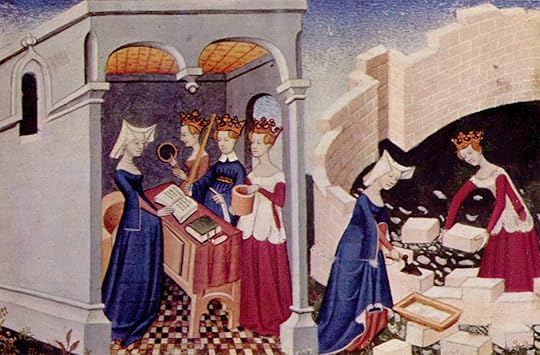
(An illustration from The Book of the City of Ladies.)
Her novel is a better read on the whole than this monograph on politics, but both are very interesting as slices of deeply important history which should not be overlooked or taken for granted. The notion of a self-educated woman in the 1300s openly challenging such deeply sanctioned social traditions makes for a very compelling subject to meditate on, even if the writing itself could be polished up (like most writing from so long ago).
Christine de Pizan is famous as France's first woman of letters. This less well-known book of hers is an extended presentation of the virtues necessary for political life. It is divided into three sections representing the virtues of the prince, those of the noble or military class, and those of the commoners respectively. A book like this served to translate the wisdom of the great writers of Greece and Rome for a Christian, medieval audience. Christine illustrates, following convention, all of the virtues that she discusses with stories from antiquity. Although the book provides a starting point for certain interesting questions, for example, "how does the honesty of the man-at-arms combine with his skill at deception in battle?" or "What does Christine's depiction of the lower classes tell us about these usually voiceless groups in medieval France?", it for the most part presents ideas that are better stated elsewhere. For the modern reader who is not a medievalist it is better to read Aristotle's Nichomachean Ethics or Plutarch's Plutarch's Lives: Volume I directly.
There is an entire genre of books aiming to provide guidance to princes. Machiavelli’s “The Prince” is perhaps the best known of these, followed by Castiglione’s “Book of the Courtier”. To read about the genre for the Italian Renaissance, see “Virtue Politics” by James Hankins. While these bear some resemblance to early modern management trade book, they are very often highly normative and try to provide a standard of principled Christian behavior for the ruler to follow, a standard that appears to have been most acknowledged by its breach. Machiavelli’s much more practical and non normative bent likely goes a long way to explaining how “The Prince” has remained so popular for 500 years.
“The Book of the Body Politic” fits right in her, although the author, Christine de Pizan, was a French woman rather than an Italian. She wrote other books and was one of the few women to address gender differences among the ruling classes of the time. This book also argues the norms for a prince and his network of counselors, servants, and other contacts, in terms of an analogy with the human body, with the Prince sitting on top of a broader collective of associates and contacts. This is not unknown among late medieval political tracts and this book’s analogy appears to be modeled after “Policratus” by John of Salsbury.
The book’s behavioral standards are normative and aspirational. There is no Machiavelli lurking around here in the shadows. Christine de Pizan was writing during a time of political turbulence in what became France.
Derivative and of mostly historical interest. (This is not a knock on the editor/translator.)
I suppose that is a bit harsh but the book is mostly examples pulled from Valerius structured according to a metaphor of society as a body, with a head (the prince), hands (soldiers and administrative staff), and all other parts (everyone else, in order, clergy, burghers/merchants, and craftsmen/laborers). As a metaphor it well enough captures the idea of division of labor that must exist in anything that can call itself a civilization.
The lessons for each of the parts are uncontroversial from a medieval point of view and perhaps somewhat more controversial from a modern perspective--but only rhetorically. I think those at the top of our society act as if they believe something like this metaphor, and that they are the head. The funny fable of the belly near the beginning of book three captures a timeless truth: since every part of the body is essential, every part wants to lead. But not all are called to or should lead.
I rated it three stars bc she is like one of the first women writers in France, maybe even THE first professional woman writer in France. I hate usually the word "female" because it feels icky. Anyway! I gave this book 3 stars because yay to a woman in a male-dominated field, but also the book was rather boring because it is like an instruction manual on how to behave and act in every level of society. I think mentioning all these ancient philosophers to help your country and your young prince during a time of war (Hundred Years War) is maybe helpful but I do wonder, given the war and civil unrest and religious disenchantment if anyone actually had the time to read it??? Makes u think, huh. Anyway x2, I had to write an essay on it and I do not think my essay was good, I also think that there was stuff that I wasn't getting so... maybe that is why I didn't enjoy it? Anyway, pray for my essay mark pls and if you're into what an educated lady thought politics should look like in the 15th century in France you may like this book!
Christine is amazing, i think knowing the context behind which she was writing was integral to my enjoyment of this novel. I didn’t love/agree with many of the concepts — that the quest for glory is good, that we ought to be good because God ordains it, that the prince can’t be spoken against — but when thinking about the rest of the time it makes sense and is largely progressive. She seems like a very well reasoned writer, which made it sad to read her apologies in advance for her lack of knowledge and asking forgiveness from everyone. Ending with “amen” was also interesting, because even though religion wasn’t a main facet of the book it was the basis of everything that was written. I could keep writing on but i have to do an essay on this and my mind is wiped out. Glad that this is the first woman we read ig, go off for inspiring Machiavelli
Not only the first female professional writer of her time but also arguably the first feminist writer, Christine de Pizan is perhaps best known for her utopian masterpiece, The Book of the City of Ladies. However, readers should begin by reading this, her major political work.
Reminiscent of both Plato’s Republic and Aristotle’s Nicomachean Ethics, and a precursor to the social contract theories of Hobbes and Rousseau, Pizan takes up the necessary education of different segments of the population, from princes to common folk, in order to create the best civil society possible.
Written in times of great tumult in Medieval France, the work expresses a longing for stability, peace, and enlightenment that will resonate with many today. See also Christine de Pizan’s The Book of Peace.