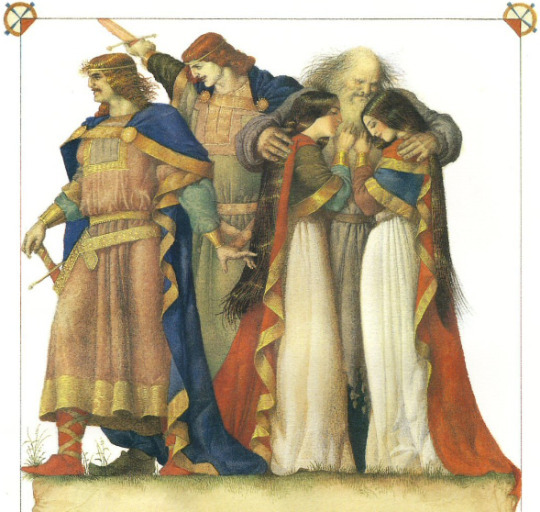
A haunting Irish legend, believed by some to be the basis for King Lear. A king's jealous wife puts a spell on his children, changing them into swans, until such time as the Man from the North and the Woman from the South - two mountain peaks - are joined together.
Each book I read offers a new perspective. In this post, I share my thoughts on this book in Persian and English. I hope this will be enjoyable for you :)
هر کتابی که می خوانم دریچه ای به دنیایی جدید است. تو این نوشته دیدگاه و تجربه ام از مطالعه ی این کتاب رو به دو زبان فارسی و انگلیسی با شما به اشتراک می ذارم امیدوارم خوندنش براتون لذتبخش باشه :)
Persian (فارسی)
فرزندان شاه لیر از شیلا مکگیل، کتابیست که نه فقط روایتگر یک افسانهی کهن، بلکه دروازهایست به دنیایی فراموششده از اسطورهها، طبیعت رازآلود، و روحی کهن که هنوز در دل مه و جنگلهای بریتانیا نفس میکشد. این کتاب با نثری شاعرانه و تصویرسازیهایی خیرهکننده، موفق میشود آن حس و حال اساطیری و باستانی را که در افسانههای سلتیک و روایتهای فولکلوریک بریتانیا جاریست، بهزیبایی زنده کند. سبک تصویرسازیاش—که به احتمال زیاد ریشه در هنر سلتیک یا هنر نو دارد—نهتنها چشمنواز است، بلکه بهطرزی جادویی، خواننده را در دل زمان و مکان دیگری غرق میکند؛ جایی که مرز میان واقعیت و افسانه محو میشود.
نویسنده با الهام از نمایشنامهی جاودانهی شکسپیر، «شاه لیر»، داستانی تازه و مستقل میسازد که در عین وفاداری به روح تراژدی اصلی، افقهای جدیدی را پیش روی مخاطب میگشاید. این کتاب نه در رقابت با شکسپیر، بلکه در گفتوگویی خلاقانه با اوست—ادامهای خیالانگیز بر پایهی میراثی سترگ، که بهجای تکرار، به بازآفرینی میپردازد. گویی نویسنده با احترام و ظرافت، افسانهی کهن را از نو مینویسد تا آن را برای نسل امروز زنده نگه دارد.
این کتاب را میتوان پلی دانست میان دنیای کودکانه و دنیای اسطورهها. برای نوجوانان و حتی بزرگسالانی که به افسانههای ملل علاقهمندند، یا میخواهند نخستین گامها را در مسیر شناخت اسطورهشناسی و فرهنگهای کهن بردارند، فرزندان شاه لیر انتخابی درخشان است. نه فقط بهخاطر داستانش، بلکه بهخاطر حالوهوایی که در دل آدم میکارد—حسی از شگفتی، احترام به گذشته، و اشتیاق برای کشف ریشهها.
English (انگلیسی)
The Children of King Lear by Sheila MacGill is not merely a retelling of an ancient legend—it is a gateway into a forgotten world of myth, misty landscapes, and an old soul that still breathes through the forests and fog of Britain. With lyrical prose and breathtaking imagery, the book masterfully revives the mythical and archaic atmosphere found in Celtic legends and British folklore. Its illustrative style—likely rooted in Celtic art or Art Nouveau—is not only visually captivating, but also magically immersive, transporting the reader to a time and place where the line between reality and myth gently dissolves.
Drawing inspiration from Shakespeare’s timeless tragedy King Lear, the author crafts a new and independent narrative that, while remaining faithful to the spirit of the original, opens up fresh horizons for the reader. This book does not compete with Shakespeare—it enters into a creative dialogue with him. It is an imaginative continuation built upon a grand literary legacy, choosing not to repeat, but to reimagine. With reverence and finesse, McGill rewrites the ancient tale to keep it alive for a new generation.
This book can be seen as a bridge between the world of childhood and the realm of myth. For young readers and even adults who are curious about the legends of different cultures—or who are just beginning their journey into mythology and ancient traditions—The Children of King Lear is a brilliant starting point. Not only for its story, but for the atmosphere it plants in the heart: a sense of wonder, a reverence for the past, and a yearning to uncover the roots of forgotten worlds.
If one is not familiar with the traditional Irish myth/legend of The Fate of the Children of Lir, one might be able to actually and perhaps even totally enjoy Sheila MacGill-Callahan's loose and much altered retelling without any reservations. For both the presented narrative and Gennady Spirin's accompanying illustrations are indeed rather charming, evocative of love, jealousy, sadness, adventure (combined with a typical, but rather clever happily-ever-after fairytale ending). However (and this is indeed a very very heavy and frustrated however), although legends and myths do indeed sometimes undergo many changes, an author should in my humble opinion ALWAYS clearly indicate whether his/her retelling, whether his/her version of a folktale, a legend is a radical departure from known and accepted versions. And in my opinion, with The Children Of Lir, Sheila MacGill-Callahan has absolutely and utterly (and unforgivably) failed to do this. Yes, she does indicate in a rather rambling (and as such also not all that readable) author's note that her reworking of The Fate of the Children of Lir is loosely based on an Irish myth. But indeed, her version of said story (with the happy ending, with the deus ex machina of the rescuing whale that actually is part of the Legend of St. Brendan, with the different spelling of Aoife's name etc.) all this is so fundamentally DIFFERENT from traditional Irish myth, legend and lore that Sheila MacGill-Callahan's The Children of Lir really is no longer simply a retelling, but an almost completely original story, one that uses the characters of the original tale (and even with these characters, there are changes), and the general concept of the Children of Lir being changed into swans by a jealous stepmother, but not much else. And furthermore, since The Fate of the Children of Lir is considered one of the most sorrowful and poignant tales of Irish folklore, of Irish myth, of Irish storytelling (their curse of having to live 900 years as swans, their final release by a Christian monk, their immediate death from old age upon release from said curse), Sheila MacGill-Callahan's version, with its fairytale-like happy ending, seems almost (actually seems very much) more than a bit of an affront to Irish culture and tradition.
Now as a tale in and of itself, The Children of Lir is actually in many ways quite lovely and moving, and Gennady Spirin's illustrations are indeed truly wonderful, stylish, artistic, expressive (a feast for the eyes and yes, to and for me, the best part of The Children of Lir). However, the presented story seems to have evolved into more of a Central (continental) European fairy tale. It no longer appears as the powerfully poignant, sorrowful tale of Irish (Celtic) myth and legend it originally was meant to be (but rather strongly reminds me of German, Lithuanian and French children into swans types of tales I have read, in which the enchantment is quickly removed and there is a happily ever after ending). And while I would I guess still but very much grudgingly recommend The Children of Lir to and for children who enjoy fairytales and folktales of transformation, especially of children being transformed into swans or other species of birds (older children, as there is quite a lot of text), I do so only with a major caveat that Sheila MacGill-Callahan's retelling of The Fate of the Children of Lir is to be approached ONLY as a very much and stylised "Kunstmärchen" refurbishing of the Irish original (and to and for me, because of the above described annoying issues with authenticity and yes, in my opinion, even possible cultural and folkloric appropriation, The Children of Lir only ranks two stars, a high two stars perhaps, but definitely not yet three stars by any stretch of my imagination).
This is a re-telling of the eponymous Irish legend with illustrations by Gennady Spirin. I quite liked MacGill-Callahan's re-working and happier ending and found her cadences good for reading aloud. I loved Spirin's palette of moss-greens and browns that seemed to reflect the forests, streams, and seas of long ago and far away Ireland.
This is an entertaining story, although after reading several reviews here on Goodreads, I understand that this book doesn't follow the original tale. Still, it was an interesting variation and we liked Gennady Spirin'a illustrations. Overall, we thought it was an engaging tale and we enjoyed reading it together.
This book was selected as one of the books for the March 2014 - Ireland discussion at the Picture-Book Club in the Children's Books Group here at Goodreads.
An Irish fairy tale Retelling. Lir, the king of Ireland has four children, twin boys and twin girls. His wife dies in childbirth so he marries her sister, who turns out to be an evil witch. The witch queen, jealous of the children, turns them into swans. The children must work with a variety of wild animals to lift their curse adn get rid of the evil queen. This is an interesting fairy tale. The pictures are complex and a little in the style of late European medieval paintings. There is little white space in the pictures, but the borders and words are almost all bordered white space. This is because it is a very wordy book. I would not recommend it for younger children because of its wordyness; however, it would work well for teenagers and young adults who want to look into fairy tales. In my English class, I would use this if I had a section on fairy tales. The story of children being turned into swans is a common one among these old stories, it's used all over Europe. It would be a great class discussion to figure out why this is.
I always loved this tale of children turned into swans. I wonder why the swan was chosen as the bird to change them into? There's another fairy tale where a girl's brothers are all turned into swans, and she's able to break the spell for all except one brother, who is left with a boy's body but the wing of a swan.
The artwork in this book is beautiful but it has a happy ending and what I like about this story is that it had a tragic ending and the children started aging rapidly because they were 900 years old or 100 depending on the version.
The four children of King Lir—twin boys and twin girls—are transformed into swans by their evil stepmother Aoife in this picture book retelling of the famous Irish myth from author Sheila MacGill-Callahan and illustrator Gennady Spirin. Taking to the skies, their mournful songs bring melancholy to all who hear them. Returning to human form every year on the same day, when their feet must not touch the ground or they will die, the children are aided by Jasconius the whale, and all the creatures of the earth and sea and sky. After seven years they are recaptured by Aoife, wrathful that King Lir, driven mad by sorrow, still prefers his swan-children's company to her own. In danger of being slaughtered, the children are again aided by Jasconius, and by the swans of the wild, who unite the two mountains, the Man of the North and the Woman of the South, and bring an end to the curse...
Sheila MacGill-Callahan departs significantly from the traditional myth in her retelling of The Children of Lir, inserting the character of Jasconius the whale, who actually belongs to the story of St. Brendan, and offering a happy ending after only seven years, rather than a bittersweet release after nine hundred. While this latter change might be said to drastically alter the meaning and overall tone of the story—in the same vein, one might argue, as Disney's reworking of The Little Mermaid—and therefore anger some, I confess to finding it quite interesting. It's not that I require a happy ending—indeed, I tend to prefer original versions, however tragic—but because it removes the heavily Christian element present at the end of the "original," in which the children are returned to human form as elderly men and women, converted to Christianity, and then pass away, it presents a fascinating inversion of the very process whereby the tale was first recorded. So many of the pre-Christian pagan stories of Ireland come down to us through the lens of the early Christian monks of that country, who were the first to record them. It is fairly clear that the insertion of Christian elements in these pagan myths, no doubt orally transmitted until that point, was a deliberate choice, and that these "original" tales actually represent a newer and transmogrified version of something more ancient. Thus, in a way, MacGill-Callahan's storytelling choices here are no more than an inversion of changes wrought by the original monks who recorded the tale.
Leaving that question aside, I did find this very enjoyable, as a myth in its own right, and I thought that the accompanying artwork of expatriate Russian illustrator Gennady Spirin was simply beautiful. I loved all of the visuals here, but I think the wordless two-page spreads were particularly lovely. With the caveat that readers be aware of the changes made to the traditional story, I would highly recommend this one to young folklore and mythology enthusiasts, and to anyone looking for beautiful picture book illustrations.
Quality Rating: Four Stars Enjoyment Rating: Five Stars
The Wild Swans is my favourite fairytale of all time, and The Children of Lir is almost like the Irish mythological version. It’s a very different tale to what I knew before, but just as enchanting and so interesting from a contextual background. This version also has the most beautiful illustrations that is so familiar from childhood fairytale books.
This is a beautifully illustrated retelling of an Irish legend. In the CHILDREN OF LIR, an evil step-mother, jealous of her husband's four children from his first marriage, curses them to live as swans for 900 years. She adds perilous condition-upon-condition that could shorten their magically lengthened lives. The ending of the tale is softened for readers, but the book's story is too intense for young ears. This is a perfect picture book for adults and older children who like folktales.
An Irish folk tale, full of deception, jealously, magic, curses, and an evil stepmother. When the king remarries his four children are turned into swans by their evil stepmother/aunt and are to remain that way until two mountain peaks, The Man from the North, and The Woman from the South are joined together.
A luminous picture book of classic fairy-tale style. I'm a sucker for swan-person tales, and this was a delightful, sibling-forward version. An all-around beauty.
The Children of Lir (1993). Written by Sheila MacGill-Callahan. Illustrated by Gennady Spirin. Motif: Evil Stepmother. This book is loosely based on an Irish folktale that tells the story of a king named Lir who has four children, a set of twin boys and twin girls. After the death of the queen, King Lir marries her sister. Unbeknownst to the royal family, the new queen has evil intentions. The evil stepmother casts a spell upon the children, turning them into swans. She swears to children that they will remain in swan-form until the two mountain peaks, the "Man from the North and the Woman from the South," are connected to each other. Luckily, the children meet friendly animal companions who help reverse the evil spell. The Children of Lir conveys themes such as family, friendship, and perseverance. Gennady Spirin's remarkable watercolor illustrations depict dark color tones and resemble a medieval European style. His illustrations enhance the written narrative. Overall, the book also does a solid job of balancing the illustrations with written text. At the end of the book, there is also a helpful pronunciation guide for the Irish named characters. Target Audience: ages 4-8.
Summary: The Children of Lir is a classic Irish version of the swan story: a king has four children, his wife dies, he remarries, his new wife is jealous and transforms the children into swans, animals befriend the children/swans, and eventually the spell is broken and the queen is forced to leave.
I love this story because it shows some of the Irish heritage in its story and it is beautifully crafted with the story meshing perfectly with the gorgeous pictures in the book. I intend to buy this book for my collection one day.
Picture Book
WARNING: this book could be controversial because of the magic involved.
This is a picture book of the Irish myth of the Children of Lir. As the story goes, a King Lir's jealous second wife, Aoife, changes his four children into swans who are destined to perish through her devilish scheming. Unfortunately for her, the children outsmart her and work with their animal friends to survive and live once again with their father.
The illustrations are beautiful and the story is captivating, although dark for very young children.
Gennady Spirin is another great children's illustrator, injecting an old-world attention to detail, yet with a soft, dreamy quality. He's illustrated many famous titles and I hope to collect them all--for the kids, of course. Oh yeah, this Irish fairy tale is lovely as well.
When I read the beginning of this story,I thought maybe I have read it in Chinese version in my childhood.But I was wrong.That story I have read is about a girl trying to save her brothers who turned into swans.
Love the illustrations. I have never heard this variation before. Some interesting possibilities for storytelling. Good for reading one on one with a child.