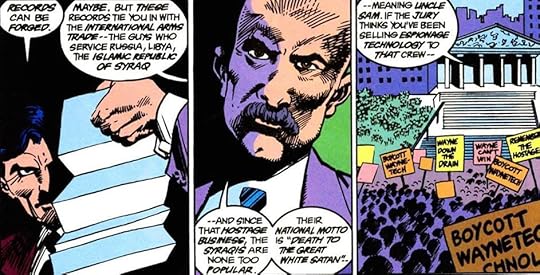
When Bruce Wayne refuses to allow illegal mind control experiments to continue at Wayne Technology, he finds himself charged with being a traitor. During the police investigation, Wayne is forced to confront memories of the various people who trained him to become the feared Dark Knight Batman. Wayne not only must clear himself, but also protect his secret and save his company from ruin. Batman screenwriter Sam Hamm makes his comic-book debut with BATMAN: BLIND JUSTICE, introducing new elements to the Batman legend including the character of Henri Ducard, played by Liam Neeson in 2005s smash film Batman Begins.
Sam Hamm is an American screenwriter, perhaps best known for writing the screenplay for Tim Burton's Batman and an unused screenplay for the sequel. As a result of his work, he was invited to write for the Batman comic. The result was Batman: Blind Justice, which introduced Bruce Wayne's mentor, Henri Ducard, who later appeared in Batman Begins. Hamm's other screen credits include Never Cry Wolf and Monkeybone. He also wrote unused drafts for Planet of the Apes and Watchmen adaptations.
This had some interesting elements like the introduction of Henri Ducard as Batman's former mentor and now his opposite number. There's also a lot of strange things like Bruce Wayne being accused of being a traitor and secret cabals within Waynetech that are experimenting on the homeless with mind transference. I thought it was just OK.
Actual rating 3.5 stars. Maybe it’s a good thing that I don’t look up page numbers when committing to a story line… (Though, I'm a little disappointed this won’t count towards my 2024 reads.)
Anyway, something I appreciated is that this didn’t show us a dedicated flashback to the ‘worst night in Bruce’s life’. That memory is a character all its own. Done as part of the moral of the story, not as a reminder to how tragic Bruce Wayne/ Batman is (though, there still is a bit of that in here).
While I understand Bruce has a lot of money to not go to jail, I think that could’ve been a cool little side thing where he’s sent somewhere for a few days, just to see how he would act.
I didn’t love the added characters of Roy and Jeannie. I liked J at first but by the end of the story, she’d been reduced to a foolish girl, projecting her knight in shining armour onto Bruce… Just to have her heart crushed.
Meanwhile, Roy was basically used as a plot device. Not necessarily a bad thing but he was effectively abandoned when he wasn’t needed.
The biggest reason someone would want to read this is also my favourite part… The conversation between Commissioner Gordon and Bruce where it is heavily implied that G knows exactly who Bruce is and will protect his friend’s character over his secret.
Overall, this was a pretty classic superhero story with an interesting enough twist to motivate you to get through the extra pages.
A great vintage read that really does the Dark Knight justice. You won't find The Joker or Catwoman in this story, or any of Batman's classic foes for that matter, which is actually very refreshing. Since Batman has so many iconic villains the plot and character of Bruce Wayne gets lost in the onslaught of other popular characters. In this story Batman doesn't have to fight for the spotlight, there isn't any Robin, Nightwing, or Batgirl to get in his way.
The story starts out as a pretty good mystery and develops into an interesting story with a satisfying conclusion. Overall, this late 80's (early 90s?) classic is a must read!
This novel was composed in honor of the 50th year anniversary for Batman and they had Sam Hamm, one of the screenwriters of the Michael Keaton BATMAN, come in to help with the story. Even though the art is a bit dated it still delivers well enough and I felt the concept was intriguing enough and executed quite nicely. In this tale Batman discovers illegal mind bending technology but finds himself in legal trouble as Bruce Wayne. There's a nice juxtaposition between Batman and Bruce Wayne here as well as said motivations of either character and whether they're morally correct.
The subplot tale of the woman who finds her brother (and had no family whatsoever before) was okay but I think they could have developed it more. I get it was a way to show her connection to Wayne's own family background. Note that the Ducard character made his first appearance here and showed up in BATMAN BEGINS.
ARTWORK: B; STORY/PLOTTING: B plus; CHARACTERS/DIALOGUE: B to B plus; EXECUTION OF SAID CONCEPT: B plus to A minus; WHEN READ: mid to late April 2012; OVERALL GRADE: B plus.
A slow piece that delves heavily into political drama. There are some interesting ideas and concepts, and when it works, it shines. However, there are times when it can feel slow and drawn out rather than snappy and concise. The supporting characters do their job well, and it's nice to see genuine consequences in a genre that's riddled with so few stakes in the current era. Interesting and wonderfully stylised visually, it's worth a read for those seeking something different.
Cada cierto tiempo, se reaviva mi interés en los cómics, en general, y en los superhéroes, en particular. A veces más intensamente, otras menos. El caso es que vuelvo a leer una historia de Batman años después, y la verdad es que me ha gustado. Tiene ese toque ambiguo que caracteriza al personaje, y también muchos de sus tropos que lo hacen reconocible. Puede que no sea el mejor tebeo del mundo, ni el mejor de Batman, pero, en cualquier caso, es una lectura muy entretenida.
For those that don't know, Hamm is the screenwriter for the 1989 Batman movie which was a huge hit on many levels. Hamm was asked to write this story to celebrate Batman's 600th issue of Detective Comics.
It's an interesting read because it has the pacing of a 2 hour movie, taking it's setting up the characters and unraveling the plot, so it feels like an 80's movie. The story actually involves very little Batman and more Bruce Wayne as he is accused of treason. Throughout the story you get pieces of just what Bruce did during his nomadic years training and this story also introduces Ducard, one of Bruce's mentors, also seen in the later reboot movie Batman Begins.
Artwise, it's the 'grim and gritty', with heavy inks and Cowyn's slightly scratching look.
All in all, a decent read, just not that exciting if you are looking for Batman. More of a "how is Bruce going to get out of this one without revealing his identity?"
DISCLAIMER: This review is based on the original comics, which are not on Goodreads, instead of the omnibus mentioned here. I couldn't find any other way to make said comics count towards my annual reading goal.
This is my first time in a long time reading an actual comic book series instead of an all-in-one omnibus...but I had a blast with it! Not only was the story great and the artwork outstanding, but even the advertising was a charming reminder of yesteryear! However, despite being old-school, it was still a bit edgier than I was expecting; while I knew there would be violence--it was a superhero story, after all--I wasn't prepared for blood, a bit of profanity, and even a reference to tobacco. You may want to think twice before giving these comics to a kid.
When i started this , i had a feeling i wont be a fan of this book , but by the end , despite some far fetched plot conveniences and some ludicrous plot twists , i was overall satisfied by the book . It had action , mystery , suspense and it also displayed the duality and moral dilemmas faced by the man who is known as Batman .
First time comic scribe Sam Hamm makes a pretty good stab at Batman for this fiftieth anniversary story. After uncovering illegal mind control experiments, at WayneTech, Bruce Wayne tries to shut it down, but is framed for treason and must prove his innocence. Alongside this, we have a parallel story of a girl finding her long-lost brother and contrasting their relationship with the isolation of Batman.
The most interesting stories about Batman have always been about the psyche of what drives Wayne and his constant renewal of the memories of his parents' death. This story plays on that nicely, without necessarily overdoing it. The art is nice as well, spiky and with a 'classic' feel to it, that is appropriate to Batman.
The volume is short, and, for me, at least, doesn't really linger in the mind very long after putting it down but it's entertaining enough while reading. Definitely worth a read, especially if your Batman lore is limited (like mine).
Bruce Wayne has been framed by a secretive international cartel because he was attempting to stop illegal mind-control experiments being carried out within Wayne-Tech. This gets Wayne and thus Batman into a world of trouble that will take all his resources - and some helpful friends to get out of.
One of the few stories that delves into the dark psyche of Batman/Bruce Wayne and does it brilliantly too. Initially published as a three part story on Detective Comics, this covers some of the ground that led up to Knightfall. Batman's mental demons have been catching up with him since the events of 'Death in the Family' and this story delves into that often ignored aspect of Batman's mythos. This would make a worthy movie, it's so good.
Good page-turner Batman story. Art was good to very good, even though the 80s style pointy shoulder pads on Batman's costume look totally stupid. I also really disliked the ugly and boring McMansion looking Wayne Manor, but that's a minor point really.
I’ve been wanting to read this as it was written by Sam Hamm who wrote the screenplay for the original Batman movie from 1989. (Arguably one of the greatest Batman movies of all time) This book was long at like 160 pages and it felt even longer than that. The story hooked me during some moments and had me falling asleep during others. On top of that, the artwork was just average in my opinion. Worth reading for the hard core Batman fans but for anyone else, I’d pass because there are PLENTY of great Batman stories out there that you’d be better off spending your time with.
What I genuinely liked about this story was the introduction of Henri Ducard, one of Bruce Wayne’s mentors who contributed to his training as the Batman. However, Ducard is quite an opportunist who doesn’t share any of Batman’s ideals and this makes his relationship with Bruce himself quite interesting and how that unfolds as this comic book progressed. Plot-wise, Blind Justice was as audacious as it can get. It dealt with mind control and some garden-variety villain who overcompensates for his physical weaknesses through the use of his intelligence. The writing remains very compelling despite the silliness of the plot nevertheless because Hamm was able to divulge into the dynamics at play among the chief characters. We get to see Bruce Wayne unmasked more often than when he’s Batman which then gives us insights on how people relate to him as the reclusive billionaire. Bruce is as socially awkward as one could expect which further alienates the people around him and that’s why it’s no surprise he retreats to his Batcave even during mornings. There are many amusing scenes about this especially when he had a brother and a sister as his house guests and they’re both trying to be friends with him yet Bruce refuses to take them fully into his confidence.
I find that some of the best Batman stories often revolve around the Bruce Wayne persona and how he works outside the costume since in this story, WayneTech faces indictment on the grounds of treason charges and he had to focus on this which somewhat cuts back his mask avenger hours at night. Alfred and Gordon were once again the centerpieces of such stories as their strenuous relationships with Bruce and Batman respectively became a strong presence for Blind Justice. Gordon also begins to suspect Wayne as Batman and even offers to testify for his defense but when Bruce fails to show up in court, that suspicion only blossoms. These plot points are the highlights of the story that make up for its average villain who feels more or less like a filler role. The real draw of Blind Justice is Bruce Wayne’s flashbacks of his training and they further paint his single-minded pursuit to become a symbol of justice and how exactly that kind of psychological obsession does damages to his personal relationships as a man.
This is number #11 of the Top 25 Batman Tales of all time as rated by IGN, which I have to admit I think is a bit high. Blind Justice is noted for being written by Sam Hamm who also penned the first Tim Burton Batman film in the late 80s starring Michael Keaton and Jack Nicholson. DC asked Sam to write something for the 50th anniversary of Batman's appearance in print. Sam of course had never written a comic in his life although he loved them and as it turns out dreamed of writing one. So it begins that he decides to tell not necessarily of Batman but rather, Bruce Wayne.
The basic plot is that an eeeeevil scientist is using WayneTech Industries for a mind control experiment and Bruce Wayne is unaware. The villain in this story is "Bonecrusher" and at least aesthetically bears a close resemblance to Bane. Just sayin'. The plot has points that are awesome if you stop and think about it, but come across as a bit cheesy due to the late 80s artwork in the strip. Also, the nakedness of Bruce Wayne continues in a staggering amount of shots of Bruce either completely nekkid or barely clothed. (I'm thinking of one rather awkward panel where Bruce is working out with a friend) Also of note, Henri Ducard is introduced in this graphic novel. He is one of the main trainers of Bruce Wayne back in the day and is also part of a hybrid character portrayed by Liam Neeson in "Batman Begins". Christopher Nolan combined the characters of Henri Ducard and Ra's al Ghul.
Overall, I enjoyed it but I didn't love it. The artwork was not old enough to be nostalgic and not new enough to be be slick. It is interesting to see the duality of Bruce Wayne and Batman once again as if Batman is a demon that has taken over Bruce. The concept of the book seems pretty ahead of its time for me because it deals with transferring consciousness and the like. Again, I have to make it through the rest of the books but #11 still seems high for this one.
Blind Justice gives us a plot involving mind control and a conspiracy that branches from Wayne Enterprises itself. The story is complex, full of original characters and also centers around Bruce's relationship with a woman and her brother, who once worked for Wayne Enterprises but has since lost his memory. These characters are welcome additions to the story, as they provide a fresh take on Bruce and Batman that we don't really see very often. They are just normal, everyday people like you and me thrown into an extreme situation and not sure how to handle it. This is a great Batman story with suprising plot twists and solid storytelling.
A really well-written Batman tale, very realistic and dealing with real world issues. Definitely recommended if you liked the movie 'Batman Begins'.
The drawing style is quite good, not a masterpiece, but that is a plus, as the art doesn't distract the attention from the story. I didn't like the coloring in the trade paperback edition: it's too bright-colored for this story, the original comic issues were colored better. Also, the TBP includes all three original covers, but only 7 pages of famous people paying homage to Batman (the original comics were published for Batman's 50th anniversary and had about 30 pages of the homage total).
I enjoyed this book. I like Denys Cowen as an artist as I am familiar with his work from The Question series. These Batman stories were to celebrate the 50th anniversary of the Batman run so these particular comic books had quite a few pages. Probably 30 per comic? Maybe more to part 1. I don't exactly know. I do recommend this if you can get it relatively cheap. It won't blow your mind, but it will certainly keep you interested. This actually somewhat inspired Batman Begins. Henri Ducard was a mentor to Batman in Blind Justice. In Batman Begins, Ra's al Ghul takes the alias of Henri Ducard. Just an interesting fact there.
Lowkey one of the greatest Batman stories ever written: top ten of all time. Maybe even of all Graphic novels of the 80s. There's a strong sense of the suffocating situation that he finds himself in in the sinister and pitiless world of 80s corporate America. The pacing here is magnificent. Few will truly appreciate this masterpiece and that's just the way it is.
Glad to reread this, thanks to my public library. I bet they could print it with more craft now. It's an ok Batman story, told with nice length and heft, with nice pencil art by Cowan and ink art by Giordano. The handful of pinups in back of the book are just as good. Mildly recommended.
I didn’t originally know the story was written by the screenwriter for the 1989’s Batman film, but after reading the forward, I found myself intrigued with seeing how he interpreted the Dark Knight.
I like what I saw.
Batman is presented with a mystery involving a revolving line of ‘roided out goons with tech able to emit lethal supersonic sound waves. When defeated the goons elect for suicide, usually in an explosive fashion, taking with them a chance to discover the men behind the masks. Yet despite knowing he is facing different men, they all seem to share the same memory. At the same time, Bruce Wayne is introduced to Jeannie, a young woman searching for a long-lost brother she’s traced back to Wayne Enterprises. The long-lost brother, Roy, is the linchpin of both plots. Found on the street as an amnesiac vagabond, he is quickly bonded with Jeannie, and Bruce invites the two to move in.
For being a story about body-swapping, the stakes presented feel surprisingly grounded. The antagonist’s scheme is easy to follow, and his end goal makes sense. The mystery has a few fun, if obvious, reveals, and the character writing is spot on. Jeannie seems poised to be made into Bruce’s new love interest, but it becomes clear the interest is one sided. It’s really Roy who spends the lion’s share of the plot with Bruce— who gets to know Bruce in a way few people do (…giggity?)— which works. Bruce’s mental state is a major focus— he seems even more driven than usual. He’s harder, more critical of himself. At the end of the story we learn this takes place after Jason Todd’s death, so the timing really fits the depiction of Bruce— and the clear symptoms of PTSD he’s manifesting— throughout.
I thought this Bruce was very well done. The text’s willingness to engage with both the morality and need of Batman, alongside themes of self-sacrifice, familial love, and duty and devotion make it memorable. A happy ending is in sight toward the end, right before a massive swerve off a cliff to hit a few trees on the way down. It’s a bit of a downer but fits exactly with Bruce at probably the lowest point in his life. It’s easy to imagine the events of this story pushing Bruce into a Dark Knight Returns sort of universe.
It's a shame Sam Hamm doesn’t seem to have done a lot of comic work after this. He has a strong grasp on the character and the noir stylings of the time— able to go ghoulish when needed, but never reveling in misery for misery’s sake. There’s a thematic point to all the pain Bruce and the others endure, and even something to say about the way the homeless are devalued by society at large. It’s a smarter story than I expected, and one I could recommend to anyone interest in a more introspective look at our favorite Caped Crusader.
Me gustó mucho la historia como también los personajes, incluso los secundarios. El conflicto y los antagonistas son realmente interesantes ya que no se trata de los típicos villanos de Batman. Mi única crítica es que hubiera preferido más desarrollo en la resolución de los problemas legales que Bruce estaba teniendo y también hubiera estado bueno verlo entender que es importante que tenga un papel más presente en su propia empresa para que no le vuelva a pasar lo mismo.
"For a man who cannot sleep, dreams pose a curious threat. Bruce Wayne's dedication is unstinting, his motives --though some might argue otherwise-- are noble. But the dream won't leave him alone. And the odd part is... he's wide awake. Awake or asleep-- it scarcely matters anymore. The nightmare is always with him. It taunts him around the clock-- subverting his resolve as insidiously as any foe he's ever faced. Each time, his parents die before his eyes. Each time he is the instrument of their doom. 'You could've let it scar you for life. But you didn't.' That's what the girl said. She admired him then. If only she'd known. Suffering is universal. Most people put it aside, look to the future, get on with the business of living. And some of them have surely suffered more than Bruce. Why can't he follow their example? Night after night he reopens the same bloody wound. Does he crave the pain, the sense of violation? Does he thrive on his own torment? He's rich, handsome, powerful. Why can't he be grateful for what he has? Why, why and why. All at once, with lecerating clarity, the answer is upon him: ...That's how Batman wants it. The world is full of evil. It needs a Batman-- to help the weak, to mete out justice. Justice. Yes. We get what we deserve. If there were justice in this world for Bruce, Batman would set him free. He'd make friends, fall in love, live his life-- as normal people do. There'd be no more anguish. No more dreams. No more wracking guilt when he tries to do the right thing-- and fails. Surely he deserves no less... But justice is blind. Blind as a bat."
This entire review has been hidden because of spoilers.
Blind Justice is a three-issue storyline that could be found in Detective Comics. In this storyline Bruce Wayne discovers a series of murders linked to WayneTech and it is up to him to solve the mystery and to clear his name. Batman: Blind Justice collects all three over-sized issues (Detective Comics #598–600) of the 1937 run of the series.
The story involves Bruce Wayne being accused of treason and looks into the men who trained him to be Batman. While abroad training, Bruce Wayne spent many years training in the Middle-East, which connected him to several notable anti-American figures. His other mentors includes Chu Chin Li and Tsunetomo, both well connected to the communist authority and Henri Ducard, the man who taught him tracking, is now an international arms dealer. Furthermore, Batman is currently hunting down a mind-hopping villain named Bonecrusher.
Sam Hamm penned the trade paperback. For the most part, it is written rather well. Sam Hamm has written a classic edge of the seat thriller that constantly shifts gears, remains unpredictable, and uses Bruce Wayne as the focal point in an intelligent drama, which connects two unrelated stories. It is a wonderful character study of both Bruce Wayne and Batman and introduces Henri Ducard, which would be instrumental in future Batman stories.
Denys Cowan penciled the entire trade paperback. Since he was the only penciler, the artistic flow of the trade paperback flowed exceptionally well. For the most part, Cowan penciling is wonderful in a traditional manner without much decorative frills, which is rather apropos to the narrative.
All in all, Batman: Blind Justice is wonderful story that celebrates both the fiftieth anniversary of Batman and the six hundredth issue of Detective Comics, which explores the character that made the series so popular – Bruce Wayne and how he became Batman.
Batman: Blind Justice is what would be considered a classic Batman story.
Bruce Wayne is Batman and what kind of justice does Batman give. WHY is Batman the way he is. Something lots of Batman stories have tried to answer and lots give a good answer and I think this one does too.
I think there are lots of things I can appreciate about the story. Some things really annoy me but overall I think this is a really good Batman story. It's consists of three issues Detective 598-600. And it was the 50th anniversary of the Bat and it contains lots of creatives talking about why they pick/love Batman.
It narrowly avoids the "Batman only needs a woman's love to stop being Batman." which I love that it does not fall into. It's smarter then that and has more to say about Batman.
It can be a bit ridiculous at times (rapidly losing money but can still afford opera tickets?) and it doesn't treat the token woman character with any respect, as she is there to fall in love with Bruce, experience tragedy, and never be heard from again.
The framing device it uses to look into his past with a trial for Bruce Wayne is well done.
Really I could go back and forth like this because everything is at least well executed. It can be annoying with the dated feeling sometimes but everything that annoyed me was not enough to not enjoy the hell out of this.
4 stars, if you like Batman this is a good one to read.
Cómic de Sam Hamm, quien guionizó las dos películas de Batman dirigidas por Tim Burton. Lectura interesante y recomendable para fanáticos del personaje. Argumento: "Cuando Bruce Wayne se niega a permitir que unos experimentos ilegales de control mental sigan adelante en el seno de WayneTech, termina acusado de traición. Durante la investigación policial, Wayne se ve obligado a enfrentarse a los recuerdos de las distintas personas que le entrenaron para convertirse en el temido Caballero Oscuro... Batman. Wayne no solamente debe limpiar su nombre, sino también proteger su secreto y salvar su empresa de la ruina. El guionista del largometraje Batman, Sam Hamm, debutó en el mundo del cómic con Justicia ciega, una historia que le permitió introducir nuevos elementos en la mitología del Hombre Murciélago. El más influyente de todos fue la creación de Henri Ducard, el mortal mercenario que ayudó a Bruce Wayne a convertirse en Batman. En 2005, Ducard cobró vida en la película Batman Begins. Denys Cowan es un aclamado director de dibujos animados (Static Shock) y dibujante de cómics (Icon). Dick Giordano ha sido uno de los más legendarios colaboradores de Batman —como editor, dibujante y entintador— desde 1970".
The execution comes off very dated, very 1989, but there's a lot of interesting stuff going on here and the plot doesn't drag. It's refreshing to see a lot of new villains and supporting characters, instead of the same overdone stories over and over. The mind control/bodyswitching again seems dated, but the concept on its own actually makes for an interesting story with Bruce out of commission for a while, but able to appear as Batman in another body... which doesn't work out very well. I thought the portrayal of Bruce's psyche, as constantly tortured by the Batman to keep him from moving on, to keep Batman alive, wasn't my favorite but was pretty reasonable as an explanation. Ducard had some pointed observations about the theatricality of his villains, too. About how their insistence on engaging him always results in the same "good vs. evil" storyline and ensures they'll be defeated, but real evil doesn't operate like that. Also I liked the Batman/Gordon dynamic, where Gordon obviously knows who Batman is but protects his identity. Bruce using a wheelchair could've been really interesting too, but I don't think they ever made much of that.
I read this novel in order to find out more about mysterious Henri Ducard, mercenary/detective that used to train Bruce Wayne before Bruce decided to become Batman.
Story in itself is solid one - Bruce trying to find himself and get out under the Batman's shadow with just a slight twist of silliness (mind control and other SF elements that I wont mention in order not to spoil experience for other readers).
But main character for me is Henri Ducard. Batman's evil twin, man who Bruce might have become if he left cynicism to take over his life, man who manages to uncover Bruce's alter-ego in a very short time but decides to keep it as a secret because Batman's actions are distractions to true criminal mastermind actions - actions in which Ducard also partakes.
This is an interesting one. Feels like Knightfall cribbed a lot from this book, with a wheelchair bound Bruce Wayne and his blonde replacement Batman. Although Knightfall does have the better villain in Bane over “Bone Crusher” and Dr. Harbinger. This was one of the more Bruce Wayne centric stories I’ve read, and I thought it was interesting to make him the target focus of the villain instead of Batman. However the plot to label Bruce as a communist felt a bit dated, even for the 80s. The mind control device plot was also pretty goofy, and I think the reader would have to be pretty dense to think Roy Kane would survive this book after learning Bruce Wayne’s secret identity. I just didn’t expect Bruce to get the poor guy killed in such a negligent manner lol
The panel where Bruce imagines himself as Batman on the witness stand clearing his name to the judge is going on my all timer list. Overall this was a fun read with decent art and a serviceable plot. Can’t ask for much more out of a comic book.



 "
"