A SWEEPING TALE OF TURN-OF-THE-CENTURY AMERICA AND THE IRRESISTIBLE FORCES THAT BROUGHT TWO MEN TOGETHER ONE FATEFUL DAY
In 1901, as America tallied its gains from a period of unprecedented imperial expansion, an assassin’s bullet shattered the nation’s confidence. The shocking murder of President William McKinley threw into stark relief the emerging new world order of what would come to be known as the American Century. The President and the Assassin is the story of the momentous years leading up to that event, and of the very different paths that brought together two of the most compelling figures of the President William McKinley and Leon Czolgosz, the anarchist who murdered him.
The two men seemed to live in eerily parallel Americas. McKinley was to his contemporaries an enigma, a president whose conflicted feelings about imperialism reflected the country’s own. Under its popular Republican commander-in-chief, the United States was undergoing an uneasy transition from a simple agrarian society to an industrial powerhouse spreading its influence overseas by force of arms. Czolgosz was on the losing end of the economic changes taking place—a first-generation Polish immigrant and factory worker sickened by a government that seemed focused solely on making the rich richer. With a deft narrative hand, journalist Scott Miller chronicles how these two men, each pursuing what he considered the right and honorable path, collided in violence at the 1901 Pan-American Exposition in Buffalo, New York.
Along the way, readers meet a veritable who’s who of turn-of-the-century John Hay, McKinley’s visionary secretary of state, whose diplomatic efforts paved the way for a half century of Western exploitation of China; Emma Goldman, the radical anarchist whose incendiary rhetoric inspired Czolgosz to dare the unthinkable; and Theodore Roosevelt, the vainglorious vice president whose 1898 charge up San Juan Hill in Cuba is but one of many thrilling military adventures recounted here.
Rich with relevance to our own era, The President and the Assassin holds a mirror up to a fascinating period of upheaval when the titans of industry grew fat, speculators sought fortune abroad, and desperate souls turned to terrorism in a vain attempt to thwart the juggernaut of change.
Praise for The President and the Assassin
“[A] panoramic tour de force . . . Miller has a good eye, trained by years of journalism, for telling details and enriching anecdotes.”—The Washington Independent Review of Books
“Even without the intrinsic draw of the 1901 presidential assassination that shapes its pages, Scott Miller’s The President and the Assassin [is] absorbing reading. . . . What makes the book compelling is [that] so many circumstances and events of the earlier time have parallels in our own.”—The Oregonian
“A marvelous work of history, wonderfully written.”—Fareed Zakaria, author of The Post-American World
“A real triumph.”—BookPage
“Fast-moving and richly detailed.”—The Buffalo News “[A] compelling read.”—The Boston Globe One of Newsweek’s 10 Must-Read Summer Books
As a correspondent for the Wall Street Journal and Reuters, Miller spent nearly two decades in Asia and Europe, reporting from more than twenty-five countries. He covered fields as varied as the Japanese economic collapse, the birth of a single European currency, and competitive speed knitting. His articles have also appeared in the Washington Post and the Far Eastern Economic Review, among others, and he has been a contributor to CNBC and Britain's Sky News. The President and the Assassin stems in part from several years of researching and writing about global trade.
Mr. Miller holds degrees in economics and communications and earned a Master of Philosophy in international relations from the University of Cambridge. He now lives in Seattle with his wife and two daughters. He enjoys mountain biking, back-country skiing, fly fishing and college football.
That's all a man can hope for during his lifetime - to set an example - and when he is dead, to be an inspiration for history. William McKinley
Scott Miller used the assassination of President William McKinley as the centering point of this historical overview of the events at the end of the 19th century and the beginning of the 20th century that brought America forward as a world power. This book came out almost at the same time as Destiny of the Republic: A Tale of Madness, Medicine and the Murder of a President, a book about the Garfield assassination,and both books are not only highly readable, but do an excellent job of describing the state of the world during these time periods.
This was a time of great expansion for the United States. Railroads were booming, factories were roaring along at such a productive rate that new markets were needed to move the surplus, and a small percentage of Americans were getting very, very wealthy. Working conditions were still at this time substandard with long hours and hazardous working conditions. The times were ripe for labor to organize and the country was beset with striking railroad and factory workers. Clashes between owners and labor often became bloody. Anarchists saw this as an opportunity to push their own agendas and their dynamic speakers spread through out the country encouraging violence and preaching that upheaval was the only chance for change. One of the most successful and sought after of these anarchist speakers was Emma Goldman.
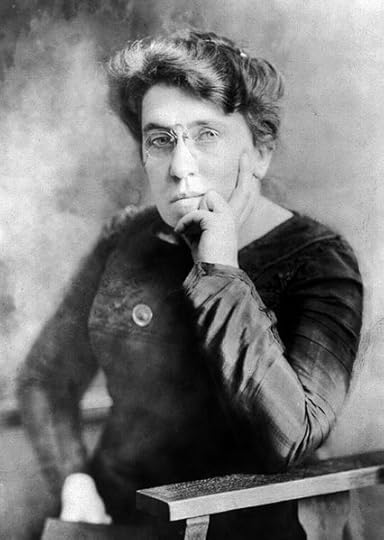
Emma Goldman Pin-up Girl for the Anarchist movement
I had to laugh when I read that Emma Goldman was the pin-up girl of the anarchist movement. Anarchists when arrested were invariably found with a picture of Emma in their wallets. I have never seen a picture of Goldman that gave me even the hint of a tingle, but to the movement, to these lonely, disenfranchised males she was the Marilyn Monroe of the day. She came to the United States and opened a restaurant on borrowed money (capitalism? hmmm)and became a successful small business owner. She became so excited about the strikes flaring up across the country that she closed her restaurant and went on a wide ranging speaking tour. Leon Czolgosz, not only saw her speak, but also spent a few hours in her company. At the time she was not impressed with him, but she soon would be.
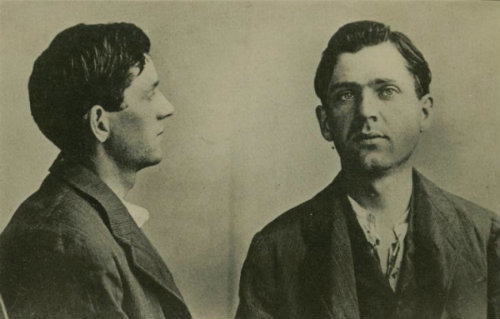
Leon Czolgosz
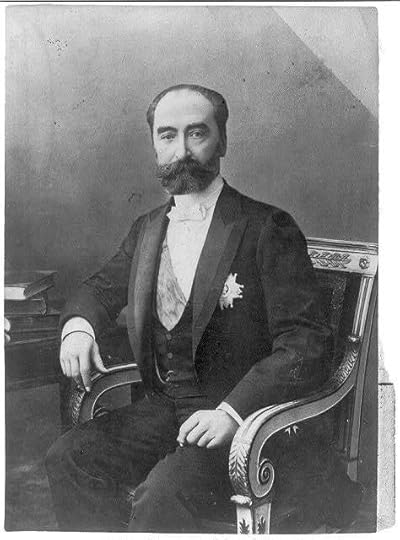
I haven't read enough on this era because I had no idea how aggressive and successful(?) the anarchist movement was not only in the United States, but across the world. In 1894 an Italian Anarchist Caserio stabbed to President of France Carnot to death.
President of France Marie Francois Sadi Carnot
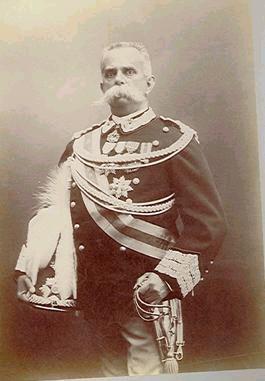
In 1900 another Italian/American Anarchist shot to death King Umberto of Italy. In a moment of real hubris the Italian American anarchist movement became frustrated with the inability of their European cousins to remove their king from power. They drew straws and Gaetano Bresci won the privilege of assassinating the foreign dictator.
King Umberto I of Italy
All of this was foreshadowing for the successful attempt on President McKinley. Leaders were accessible and all it took was a man with the nerve to perform the deed.
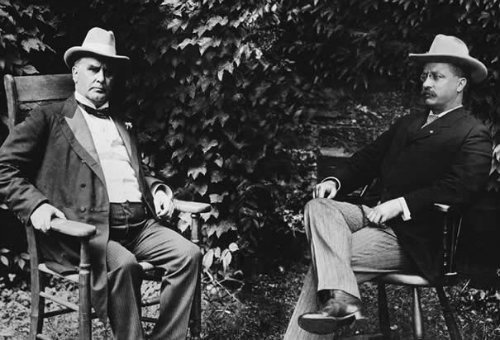
When Spain started having difficulties with the natives of Cuba the United States sent the war ship S. S. Maine to Cuba to protect the 8,000 American citizens on the island. This was read correctly by the Spanish as a move of intimidation. The explosion of the Maine was the impetuous the US needed to intervene. Under the leadership of George Dewey the American Navy decimated the Spanish at the Battle of Manila Bay. The Spanish sue for peace and in the process the US obtains Guam, the Philippines and Puerto Rico. Cuba is also liberated and the influx of American business men with bulging briefcases of cash invade Cuba. This was the perfect opportunity for America to bring Cuba under the flag, but due to an anti-imperialist movement the island slips through their fingers. The emergence of Teddy Roosevelt during this time was a marvel. Garret Hobart died leaving the vice presidency open, and Roosevelt aggressively campaigned for the job. With a healthy, young President the party decided one of the safest places to tuck Teddy was in the vice presidency.
William McKinley and Theodore Roosevelt
This is an interesting time in American history with emerging markets in China, the development of a strong navy, our involvement with the Philippines, the beginnings of organized labor, and oh yes the assassination of an American President. I am the eternal optimist when reading a book like this. I know the outcome and yet as I'm reading the book I'm still pulling for a different result. This time the secret service will react fast enough and Czolgosz will be thwarted or the gun misfires as it did with the assassination attempt on Andrew Jackson. Alas, the space time continuum remained intact and the bullet does perforate McKinley's stomach, pancreas, and kidney, and 8 days after he is shot McKinley dies. This is one of those books that leaves the reader with a working knowledge of an important decade in American history and also encourages the reader to explore further. Every chapter presented a new perspective and I could feel the building blocks of knowledge sliding into place. Highly recommended!
Scott Miller has written a popular history of the assassination of President William McKinley, and the political and social climate leading up to the fateful day in 1901. He used a two-pronged approach in writing the book. Chapters dealing with McKinley's presidency alternate with chapters involving the anarchy movement and his assassin, Leon Czolgosz. The chapters about the history of the anarchists are often set up to a decade earlier in time than the McKinley chapters, but the two timelines meet when McKinley is shoot at the Pan-American Exposition.
The United States was changing from an agrarian society to an industrial one. Factory workers worked long hours in dismal conditions for little pay. At the same time, the heads of big businesses were growing extremely wealthy. The factories were producing at top levels with an oversupply of products, so McKinley looked abroad for more markets. The navy was strengthened as ships were added with the help of Theodore Roosevelt. McKinley slowly changed his views on imperialism during the Spanish-American War, the annexation of Hawaii, and American involvement in China since he hoped to export goods overseas. The United States was becoming a stronger international power as it developed a presence in Asia.
On a personal level McKinley comes across as a caring man who was a devoted husband to his invalid wife. He had a genuinely friendly attitude so he was also popular with everyday people. He was a supporter of big business as a way of keeping everyone employed.
This was a time when labor unions had little power, and already low wages were sometimes reduced even more. If the workers went on strike they were easily replaced. The book tells about some of the chief anarchists who were fighting for the common man such as Albert Parsons, Johann Most, and Emma Goldman. Leon Czolgosz was a Polish immigrant and factory worker. He was a loner who was attracted to anarchism, and was especially fired up by the speeches of Emma Goldman. Czolgosz viewed the government as a friend to business interests while ignoring the workers. He said, "I killed the President for the good of the laboring people, the good people." But McKinley was a beloved, popular President so the country was in deep mourning.
Scott Miller, a journalist, wrote an engaging book about the era. It does not have as much detail as a complete Presidential history, especially about domestic policy, since its focus is on events leading to the assassination. The author is a good storyteller who writes about history in a colorful and accessible way.
Both The Destiny of the Republic by Candice Millard and The President and the Assassin by Scott Miller were first published in 2011 and have similarities worth comparing. Both have as subjects presidents (Garfield and McKinley) who were assassinated by lone gunmen, Garfield in 1881 and McKinley in 1901. Both assassins had gripes, one personal (Guiteau) and one was an anarchist (Czolgosz). Both presidents were competent men and popular in their times although largely forgotten now.
The President and the Assassin tells the story of McKinley and Czoglosz in alternating chapters. The book deals heavily with anarchism in America, the beginnings of the U.S. in world politics, colonialism and big business/labor issues. I found this book to be good history but not nearly as engaging as the writing about Garfield and his times by Millard. It is worthwhile to read both books as studies of assassins and to see how times were definitely changing by 1901.
Scott Miller weaves together 2 stories: the presidency of William McKinley, and his assassination by the anarchist Leon Czolgosz. He alternates chapters and brings the stories together at the end. Sometimes this format works well and sometimes it doesn’t. I thought it worked great in this book– it was Erik Larson quality.
Miller presents a succinct biography of McKinley and describes some of his presidential challenges. The war with Spain was given a lot of attention, which makes sense because this was a driver of anger from the anarchists that Czolgosz spent much time absorbing. If you believe Miller, McKinley comes across as a good man, a devoted husband (to a wife troubled with physical and psychological ailments), and a competent president. I also liked learning about U.S. attempts to establish a global empire by getting its hooks into Cuba, the Philippines, and Puerto Rico.
The chapters that tell the story of Czolgosz don’t focus on Czolgosz himself but instead tell the broader story of the anarchist movement and why someone like Czolgosz (an unsuccessful loser who blamed others for his failures) was attracted to it. My favorite part of the book was learning about the anarchist history in the U.S. Anarchists were a key part of the history of the time, both in the U.S. and Europe. There were several leaders murdered by anarchists around this time, like the King of Italy and the Prime Minister of Spain.
I’m interested in learning more about the anarchist movement. They were driven by anger over labor issues and seem very similar to Communists. I don’t quite understand the distinction between these groups. It’s also interesting how in the U.S., we were able to handle having some low level revolutionary activity without it getting too high, and without too severe of a right-wing backlash. And it’s amusing to think about these angry, unsociable loners like Czolgosz trying to band together and make plans to implement their revolution.
The McKinley assassination is the least discussed of the 4 U.S. Presidential assassinations. I think much of this is that Czolgosz is a drip. He never said much about why he did it, other than to repeat some anarchist slogans. He is just an angry, impressionable loser who one day learned that McKinley will be near him. On a whim he decided to murder him and accomplished it thanks to a soft spot in McKinley’s security that day. It’s actually quite disconcerting and makes me think assassinations of our leaders are much more probable than we think – it just takes one disturbed individual that is lucky enough to find an opportunity.
President William McKinley is usually remembered as the President who was assassinated which brought Teddy Roosevelt to the Presidency. Roosevelt's vibrant persona and daring deeds overshadowed the thoughtful McKinley but it was McKinley who began the programs/conquests that Roosevelt carried to fruition (or disaster, depending on your politics). It was a time when America emerged as an industrial powerhouse, spreading influence around the world, usually by armed forces.
This is a dual biography of McKinley and his assassin Leon Czolgosz, with more emphasis on the President since Czolgosz's life story is somewhat vague. Was Czolgosz an anarchist or just a misguided young man who craved attention? I don't think the author answers this question but I'm not sure there is an answer because of Czolgosz's enigmatic personality.
The author does a first rate job of melding the cast of characters from noted anarchist Emma Goldman through Secretary of State John Hay and McKinley's frail wife, Ida. He has used his resources material well and brings to life a time when America was young and brash, and a gentle, introspective President was gunned down senselessly. This is an excellent book which I would highly recommend.
Quite an interesting book about America and the man (McKinley with help from Teddy Roosevelt) that had a vision for imperialism and economic expansion in the latter part of the 19th century, the radical aspects and actions of anarchic thought and its main figures of the time (Emma Goldman, Albert Parsons and Johann Most, just to name a few) and the eventual murder of a beloved President that had the ambition to take a developed society to the forefront of being a superpower in the world for years to come.
As alternating chapters capture McKinley, his excuse for war with Spain over Cuba to expand the American economy westward (a la Manifest Destiny but on a completely different scale!) and political struggle of a group with the political philosophy of anarchy and what they intended to do for the betterment of society, without government, viva la anarchie!, Miller shows a troubling time in our recent past, but also an ambitious one as well. Ultimately, with the Haymarket affair still on the minds of many, a lost man of thought and mind, a German immigrant looking for anything that meant something, that called his name, to do his duty per se, took it upon himself to do what he thought needed to be done in the name of his belief, his philosophy: Leon Czolgosz murdered the most important figurehead in America.
Prior to reading this, I hadn't read much on McKinley and his tenure as President because I mostly knew of him as the third president to be assassinated. I would say many of my generation think of him in these terms, that's if they even know about it. When it comes to assassinations, many think of Lincoln and Kennedy; Lincoln, because we, as Americans are all taught about the Civil War and the effect it had on society during and afterwards and Kennedy, with his celebrity and it being a mysterious so-called conspiracy that many older adults still recall from their youth as if it was just yesterday.
Don't you think it's interesting that some Presidents are mostly known for the bullet that shattered their lives?
If you are a fan of narrative history that is well written and provides an engaging story with a tinge of analysis then Scott Miller’s THE PRESIDENT AND THE ASSASSIN should be of interest. Miller has written a dual socio-political biography of William McKinley through his assassination in 1901, and the development of anarchism in the United States zeroing in on Leon Czologosz, McKinley’s assassin, and other anarchists including Emma Goldman. As you read the book many comparisons to contemporary problems emerge. Miller’s dominant theme centers around the idea that the election of William McKinley in 1896 and the policies pursued by his administration set the tone for the 20th century and set the United States on course to being the dominant power in the world. While a strong case is made in support of this viewpoint there is very little that is new in terms of historical interpretation. What is valuable is how Miller synthesizes a great deal of material in a very cogent and readable fashion.
What is most interesting in the book is the development of the Open Door Policy that has been attributed to Secretary of State John Hay. In fact the British approached the United States as a means of protecting their trade in China as they were engulfed in the Boer War from 1899-1902. For the United States the policy was designed to guarantee trade access to China at a time of political disintegration and foreign threats from Japan and Russia. The discussion is well laid out as are other diplomatic issues. On the domestic front Miller does his best work as he explores the origins of anarchism in America through the eyes of Albert Parsons, Johann Most, Emma Goldman and the revolutionary want to be, Leon Czologosz. The author takes the reader through the labor unrest of the 1880s and 90s concentrating on the Haymarket Massacre in Chicago and the Homestead Strike in Pennsylvania. The main characters with their ideology and motives are delved into nicely and the plight of labor is reflected in a very sympathetic fashion.
McKinley is presented as a moral person who evolves into a proponent of imperialism. With the backdrop of the Depression of 1893 McKinley, who viewed himself as a god fearing man will justify the annexation of Hawaii, the Spanish American War, and the insurrection in the Philippines on moral grounds. McKinley reached the conclusion, (through the assistance of prayer!) that the American economy if it were to recover needed foreign markets. So “the man with no overseas ambitions….spoke of extending America’s footprint from the Caribbean to the farthest reaches of the Pacific.” (178) With the Spanish Empire available, McKinley prayed for guidance, then took the plunge resulting in war with Spain and the crushing of a bloody indigenous movement in the Philippines resulting in the death of 4,234 Americans as well as 2,818 wounded. On the Filipino side 16,000 native soldiers were killed and up to 200,000 civilians passed from famine and disease. For the United States this was the American version of Rudyard Kipling’s “White Man’s Burden.” Reflecting our racial superiority, Americans believed it was our duty to pacify and civilize native populations, as was seemingly preordained by the concept of America as a shinning “city on a hill” during the Puritan era.
In comparing the problems faced by the United States during McKinley’s administration and events of today it is interesting to compare what occurred in the Philippines to Iraq and Afghanistan. In particular it is important to contemplate these events and their outcomes as the debate rages in Congress as what Washington should do about the slaughter that is taking place in Syria. Other comparison might be made on the economic side as trusts dominate business at the turn of the century and how multinationals and other large corporate entities control our economy today. The Depression of 1893 and the 2008 meltdown may bring food for thought as do the “Robber Barons” of yesteryear and the “1%” today. Realizing that historical comparisons can overdrawn, but I give the author credit for suggesting that as George Santayana has stated “those who do not remember the past are condemned to repeat it,” again food for thought.
“The President and the Assassin: McKinley, Terror and Empire at the Dawn of the American Century” is Scott Miller’s 2011 tale of McKinley’s presidency – and of his assassination. Prior to writing this book Miller spent almost two decades as a correspondent for Reuters and the Wall Street Journal.
Two things are immediately obvious to readers of this popular history. First, despite the fact it covers much of McKinley’s life in one form or another, this is not a traditional biography. Rather, it is two-books-in-one, alternating between story lines involving President McKinley and Leon Czolgosz (his assassin).
Second, Miller is a natural storyteller and not a historian. He draws the reader into the narrative by vividly setting each scene; his style is perfectly calibrated to maintain interest. Rather than recounting tedious historical facts, Scott simplifies the landscape and engages the reader by dramatically describing the two Americas of McKinley’s day: one controlled by large corporations and another comprised of a working class struggling to survive on poverty-level wages.
The book alternates between chapters focused on McKinley’s presidency and others focused on Czolgosz. Unfortunately, in order to fit McKinley into his narrative the author oversimplifies him as completely captive to big business and largely oblivious to the plight of the poor. Almost completely ignored are McKinley’s long-held views for strong tariff protection in sympathy with the working class.
The thread involving Czolgosz is a fascinating (if depressing) description of the economic circumstances which led to increasingly frequent, and violent, labor unrest during this period. One can almost sense John Steinbeck’s approval of how Miller handles this aspect of the story. And although the reader never sympathizes with Czolgosz himself, it is impossible not to better appreciate the conditions that led to the era’s labor strife.
The parallel construction Miller employs is interesting and potentially compelling, but imperfectly synchronized. The chapters involving McKinley are often several years ahead of adjacent chapters covering Czolgosz. As the narrative bounces between the two story lines, great care by the reader is often required to avoid confusion over the chronology. Only as the date of McKinley’s assassination approaches do the two timelines converge.
To his credit, Miller does a far better job than most biographers in describing the American conflict with Spain over Cuba and the Philippines. His ability to boil complicated issues down to their most colorful and comprehensible essence is admirable. But in simplifying history, he often ignores or overlooks important (if tedious) nuances that are critical in really understanding a particular issue.
But what is really missing from Miller’s book is a more complete portrayal of McKinley himself. His pre-presidency is only briefly addressed. His formative political years in Congress and as governor of Ohio, in particular, are given only cursory coverage. In addition, interesting (and revealing) moments are missed such as his cabinet-building process, his domestic policy efforts while in office, and his relationships with his ailing wife and most important political advisers.
Despite these handicaps, however, Miller has authored a fast-paced and captivating book about the convergence of McKinley’s life with that of a disaffected anarchist who prematurely ended this president’s second term in office. Judged as a comprehensive and critical biography of McKinley and his evolution as a politician (a role it does not feign to assume) this book falls far short. But as a popular history focused on the events leading to McKinley’s assassination, Miller’s book is endlessly engaging and entertaining.
Despite two assassinations in the previous thirty-six years, Presidential protection in 1901 was still not very good. Unfortunately, William McKinley found out just how vulnerable he was when Leon Czolgosz shot two bullets into him at the Pan-American Exposition in Buffalo. McKinley lingered for about a week before dying, at first seeming to stabilize but then rapidly deteriorating due to gangrene. Scott Miller writes about the times and circumstances leading up to this long-ago and barely-remembered event. Miller takes us around the globe: Cuba, the Philippines, China, Japan; and around the country: Washington D.C., Canton, OH, New York, Pittsburgh, Chicago and of course Buffalo at the end.
This is not a biography of McKinley, nor of Czolgosz (there would not be enough material to write a book solely based on this wretched man). Instead Miller focuses on important events that occurred and actions that McKinley took during his momentous first term in office. McKinley, initially not intentionally, helped usher in a new century for America - one in which the country would venture out across the globe, attempting to spread its "values" to peoples it considered inferior to itself, and putting a hand into the cookie jar labeled "Imperialism" multiple times. McKinley was not elected for that, and was lukewarm at best when he was first presented with avenues to expand U.S. influence. His attitude changed fairly rapidly though, sometimes with little justification for doing so.
McKinley, while not looking for war, seemed resigned to the fact that it would happen with Spain. Miller never successfully gets into his thinking; yes, McKinley did want to open up trade routes around the globe, and he supported Secretary of State John Hay's Open Door policy with China. But McKinley, a Civil War veteran himself, and very solicitous of the needs of U.S. troops, did not attempt to the pump the brakes on Theodore Roosevelt and others who were clamoring for war with Spain. Ostensibly, the U.S. used the (almost certainly) accidental explosion of the USS Maine as a pretext for war. In reality, it would seem beyond a reasonable doubt that the Spanish did not blow up the ship, that in fact it was due to spontaneous combustion of its coal supply. While this was determined decades later, even at the time of the incident, there existed no proof that the Spanish were behind the sinking of the vessel. Nonetheless, McKinley used it as a pretext to wage war. And for good measure, why stop with just Cuba? Get the Philippines too, was the thinking. They would be a nice possession, McKinley and Congress thought, following the recent U.S. annexation of the Hawaiian Islands.
Miller also examines the anarchist movement, focusing in particular on the Haymarket riots, the Homestead strike, Alexander Berkman, and Emma Goldman. Czolgosz pops up in the narrative here and there, but he is almost a minor character throughout the book. Miller pays more attention to the nascent anarchist movement and how most Americans viewed anarchists. Czolgosz seemed to me to be at the fringe of the movement, much more so a loner than anything else. He was mildly lazy, working sometimes, loafing others. He was also a vagabond, bouncing around between Cleveland, Detroit, Chicago, Buffalo and Akron. Czolgosz had no friends; even his family disliked him due to his disagreeable nature.
Also, and perhaps I missed something here, but I did not fully make a connection between Czolgosz and anarchism. He was not very active in their causes. While he did attend some meetings at intervals, he was viewed with suspicion by most of the other known anarchists. He did not evidence any hatred or intense dislike of McKinley prior to pulling the trigger of his revolver. So was he an anarchist? Or just a disgruntled loner? I am not really sure. Unlike Charles Guiteau (James Garfield's assassin) he was not judged insane or anywhere close to that. Honestly, he made me think of Oswald and his assassination of John F. Kennedy. Both of these men did not seem so much as to espouse any particular cause (although Oswald definitely held some Communist leanings) as to be nasty little men lived unhappy existences and made those around them unhappy.
Miller provides a nice epilogue, reviewing in brief all of the major areas that he covered in the book: anarchism, China, Cuba, the Philippines, the Open Door policy, Ida McKinley, American imperialism, and Goldman. The events of McKinley's presidency significantly altered America's role in global affairs, and while not making it a super power overnight, definitely set it on the path to becoming one by the end of WWII.
But ultimately this book did not fire on all cylinders for me. There was too much jumping around, both in timeline and in geography. Miller alternated chapters between the imperialist storyline and the anarchist movement. And among those, the location changed each chapter. So the result is that the reader is plunged into 1890s Cuba only to immediately be throw backward into Chicago twenty years before, then sent forward to the late 1890s but in China instead of Cuba, then back in time again, but this time to the early 1880s in Pittsburgh. It did not work for me. I am not opposed to alternating the storylines between chapters. Many writers do that well (Erik Larson is one that immediately comes to mind). But the shifting places and combined with the shifting in time, and then throw in different people being the focus from one chapter to another, made the narrative disorienting. The actual assassination itself, aside from the lead-up to it in the very beginning of the book, almost seems like an afterthought by the time Miller gets to it. In addition, he abruptly returns to the moment when McKinley is shot, in the middle of a chapter. Conceptually, this probably looked a lot better in an outline form than how the final product ended up.
The late 19th century was a bumping time for much of America. With the pesky Gold versus Silver standard thing out of the way (think of the troubles it would cause if the Fed started buying up Bitcoins), McKinley was able to swagger into office amid a boom in American production and exports. Railroads are crisscrossing the nation, we’re fighting over a whole bunch of islands and coming to the conclusion that we’d pretty much be doing the entire world a disservice if we refused to get at least a little bit of an imperial groove on. Oh and also terrorism.
My Cop-Out: I really enjoyed this book- I think depicting parallel lives is a great way to illustrate the goings-ons and social movements of an era. Alas, I find summarizing history a daunting task, and I highly recommend Jeffrey Keeten’s review for a witty Cliff’s Notes version/review of this book.
Tidbits of interest : Shockingly (note my sarcasm), some people made out better than others in this thriving economy. Turns out income inequality is not something invented in the 20th century. In other news, OSHA wasn’t really a thing, and children’s little hands made them particularly useful candidates for 80-hour work weeks. The plight of the working class was seized upon by a cast of characters, including the poster girl Emma Goldman, to stir up an American anarchist movement. I mean, who wouldn’t want to blow themselves up for this face?
Our assassin, Leon Czolgosz, has got to be one of the most annoying humans out there. No one liked him. He lazed around his father’s farm, claiming to be too sick to work and incurring the wrath of his stepmother who correctly diagnosed him with a bad case of malingering. Had it been invented, he definitely would have been playing XBox all day. The anarchists didn’t even like him. Smooth was not his middle name. “Hey, do you guys have any secret meetings going on?” Seriously, he just sucks so much.
Ida McKinley has been officially nominated (by me) for the least likable FLOTUS award. Pulling McKinley from meetings to help her pick out a dress - really? Mckinley was seriously whipped.
This is a biography about two people - a victim and his killer. It's not merely a description of their lives; it's also an account of the time in which they were living. As president of a new, fledgling global force, William McKinley had lots of power. He was president during the Spanish American War; a war which resulted in American control of Cuba and the Philippines. Two nations on opposite sides of the world. McKinley's assassin, Leon Czolgosz, a first generation immigrant, had no power. Czolgosz became enamored of the currently popular anarchist movement. He had his own interpretation of the anarchist philosophy and decided he would be doing a good thing if he eliminated the most powerful person in his new country.
I had an inkling of the turmoil in the US at the turn of the 20th century but not to the extremes described in this book. Labor strikes were ugly and gruesome. Regular citizens were both proud and aghast at their country's new station in the world. They didn't see themselves as Old World imperialists but rather as defenders of freedom. Everyone was having trouble figuring it out.
I found this all very enlightening. This book filled a "black hole" I had/have about this period in US history.
Interesting at parts. The long Afterword brought this rating down a star. No real necessity for such a long Afterword. I didn't have much problem with the lengthy discussion of the Spanish-American War, history of anarchy, etc., but I wasn't crazy about the recapping of the previous 300 pages.
Not really all that much detail about the medical mess made of McKinley and his missing bullets, which is something I thought would be included. There are also other books that go further Czogolz and his motivations. The labor movement got short shrift here, too.
Great bit of history. There was much more to learn other than the obvious details of President McKinley's assassination. Most notably, the US move into the 20th century and the era in which it took it's place as one of the world powers. There were a lot of unanswered questions about my countries history that were satisfied within these pages. Well worth the read.
Contains biographical elements, but more a history book focusing on American society during McKinley's presidential years, including the first campaign itself, sadly a forerunner of the Citizens United issue a century later. Focus alternates between the men, giving an incredible fly-on-the-wall feel! Strange parallel to JFK's 1963 Grassy Knoll site, as in both cases staffers didn't want the President at the location; in this case, it was McKinley himself who insisted on being there at that time.
Four stars as it didn't quite keep my attention consistently enough for five (a bit of skimming).
Scott Miller documents the events leading up to the assassination of William McKinley in what follows the pattern of dual biographies. Since much less is known about the assassin, Leon Czolgosz, Miller provides what we do know about him, but mostly provides a history of the anarchist movement. It sort of works, but gets a little confusing as alternating chapters between McKinley's life and anarchism are often separated by many years. It is still interesting, and we learn more about Czolgosz than we might expect since he lived long enough for a trial, unlike JFK's assassin, Lee Harvey Oswald.
The President and the Assassin is a great book about an underappreciated President and a relatively unknown assassin. The author goes back and forth between President McKinley and his assassin Leon Czolgosz.
I will start with President McKinley’s great accomplishments. First, exports nearly doubled going from $833 million in 1896 (when McKinley took office) to 1.5 billion when he was unfortunately murdered. Workers wages increased, cotton, wheat and corn prices climbed and inventions for convenience and pleasure increased as well. Kodak Camera and Hoover vacuum machines for example began. Electricity became common and cars had just started providing transportation. Medical advances also occurred at a rapid rate. For example, Dr. Walter Reed had proved that mosquitoes caused yellow fever during McKinley’s reign as President. New York had become the world’s Center of finance. The Park Row building in New York was the highest building in the world. Hawaii became a state, Guam and Puerto Rico had become U.S. protectorates as a result of the decisive victory for America in the Spanish American war and brilliant power diplomacy employed by the President.
Leon Czolgoszi, on the other hand, was a very smart, reserved and introverted hard working individual. However, when the Depression of 1893 left him unemployed his vision of capitalism collapsed as well. He was prone to read inflammatory anarchist literature. He also became a follower of the brilliant anarchist linguistic Emma Goldman. Anarchists had a large following in the late 19th Century. They were, somewhat, the predecessor enemy to the government as the communists would be in the 1940’s. However, communists generally tried to change people’s minds while Anarchists looked to kill political and business leaders as a goal to self government. Many laws were passed to curb anarchism. Also anarchist communities were set up in places like New York but they always failed.
Czolgosz took it upon himself to rid the world of the American president and bought a .32 caliber revolver to accomplish this. When Czolgosz found out that McKinley was attending the Pan American Expeditions in Buffalo, NY he showed up with his weapon. When the President reached out to shake his hand Czolgosz fired 2 shots. Czolgosz was immediately tackled and beaten. McKinley while bleeding profusely ordered them to stop. The President died a few days later. Czolgosz was later executed.
The President and the Assassin is structured as a dual biography of President William McKinley and Leon Czolgosz, his assassin. The stories are told in alternating chapters. However, the two halves make an awkward whole.
The chapters about McKinley are focused almost entirely his presidency. McKinley's political career spans almost the same years as his assassin's life. His presidency was preceded by a term as governor (a state where his assassin came to resident) and his 14 years in Congress included a famous tariff that bears his name. McKinley often gets overshadowed in his own half of the book by the issues of empire. While McKinley presided over a major expansion in American territory, he was not the driving force of that expansion; it came largely as the result of a war he wanted to avoid. Several chapters cover the events of the Spanish-American War, in more details than I think were necessary for the overall story.
Czolgosz's story is likewise partly his own. Many chapters cover the history of the Anarchy movement in late 19th century America - a political ideology that inspired the assassination of McKinley and numerous other world leaders around the turn of the century. Anarchy, in this context, had politics that today be called anarcho-communism. In the USA was a movement very much of its time, responding to unregulated capitalism exploiting workers, especially poor immigrants.
Thus McKinley's half of the book only covers a five-year period while Czolgosz and Anarchy cover about two decades. McKinley's half most deals with foreign policy while Czolgosz mostly covers domestic issues.
Being generally familiar with McKinley's presidency, especially the Spanish-American War, but knowingly very little about the Anarchy movement, I found the Czolgosz half of the story for more interesting.
McKinley does come of rather positively in this book. He seems a decent, well-meaning president overshadowed by the larger personalities around him - not unlike Gerald Ford.
The descriptions of Czolgosz leave me with unanswered questions. Although he has widely regarded - both then and now - as "sane" I am left with the distinct impression he was either autistic or had a personality disorder.
This book was published in 2011, which makes for an interesting place in the historiography. It's a modern book but written before the 2015 renaming of Mount McKinley, which revived McKinley's largely forgotten legacy, once again making him a Republican martyr and the patron saint of tariffs. It also explores radical leftism before the modern upsurge in leftist activism, although anarcho-communism remains on the fringe.
The writing is solid; the chapters are short and sharp. It's a good read.
Overall, it's not the book I was hoping it would be and I think could have covered the subject matter better. However, for a look at late 19th century American politics it's a good book, especially if you have never read anything on the subject before.
This is an interesting telling of a period of American history that I knew little about. This follows the rise of William McKinley from his humble beginnings in Canton, Ohio to the White House, and his eventual assassination. It also follows the end of the gilded era in the United States and the rise of the progressive era. At the epicenter is the Industrial Revolution and the fight for workers rights.
I didn't really expect this book to be a full history of Pres. William McKinley but that's what it is. I thought it would focus perhaps on the tail end of his presidency close to his assassination in Buffalo. You really can't understand why he would've been assassinated by this anarchist if we didn't have this broader picture about the unrest in the United States at the time.
It was illuminating for me to learn out the discontent across the United States as the economy began to shrink and workers felt like disillusioned pawns on the chessboard, out of work out of money. The railroad system became oversaturated and the need for steel was drying up. But there was a promise of what would happen in China with its sudden thirst for steel. Workers in the United States were treated poorly. Many of the steel magnates were paying workers $.90 a day at best. Children as young as 11 years old were sewing buttons on shirts because their fingers were small enough to handle the job
I was really struck between the similarities of early 1900 and the year 2012. The fight over collective-bargaining rights among labor workers call for better wages. But the fight was very similar to the fight we're having now over the haves and have-nots the 1% versus the 99%. History repeats itself.
The author also covers an interesting moment in American history where utopian villages began to pop up. In upstate New York a harmony style village emerged where workers would live off the land and others could contribute $100 and be free of having to do manual labor. In many ways it was socialist commune. A few of these failed miserably. And then others popped up and tried to improve upon the model but inevitably they fell apart. I would love to read a hasty Odgers see of these communes as a stand-alone work.
The author paints a portrait of United States as a picture of discontent. It is out of that discontent that is born the assassin, Leon Czolgosz.
As Leon Czolgosz was being electrocuted following the assassination he finally remarked that he did it for the workingman, the laborer. Remarkable for me was the level of access the people had to the President. That a guy like this could just walk right up to the president at an event and point a gun, covered in handkerchief, at McKinley's chest and pull the trigger. People who wanted to meet the president could go to the Oval Office sit outside in the waiting room, help themselves to a glass of water out of the jelly jar, and wait his/her turn to see the president. Sounds like a doctor's office.
I thought the author did a great job of capturing the sentiment of the United States in the late 1890s through the assassination of McKinley in 1901.
** I really want to do some further reading about the sinking of the Maine off the coast of Cuba. In the afterword Scott Miller highlights some recent research that shows the Maine blew up on accident. The Spanish-American War started because of an accident!
I was debating going between 3 and 4 stars for this but ultimately erred low.
While the synopsis does say that it is "the story of the momentous years leading up to that event", I feel like that doesn't adequately portray just how much of the book isn't about the assassination. There is the opening chapter and the last 40 or so pages, and that's it. The rest is about anarchism, McKinley's and Czolgosz's paths, the Spanish-American war... It's just so much about other things that I feel it should have had a different title or something.
The synopsis also says "The two men seemed to live in eerily parallel Americas", which I don't even really know what that's supposed to mean. Other than that they both lived in Ohio for periods (McKinley moreso than Czolgosz), I didn't find much parallel about their lives, let alone anything eerily parallel. The only thing I could see is "how these two men, each pursuing what he considered the right and honorable path", but even that doesn't feel right for what I actually read.
Ultimately this book was fine. I learned more than I ever wanted to about the Spanish-American war, but the information about anarchism was interesting (though mostly focused on Albert Palmer and Emma Goldman). I'd really only recommend it if those are your interests. If you're going into it expecting more about the actual assassination, I'd look for a different book.
Review of: The President and the Assassin: McKinley, Terror, and Empire at the Dawn of the American Century, by Scott Miller by Stan Prager (9-2-24)
Noted biographer David Herbert Donald, confident in his conviction that Abraham Lincoln’s character was defined by what he styled as “his essential passivity,” was to take him at his word in an 1864 letter in which the then-president alleged that "I claim not to have controlled events, but confess plainly that events have controlled me." That someone of Donald’s stature could be so utterly deceived by Lincoln’s celebrated acumen for spinning different yarns for assorted audiences simply astonished me. While I bristled quietly, acclaimed Lincoln scholars objected both audibly and vehemently, and do so to this day. But if ever there truly was a passive occupant of the White House driven almost entirely by outside events, it was the William McKinley that emerges in The President and the Assassin: McKinley, Terror, and Empire at the Dawn of the American Century [2011], by international correspondent Scott Miller, a fast-paced, well-written portrait of America in the final years of the nineteenth century burdened by one of the most ill-conceived and awkward titles in recent memory. McKinley, the mild-mannered pro-business twenty-fifth president, is largely remembered—when he is remembered at all—for his assassination at the turn of the century, which catapulted his far more colorful and politically progressive Vice President Theodore Roosevelt into executive office. Yet, it was McKinley who presided over a newly-expansionist America’s initial violent baby steps towards a global presence in its first significant act of overseas aggression, the Spanish-American War of 1898. But here too McKinley was upstaged by Roosevelt, who in his then-role as Assistant Secretary of the Navy helped instigate the war, and then famously led his “Rough Riders” on charges up Kettle and San Juan Hills in Cuba. Meanwhile, McKinley spent much of his time quietly vacillating over policy, when not tending to his sickly, likely hypochondriac, wife Ida. McKinley, who was quite popular and even beloved, won reelection in a landslide, but his second term was abruptly cut short by bullets fired by anarchist Leon Czolgosz during his attendance at the Pan-American Exposition in Buffalo, New York on September 6, 1901. He died of his wounds one week later. Those who turn to The President and the Assassin for a focus upon McKinley’s untimely end may be disappointed, because despite the title this incident represents only a small slice of the narrative. But that turns out to be just as well, because Miller instead serves up a much wider menu that ranges from the explosive expansion of the American economy fueled by industrialism and innovation, the roots and endurance of labor unrest, the related growth of political radicalism and its sometime close cousin anarchism, and Washington’s lust to join the other Western powers in an orgy of imperialism that included the peaceful annexation of Hawaii, along with the ill-begotten gains from the war with Spain that added Guam, Puerto Rico, and the Philippines as overseas territories, while asserting an “Open Door” right to access Chinese markets. Each of these topics merits a book-length treatment, but Miller succeeds in blending these themes and much more into a fascinating and immensely readable account of disparate forces that coalesced to shape the nation as the nineteenth century drew to a close. The post-Reconstruction Republican Party largely abandoned African Americans and their struggle for civil rights while embracing big business and pro-growth policies that in an era lacking any real regulation created enormous wealth for some while tethering the welfare of masses of wage workers, many of them immigrants, to the whims of the few who controlled factories, mills, mining, and other industries. The vast economic inequality that characterized the Gilded Age bred deep resentment and anger among the working class, who found themselves paid a pittance of near-starvation wages while compelled to labor long hours in often unsafe conditions and liable to be fired at a moment’s notice if they advanced even the slightest objection. The protectionism in vogue at the time—McKinley made his political career championing tariffs—kept prices high even when wages arbitrarily fell. The law favored business and their captains of industry, such that the attempts of organized labor to improve their lot were frequently crushed with the support and active participation of the police and the military, leaving workers dead, imprisoned, or unemployed, even blackballed from being rehired ever again. McKinley, who many years earlier served pro bono as counsel for striking miners, as president demonstrated little concern for the plight of workers, but he was, as the author emphasizes, consumed with the growing problem of overproduction that was threatening the nation’s long-term economic health. In short, the buying power of the population of the United States could not support purchasing the amount of goods that factories were churning out. Rather than producing less, as the typical capitalist supply and demand economic imperative would dictate, manufacturers kept up a frenetic pace of increased supply, cutting wages by caprice to increase profitability. It was this dilemma that got the president to shift his gaze overseas. If cutting production was unthinkable, perhaps expanding the market for American goods to foreign shores would do the trick. And it was that notion that saw McKinley, a Civil War veteran who had witnessed enough bloodletting in his time to enter office firmly resistant to any kind of jingoist adventurism, begin to temper that opposition even as larger events presented a convenient opportunity to do so. Those events centered around the ongoing guerrilla war in Cuba by insurgents seeking the island’s independence from Spain. Americans were generally sympathetic to the rebels and eager to see the Spanish driven from the hemisphere. In 1897, McKinley even offered to purchase Cuba, but was rebuffed by Spain. When the US battleship Maine exploded for unknown reasons and sank while docked at Havana Harbor in February1898, forces were set in motion that would lead to war. At first, McKinley sought a diplomatic solution, but he also dithered, while others—especially Roosevelt—lobbied for aggressive action. Finally, McKinley’s longing for foreign markets for American goods aligned with the pleadings of those who urged him to act in the national interest, and a shooting war was on. The once-mighty Spain fell rapidly to American firepower on land and at sea. The United States acquired Guam, Puerto Rico, and the Philippines. Cuba was granted its independence, as such, even as it fell under the thumb of US domination for six decades to come. The real war, with Filipino guerrillas seeking their own sovereignty, had just begun, and was put down brutally by the United States. Later termed the Philippine–American War, it resulted in the deaths of over 200,000 civilians. While Miller’s coverage here generally deserves high marks, he tends to be far too sympathetic to American objectives and little dwells upon the terrible atrocities committed by US forces in the process of pacifying the Philippines. For that, the reader must turn elsewhere. Meanwhile, as attempts at organized labor fizzled and union-busting went unpunished, more radical politics began to inform the disenfranchised seeking some form of satisfaction. At the fringes were anarchists like Emma Goldman who preached against any form of authority, a message that resonated among some sectors of the oppressed. Still, the powers that be feared anarchism far out of proportion to its actual influence. I have often compared George W. Bush’s vague, ill-judged “War on Terror” with comparable efforts against anarchism back in the day. Since neither jihadists nor anarchists can commonly be identified with any formal organization, attacking each with all forces at your disposal amounts to little more than punching at paper bags in a darkened room, with similar results. Chicago’s Haymarket Affair, now recalled as the origin of International Workers' Day, began as a peaceful assembly in support of a workers’ strike that turned violent when police interceded, and a bomb was thrown by an individual who was never identified. Eight anarchists were arrested, and four were hanged, including the well-known activist Albert Parsons, even though there remains no evidence any were involved with the bombing, while the responsibility for the deaths of nearly a dozen at Haymarket were likely the result of police gunfire. But there was indeed also an authentic violent streak in anarchism. In the two decades leading up to McKinley’s assassination, anarchists murdered the Russian tsar, the president of France, the Spanish prime minister, the Austro-Hungarian empress, and the king of Italy. It was Czolgosz’s turn next, but in Miller’s characterization, he comes across as the unlikeliest of assassins. A lazy, aimless, disaffected, and socially-awkward loner, his passion for ideology seemed to come in a far distant second to his desperation for finding a place to fit in. Instead, it cost him his life. Still asserting that he acted in support of the working man, he was swiftly tried and executed in the electric chair only forty-five days after McKinley succumbed to his wounds. Presidential biographies are a favored genre. I found The President and the Assassin on the shelves of my personal library shortly after reading two books on James A. Garfield back-to-back, including Candice Millard’s Destiny of the Republic, which is devoted to Garfield’s long, excruciating death from gunshot wounds. McKinley and Garfield had much in common. Both were Civil War generals. Both mourned the loss of young children. Both were Republican politicians, highly regarded by their peers, who advanced to the presidency. Also, tragically, both fell to an assassin’s bullets, almost exactly twenty years apart to the very month. Unlike Lincoln and JFK, who were shot in the head, both Garfield and McKinley suffered injuries to the torso that need not have been fatal. Garfield, whose wounds were probed with unwashed fingers, lived an agonizing seventy-nine days before dying of the resulting infection. Medical care had improved dramatically since Garfield’s day, but it did not save McKinley, who mercifully only lingered for a week, but yet died of gangrene. While it was perhaps a morbid fascination with McKinley’s end that first brought me to The President and the Assassin, the book turned out to have far more to offer. I want to believe that the ungainly title was forced upon Miller by an editor eager for book sales who either disregarded or disdained the author’s intended audience, but it certainly shortchanged the value of this book, which deserves not only a better title but an expanded readership. I highly recommend it.
Sidney Blumenthal objects to Donald’s characterization of Lincoln in the prologue: Review of: A Self-Made Man: The Political Life of Abraham Lincoln Vol. I, 1809–1849, by Sidney Blumenthal
For more extensive coverage of the Spanish-American War and especially the Filipino insurgency: Review of: The True Flag: Theodore Roosevelt, Mark Twain, and the Birth of American Empire, by Stephen Kinzer
For an account of Garfield’s long death: Review of: Destiny of the Republic: A Tale of Madness, Medicine and the Murder of a President, by Candice Millard
More on Garfield and Republican politics: Review of: President Garfield: From Radical to Unifier, by C.W. Goodyear
Review of: The President and the Assassin: McKinley, Terror, and Empire at the Dawn of the American Century, by Scott Miller – Regarp Book Blog https://regarp.com/2024/09/02/review-...
Scott Miller's “The President and the Assassin” combines masterful storytelling with American history. The book explores two prevailing points of view of America during the latter part of the 19th Century and how these two worlds ultimately and fatally collide. In one world we see the dawn of the American Empire and its growing industrial and military might as it enters the 20th Century. In another, we see the inequality of those left behind, an American tale as old as the industrial revolution itself. The two competing characters of the book include President William McKinley and his role leading America into a new century, and Leon Czolgsoz (prounced Chowl-gosh), the son of Polish immigrants and his descent into the burgeoning Anarchist movement.
Each chapter of The President and the Assassin fluctuates between each competing points of view. While certainly no full-fledged biography of President McKinley, the book does a wonderful job outlining his rise and his reluctant entry into the Spanish-American War. It displays an America coming of age as it’s might flexes over the Spanish controlled Cuba and Philippines. Throughout the book, we’re introduced to iconic American individuals such as Theodore Roosevelt (McKinley’s Secretary of Navy, Spanish-American War Roughrider, Vice President, and ultimately President succeeding McKinley), and William Howard Taft as Governor to the Philippines.
Similarly, in the competing chapters, we see an America left behind as the Industrial Revolution takes full swing. Brutal social conditions, labor union strikes, socialist movements, titans of industry and their indifferent treatment of workers, and a fledgling Anarchy movement undertaking. In this world we’re introduced in linear fashion to pioneering socialist and anarchist Albert Parsons, who was controversially sentenced to death for helping to conspire the Chicago Haymarket affair, which bombed police. Emma Goldman, a European immigrant who was inspired to join the Anarchist movement after the Haymarket affair. And Leon Czolgsoz, a down on his luck laborer who was drawn to anarchism after hearing an Emma Goldman speech in Cleveland. Enraged by the social conditions of the country and inspired by the assassination of the Italian King Umberto I by an anarchist, he set out to do the same to the American President.
For readers interested in the period in American history but not looking for a full fledged examination of the topics touched upon, The President and the Assassin does a wonderful job of combining American history of the later part of the 19th Century with a gripping storyline of two world’s colliding.
Since I live near Buffalo and had recently visited the Roosevelt inauguration site, I jumped at the opportunity to borrow and read this book. I knew a small amount about McKinley's assassination, that it happened at the Pan-American Exposition in Buffalo and was carried out by anarchist, Leon Czolgosz. This book details the lives of McKinley and Czolgosz until their paths met on September 06, 1911. They came from very different backgrounds and while McKinley headed a country on its path to gobal domination, Czolgosz was a drifter looking for something in which he could believe. This book tells us that he found that something in a speech of Russian anarchist Emma Goldman, but I'm still undecided as to whether or not Czolgosz wholeheartedly embraced the cause.
The President and the Assassin is very detailed and I frequently headed online to learn more about the people and situations in it. I think I learned more about the anarchist cause than I'd ever had reason to before, including the attempted murder of Pittsburgh industrialist Henry Clay Frick by an associate of Goldman's. I also came to understand how America became involved in Cuba, the Philippines, and Guam with the Spanish-American War.
The downside to this book - and the reason I only give it three stars - is that the two timelines do not run parallel. The 34 chapters alternate between McKinley (and US actions) and Czolgosz (and other anarchists) but go back and forth in time. For example, chapter 10 looks at the sinking of the USS Maine on 15 February 1898, but chapter 11 takes the reader back to the Haymarket riot of 04 May 1896. As a result, the narrative is disjointed.
The only structure remaining in Buffalo connected to McKinley's assassination is the building where his Vice-President, Theodore Roosevelt, took the oath of office. The Pan-Am Expo had an amazing layout, but the buildings never intended to be permanent and were torn down after the fair ended. A plaque on a residential street now marks the location of the shooting. The Milburn House, where McKinley died, was demolished in 1956 to make way for a high school parking lot.
Miller is a good writer and it is a smooth read. The turn of the last century is a fascinating time in American history. He does a pretty good job of showing how the US empire grew. The idea of juxtaposing President McKinley's life against that of the man who killed him was a good one. It does give you a certain sense of the time.
It is clear; however, where Miller's politics lie. Not surprisingly, a man who worked for the Wall Street Journal and graduated from Cambridge does not have a lot of love for anarchists. It would have been better if he just let all his disdain ooze out everywhere. Instead, if you don't know anything about the time or people he is talking about, you might think he is giving fair portraits of people like Emma Goldman.
He finds plenty of time to paint a loving portrait of a warmongering, imperial president. So there is no excuse for picking out only the most violent or pathetic examples when he is describing anarchists. He describes the violence in Europe without any mention of how much was later found to be the work of provocateurs. In talking about the roots of anarchism, he speaks only about a few out-of-context ideas of William Godwin and mentions nothing about Kropotkin or even someone like Tolstoy.
Miller's tendency to humanize McKinley and dehumanize the anarchists would be enough to annoy me. But he also quickly descends into the usual historian boy bullshit. That would be history books filled with long descriptions of battle and which contain virtually no mention of women. Where there are mentions of women, they are either the archetypal mother (McKinley's mother), the sickly or neurotic woman (McKinley's wife), or the whore (Emma).
The book is still worth a read if you are interested in that time. But you should definitely pair it with a more radical view of empire building (perhaps Harvest of Empire) and some material on anarchists that isn't so one-sided.
This must be my week for late 1800's intrigue. I just reviewed Candice Millard's strong "The Destiny of the Republic" about the events surrounding the murder of James Garfield and now I turn to Scott Miller's "The President and the Assassin" which travels not too dissimilar ground in the assassin of Wm. McKinley.
Millard tells the better story, but Miller had the better material. History, to have impact, needs theater and relevance in its telling, and our great historians (Shelby Foote, David McCullough, Joseph Ellis, Edmund Morris, Jay Winik, Stephen Ambrose, Stephen Catton, Carl Sandberg, Barbara Tuchman, Hampton Sides and Candice Millard) have all been captivating storytellers first and foremost. Miller is simply a former journalist.
Miller tries to tell this story as a parallel biography: McKinley and, his assassin, Leon Czolgosz. I think the story, unfortunately, was more in the clash between capital expansion and anarchy. Neither McKinley nor Czolgosz were prime movers of their time, they were flotsam on the waves of countervailing currents of America of the time. Miller seems to recognize this with his extended, yet inert, focus on the anarchist voice, Emma Goldman. The problem with the anarchist story is that it doesn't fit nicely into the time frame Miller has prescribed ... the growing anarchist movement goes from well before Haymarket, featured here, through, at least, the bombing of the LA Times Building in 1910.
Like Garfield, McKinley was not served by his security or medical teams, but Miller doesn't really pursue that angle. Todd Lincoln's presence at both assassination attempts goes un-mentioned. And much like wasting an Oscar winner in doing voice-over, Miller hardly mentions Teddy Roosevelt, McKinley's VP and successor. I think he was worried about the comparison.
I struggled to identify what this book wanted to be. On the one hand, Miller's approach of the competing narrative (McKinley vs. Czolgosz) has echoes of Erik Larsen and Candice Millard, attempting a narrative parallelism that collides in the moment of McKinley's assassination. On the other hand, Miller's aim to discuss the forces of the late 19th century, of imperialism, anarchism, and political identity, lends itself to a thematic, if not chronological, examination of the time period. But in trying to combine both formats, I was left with a muddled story that bounced around between topics of note that never fully captured my attention.
The book opens on a strong note, describing the Fair where the McKinley/Csolgosz encounter occurred. The setup leads the reader into wanting to learn more about each individual's past, which Miller provides with detail sufficient for this book's intent. But I quickly lost interest in the dual narrative, with no real linchpin to hold the stories together. Miller details the development of the anarchist movement, from separatist communities to Emma Goldman, the Haymarket Affair, and the Pullman Strike. Simultaneously, we are taken through McKinley's rise to the presidency, the eventual embrace of war with Spain, and the buildup of the United States as an empire. If Miller had done more to show me why these parallels were important to study in tandem, I might have understood the approach better. The afterword seems to highlight the disconnect most clearly, with Miller cataloging each theme of his book separately rather than trying for some grander arc.
This book is not exhaustive in length or difficult to follow, and the reader looking for an overview of the second half of the 1800s, this book fits the bill. But I struggled to maintain my attention on this text, and was ultimately disappointed by what it promised to deliver.
First, I have to agree with other reviewers that it's more like Sunday newspaper magazine essays loosely tied together. And, extraneous elements? Yes, it's also true that much of the "anarchist" side of the story, like injecting Emma Goldman into the story, is itself yet more problematic.
And, the source of one of two clear historical errors by Miller.
He claims Goldman spoke English with a "German accent." WRONG!
She was from Russia, not Germany. She was ethnically Jewish, not German. She may have spoken English with a Yiddish accent, but not a German accent.
Next, Miller claims the U.S. was the seventh largest nation-state, counting all possessions, at this time. I'm not sure how he gets there.
I have 1. Russia 2. (I think) British empire, not counting Canada as separate dominion. (Australia gained Dominion status in 1901. 3. (Maybe?) the French empire, but, with no India, setting aside Australia, I'm not sure it was bigger than the US. 4. China. 5. Canada, which was (I checked) just barely bigger than the US with Newfoundland a separate Dominion at this time. 6. US.
So, he's off by at least one, if not two, on his count.
This book was amazing if only for the fact that I learned so much about the US and their foreign policies of the early 1900's. The story of our involvement with Hawaii, Guam, Cuba and the Philippines is all in there. Amazing what just one president did.
It is also the story of the assassin that killed him and I think the author did an amazing job going back and forth between the two stories and keeping us interested in what what going on with both men.
Finally, I was shocked at how similar things were back then to our times. Wars in several different countries, political manipulations, corporations ruling with iron fists and making/destroying the economy. It all sounded very familiar to what is going on now. Very interesting and I appreciated that the author didn't tell me what he though about these things. He just presented the facts as he found them and I drew the parallels. (seriously, he never said ANYTHING like "hmmmm, doesn't THIS sound familiar?" I really appreciated that)
Anyway, this is a great book. I think anyone who likes this genre will love it.
This goes great with, or after reading Dentiny of the Republic by Candice Millard. Another page turner to keep you up late at night. Really hard to put down. I liked the portrayal of America around the turn of the century. I used to live in a town called Arcata in California (a really weird place to live) that had a statue of McKinley in which there was often heated debates about taking it down (I've read that it has since been removed). I knew next to nothing about McKinley, other than he was assassinated. This book takes on a lot of history, and tries to cram it into 350 pages. It is a little overwhelming. Cuba and the war with Spain. A dual biography of McKinley and Leon Czolgosz (pronounced like shawl'gosh). "The Dawn of the American Century". China & Japan. The Philippines. Hawaii. So much information. A very large cast of characters. The book was simply too short, though it was really good writing. Anyway, I'd recommend this. I learned stuff. It made me want to dig deeper.
This book has been on my To Read list for years. I bought a copy of the book for super cheap back when I was a bookseller but never got around to (finally) diving in. A few weeks ago I noticed my library had the audiobook available and I figured it would get me through a day or two of post-holiday slowness at work. That day or two turned into two weeks.. I don't know why this didn't work for me as much as I had hoped, but I'm SO disappointed. After years of staring at the copy on my shelves, I'm sad to say it wasn't as intriguing as I had expected.
My junior high history teacher — going back to the mid 1960s — told me to read this book during a phone conversation we had several months ago. I’m glad I did my assignment.
“The President and the Assassin” started slowly. I didn’t think, early on, that I would finish it. About a third into to it, though, my interest picked up. At the halfway mark, I was hooked.
Scott Miller provides the reader with a dose of late 19th and early 20th century politics, an overview of the rise of anarchism in Europe and North America, an accounting of the U.S.S. Maine sunk in Havana’s harbor, America’s subsequent war with Spain, a profile of McKinley’s killer and a summary of the implications of everything that occurred — what happened to the anarchist movement, and how the politics behind the Spanish-American War carried over into troubles in Asia and into World War II.
The assassination is introduced in the first chapter. As a reader, I said, Huh? Then Miller divides the rest of the book into parallel worlds, in a way. We learn about the leaders of anarchism in the United States and about a simple worker, but socially challenged Leon Czolgosz, aka Fred Nieman, who toys with anarchism but is more a drifter looking for something.
What really struck me was the presentation of the Spanish-American War, which I admittedly didn’t know a lot about, other than the yellow journalism that stirred public opinion toward the demand for war. President McKinley’s handling, as laid out here, shows a leader who wanted facts and sought a diplomatic solution — before slowly coming to the realization that the U.S. could not only rid Cuba of the Spanish but also claim Puerto Rico and begin building a sea bridge to open trade with China.
The reader is taken into depth through the war in Cuba, the taking of the Philippines and Guam, and the annexation of Hawaii. McKinley entered the White House as a politician wanting to continue and expand what was then highly successful economic times — which were being built on the back of poorly paid and often-abused workers. Expanding America’s reach, pursuing an almost colonial building attitude, is shown to be his way of expanding American markets, in which manufacturers were overproducing because they, well simply put, could.
I learned more about our “take over” of the Philippines than in any previous classroom or textbook discussions. I particularly enjoyed the way the U.S. military finally found a way to capture the last major anti-American Filipino rebel by way of trickery. Meanwhile, overtures by the world to tap China’s potential markets are detailed, as is the Boxer Rebellion, and how it was put down by international forces, which included the U.S. in what then was an unheard of role.
Readers get a long look at Czolgosz, the emerging assassin, through the eyes of his own family, the anarchist acquaintances he made and alienated, and others along the way. Was he mentally unstable? Was he mired in deep depression? Did he have a personality defect? After the assassination, a lot of effort was made by most leaders of the anarchy movement to distance themselves from Czolgosz. Did he help or hurt the cause becomes a debatable question.
The book builds until the collision of assassin and president in Buffalo. Like a good movie that starts with a snippet of the end, then rolls from the beginning, you find yourself in the room when opportunity presents itself to the assassin. Readers then learn of the medical efforts made to save the president. What went wrong in the treatment McKinley received is examined. And we, as readers, are taken into the death chamber, where Czolgosz in executed in the electric chair.
The book was an eye-opener for me. The 1890s and early years of the 20th century were pretty amazing growth years — the U.S. economy, U.S. political power at home and emerging internationally, the rise of Germany, abuses by growing and powerful corporations, assassinations in Spain and Italy. And I even learned that McKinley was the first president to ride in a engine-powered automobile; he was picked up by a friend, who, with McKinley aboard had to swerve to miss hitting a bicyclist.
Now, at age 58, I find myself prepping to present an oral report of my take on Miller’s book. Wish me luck.