

What do you think?

Search Sweet Country
Describes the experience of a corrupt government official, an idealistic professor, a bishop, a witch, and other characters living in Accra, Ghana, in 1975
308 pages, Paperback
First published January 1, 1986
About the author
Kojo Laing
8 books22 followersB. Kojo Laing or Bernard Kojo Laing (1 July 1946 – 20 April 2017) was a Ghanaian novelist and poet, whose writing is characterised by its hybridity, whereby he uses Ghanaian Pidgin English and vernacular languages alongside standard English. His first two novels in particular – Search Sweet Country (1986) and Woman of the Aeroplanes (1988) – were praised for their linguistic originality, both books including glossaries that feature the author's neologisms as well as Ghanaian words.
Ratings & Reviews
Friends & Following
Create a free account to discover what your friends think of this book!
Community Reviews
Displaying 1 - 30 of 37 reviews

Read
April 26, 2023Although this was a DNF for me, before I explain why, I want to praise and show examples of the remarkable writing. I notice the first two reviews listed on GR have the word ‘astonishing’ in their opening sentence. So here are a couple of examples of the writing, of many passages I could have chosen, from early in the book:
“Kojo Okay Pol was the optimist, was the monkey that believed he could climb down his own tail in any emergency. In the rush to trail Kofi Loww he had changed from a slightly quiet man into a slightly talkative one. His slanting eyebrows were two little steps of doubt leading up to a bewildered frown. His height suddenly ended up crowded at his hunched shoulders, with his head and neck almost irrelevant, until he smiled teeth shut yet with such light that his whole upper body glowed. This happened even when there was a fly on his shoulder. Under a thick brofo-nut tree he stood deep in thought; then he moved in fits and starts, much like a preset hiccup. He approached the corner carrying a breeze which had pushed too many faces aside before now reaching his own; and his jaws thus carried the weight of wind, their shape showing this: gently hollowed, almost crouching under the high cheekbones, so that words left his mouth as if over a bridge. The space between his hopes and his life stretched further than Navrongo. But his faint-green fez, worn in a short period of sudden inspiration, added the touch of ridicule that both freed and imprisoned him. When he was sure of himself he took advantage of other people’s underestimation of him, and when he was confused the entire universe – a look, a remark, a situation, tomatoes, cars, the moon – crushed him.”
“Baby Yaa said with her small yoyi eyes beaming their blackness out of her round, fawn face. It was a face that corn had once grown near, noisily, when she was in the village planting seeds reluctantly, and when her mother had taken seed every year. The city had shortened her already short smile, so that she now spoke at double the speed that she used to last year. There was no longer any village left on her teeth.”
Brilliant writing from a Ghanaian author we are told was primarily a poet.
I read about 60 pages into the book. The major theme I could see shaping up (and it shows in some of the passages above) seemed to be how urbanization disrupted the social organization of people who arrived from the rural villages.
There were four main characters and two of those were ‘crazy.’ There’s a father and son. The father criticizes the son for spending too much time reading and studying when he should be ‘getting on with his life.’ The older man’s wife, the young man’s mother, went nuts and left the household when the young man was a boy. Now that her son has a child, she is back, trying to reinsert herself into his life and threatening to kidnap her son’s child. Another crazy character keeps reappearing - an old man who is soliciting money to try to start a village – perhaps to replace the community that these now-urban people lost after coming to the city.
So why a DNF? I don’t really know. (I didn't give it a rating.) The characters simply didn’t pull me into the story. I was still a bit confused at page 60 of who was who and new people kept appearing.
There were too many Ghanaian words used. Yes, a glossary is provided, and the use of a few words in a new language is great. But 300 in a glossary is too many, even when you ignore the ones for, let’s say, foods and trees. And even if you look up a word on page 7 doesn’t necessarily mean you will remember what it is when that word is used again on page 37 and page 107. (YOU may remember, but I’m speaking for myself here!) Many of these words are needed to understand what is going on; you can’t figure out all these words in context. The author also coined neologisms such as zagazogo (wild man), shoogmadoodle (nonsense), logologo (genital) and fikifiki (yes, you guessed that one right).
The Ghanaian author (1946-2017) wrote three novels in English but all, including this one, have very few reviews and ratings on GR, so his work remains relatively unknown.
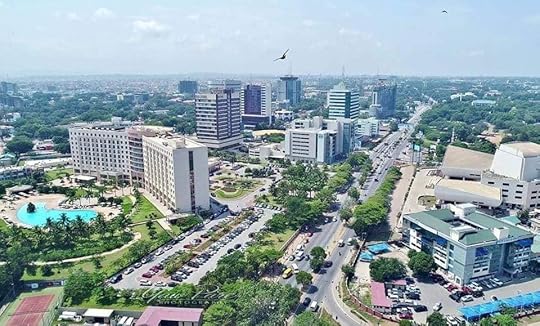
Top photo of Accra, capital of Ghana, from Wikipedia
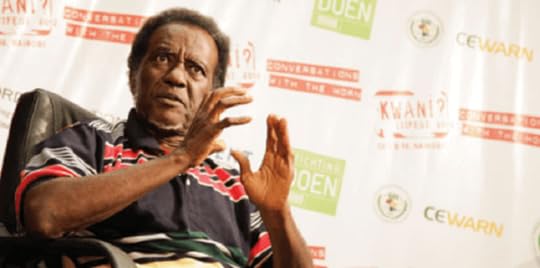
The author from brittlepaper.com
“Kojo Okay Pol was the optimist, was the monkey that believed he could climb down his own tail in any emergency. In the rush to trail Kofi Loww he had changed from a slightly quiet man into a slightly talkative one. His slanting eyebrows were two little steps of doubt leading up to a bewildered frown. His height suddenly ended up crowded at his hunched shoulders, with his head and neck almost irrelevant, until he smiled teeth shut yet with such light that his whole upper body glowed. This happened even when there was a fly on his shoulder. Under a thick brofo-nut tree he stood deep in thought; then he moved in fits and starts, much like a preset hiccup. He approached the corner carrying a breeze which had pushed too many faces aside before now reaching his own; and his jaws thus carried the weight of wind, their shape showing this: gently hollowed, almost crouching under the high cheekbones, so that words left his mouth as if over a bridge. The space between his hopes and his life stretched further than Navrongo. But his faint-green fez, worn in a short period of sudden inspiration, added the touch of ridicule that both freed and imprisoned him. When he was sure of himself he took advantage of other people’s underestimation of him, and when he was confused the entire universe – a look, a remark, a situation, tomatoes, cars, the moon – crushed him.”
“Baby Yaa said with her small yoyi eyes beaming their blackness out of her round, fawn face. It was a face that corn had once grown near, noisily, when she was in the village planting seeds reluctantly, and when her mother had taken seed every year. The city had shortened her already short smile, so that she now spoke at double the speed that she used to last year. There was no longer any village left on her teeth.”
Brilliant writing from a Ghanaian author we are told was primarily a poet.
I read about 60 pages into the book. The major theme I could see shaping up (and it shows in some of the passages above) seemed to be how urbanization disrupted the social organization of people who arrived from the rural villages.
There were four main characters and two of those were ‘crazy.’ There’s a father and son. The father criticizes the son for spending too much time reading and studying when he should be ‘getting on with his life.’ The older man’s wife, the young man’s mother, went nuts and left the household when the young man was a boy. Now that her son has a child, she is back, trying to reinsert herself into his life and threatening to kidnap her son’s child. Another crazy character keeps reappearing - an old man who is soliciting money to try to start a village – perhaps to replace the community that these now-urban people lost after coming to the city.
So why a DNF? I don’t really know. (I didn't give it a rating.) The characters simply didn’t pull me into the story. I was still a bit confused at page 60 of who was who and new people kept appearing.
There were too many Ghanaian words used. Yes, a glossary is provided, and the use of a few words in a new language is great. But 300 in a glossary is too many, even when you ignore the ones for, let’s say, foods and trees. And even if you look up a word on page 7 doesn’t necessarily mean you will remember what it is when that word is used again on page 37 and page 107. (YOU may remember, but I’m speaking for myself here!) Many of these words are needed to understand what is going on; you can’t figure out all these words in context. The author also coined neologisms such as zagazogo (wild man), shoogmadoodle (nonsense), logologo (genital) and fikifiki (yes, you guessed that one right).
The Ghanaian author (1946-2017) wrote three novels in English but all, including this one, have very few reviews and ratings on GR, so his work remains relatively unknown.
Top photo of Accra, capital of Ghana, from Wikipedia
The author from brittlepaper.com

March 6, 2022
An astonishingly unique prose stylist, Laing’s masterpiece evokes the city of Accra as Dickens evokes London or Joyce evokes Dublin, peopling his pages with an unforgettable cast of characters that perfectly capture the frantic, raucous spirit of Ghana, spraying each paragraph with utterly distinctive turns of phrase, invented and real slang words, and a delicious sensory accumulation of detail. The African Ulysses? Why not. It’s a perfect candidate for that honour.

October 1, 2023
It took me a good 50-60 pages to get into this but once I did I relished the baroque descriptions of the characters that often kicked off a new chapter. Although there's an extensive glossary of local terms since most of them relate to food (and often to different ways to prepare plantain and/or beans) I didn't resort to using it all the time.

October 15, 2016
Excellent stuff - very much worth checking out. If you are interested a quick google will bring up a number of good reviews from various newspapers etc that are worth reading if you are curious
Mcsweeny's just brought out a nice looking hardback from what I can see, so this obviously is no longer as buried as it once was.
Mcsweeny's just brought out a nice looking hardback from what I can see, so this obviously is no longer as buried as it once was.

November 6, 2012
This strange and beautiful book, full of amazing imagery, is like nothing else I've ever read (except, of course, Major Gentl and the Achimota Wars, another novel by the same author with similar properties). There's no real plot, but there are several interwoven tales. The characters are memorable and differentiated, but the setting -- Accra in 1975 -- is the central figure of the book.
The prose is overwhelmed by a kaleidoscopic series of metaphor, anthropomorphism, proslepsis, hyperbole, synecdoche, and every other figure of speech one can think of, which makes for a difficult first impression. Once you grasp that these images are the story, you can relax and enjoy the ride. This is a great, unique novel.
The prose is overwhelmed by a kaleidoscopic series of metaphor, anthropomorphism, proslepsis, hyperbole, synecdoche, and every other figure of speech one can think of, which makes for a difficult first impression. Once you grasp that these images are the story, you can relax and enjoy the ride. This is a great, unique novel.

Read
May 19, 2021Το μοναδικό αρνητικό του να διαβάζει κανείς ένα βιβλίο από κάθε χώρα στον κόσμο είναι ότι το βιβλίο που βρίσκεις από την συγκεκριμένη χώρα είναι το μοναδικό που βρήκες εύκολα, και αφού το ξεκινήσεις συνειδητοποιείς ότι θα είναι μάπα το καρπούζι.
Αυτό έπαθα με το συγκεκριμένο βιβλίο από την Γκάνα, που διαδραματίζεται κυρίως στην πρωτεύουσα της Γκάνας, Άκκρα, γραμμένο από Γκανέζο συγγραφέα.
Ακούγεται ιδανικό για κάποιον που θέλει να διαβάσει βιβλίο από την Γκάνα, αλλά η συγκεκριμένη ανάγνωση απορρίφθηκε από το μυαλό μου. Όπως απορρίφθηκε και το Σχέδιο Ανάν για τη λύση του κυπριακού, που πήρε το όνομά του από τον επίσης Γκανέζο Γ.Γ. του ΟΗΕ Κόφι Ανάν.
Δεν το 'χουμε φαίνεται στην Κύπρο με τους Γκανέζους..
Πέραν του αστείου, η γραφή του συγκεκριμένου βιβλίου ήταν ποιητική και μελίρρυτη ΑΛΛΑ η πλοκή ήταν θαμμένη κάτω από τόνους ποίησης και συμβολισμών.
Επίσης τα αμέτρητα γκανέζικα φαγητά και ορολογίες με έκαναν κάθε λίγο και λιγάκι να διακόπτω την ανάγνωση και να τσεκάρω πίσω στο γλωσσάριο τι σημαίνουν.
Πολλές φορές όμως αντί να με βοηθήσει το γλωσσάριο έκανε τα πράγματα πιο δύσκολα, π.χ. έβρισκα στο κείμενο τη λέξη nkonkonte: πηγαίνοντας το γλωσσάριο η επεξήγηση ήταν nkonkonte= ζύμη από κασσάβα. Και αν δεν ξέρεις τι είναι το κασσάβα τότε άδικος κόπος το τσεκάρισμα στο γλωσσάριο και η διακοπή της αναγνωστικής ροής.
Επιπλέον για πολλά ονόματα δεν ήξερα αν ήταν αντρικά ή γυναικεία έτσι περίμενα την αντίστοιχη αντωνυμία μέχρις ότου καταλάβω αν ήταν άντρας ή γυναίκα ο συγκεκριμένος χαρακτήρας (ονόματα όπως τα παρακάτω: Adwoa, Erzuah, Akosua, Owula κλπ.)
Ένα τέταρτο στοιχείο που δεν βοήθησε στην απόλαυση του βιβλίου ήταν ότι ένα κεφάλαιο ξεκινούσε στη σκηνή Α, με χαρακτήρες 1 και 2, και λίγες παραγράφους μετά χωρίς προειδοποίηση μεταφερόταν στη σκηνή Β, με χαρακτήρες 3 και 4 και τούμπαλιν.
Αυτό γινόταν για 22 κεφάλαια και 346 σελίδες. Δεν υπήρχε αρχή και τέλος, δεν υπήρχε ένας κεντρικός άξονας στην ιστορία.
Ονόματα, πλοκή, συμβολισμοί, διάλογοι, εικόνες και ιστορίες ήταν συντρίμμια μετά από τσουνάμι. Ένα παζλ ανακατωμού και καταστροφής.
Παρόλο που αναγνωρίζω την λογοτεχνική αξία αυτού του βιβλίου δεν σας το συστήνω. Όπως δε θα συνιστούσα και επίσκεψη στον οδοντίατρο.

June 29, 2012
I wanted so much to love this book. When I read the introduction and Binyavanga Wainaina says,
"The finest novel written in English ever to come out of the African continent," I want to agree. But this book was much harder for me to get into than I thought. In fact, I had to start over and over again trying to read this book. It is not an easy read. But at the same time, I felt like I had to finish it. It took me a long time and a lot of concentration. When I got to the end, I realized it is beautifully written, but I don't really have any confindence that I understood this book at all. I think it is one that I will have to come back to in five years time and see if I am in a different frame of mind to enjoy it more.
"The finest novel written in English ever to come out of the African continent," I want to agree. But this book was much harder for me to get into than I thought. In fact, I had to start over and over again trying to read this book. It is not an easy read. But at the same time, I felt like I had to finish it. It took me a long time and a lot of concentration. When I got to the end, I realized it is beautifully written, but I don't really have any confindence that I understood this book at all. I think it is one that I will have to come back to in five years time and see if I am in a different frame of mind to enjoy it more.

June 6, 2020
What I look for in literature is comfort but also a window to a new world. Comfort of emotions I recognise, rather than familiar cultures. By window to a new world I mean the style of writing I don’t feel comfortable with, that challenges me, that requires some effort from me. Kojo Laing’s “Search Sweet Country” is definitely a book the reading of which wasn’t a breeze and which forced me to get out of my comfort zone.
The last decade saw a lot of debating and arguing among African authors on how one should write about the continent and its inhabitants (that’s a fascinating topic, worth of a separate post). Laing’s writing is most original and spellbinding. The novel has been compared to Joyce’s “Ulysses”, but having not read “Ulysses” I compare it to “Blinding” by the famous Romanian writer Mircea Cărtărescu. Reading “Search Sweet Country” is like looking through a kaleidoscope with rapidly changing combinations of colourful glass elements or like watching a film played in fast forward, with the myriad of characters, none of them taking the spotlight, and a cacophony of voices. My knowledge of Ghanaian culture and history is inadequate to let me say whether the author depicted the pulsating heartbeat of Accra in the 1970s well, but he certainly allows the reader to get a glimpse into the rhythm of the capital in those times. The style of writing, with multi-layered metaphors and similes, references to folklore, witchcraft and religion, as well as Ghanaian words and author’s own neologisms heavily peppering every page, is captivating and often draws attention away from the narrative, which is non-linear and incoherent.
It’s obvious, reading “Search Sweet Country”, that Laing wrote this novel with a Ghanaian reader in mind, not really caring about how the book will be received abroad. This is the strength of his writing and storytelling. It feels genuine, it feels like it’s coming straight from his imagination rooted in the reality around him. Nearly 35 years after the first publication it still feels fresh and still has the power to bewitch.
The last decade saw a lot of debating and arguing among African authors on how one should write about the continent and its inhabitants (that’s a fascinating topic, worth of a separate post). Laing’s writing is most original and spellbinding. The novel has been compared to Joyce’s “Ulysses”, but having not read “Ulysses” I compare it to “Blinding” by the famous Romanian writer Mircea Cărtărescu. Reading “Search Sweet Country” is like looking through a kaleidoscope with rapidly changing combinations of colourful glass elements or like watching a film played in fast forward, with the myriad of characters, none of them taking the spotlight, and a cacophony of voices. My knowledge of Ghanaian culture and history is inadequate to let me say whether the author depicted the pulsating heartbeat of Accra in the 1970s well, but he certainly allows the reader to get a glimpse into the rhythm of the capital in those times. The style of writing, with multi-layered metaphors and similes, references to folklore, witchcraft and religion, as well as Ghanaian words and author’s own neologisms heavily peppering every page, is captivating and often draws attention away from the narrative, which is non-linear and incoherent.
It’s obvious, reading “Search Sweet Country”, that Laing wrote this novel with a Ghanaian reader in mind, not really caring about how the book will be received abroad. This is the strength of his writing and storytelling. It feels genuine, it feels like it’s coming straight from his imagination rooted in the reality around him. Nearly 35 years after the first publication it still feels fresh and still has the power to bewitch.

March 26, 2013
A novel set in 1975 Ghana. It's not entirely fair to call it a plotless novel, as there are several plot threads winding their way through the narrative, but the plot is really beside the point; the book is mainly a critical yet loving portrait of Ghana's capital city, Accra, and its people. There are venal politicians, intellectuals, religious people, small-time merchants and hustlers, officious policemen, even a witch who flies above the city and reads the hearts of its people. (Partly because of the witchery, the book has been sometimes tagged with the ill-fitting label of 'magical realism'.) Perhaps most of all, there are husbands and wives struggling with each other for the upper hand in their marriage; nearly every married couple presented here exhibits that struggle in different ways. And all these disparate characters are linked together by the wanderings of a mad donkey-riding beggar named Beni Baidoo; who is forever seeking money and land to start his very own village, and wants the other characters to all live in that village with him. Perhaps he understands that he already has his village...
This was Laing's first novel, but he was a poet before he was a novelist, and his prose style carries the beauty of poetry, full of surprising and evocative imagery. He writes sentences like "Each piece of doubt had the status of a grain of sand", or "And his eyes: it was said they contained so much that was unclear that there had to be more than one human being wearing them". Or consider this description of one character:
"His slanting eyebrows were two little steps of doubt leading up to a bewildered frown. His height suddenly ended up crowded at his hunched shoulders, with his head and neck almost irrelevant, until he smiled teeth shut yet with such light that his whole upper body glowed. This happened even when there was a fly on his shoulder. Under a thick brofo-nut tree he stood deep in thought; then he moved in fits and starts, much like a pre-set hiccup. He approached the corner carrying a breeze which had pushed too many faces aside before now reaching his own; and his jaws thus carried the weight of wind, their shape showing this: gently hollowed, almost crouching under the high cheekbones, so that words left his mouth as if over a bridge."
From reading that passage, you can probably determine whether you'll enjoy this book. Every page is like this; chock full of charming, startling, imaginative metaphors and imagery; but also frequently difficult to understand. It was not unusual for me to realize that I had no grasp of what I'd just read, and to have to go back over the passage more slowly. That can make it a frustrating read; it's slow going, and you have to be patient with it.
For readers who love creative wordsmithery, Search Sweet Country is a rare treat. For most everybody else, there are probably not enough rewards here to be worth the frustration.
This was Laing's first novel, but he was a poet before he was a novelist, and his prose style carries the beauty of poetry, full of surprising and evocative imagery. He writes sentences like "Each piece of doubt had the status of a grain of sand", or "And his eyes: it was said they contained so much that was unclear that there had to be more than one human being wearing them". Or consider this description of one character:
"His slanting eyebrows were two little steps of doubt leading up to a bewildered frown. His height suddenly ended up crowded at his hunched shoulders, with his head and neck almost irrelevant, until he smiled teeth shut yet with such light that his whole upper body glowed. This happened even when there was a fly on his shoulder. Under a thick brofo-nut tree he stood deep in thought; then he moved in fits and starts, much like a pre-set hiccup. He approached the corner carrying a breeze which had pushed too many faces aside before now reaching his own; and his jaws thus carried the weight of wind, their shape showing this: gently hollowed, almost crouching under the high cheekbones, so that words left his mouth as if over a bridge."
From reading that passage, you can probably determine whether you'll enjoy this book. Every page is like this; chock full of charming, startling, imaginative metaphors and imagery; but also frequently difficult to understand. It was not unusual for me to realize that I had no grasp of what I'd just read, and to have to go back over the passage more slowly. That can make it a frustrating read; it's slow going, and you have to be patient with it.
For readers who love creative wordsmithery, Search Sweet Country is a rare treat. For most everybody else, there are probably not enough rewards here to be worth the frustration.
August 2, 2020
"Loww saw how clearly everything - from fresh water and churches to governments and castles - could fit so easily in reflection of the gutters. This city could not satisfy the hunger of gutters, for there was nothing yet which had not been reflected in them"
A stunning novel, ripe and brimming with love for his country, his people and their flaws. This is one of the greatest novels I have ever read. I believe it stands amongst the greats of literature and should be treated as such. Get this book into your bookshelf now!
Laing has the ability to create a scene that vividly brings to life Accra in a time and place, then infuse it with characters whose thoughts, discussion, debates and problems reflect a humanity in re-definition. Possessing every flaw known to plague humans and every virtue that might bless us, the characters interact in 1970s Ghana, sharing with us their trials, failures, successes, corruptions and thoughts on the country and their co-conspirators.
Describing the state of Ghana, "the glass of the new office block was trying desperately to throw off the horror of gutters". Few books deliver such vivid imagery to the reader, bringing alive the eternity of people's spirits and connection to their ancestral past with a hurtling sense of modernity, carrying the past on its back.
Whether its Kofi Loww, Dr Boadi, Professor Sackey, Beni Baidoo, Adwoa or the other characters, a narrative peppered with small interactions, micro-plots, gives the reader a sense of being a spirit, watching over the city of Accra, observing its people. The narrative structure and prose make this one of the most unique books I have ever read and a must-read if you care about literature. The novel is like breathing in a city and exhaling its stories.
I cannot sing its praises highly enough and will close this out with a quote from the book.
"By the edge of the skyline where the trotros took people to and from poverty, to and from different levels of gari, the cock crowed into the city. And the city held the neck of the crow. The early November mist was stuck to grass and gutter, roof and valley, like endless chewing gum locally made ... the mist would not be imported. Over where the early risers walked, the quiet street branched into the long thighs of a woman sleeping. Accra was a cola-nut in the mouth of a Mallam hurrying to spit it out. And the sun was bad: at last it found the shoulders to push aside the lazy mist ....mist slept at a slow sleep ... and its rays caressed thousands of legs, brown and unbrown, shapely and unshapely. The cries of goats steadied in the concrete in a bank building and pushes Kofi Loww in not particular direction but certainly towards his own sense of being."
Read this book now!
A stunning novel, ripe and brimming with love for his country, his people and their flaws. This is one of the greatest novels I have ever read. I believe it stands amongst the greats of literature and should be treated as such. Get this book into your bookshelf now!
Laing has the ability to create a scene that vividly brings to life Accra in a time and place, then infuse it with characters whose thoughts, discussion, debates and problems reflect a humanity in re-definition. Possessing every flaw known to plague humans and every virtue that might bless us, the characters interact in 1970s Ghana, sharing with us their trials, failures, successes, corruptions and thoughts on the country and their co-conspirators.
Describing the state of Ghana, "the glass of the new office block was trying desperately to throw off the horror of gutters". Few books deliver such vivid imagery to the reader, bringing alive the eternity of people's spirits and connection to their ancestral past with a hurtling sense of modernity, carrying the past on its back.
Whether its Kofi Loww, Dr Boadi, Professor Sackey, Beni Baidoo, Adwoa or the other characters, a narrative peppered with small interactions, micro-plots, gives the reader a sense of being a spirit, watching over the city of Accra, observing its people. The narrative structure and prose make this one of the most unique books I have ever read and a must-read if you care about literature. The novel is like breathing in a city and exhaling its stories.
I cannot sing its praises highly enough and will close this out with a quote from the book.
"By the edge of the skyline where the trotros took people to and from poverty, to and from different levels of gari, the cock crowed into the city. And the city held the neck of the crow. The early November mist was stuck to grass and gutter, roof and valley, like endless chewing gum locally made ... the mist would not be imported. Over where the early risers walked, the quiet street branched into the long thighs of a woman sleeping. Accra was a cola-nut in the mouth of a Mallam hurrying to spit it out. And the sun was bad: at last it found the shoulders to push aside the lazy mist ....mist slept at a slow sleep ... and its rays caressed thousands of legs, brown and unbrown, shapely and unshapely. The cries of goats steadied in the concrete in a bank building and pushes Kofi Loww in not particular direction but certainly towards his own sense of being."
Read this book now!

May 3, 2012
This complicated, unique book came with my McSweeney's "book club" membership, and despite mostly hanging on through the end, there wasn't much of a connection. The writing almost feels like a fever-dream, or a dream-world, enveloping the reader in the spiritual/cultural/political world of Ghana to which of course I have no knowledge. So, it was a struggle. There are passages I love, and a character or two that piqued interest. This novel requires some knowledge of Ghana, it's cutlure and stories, to truly appreciate.

February 20, 2013
there's definitely poetry in this book's language (no surprise, given the author), and at times it can be a fascinating look at ghana in the mid 1970s. but the cast of characters is a bit scattered, and the narrative doesn't stick with any one of them for long enough to make you care. by the end you know who everyone is, but by that point it's too late. the author also has a tendency to get deep in the intellectual woods, and have his characters talk about their country in an unrealistic manner (not that everything needs to be realistic, but it's distracting here).

December 19, 2012
Search Sweet Country (Heinemann, 1986; 352) is the first novel by the Ghanaian poet, Kojo Laing. It expanded what the author had already started started with his poetry, his unique use of words, his ability to make words turn, somersault, split and do some weird, but adorable, gymnastics. As is the foibles of poets, Laing's poetry seeped unrelentingly into his prose in a lovely kind of way.
continue here http://freduagyeman.blogspot.com/2012...
continue here http://freduagyeman.blogspot.com/2012...

September 27, 2013
A hat for the world to keep its cruelty under, a polite hatred, silence breeding a new architecture, a wall loving your knees, a love more than legs, marriage filling a room, losing little ironies, eating the future, houses taking on loneliness, she only saw the jaws still eating, flowers snarling and growing in war, something strange at the back of your eye, flesh turning into ghost turning into semiflesh, again and again.
August 29, 2020
Appreciate this may be one of the classics, but the style of writing where there is no respite and it’s scene after scene after scene is not my cup of tea. So I stopped reading after about 20 pages.
Shame though, because I could see some amazing insights into the Ghanian way of life back in the 70s
Shame though, because I could see some amazing insights into the Ghanian way of life back in the 70s

Read
May 26, 2012It's nonsense. It reminds me of Lowry's Under the Volcano. I think I need to be drunk to read it clearly. A quote from a review on the back cover says "dizzying prose" and I cannot agree with the underlying meaning in that chosen phrase. Sorry, McSweeney's, but now I doubt your choices. IMO

Want to Read
June 29, 2012Started wanting to read this book when I read this review of it: http://www.slate.com/articles/arts/bo....
May 28, 2013
I really, really wanted to like this one more than I did. Some of the sentences were really beautifully written. I think Laing and I are looking for different things aesthetically. I'm not sorry I read it, but it was a struggle, and I can't realistically see myself going back to it.
February 18, 2020
Maybe 2 1/2 stars. This was such a struggle! Definitely an amazing piece of literature but not what I was expecting. Too many characters, certain passages were confusing and I had no idea what was going on.
I would recommend to do some research before reading.
I would recommend to do some research before reading.

June 19, 2012
I wanted to like this beautiful book, but just could not get into it. Perhaps I'll try again.
August 22, 2012
I wanted to like this book, but so far I am finding it a very hard read. The prose is very constructed and rich, maybe it would be better as a mother tongue english speaker.

February 23, 2013
This is my second read of this book, and the 2025 read is from the Penguin edition.

June 15, 2013
Beautifully written. Must-read. Expanded my ideas about how the English language can be used.
August 1, 2025
My first by Kojo Laing and the first book I've read from Ghana. Laing's story follows an ensemble of characters in Accra, the capital of Ghana, in the 1970s, including an eccentric old man who dreams of founding his own village (I think mostly so he can have lots of women), a father and his adult son, a corrupt politician, a frustrated college professor, a young witch and her British witch friend, a devout priest and a laid back bishop, a family of three generations of women, and a farmer, among others. Laing's characters use a lot of Ghanaian idioms (fortunately there is a glossary, and a lot of them are just different foods, clothes, etc.), and Laing's background as a poet is clear, as the book has tons of abstract and figurative language. People's features often behave independently of them - somebody's smile sits down before they do, somebody's hair is unsure of something, that sort of thing. It's definitely different from anything I've read before and definitely challenging, but I enjoyed it.
December 11, 2024
As a reader with a western lens, this book is unlike anything I have ever read. The use of traditional Ghanaian words and the 60+ characters mentioned by name made this book a struggle to get through, but if given the time and the energy, I would read it again. The personification in Laing’s writing is so rich and literally gives Accra its own personality. I would give 3 1/2 stars if I could, because the book was a little bit too dense for me and wasn’t the most enjoyable read ever, but I value what I learned from it. If you really want to understand this book as a westerner, you should read it twice at a MINIMUM.
Read
August 12, 2020I liked this book.
It's very postmodern. A bit of magical realism. Uses many Ghanaian words for food, religious concepts, everyday speech etc, and has a very playful langauge overall. It's a very unique view into Ghana in the 1970s for me as a German. I should have read it in English though, not in German, because a few characters speak "broken English" which doesn't translate well.
At times the metaphors were too abstract for me, and I wish there was more plot.
It's very postmodern. A bit of magical realism. Uses many Ghanaian words for food, religious concepts, everyday speech etc, and has a very playful langauge overall. It's a very unique view into Ghana in the 1970s for me as a German. I should have read it in English though, not in German, because a few characters speak "broken English" which doesn't translate well.
At times the metaphors were too abstract for me, and I wish there was more plot.

April 3, 2023
Kojo Laing weaves a complex story with many different characters related and unrelated in 70s Ghana. The innuendo he casts in this veiled commentary of life under military rule and the aphorisms and observations of the Ghanaian psyche rings true to this day. The language of the Ghanaian of the 70s feels familiar yet distinct and frames the plot in the era. Search Sweet Country is beautifully crafted in its complexity. I would recommend this read wholeheartedly!
April 18, 2025
"They made around each other's hearts buildings of the future."
&
"The secret for both of them now was to burst through someone else's life, but gently enough to catch the old memories when they fell."
Dit boek was me een ervaring - ben door de hoeveelheid, gelaagdheid, de taal (zo veel creativiteit met de taal!!) en de personages wel degelijk omvergeblazen. Heb ook erg vaak hardop gelachen. Máár: heb er af en toe wel echt m'n best voor moeten doen.
&
"The secret for both of them now was to burst through someone else's life, but gently enough to catch the old memories when they fell."
Dit boek was me een ervaring - ben door de hoeveelheid, gelaagdheid, de taal (zo veel creativiteit met de taal!!) en de personages wel degelijk omvergeblazen. Heb ook erg vaak hardop gelachen. Máár: heb er af en toe wel echt m'n best voor moeten doen.
Displaying 1 - 30 of 37 reviews