Rissa breathes a sigh of relief as the ship lifts off. It seems she's escaped danger, and no one has recognized the scientifically altered being as the beautiful young heir to the Hilzein Establishment-or so it seems. Possessing the only force capable of challenging the tyranny that devastated the Earth and Universe, Rissa can do almost anything--then again, almost anything can happen to her while she's doing it.
This book is part of the Hulzein saga-- an eight novel series-- but can be read as a standalone. Set in the somewhat near future, Earth is largely ruled by corporations and the big one in North America is UET. UET set up a 'welfare' system that is really a thinly disguised slavery system; once you get on welfare, you never really get out. Rissa begins this book at age 5 when her parents were killed during a riot; she and her brother were 'welfared' immediately afterwards. The first part of the book deals with her growing up in welfare until she won a lottery and escaped. The lottery is basically a feel-good fiction as the winners are all, after a few months, found to have committed some crime and are put back into welfare (asset stripped). Not so for Rissa, who, with a little help, flees not only North America, but Earth itself!
If you have read the first few volumes of the Hulzein saga, some of this story will be very familiar, albeit told from Rissa's perspective rather than Tregare's. Tregare was the first mutineer to seize an armed spaceship and is something like UETs most wanted pirate.
Busby employed a strong female lead here, and at the time, it was almost unique (this was first published in 1977). Busby may have some pacing issues, but his dialogue is whip smart as is the action. Rissa has, lets say, a horrible childhood in welfare, with almost daily sexual abuse (the female welfare inmates are sterilized so no fear of unwanted kids...). After the lottery escape, she trained for a year in all forms of combat, espionage, deception and so forth in the special training school the Hulzein enclave in Argentina set up. Rissa is not especially attractive, but she is very smart and cunning; again, not traits often found in 70s space pulp. She moves from one challenge to another with aplomb!
So, while this obviously has some triggers (Rissa's sexual abuse/rape), Rissa emerges as a strong, talented young woman ready to take on the world on her terms. Fun romp by Busby! 3.5 stars, rounding up for nostalgia's sake.
VERDICT: 2.0 stars, barely. A nearly unrateable light (and thin) SF/fantasy romp. Overall, a passing grade by a nose, IF compared against similar light fare from the 1970s. The plot is low on realism, but there's a moderate-level adventure here, with some interesting parts.
SENSITIVE READERS:
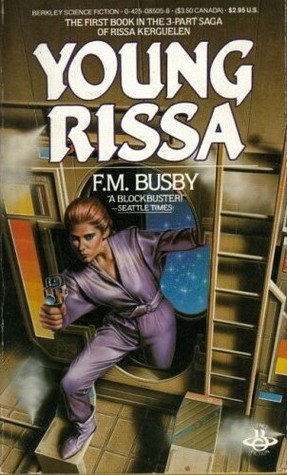
NOTE: The cover art is pure fancy; the scene occurs nowhere in the book:
It's only marginally SF in that it happens in the future, includes some space travel and brief mentions of technology, and is partially set on a non-Earth planet. It reads more like a fantasy tale written by a male teenager who knows little or nothing about the ladies. But to be fair, I've read far worse.
As a young girl, raised in a home with two alcoholic parents, I know a lot about neglect, emotional, physical and sexual abuse. When I first read Young Rissa, I finally found someone in whom I could find hope for a better life.
Rissa Kerguelen is sent into the Welfare program on Earth at age five when her parents are killed. Along with her brother, Ivan, they are ripped from the comfort of a luxurious and safe home and sent into hell.
On Earth, approximately 30% of the population is indentured to the Welfare system and almost no one ever buys their way out. Occasionally, someone hits the Government run lottery and escapes but usually falls back into Welfare's clutches.
Rissa and Ivan are in the system for close to six years. Enduring physical abuse and rape, Rissa worries about her brother. All of the reports she hears about Ivan are that he is "in punishment status."
Shockingly, Rissa discovers that she has won the biggest Welfare lottery and is freed around her 11th year. Her Uncle Voris meets her and explains the danger she now faces.
The rest of the book is a triumph over the worst odds, a thrilling hope to anyone who has ever been held in captivity and one of the best Space Operas I've ever read.
It's been close to 45 years since I last read this book but it was like coming home to re-read it. F. M. Busby's Rissa Kerguelen is why I'm a Science Fiction fan for life.
The general story line was great, but bleak in its view of human nature. This book was also deeply disturbing in its portrayal of sexual abuse. This book is an example of how the abuse of women often gets trivialized in books written by men. Our heroine is repeatedly raped throughout her life, but casually shrugs it off as a minor inconvenience. She ultimately ends up marrying (and liking and respecting) one of her would-be rapists, because he was really a pretty good but misunderstood guy, despite intending to rape her. But hey, she ended up deciding to sleep with him as her choice (and the safest course of action), so it was all OK! Her choosing to sleep with him as a matter of expediency means he isn’t a rapist after all! Gag.
This series was an important one to me growing up. Aside from Heinlein's Friday, it was about the only SF series where the lead was a female hero. And frankly, Rissa kicks Friday's butt. Plus, she's not by any means the only strong female character. And there are some cool guys as well.
It's a fun space drama, the plot sweeps you up and keeps you going. However, three things have always bothered me about this book:
Firstly, non-consensual and semi-non-consensual sex are prevelant throughout. By "semi" I mean circumstances in which the heroine allows unwanted sex even when she could easily fight off her aggressor. Remarkably, she bears that man no ill will and indeed becomes friends of a sort with him. There are also circumstances in the story in which she has completely consensual sex with people, but she never ever comes.
I blame the time period - the mid 1970s - the book was written in for some of this stuff. Even mainstream romances written by women sometimes had problems with permission then. I blame the maleness of the author just for the sheer volume of sex that occurs in a book where the main character isn't interested in it. I suppose he must have found the topic exciting, whereas certainly few women would. Why would anyone want to read about so much sex with so little pleasure? (Note: despite the amount of sex, there are next to no details. This is not erotica or even soft core.)
Secondly, Rissa speaks very stiffly. Here's an 18 year old girl, raised in a place with uneducated cohorts and TV. she would certainly use slang and contractions. I don't think she ever uses a contraction in her speech ever. And she always sounds almost cold and calm, far older than her age.
Lastly, the whole training camp where she basically becomes a female James Bond, able to fight, speak several languages, decode spy messages, use weapons, do clever financial things, understand socio-political maneuvering, etc...it's a lot of fun to think about, but absolutely unbelievable she would be able to learn all of this in one short year, in particular with no educational background to speak of. That moves the book from SF to fantasy, which is too bad because it didn't need to.
All of this aside, it's still one of my favorite series. Given the utter coolness of the heroine, plus spaceships, multi-planet intrigues, etc., well, it's still a satisfying read.
This three book series was, I think, originally published as one book. It reads better that way - and the final third is a doozy! Worth getting to. Then there are a few spin off novels.
Rissa, forced into an orphanage/indentured servitude as a child, escapes from Earth and gains power.
This is a re-read of a book I read more than twenty years ago. For the first half, I was impressed. The book was action packed, hard to put down, and I liked Rissa, a strong and intelligent woman. I was looking forward to continuing to re-read the series. But then (you knew there would be a 'but then', right?). Rissa books herself onto a space ship to get further from Earth and the captain (Tregare) informs her that she must be his doxie in addition to her payment. And she's disgruntled, but goes along with it. And after she departs, she just can't stop thinking about him (pause for a moment for gagging). I had read others in the series, and I remembered that Rissa and Tregare end up being a couple. So her insta-love for someone who forced her to have sex with him forced me to re-evaluate. No more books in this series for me. Judged on when it was written, it's still pretty good but no way can I sit through books of their loving togetherness with that start. She apparently forgave him, but I can't.
Rissa hops from bed to bed (well, sometimes on the grass) in this yarn. That's my only hangup with this story, and it cost it a star because there's more than necessary.It's not "blow-by-blow", so if you're looking for porn, look elsewhere.
Other than that, she's a kick-ass heroin and a survivor. Well-written and well-edited (by Berkley). Busby has created a sympathetic character in this first book of the series. Also, the story is complete with just a small hole pointing to the next book.
This started off compellingly enough, with a bleak dystopian world where Rissa and her brother were separated, then sold into slavery. Severely abused, Rissa wins the lottery and buys her freedom. This is the point at which it fell off for me. Though still a decent read, Rissa's transition from abused child to virtual superwoman seemed a bit to abrupt for my tastes at least. It was okay, but it never regained the blunt intensity of the early third of the book.
This is a re-issue of course, of the 'preques' to FM Busby's Kergulian/Trgare series. Itmade me remember how much I loved his books and enjoyed them, and how I miss them because they are packed away in storage.
Summary Rissa is orphaned, separated from her brother, and sent into the harsh hands of Welfare to be made a productive member of society. By luck, she finds a way out and a path to success.
Review I haven’t read any of Busby’s other work, so wasn’t sure what to expect, but had picked this up for free at some point, and I’m always open to new authors. Ignorance didn’t work in my favor this time. Young Rissa is an origin story for those already familiar with the later actions of its protagonist, Rissa Kergeulen. Since I wasn’t, I’m sure I missed a good deal.
Having not read Busby before, I can’t be sure whether the clipped, summary nature of the prose is his style or lack of interest on the author’s part. I grew accustomed to it, but never felt very engaged by the characters. Rissa herself, while somewhat interesting, is portrayed somewhat inconsistently, which countered her intriguing traits. Much of what she does have she owes as much to luck as to determination
Busby is given to Heinlein-esque declarative statements that purport to convey universal truths. In the context of the brusque voice of the piece, it worked to an extent, but I wasn’t convinced by it the way I was by Heinlein when I was 12. That may not be Busby’s fault. There’s also a very utilitarian approach to sex that somewhat fit Rissa’s character, but I eventually found tiring. Not every problem can be solved by either fighting or having sex, not even if you combine them.
All in all, I imagine this may be of interest to existing Rissa Kergeulen fans, but not for new readers.
It’s more of a 4.5 but I rounded down because it wasn’t perfect.
The parents of Rissa Kerguelen and Ivan Marchant were murdered by UET - United Energy and Transportation. They were the ruling corporation of North America. The family was freeborn and UET didn’t like it. They claimed her parents had instigated a riot and so their assets were forfeit. As such, the children were placed into Total Welfare, something created to keep legal slaves.
This told how Rissa survived and eventually thrived. It was also the time when she met Bran Tegare, the subject of the books one and two of the Hulzein Dynasty. This book is both Book One of the Rissa Kerguelen saga as well as unofficially Book Four of the Hulzein Dynasty. The end of Rebel’s Quest and this book converge. It’s a tumultuous relationship between the two but Rissa is strong enough to handle most things.
The reason it didn’t get a full 5 stars is because Rissa is too perfect. Expert with disguises and with fighting, for which she has a special talent to help her.
My son recommended it. I make sure to look at the year it was written. Being from the mid 70's, it is written like a sci fi version of a romance novel from those times ( or as I imagined one as I didn't read them) it was a dystopian view with hope. Many of the key social comments were present as was the fear of cloning and it's far reaching possible ramifications much like we have with AI now. Distractors which are very acceptable in a novel like this, is the thin veil of monetary exchange, the use of a "new" language and it's slang, the robot like characters that go from strict formal no nonsense rigid humanoids to sentiment softies within a page. All laughably acceptable in a book like this. Enjoy it for what it is. It is worth going onto the next 2 as he has the other 2 in the series.
This entire review has been hidden because of spoilers.
Story of a strong willed young girl who manages to get out of the UET "Welfare" system exchange word slavery for this state run institute. By a fluke a lottery ticket in Rissa's name won the big lottery and with help from the Hulzein family she managed to escape Earth. On a Hidden world she is challenged to a duel to the death. Her sponsors on this Hidden World also belong to the Hulzein family and they take care of her and arrange her marriage to Bran Tregare. And her adventures started.
Rissa breathes a sigh of relief as the ship lifts off. It seems she's escaped danger, and no one has recognized the scientifically altered being as the beautiful young heir to the Hilzein Establishment-or so it seems. Possessing the only force capable of challenging the tyranny that devastated the Earth and Universe, Rissa can do almost anything--then again, almost anything can happen to her while she's doing it.
I quite enjoyed this book. It is the first book in the 3-part Saga of Rissa Kerguelen, about a young girl whose parents are killed by the State, which is actually a huge corporation run wild. She succeeds in escape imprisonment, goes offworld, and is mildly successful. I’m looking forward to the next two. (1976 - science fiction)
This is by far the stupidest book I've ever read. Every character is a superficial stick.figure or a stereotype. It's like the author just filled up a mad libs with sci fi tropes. I only finished it because im doing an alphabet challenge and I needed a Y. Don't waste your time. I gave it one star so it would show up on the tally but Really this book owes me stars.
I first met Rissa in a paper copy in the 1970s and met her author at a Worldcon a few years later. He was such a lovely gentleman. Rissa’s rise from slave to oligarch is a favorite of mine that I happily revisit every few years.
This book starts out with one happy family that is destroyed and ends with a new happy family that will change a universe. If you like a strong female protagonist, this is a book for you.
I really enjoyed this series/universe when I was a teenager. All 8 books are pretty good. The final one is a bit weaker, but the rest... Forgot about them for a long while, but managed to dig them up again recently.
I’m not sure what to say about this. It’s fast-moving, and also somewhat dated, but not nearly as much as it seems like it should be. The sexual parts are the most problematic.
This entire review has been hidden because of spoilers.
I didn't read the subsequent stories in the trilogy/universe, but the book description gives wrong information--she is not, at least at this point, a heir to the Hulzeins oligarchy. This one gets four starts for no ill-wrought subplot to slow me down as I turned the pages and stayed up late to finish it. Fast and gripping reading, with very little meat around the main sketch of the story. Growing up in a world where corporate UET rules all of North America and beyond, Rissa and her older brother are sacked from their home when their parents are killed during a riot they were reporting for TV. The siblings are separated when they arrive at the Total Welfare Center--a mix of prison for life and slave depot where orphan kids and adults who can't pay their taxes are locked up. She quietly endures lack of family and warmth from age 5 until she reaches puberty--when other abuses await in the new section she is transferred to. Rissa is picked out of the lot for a secretarial job after showing some basic skills in reading and math, and in the job she patiently gathers information that give her access to her brother's files. She learns of his constant rebellion and potential brainwashing. Upon winning a lottery and her way out of her prison, Rissa has the help of a family friend to run away to Argentina where an elderly but fit woman with a German-sounding name--who was conceived via parthenogenesis to carry all of her mothers genes; what's up with the Mengele/Nazi reference I cannot tell--runs a small but powerful enclave. She trains to become a skilled ninja in all kinds of human interaction--combat, sex, politics... Even before turning 18 Rissa is a millionaire savant on her way out of Earth, with a connection to the Hulzeins, looking for a new place to call home. She gets a ride with an escaped ship run by Tregare, who was once an official under UET rule. On her new planet, the Hulzeins are one of a few oligarchies in power. Right upon arrival Rissa gets in an altercation with a moderately powerful man that will delineate her fate and the rest of the story. She is now marked to die and has to make her choices in order to survive seemingly sure death.
First volume in the Rissa Kerguelen trilogy - female fronted space opera. As the title suggests this one's all about the figurative birth of the heroine. We begin when Rissa is 5, her journalist parents are assassinated and Rissa and her brother are put into an orphanage and treated little better than slaves. Finally breaking free of the system she starts a quest to track down her parents murderers, hooks up with a rogish space pirate and ends up on a back water planet where an uppity bureaucrat insults her and she challenges him to a duel.
The last part is all about the duel to the death match - its rather unusual to see a male vs. female almost gladiatorial bout, which is refreshing.
My favourite thing about the book is the concept of parthenogenesis and cloning - the current government ousted the Hulzein establishment that still exists as a sort of powerful underground movement. The Hulzein's are created by parthenogenesis - direct replication and the further down the line the more the DNA degrades and madness sets in. I hope there are going to be some really interesting developments on this theme in the next volumes.
Rissa is a strong heroine, but I did find her a tad cold. She's almost a spy or assassin the way she changes identity, uses people and cannot respond physically. Still after the hell she went through growing up could you expect anything less.
Simple, pacy plot with a strong female read and some interesting ideas. Looking forward to seeing how the story plays out.
I found an earlier addition of this book (different cover) and really enjoyed it. I am currently trying to order the sequels because of it.
Rissa is a girl who's parents are branded as traitors of the state and killed. She grows up in the very restrictive welfare system. She ends up winning a lottery just as she comes of age and, with the help of the "underground" escapes.
I could hardly put it down, reading it instead of doing things I really needed to do, a true sign that a book is very good.
This isn't real thick, I suspect that Busby probably would've written several hundred more pages these days. In 1977, the addition I read, the publishers seemed to think people wouldn't read books of much more than a couple of hundred pages.
Not much of a story. The protagonist's emotions are inaccessible until she is suddenly and unbelievably tearful. Although she does this more than once, the main character describes an incident like this near the end of the book as unusual for her. Seriously? This book was written by a man who finds female emotions incomprehensible and therefore indescribable. Feminist? No, insulting! Feminists are not women without sexuality or internally consistent emotional lives. Based on what other readers wrote about it, I was looking for a female character driven space opera a la Shards of Honor and Barrayar. Not even close.
This was the book that got me reading FM Busby originally. I found it in a second hand shop in Christchurch about 20 yrs ago. Bought it, read it and went looking for the rest of the series. I'm going through and re-reading a lot of old favs.