Jump to ratings and reviews
Rate this book

Demon Princes #1

De Sterrekoning

Rate this book
Attel Malagate is een van de vijf Duivelsprinsen die in het jaar 1499 (nieuwe rekening) vrijwel de hele bevolking van Fraaibergen uitmoordden of als slaven wegvoerden. Op twee na: de jonge Kirth Gersen en zijn grootvader. Kirth heeft een dure eed gezworen het gruwelijk vijftal een voor een te vernietigen. Eenvoudig is dat niet, want de wet van de beschaafde planeten heeft geen macht in de Zelfkant van het heelal, waar het meeste gespuis zich ophoudt. Toch maakt Gersen vastberaden jacht op de weergaloze misdadigers. Attel Malagate moet zijn eerste slachtoffer worden..

Lugo Teehalt is een verlopen plaatsbepaler die een onschatbaar waardevolle wereld heeft ontdekt, maar te laat bemerkt dat zijn werk betaald wordt door Malagate 'de Plaag'. Dankzij de loslippigheid van de bevreesde Teehalt vlak voordat deze door Malagate wordt gedood, komt Gersen de beruchte Duivelsprins op het spoor. Maar dan wordt zijn pad gekruist door een Sterrekoning, een van de geheimzinnige, zeldzame wezens die uiterlijk precies op mensen lijken. Uiterlijk - want hun gedachten en drijfveren hebben niets menselijks...

192 pages, Paperback

First published April 1, 1964

74 people are currently reading
2899 people want to read

About the author

Jack Vance

776 books1,583 followers
Aka John Holbrook Vance, Peter Held, John Holbrook, Ellery Queen, John van See, Alan Wade.

The author was born in 1916 and educated at the University of California, first as a mining engineer, then majoring in physics and finally in journalism. During the 1940s and 1950s, he contributed widely to science fiction and fantasy magazines. His first novel, The Dying Earth , was published in 1950 to great acclaim. He won both of science fiction's most coveted trophies, the Hugo and Nebula awards. He also won an Edgar Award for his mystery novel The Man in the Cage . He lived in Oakland, California in a house he designed.

Ratings & Reviews

What do you think?
Rate this book

Friends & Following

Create a free account to discover what your friends think of this book!

Community Reviews

5 stars
569 (26%)
4 stars
865 (40%)
3 stars
565 (26%)
2 stars
138 (6%)
1 star
25 (1%)
Displaying 1 - 30 of 189 reviews
Profile Image for Lyn.
2,009 reviews17.6k followers
May 25, 2019
Kill Bill – Jack Vance Sci-Fi style.

Decades before Tarantino, GrandMaster Jack Vance set up the vengeance factor and turned loose the victim turned predator on an unsuspecting galaxy.

The 1964 title pulp title makes me think of the Marvel film and comic Guardians of the Galaxy and the hokey delivery: “Star Lord”. Written with Vance’s signature prose, highbrow but with personality and some humor.

Kirth Gerson, another one of Vance’s ubiquitous anti-heroes is equally as capable of good and evil. Like the Bride in 2003 Tarantino’s film Gerson has a lot of scores to settle and he has a list, and he checks it twice, and the bad guys on the list are in trouble. The Demon Princes are who he’s after and he’s looking to deal out justice after having been raised and trained for this sole purpose. In classic Vance style, though, Gerson wonders what he’ll do one day when his vengeance has been spent.

For Vance fans and also for readers of 60s pulp SF.

description
Profile Image for Algernon.
1,840 reviews1,164 followers
December 14, 2021
Does infinity, as an object of experience instead of a mathematical abstraction, daunt the human mind? Are we complacent and secure, knowing the riches of the galaxy are always there for the taking? Is contemporary life already sated by too rich a diet or novelty? Is it conceivable that the Institute wields more power over the human psyche than we suspect? Or is there current a feeling of frustration and staleness, the conviction that all glory has been won, that all meaningful goals have been achieved?

Jack Vance deserves his title of Grand Master of speculative fiction, easily crossing the genre borders between science-fiction and fantasy. Who needs psychedelic drugs when you can go on a bizarre, dangerous and exuberant trip through the galaxy simply by reading one of his novels? The first one of his Demon Princes series showcases the author at his best, combining space opera adventure with subversive essays on ethics and on the relationship between the individual and the state. The constant tonality of his opus remains a bittersweet view of decadent humanity balanced by an undeniable passion for the diversity of life, a thread that can probably be traced back through Jack Vance memoirs as he remembers the hardships of his youth in the aftermath of the Great Depression.

“Over a span of four or five years, I developed from an impractical little intellectual into a rather reckless young man, competent at many skills and crafts, and determined to try every phase of life.”

Another signature move by Mr. Vance is to grab the reader’s imagination right from the opening paragraphs, with irreverent twists on genre expectations. The current space-opera starts not with an inter-galactic war but with two ‘locaters’ meeting by chance on a remote planet that is the private property of one entrepreneur, a tavern owner named Smade.
A ‘locater’ in the terminology of the Oikumene galactic region is a solitary navigator who searches for undiscovered, inhabitable planets. They are described by the author as ‘scholar, poet, wastrel in equal parts’

Q: Do you ever get lonesome, Mr. Smade?
A: Not with three wives and eleven children.
Q: Whatever impelled you to settle here? A rather dismal world, on the whole, isn’t it?
A: Beauty is in the eye of the beholder – I don’t care to run a vacation resort.
Q: What kind of people patronize the tavern?
A: People who want quiet and a chance to rest. Occasionally a traveler from inside the pale or an explorer.
Q: I’ve heard that some of your clientele is pretty rough. In fact – not to mince words – it’s the general belief that Smade’s Tavern is frequented by the most notorious pirates and freebooters of the Beyond.
A: I suppose they occasionally need rest too.


The Beyond referred to in the interview is short for of ‘beyond the pale’ or the galactic space outside the control of the Oikumene, or the ‘civilized’ portion of the human colonization of space. Inside the rule of law is guaranteed by the IPCC or The Interworld Police Coordination Company, ‘a strictly commercial proposition’, a rather sharp and poignant commentary on the ease a police state can creep up on a permissive society. The Institute is a faculty that obtain a monopoly on scientific research. Another company controls the technology that permits fast travel between stars, but that is getting ahead of the story when I didn’t even finish with the introduction to the series.

To Smade’s Tavern in the July of 1524 came Kirth Gersen, representing himself as a locater. His boat was the standard model leased by the estate houses within the Oikumene, a thirty-foot cylinder equipped with no more than the bare necessities: in the bow the monitor-autopilot duplex, a star-finder, chronometer, macroscope, and manual controls; midships the living quarters with air machine, organic reconverter, information bank, and storage; aft the energy block, the Jarnell instersplit, and further storage; Gersen’s personal disguise was no more than well-worn clothes and natural taciturnity. Smade accepted him on his own terms.

Putting aside for the moment the temptation to develop my review on the theme of hard-science versus social studies and on Vance positioning towards the softer aspects of science-fiction, let us focus instead on the character that will guide us through all five episodes of the series: Kirth Gersen. He is a dark horse with a nonchalant attitude towards torturing and killing other people, preferring to follow his own code with little regard for established notions of good and evil. In other words, a typical amoral, adventurous and amusing Vance hero.

“Uncertainty hurts more than ignorance.”
“You can’t believe that a man is the better for ignorance?”
“Cases vary,” said Gersen, in as easy and light a manner as was natural to him. “It’s clear that uncertainty breeds indecision, which is a dead halt. An ignorant man can act. As for right or wrong – each man to his own answer. There never has been a true consensus.”
Teehalt smiled sadly. “You espouse a very popular doctrine, ethical pragmatism, which always turns out to be the doctrine of self-interest.”


The conversation partner for Kirth Gersen is a stranger who introduces himself as Lugo Teehalt, a fellow ‘locater’ who has just returned from a very interesting expedition. Gersen becomes an avid listener when this Teehalt starts complaining about his sponsor, a dangerous character known in the underworld as Malagate the Woe. In one dark corner of the tavern, the presence of a rarely seen and inscrutable Star King seems to add to the ominous vibe of their conversation.
Teehalt has deep scruples about revealing the location of the idyllic planet he discovered to Malagate, afraid that the sponsor will only abuse and destroy its pristine beauty.

On the turf in front of the ship Teehalt stood entranced. The air was clear and clean and fresh, like the air of a spring dawn, and utterly silent, as if just after a bird call.

This uncharted, unexplored new planet is not only Earth-like but inhabited by a strange race of ‘dryads’ that may or may not be intelligent, but seem to have created their own symbiotic ecosystem with other life forms that resemble trees and earthworms. Teehalt is afraid all of this knowledge will be lost when Malagate will transform the planet into a gangster’s paradise of shady enterprise and cheap entertainment.

“Something ordained, stately, ancient – like the tides, or the rotation of the galaxy. If the pattern were disturbed, if one link were broken, the whole process would collapse. This would be a great crime.”

Gersen tries to figure out where he comes into the story when goons sent by the crime lord manage to eliminate Teehalt. Still, Gersen has his own agenda that involves Malagate, and the secret revealed by Teehalt might have just offered him a means to track and destroy his secret enemy.

>>><<<>>><<<

This was a rather elaborate way to introduce the plot, captured as I was by the beauty of the presentation. Let me try to make it easier: Gersen is a space version of the Count of Monte Cristo, a man with a secret identity and a private fortune that is driven by a quest for revenge against a group of criminals who destroyed his family. Malagate is the first name on his hit list. Meeting Teehalt was just a convenient coincidence.

Five pirate captains destroyed certain lives and enslaved others who were precious to us. Revenge is not an ignoble motive, when it works to a productive end.

After the fateful meeting at Smade’s Tavern, we are offered the background story for Keith Gersen, a man of many abilities in dirty fighting and deceit. I will leave it to the reader to discover the particulars of his quest. What stands out in this first novel, even when compared with other Jack Vance works, is the willingness of the author to condense the action/adventure parts in order to leave space for rather lengthy essays in the style of his friend Frank Herbert that are included at the beginning of each chapter and are used either to expand the worldbuilding or to debate the merits of certain moral quandaries.

What is an evil man? The man is evil who coerces obedience to his private ends, destroys beauty, produces pain, extinguishes life. It must be remembered that killing evil men is not equivalent to expunging evil, which is a relationship between a situation and an individual. A poisonous spore will grow only in a nutrient soil. In this case the nutrient soil is Beyond, and since no human effort can alter the Beyond (which must always exist). You must devote your efforts to destroying the poisonous spores, which are evil men. It is a task of which you will never see the end.

Personal revenge is presented in terms of a general fight of good versus evil, but knowing Jack Vance this distinction is rarely easy to make. The actual plot of the novel combines a murder investigation (of Teehalt in the first chapter) with the series-spawning quest for revenge from Gersen and with the occasional drift into romantic entanglements. There is as usual for Vance a self-awareness of the hero’s limitations that translates into ironical, humorous conversations and clever uses of deceit to get out of thorny situations.
The whole fabric of the story is supported by the baroque excesses of geographical and social elements of the world-building. I was not surprised to read in the biographic notes that Vance cited P G Wodehouse, Clark Ashton Smith and James Branch Cabell among his influences. The language may seem old fashioned to the modern reader, but I personally find the formal, careful phrasing and the richness of the vocabulary among the best features of the Vance universe.

Binktown must be seen to be believed, and even then the hard of belief depart incredulous. [...]
What elaborate magnificence, what inspired scrimshaw, what intricate, inventive, farcical, wonderful applications and misapplications of likely and unlikely materials! [...]
The magistrates are assassins; the civil guard arsonists, extortioners and rapists; the elders of the council, bordello owners. But civic affairs proceed with a punctilio and gravity worthy of the Grand Sessions at Borugstone, or a coronation at the Tower of London.


Pausing the lecture in order to re-read some favorite passage can reveal literary Easter eggs, like anagrams of the names of author’s friends hidden among the fictional essay authors or the occasional humorous self-reference:

There are also those who, like the author, ensconce themselves on a thunderous crag of omniscience, and with protestations of humility which are either unconvincing or totally absent, assume the obligation of appraisal, commendation, derogation or denunciation of their contemporaries. Still, by and large it is an easier job than digging a ditch.

I must say, Jack Vance makes writing a literary adventure story seem like a piece of cake (and I know he dug a lot of ditches in his lean years), packing an epic scope in less than two hundred pages. I know some authors who can go on for almost a thousand pages and include less ideas and more popcorn. I also know that I can hardly wait for the next Demon Princes instalment.

>><<<>>><<<

Before I go, I deliberately said as little as possible about the Star King from the opening chapter. But, considering the title of this first novel, I would suggest he, she, it or whatever this creature is, might hold the key to resolving the mystery:

... As men have traveled from star to star they have encountered many forms of life, intelligent and not intelligent (to emphasize a perfectly arbitrary and possibly anthropomorphic parameter). No more than half a dozen of these life forms merit the adjective ‘humanoid’. Of these half dozen, a single species closely resembles man: the Star Kings of Ghnarumen.

>>><<<>>><<<

And, if Goodreads will allow me the wordcount before chopping down the review, I would like to include a final quote that is much too long to use effectively as a prop, but one that I consider relevant to the theory that the more a science-fiction writer imagines the distant future, the more he is actually commenting on present day trends.

Humanity many times has had sad experience of super-powerful police forces. As soon as (the police) slip out from under the firm thumb of a suspicious local tribune, they become arbitrary, merciless, a law unto themselves. They think no more of justice, but only of establishing themselves as a privileged and envied elite. They mistake the attitude of natural caution and uncertainty of the civilian population as admiration and respect, and presently they start to swagger back and forth, jingling their weapons in megalomaniac euphoria. People thereupon become not masters, but servants. Such a police force becomes merely an aggregate of uniformed criminals, the more baneful in that their position is unchallenged and sanctioned by law. The police mentality cannot regard a human being in terms other than as an item or object to be processed as expeditiously as possible. Public convenience or dignity means nothing; police prerogatives assume the status of divine law. Submissiveness is demanded. If a police officer kills a civilian, it is a regrettable circumstance: the officer was possibly overzealous. If a civilian kills a police officer all hell breaks loose. The police foam at the mouth. All other business comes to a standstill until the perpetrator of this most dastardly act is found out. Inevitably, when apprehended, he is beaten or otherwise tortured for his intolerable presumption. The police complain that they cannot function efficiently, that criminals escape them. Better a hundred unchecked criminals than the despotism of one unbridled police force.
Profile Image for Phil.
2,434 reviews236 followers
July 25, 2025
A nifty revenge story by Vance, an author that can pack more story in fewer pages than anyone I can think of. Vance just dropped the reader into this-- our main protagonist, Kerth Gersen, arrives at a lonely planet in the 'beyond', e.g., beyond the core of humanity, something like the fabled Wild West of American lore. Vance starts each chapter with some quotes/excerpts that start to unravel the story as we go along. Smade's planet is inhabited only by Smade, his three wives and many kids and Smade runs a inn there; something like a watering hole for the outlaws (and others) who travel in the beyond.

We slowly learn more about Kerth (mild spoiler alert). He was born and partially raised on a planet in the beyond until one day slavers, lead by the five 'demon princes', either killed or enslaved the entire town-- only Kerth and his grandfather survived. Kerth was raised by his grandfather to become the sword of justice for his murdered family and after lots of training, he set out to find the five princes. It took several years just to get the names, but at Smade's inn, he gets his first clues regarding Attel Malagate, an infamous slaver/bandit/killer and one of the five demon princes. The trouble is that Malagate is very careful, so it will take some shrewd work to track him down...

Vance is in very good form in TSK, giving us interesting aliens-- the star kings for one-- and a complex universe that he depicts very deftly. We even get some good character development for Kerth as the novel moves along! Another reviewer called this Kill Bill in space, and that is not too far off. I take it that the next four in the series will concern Kerth tracking down the rest of the names on his nasty little list, and I am up for that!

The Star Kings are great aliens who can pass as humans (given some surgery and so forth) and make for great villains! Another great thing about the novel that even though it was published back in 1964 it does not have a dated feel; perhaps because the tech is never really discussed in detail. 4 cold stars!!
Profile Image for Stephen.
1,516 reviews12.4k followers
July 7, 2009
4.5 to 5.0 stars. Classic Jack Vance tale featuring Kirth Gersen's quest for vengeance against the five "Demon Princes." The Demon Princes are criminal masterminds who led a raid on Gersen's home world that culminated in the " Mount Pleasant Massacre" that destroyed his family and his world. Kirth was then raised by his grandfather as a killing machine, adept in all of the killing arts, and motivated by nothing but revenge.
Profile Image for Petertpc.
37 reviews26 followers
January 11, 2012
Man, do I love the way Jack Vance writes. This is my very first story of his and I feel like I now want to read everything he has ever written. He tells an epic, galaxy-spanning story of betrayal and revenge in 200 pages. All I can say is awesome. Off to read the Dying Earth now.
Profile Image for mark monday.
1,876 reviews6,304 followers
April 30, 2025
a "Star King": a species born in the shape of a lizard that can form itself into the shape of a man; an alien race that lives for competition and for competence. Attel Malagate: a Star King gone renegade; a grim and saturnine mass murderer and slaver. Kirth Gersen: a man with one goal in life: kill his five enemies. the moral of the tale: the longing for superiority may yield a painful comeuppance. dig in the earth as you will, Star King, try to hide away; the sharp white proboscis of fate will skewer you still.

3.5
Profile Image for Xabi1990.
2,127 reviews1,387 followers
November 14, 2020
4/10 en 2011.
Sólo para forofos de la CF. :-|
Sólo para forofos de la CF y que no les importe el estilo literario. :(
Sólo para forofos de la CF, que no les importe el estilo y que estén ansiosos por leer algo del Vance... :((

... qué coño, sólo para NADIE

(opinión personal, claro. Si a pesar de todo alguien lo lee y le encanta, ya sabéis, hay gustos para todo y todos valen. Que no me matéis, digo).
Profile Image for DJNana.
292 reviews14 followers
July 25, 2024
Jack Vance is in the pantheon of greatest writers, and not just in the genre of science fiction.

With that grand sweeping statement out of the way, this is perhaps not his best work - and yet it's still at 4 stars. All the ingredients are here, but the results are perhaps a little too slight.

The first character introduced is named "Smade", which is such a weird and peculiarly Vance-y name, it took me right back to 2 decades ago: teenage me, digging through a large pile of sci-fi at my local library. Vance stood out from all the other run-of-the-mill authors like Asimov, Clarke, Pohl, like a startlingly vibrant gem. (Cadwal Chronicles was my introduction to this off-centre author, if you'd like to know.)

This series follows the character of Gersen, who is on a private mission of vengeance to assassinate all 5 of the evil, so-called "Demon Princes". This first book is really a mystery / detective story, as Gersen tries to discover the hidden identity of the eponymous Star King, Malagate Woe. And kill him.

There's the usual good prose, the very terse main character (he's neither evil nor good), eclectic cast of side characters, strange little bits of lore and world-building that are incredibly well thought-out, that from other authors would constitute a whole book but for Vance it's just a little extra Easter egg thrown in for our amusement - all the usual Vance goodness.

I wish this had had more time to luxuriate, to settle into itself, really soak in the details. It's over and done before you really have a chance to come to grips - but I assume that's because it's a series.

Would I re-read: yes.
Profile Image for Doug.
376 reviews23 followers
October 6, 2018
A rather flat piece of (very) traditional science fiction.

If you like traditional science fiction, you'll probably enjoy this book more than I did. Everything from the prose to the way that chapters begin with small excerpts of in-universe encyclopedias, journals, etc., to help fill out the world just screams: "traditional science fiction."

The story follows an assassin who is hunting down a so-called Demon Prince, Malagate the Woe. And he's travelling across the known universe to do it.

It's about as bland and cliched as it sounds. The story is not at all adventurous.

It exists just for the sake of this world, which is not really that interesting -- or, at least, not to me. Perhaps in the 1960s, this kind of story was just rarer. Maybe the idea of a world-hopping assassin would have struck readers as not having been done before. Nowadays, it just seems completely overdone.

It doesn't help that none of the characters stand out in any way. They are not developed at all. They are so un-developed that there isn't even anything to say about how little development they receive. There is virtually nothing that could make you feel anything, positively or negatively, regarding the characters.

If you like traditional science fiction, you might want to give this a shot, but I wouldn't count on enjoying it in any case.
Profile Image for Derek.
1,382 reviews8 followers
July 10, 2012
It's not like the Jack Vance novels that I'm used to seeing: Kirth Gersen has none of the usual wit and banter about him, and while he executes a roundabout path to vengeance, this path has little digression and is not a picaresque.

Pallis Atwrode, his almost love interest, is badly handled as a character and serves as little more than a plot token. She undergoes a traumatizingly horrible experience at the hand of a villain, but snaps out of it later when the story demands an upbeat ending.

Profile Image for TJ.
277 reviews9 followers
May 28, 2024
The Star King is the first of five easy to read, fast paced, entertaining, well written novels that comprise the Jack Vance series called The Demon Princes. The Star King was first released in 1963 and 1964 as a serial in Galaxy magazine. Originally the name of the first star king encountered was Grendel the Monster but in the novel released in April 1964 he was renamed Attel Malagate or Malagate the Woe.
For the most recent review and other Vance reviews please see:
https://vancealotjackvanceinreview.bl...

Star kings are nonhuman, asexual, alien beings who have changed their appearances to look like men. When our main character, Kirth Gersen, was a 9 years old, five of the star kings organized an attack one of the colonies on a planet where all of the people, including his parents, were killed or enslaved except for Kirth and his grandfather. This attack was subsequently referred to as the Mount Pleasant Massacre. After escaping the planet Kirth Gersen's grandfather raised him and had him trained for many years in hand to hand combat and the skillful use of weapons and poison so that Kirth when an adult would be able to track down and kill all five of the star kings. Kirth became a highly trained killer with one life ambition. For Gersen, however, revenge is more of a mission of justice than an act of anger.

The story begins in the far future with Kirth Gersen's visit at Smade's Tavern, a colorful tavern and hotel on Smade's Planet that is near the border of the civilized world called The Oikumene and the wild ungoverned planets of The Beyond. (Vance fans will probably note some similarities between The Oikumene and Vance's later Gaean Reach.) While sitting at the tavern Gersen meets an explorer Lugo Teehalt who claims he has discovered a rare, amazingly beautiful new planet with exotic life forms on it. Teehalt is hesitant to report his discovery to his employer, Attel Malagate, who owns the spaceship because Malagate is a known criminal and Teehalt is fearful of what Malagate might do with the newly discovered virgin planet. But Malagate's agents are already on Smade's Planet and after dealing with Teehalt they take what they think is the spaceship Malagate loaned to Teehalt. But it turns out to be Gersen's spaceship and Gersen ends up with the ship Teehalt had been using. Gersen, however, has concerns beyond getting his own ship back. He is now on the trail of Malagate, one of the five star kings who killed his parents and destroyed the colony he lived in. Having Malagate's ship is his bait for finding Malagate.

Although The Star King is not quite as interesting as the last two books in The Demon Princes (The Face and The Book of Dreams), it is a very good novel and provides all of the background information so that The Demon Princes series makes sense. (It needs to be read first.) It does have a few flaws, however. There is a romance between Gersen and a woman named Pallis Atwrode but it is not well developed and the woman seems like a mere token figure rather than a fleshed out character. The novel might not seem as deep or complex as some of Vance's really great novels. A few readers might have some difficulty emphasizing with Kirth Gersen because he is so obsessed with killing star kings. But subsequent novels in the series provide more development to his character, and The Star King is more than simply a straight forward, easy to read revenge novel. I loved reading about the strange places and planets that were described in detail along with the unusual and interesting alien creatures. The 140 pages are entertaining and filled with action. I also thought the dialog was engaging and lively. After my first reading of The Star King several years ago I rated it a 4 and upon rereading it twice more I liked it even slightly better.
Profile Image for Kat  Hooper.
1,590 reviews430 followers
September 3, 2010
ORIGINALLY POSTED AT Fantasy Literature.

When he was a child, Kirth Gersen's village was raided and massacred by the five Demon Princes. He and his grandfather escaped and, at his grandfather's encouragement, Kirth has spent his life training and preparing for revenge. Now it's time...

Jack Vance's DEMON PRINCES saga consists of five short science fiction novels which each tell the tale of how Kirth Gersen tracks down and deals with one of the evil men who killed his family. In the first installment, The Star King, Kirth is looking for Attel Malagate, aka Malagate the Woe, who may be masquerading as a university academic. Along the way, Kirth must get past Malagate's henchmen, including the memorable Hildemar Dasce, also known as Beauty Dasce or Fancy Dasce:

Into the hall stepped the strangest human being of Gersen's experience.

"And there," said Teehalt with a sick titter, "you see Beauty Dasce."

Dasce was about six feet tall. His torso was a tube, the same gauge from knee to shoulder. His arms were thin and long, terminating in great bony wrists, enormous hands. His head was also tall and round, with a ruff of red hair, and a chin seeming almost to rest on the clavicle. Dasce had stained his neck and face bright red, excepting only his cheeks, which were balls of bright chalk-blue, like a pair of mildewed oranges. At some stage of his career his nose had been cleft into a pair of cartilaginous prongs, and his eyelids had been cut away; to moisten his corneas he wore two nozzles connected to a tank of fluid which every few seconds discharged a film of mist into his eyes. There was also a pair of shutters, now raised, which could be lowered to cover his eyes from the light, and which were painted to represent staring white and blue eyes similar to Dasce's own.


Yikes!

Kirth Gersen is the type of hero who was popular back in the 1960s when this series was written: a single unattached worldly man who's clever and brave, but only slightly more clever and brave than his enemies — a James-Bond-type hero. His enemies are James-Bondish, too (Beauty Dasce reminds me of Jaws from The Spy Who Loved Me and Moonraker). In fact, these are the kind of books that would make great movies because they're short, the plot is tight, fast, and action-packed and there's plenty of violence, but it's not gory. There's even a bit of romance and mystery.

But what sets these stories above most novels and movies of this type is Jack Vance's succinct, perfect prose and the scope of his active imagination. In his science fiction novels, he's got an entire fictional universe to work with and he makes the most of it, offering us fascinating and ever-changing vistas, races, and cultures.
Profile Image for Frank Davis.
1,094 reviews49 followers
August 19, 2023
A bit of a generous 4-star, this had some richly detailed descriptions of the alien worlds visited and of the respective inhabitants but I found it a bit too conversational in tone. The plot kept me interested but not feeling fully invested.
Profile Image for TOM SERVO.
28 reviews1 follower
October 11, 2025
Insanely good and well written. Easily in the top 5 sci-fi books I have ever read. It's shocking how well written it is. I will recommend this to anyone who will listen.
Profile Image for Mark.
1,272 reviews148 followers
September 15, 2025
Kirth Gersen is a man on a mission. In his pocket rests a list of five names of men of great evil whom he is determined to kill. It is while he is searching for one of them that he encounters Lugo Teehalt, a “locator” who has discovered an alluring world of idyllic appeal that he is trying to keep hidden. Hunted by a trio of assassins, he entrusts the secret of its location to Gersen just prior to his murder. Now himself the target of killers, Gersen seeks to unlock the information entrusted to him – so that he can use it to identify and kill his quarry.

Thus begins the inaugural book in Jack Vance’s “Demon Princes” series. Written over a period of a decade and a half, the series follows Gersen on his mission of revenge across the galaxy. The reader is plunged right into these events, with only momentary exposition and brief flashbacks provided to supply the context for them. While in the hands of a lesser author the effect can be disorienting, in Vance’s everything important is explained sufficiently to keep the story moving along. What matters most is that the author has a clear understanding of the world he’s created and his characters’ places in it. It’s one that is a curious blend of the fantastic and the dated, with people tinting their skin in the name of fashion while waving around physical currency. In that respect, it is very much a product of an author of incredible vision, yet still very much a man of his time.

Vance’s novel, though, is as much a mystery as it is a space opera. Gersen is hunting for someone who is a master of disguise, and who could be one of three people he encounters. Gersen’s efforts to identify his target drive the plot forward, yet more so than other novels of the era his book serves as a character study of his protagonist. Throughout the novel, Kirth Gersen is less a well-developed figure than a machine programmed to seek out and kill his targets. Such two-dimensional characters are all too common in the adventure-focused science fiction of the era; what sets this novel apart is Gersen’s own sense of his limitations as a person and his lack of the sort of life that defines human existence for so many. In some ways Vance’s portrayal feels like a pointed commentary on the narrowness of Golden Age science fiction novels, which typically prioritized plot over character. Not the least reason I’m looking forward to the next book in the series is to discover whether these threads Vance lays out in this book are taken up and woven into a story of a man who, in his quest to destroy monsters, realizes that he may be one himself.
Profile Image for Matthew.
9 reviews
September 14, 2014
The Star King by Jack Vance

The Star King is the opening novel of a five book series known as the Demon Princes—which tell the story of Kirth Gersen as he attempts to take revenge upon the five criminals who slaughtered his family when he was a child. Admittedly, the plot of the series sounds a little clichéd and even the title of the series itself probably gives the wrong impression of what lies beneath the covers. Make no mistake, this is golden-era space opera that was serialised by Galaxy Science Fiction magazine, but it soon becomes apparent that there is much more to this book that meets the eye. Those who choose not to judge this book by its cover will be greatly rewarded by something that was quite unique to similar works in the genre at the time, wrote by a skilful, inventive and confident voice.

More time passed. The ship traversed new regions, and regions after regions where no man had passed but one: Lugo Teehalt. To all sides hung stars by the thousand and the million: streaming, swarming, flowing, glaring, glittering; shifting silently one across the other, and the other across another still—worlds of infinite variety, populated by who knows whom; each drawing the eye, fixing the imagination, evoking wonder; each world an urge, a temptation, a mystery; each a promise of unseen sights, unknown knowledge, unsensed beauty.

This is the first of Vance's multi-book series—a trend that he leaned more and more towards as his career progressed—and it presents the opportunity for Vance to really develop his vision of the future—the worlds of The Oikumene and The Beyond—which later blossomed into the Gaean Reach, which is used throughout his career in most of his future works. The Oikumene is a set of colonised planets and solar systems which are centrally governed and policed, and are generally regarded as safe. Travel between these world is trivial for anyone and this has bred a cosmopolitan, forward-thinking and peaceful population. Outside of this comfortable existence, however, there are many more unpoliced planets—known as The Beyond—which are deemed unsafe and are an easy hide-out for criminals of varying degrees of evil.

“What a paradox, what a fearful reproach, when the distinction of a few hundred miles—nay, as many feet or even inches!—can transform heinous crime to simple unqualified circumstance!”

Kirth Gersen—the series main protagonist—has been trained from a young age by his grandfather with the necessary skills to hunt down and kill the men who were responsible for the deaths of his family. The story begins at Smade's Tavern, on Smade's Planet—a wonderfully simple yet memorable setting—which sits somewhere between the safety of the controlled Oikumene and the lawless Beyond. It is here that Kirth Gersen meets Lugo Teehalt, a troubled Locator—someone who is commissioned to trawl through unknown intergalactic space in search of new worlds. Here, Teehalt sombrely tells Gersen that he has found out to his utter dismay that the person sponsoring him to find new worlds is Attel Malagate, also known as “Malagate the Woe”—one of the so called Demon Princes that Gersen is searching for. Teehalt has found a world which is beautiful beyond description, but his heart is torn because he does not want this world to fall into the hands of Malagate the Woe.

Teehalt smiled, nodded slowly. “But still—there's always excitement The star gleams, you notice a circlet of planets, you ask yourself, will it be now? And time after time: the smoke and ammonia, the weird crystals, the winds of monoxide, the rains of acid. But you go on and on and on. Perhaps in the region ahead the elements coalesce into nobler forms. Of course it's the same slime and black trap and methane snow. And then suddenly: there it is. Utter beauty...”

From the events at Smade's Tavern, the story takes on the form of a mystery amongst the stars, as Gersen begins to piece together evidence to lead him closer and closer to the identity of Attel Malagate. This serves as a means for Vance to take us on a tour of several worlds of The Oikumene as the plot unwinds. One of the interesting peoples mentioned in the book—and to which the book is named after—are the Star Kings. These are a race of people who on the surface appear to be human, but are actually a race that has evolved to compete with humans by mimicking their physical appearance.

One of the truly great aspects of The Star King—and all the books in the series for that matter—are the footnotes at the start of each chapter, which are not only a real pleasure to read, but they also flesh out the various peoples and places that are relevant to the story in an amusing and witty way which is just as enjoyable to read as the story itself. For example:

Deeming the unsubstantiated dogma of a localized religious cult to be an undignified and unsuitable base on which to erect the chronology of galactic man, the members of this convention hereby declare that time shall now be reckoned from year 2000 A.D. (Old System), which becomes the year 0. The revolution of Earth about Sol remains the standard annual unit.

There is an interesting cast of characters in The Star King from poor Pallis Atwrode—the seemingly obligatory love interest of Vance's stories who is thrust into danger for just being associated with Kirth—to Hildemar Dasce the “Beauty” and Robin Rampold—who have an unusual and complicated relationship displaying symptoms of both Stockholm Syndrome and pure hatred for one another. One of Vance's greatest strengths is his wonderful descriptions of these characters:

Kagge Kelle was a small compact man with a large solid well-arranged head. His skin was only faintly dyed, to a waxy bisque pallor; he wore a severe costume of dark brown and purple. His eyes were clear and remote, his nose short and blunt, his mouth prim, held firmly as if in compensation for its over-fullness.

The Star King is a fantastic book, written with confidence and flare, and it sets the tone for the following books in the series. Highly recommended as starting point for those unacquainted with Vance's works.
Profile Image for Matthew.
36 reviews11 followers
October 27, 2023
Pulp-SF revenge-Western whodunnit. Outside the civilized planets of the Oikumene, the Beyond is a lawless country where you can have a whole planet to yourself, if you can make your claim stick.

This book is super fun, even if the characters are somewhat indistinct and underdeveloped. The revenge aspect needed more emotional, visceral motivation. I could list more shortcomings, but fact is I was greatly entertained. And lurking in the nuances of the story are the seeds of some big ideas about evolution, predator-specialization, civilization, and nature.
Profile Image for Jamie.
1,435 reviews221 followers
July 5, 2018
Classic revenge story with amazing, rich yet economical, world building that is signature Vance.
Profile Image for Ivan Stoner.
147 reviews21 followers
June 29, 2020
Star King is Vance at his most contradictory.

On the one hand Star King hits its intended notes with virtuosic perfection. It's a story set in a future where mankind must grapple with an effectively infinite universe and technology that lets us explore it frictionlessly. Anyone can go far enough and occupy his own planet -- escape any stricture. There is always a "Beyond." This state of affairs has psychological as well as practical impacts.

Psychological -- what do we do about the fact that the universe's unlimited resources could give everyone the ability to live a life of total indolence and never work or even try?

Practical -- what do you do with crime? A criminal who chooses to flee can never be caught.

Vance answers both questions in Star King in a way that are thematically and structurally brilliant.

Psychological -- Occasional notes and excerpts included as chapter headings reference a shadowy "Institute" that deliberately deprives people of life-improving technology. The Institute ensures that people can starve and suffer if they don't work hard enough. Villainous! Though how exactly it does that is unclear. And while the Institute members are self conscious of the fact that their activities are .... problematic, they believe they are justified to avoid dissolution of the human species.

But for the average person, the Institute is not the world, it is only implicit in the way the world works. So when Vance actually tells the story, he doesn't talk about what the Institute does. The only time we hear about it is in the notes. So see? The book's structure mirrors the structure of the world and informs and enhances our experience with the world! Great.

Practical -- The story is about a crazy hero (Gersen) attempting to take revenge on galactic super criminals who can take refuge in the Beyond, free from any law enforcement. His life is a pure representation of brutal practicality. It is what the Institute has wrought. Though Gersen doesn't think about it this way. He doesn't really think about the Institute at all. We the readers therefore experience Gersen's story as a conventional narrative structure with conventional goals where people face conventional limitations. That's the world the Institute has created for us!

And Vance does a wonderful and subtle job at setting this dichotomy up. Great prose, creative settings, the works.

HOWEVER!

There are aspects of Star King that are just really unsatisfying. Gersen's narrative reads in some ways like a pulp, midcentury detective story -- maybe even a mediocre one. Gersen wants revenge on the baddie. The baddie is hidden so Gersen follows leads. Gersen meets a girl along the way. She's sparkling and pretty but ultimately lacks any personality except to be an appropriate love interest for Gersen. In utterly predictable fashion, the baddie's henchman kidnaps the girl. But Gersen tracks him, uncovers the baddie and wins the day.

From this standpoint Star King seems almost lazy, reliant on stock characters and chauvinistic attitudes. Lacks crispiness. This is odd, because many of the characters are really good and original.

It's like Vance excels at both the macro- and micro- aspects of writing but the middle really falls apart. Or maybe at this stage in his career he was still in the habit of writing in a way calculated to please the editor of Amazing Stories! magazine.

Anyway, certainly worth a read.
Profile Image for Ĝan Starling.
18 reviews2 followers
April 14, 2015
I have re-read all five books of The Demon Princes series at least seven times. I own all five in hardbound editions, signed by the author. I give Star King three stars only in comparison with the rest of the series, especially the final two.

In re-reading the series, though...never do I skip over this one. Despite the villain being least compelling of the five, still he has his appeal. You can understand his motives, however abstractly. Better still can you follow those of the hero, and identify also with him...even though from the very start of this book it is clear he is the good guy only in comparison with the other five.

Unlike all other heros from SF novels of the 60's and earlier, Kirth Gersen is the one most true to life. He has a dark side...but it upsets him some that he does. He needs it though, to complete his task. He does distasteful things because they are needful, yet excuses himself not at all. He's no James Bond. His single-minded acquisition of deadly competence has required the sacrifice of his every social need. And he feels the lack, laments its loss. Women don't simply melt in his arms. He both wins and loses with them. I like Kirth a lot. Almost, though, I like some of his enemies more. Almost...not quite. It's a near thing.

The series is an all-time classic that simply does not age. It is the story of a man raised from childhood for a life of revenge...a life he himself would not likely have chosen. He fears to become (if not having done so already) a mono-maniac in this regard. In pursuit of his goal he feels himself slowly becoming closer in kind to the five arch criminals he is bent on destroying...as indeed he slowly does to some degree. The stories are set in a Jack Vance world...in a plurality of Jack Vance worlds...all described in such depth and breadth, and with a weight of history to them that these details alone make the stories fresh each time I re-read them. Then there is the dialogue between characters, at once both subtle and overt. It hardly matters that one has read it six times before. One day I shall translate this series into Esperanto. But first I must finish translating The Dying Earth.
Profile Image for CJ.
205 reviews12 followers
December 6, 2024
A rambling, pulpy story, heavy with "Aren't I, the author, so very clever" kind of exposition and cardboard characters that make it feel way longer than it actually is. Vance's protagonist is so terribly uninteresting and lazily written--he feels a lot like an early version of "empty shell" characters like Bella from Twilight or Shadow from American Gods, that supposedly let the reader insert themselves into the protagonist. GRRM apparently recommends this series to fans, and while we might chalk that up to GRRM being an old man with old man tastes, I can see how a work like this influenced him--and I don't mean that flatteringly. Since GRRM praises Vance as some kind of GOAT, we can assume Vance has had major influence on GRRM and it would seem works like this is where GRRM got his license to include some of the more regressive elements of his own worldbuilding.

What's interesting to me here is when this was published in the evolution of SF lit: 1964. Vance had just won the Hugo for a short story the year before, so you'd think he was at his best. Yet in many ways this is an incredibly unambitious, even regressive work for that time and for an author with as much experience as Vance. Vance started publishing in 1950, and here he was some 14 years later, writing lazy, conventional pulp SF that feels a decade older than it is. Why I find this interesting is what was about to happen in SF lit: New Wave, which was a very conscious break from the older pulp style of writing of the 1950s toward broader and more literary styles and elements. Over the next few years, several emerging SF authors would start to deliberately steer the course of SF away from what Vance was doing in this novel, while Vance would go on to write 4 more installments of this series, which I will assume are just as pulpy and unambitious as this one. So I don't think it's much a mystery why readers today likely know New Wave names like Ellison, Le Guin, Herbert, Lem and Zelazny, but may not have heard of Vance without a champion like GRRM.
Profile Image for Robin Duncan.
Author 10 books14 followers
April 6, 2022
Full disclosure, I have been a devotee of Jack Vance for more decades than I care to remember (Okay, it's four; there, are you happy?). I longed to revisit The Demon Princes series after many years since my last reading, and was delighted to discover this new audio production, of which there are more in the works (Book 2, The Killing Machine, is due on 26th April 2022).

The story itself is as colourful yet steely, as direct yet poetic, as taut yet expansive as ever Mr. Vance's work was. He remains, in my view, the most criminally underrated SF author of the Golden Age. In this new audio production of The Star King narrator Stefan Rudnicki's performance of the book is, for me, exemplary; full of the energy, care, and drama that the story deserves. Rudnicki's respectful ministrations bring Vance's protagonist Kirth Gersen to life in all his admirable determination and cold vengefulness.

Fans of swashbuckling Space Opera of a certain vintage are likely to know Vance well already, but if that is your bag and you don't, then I urge you to seek out The Demon Princes series, and Jack Vance's many other delightful works of SF and Fantasy. There are too many to list here, but The Dying Earth series, and The Complete Lyonesse series are stand out examples.
Profile Image for Daniel.
164 reviews15 followers
February 15, 2018
Jack Vance is a world builder, I dare to say the best one, but is a terrific mystery/murderer writer as well, so I think we can say that this is a space opera novel that is thematically also a mystery novel. Vance's prose and dialogs are simply difficult and so well constructed and please do not expect characters to answer questions with just one word when they can discuss philosophies, social theories or imaginary religions.

This is book one of the Demon Princes saga, it tells the story of Kirth Gersen, one of the two survivors of a massacre perpetrated by a group of five galactic mobsters and it tells Gersen's revenge story, but it is not just about that.
113 reviews2 followers
May 20, 2009
Hard-boiled science fiction.
Profile Image for Tom Meade.
270 reviews8 followers
February 6, 2019
While Jack Vance wrote a wide variety of books in a number of genres, ranging from fairly straight genre pieces to highly idiosyncratic literary fare, The Star King is an excellent example of what you might consider a classically Vancian story - a bizarre hybrid of styles sitting somewhere between his straight pulp stories such as the Planet of Adventure series and his more outre fantasy work. It's fundamentally a space western; and the plot could, with a simple exchange of setting and the assignation of period appropriate roles, work more or less exactly as it does if transferred to the Old West, or perhaps a 1920s detective story such as Dashiell Hammet might have written. However, to view the book purely in terms of plot would be to do it a great disservice.

Firstly, it's a solid enough revenge narrative, covering all the themes of obsession and self-doubt one expects from a good revenger, and full of memorable characters and action set-pieces. Secondly, the plot is in a lot of ways ancillary to the world and the characters which Vance has created - a sprawling example of high tech globalisation in space which reminded me as much of William Gibson as it did E.E. Doc Smith. Weaponised Body mods, culture clashes and overpowered private organisations that function more like states than companies are all present and integral to the book. The classic revenge narrative - the survivor of a massacre is trained from youth by a wise old mentor to eliminated the five crime lords responsible, and sets out to methodically work his way through his kill list - only serves to highlight the strangeness of this setting, in much the same way Kill Bill derived a great deal of entertainment value from having classic Western and Martial Arts scenes play-out against the backdrops of suburban California and the modern day American South West.

As with his Dying Earth series, Vance has a lot of fun playing the various elements of the book off against each other. The most obvious technique is to preface each chapter with excerpts of varying length from a number of in-universe texts, all of which either provide context or in some way comment ironically upon the world of The Star King, but there's a lot else going on here. The prose is all in that slightly obtuse, rather wordy style he tended to use which seems to be simultaneously celebrating and parodying the language of old sf pulps, while at the same time giving the whole book an air of the convincingly alien and futuristic. Scenes which could have come from any bad sf paperback are approached from odd angles, or deliberately deflated of tension, only to suddenly explode into well-written flashes of violence. At one point a conversation with an elderly prospector (they're called "locators" in the book, but they're clearly prospectors working in Indian territory) leads to a long, beautiful and moving reflection on the strange charms of an unspoilt planet the man discovered, that seems like it could have come from a different book entirely. And, perhaps as one might expect, the protagonist's quest for vengeance is called into doubt and undermined at every turn, until by the end of the book neither the reader nor the character is sure that he isn't just working through a grocery list out of a sense of compulsion. And of course there are loads of comic book maniacs and damsels in distress, all larger than life while also fundamentally believable (the handling of the damsel is in fact quite intentionally distressing). And while the main revenge narrative may be intentionally deflated, a secondary one crops up during the course of the book which is very satisfying indeed.

In the end probably the best compliment I can pay The Star King is that while it manages to be extremely enjoyable as a deconstruction of its genre, like all the best of such things it is first and foremost an excellent example of the genre it is deconstructing. You can come to it as a fractured, ironical take on old space operas, or simply read it as a fun adventure story with a poignant ending.
Profile Image for Tommy Verhaegen.
2,980 reviews5 followers
March 7, 2024
Jack Vance is een gerenommeerd SciFi auteur, terecht wordt hij bij de allergrootsten uit het genre gerekend. De Duivelsprinsen is misschien wel wel zijn bekendste vijfling.
Dit is het eerste deel en, nu ik het na vele jaren opnieuw lees, het valt een beetje tegen. Er zitten heel wat stukjes duiding tussen, gefingeerde uittreksels uit naslagwerken om de lezer van de nodige achtergrond te voorzien. Maar bij een tweede keer lezen zijn die natuurlijk overbodig al bewijzen ze natuurlijk wel hun nut de eerste keer.
Gersen gaat hier op jacht naar de eerste Duivelsprins maar het valt op dat de schrijver nogal weinig details geeft over de gebeurtenissen die naar die wraakoefening geleid hebben. Een kolonie wordt vernietigd, de overlevenden weggevoerd in slavernij. Dit alles is een terreuraktie door een toevallig verbond van 5 super-criminelen die hun bijnaam De Duivelsprinsen alle eer aandoen. Er zijn 2 overlevenden, Gersen en zijn grootvader. Gersen wordt gedurende vele jaren klaargestoomd om wraak te nemen. Eerst onder directe leiding van zijn grootvader, na diens dood op eigen initiatief.
Eigenlijk gaat wat de lezer interesseert, het opsporen van Duivelsprins nummer 1, Malagate 'de Plaag' en de strijd op leven en dood, nogal snel voorbij en neemt in verhouding weinig bladzijden in beslag. Velen sterven en de aktie flitst maar Vance bereikt weinig diepgang.
Toch blijft dit een zeer aanbevelingswaardig werk, vooral in de context van de groep van 5 boeken waar dit een deel van is. Historisch een monument van de SciFi.
Profile Image for Jared Shurin.
Author 36 books106 followers
May 8, 2018
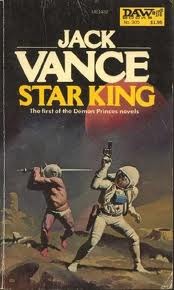
What is this cover?!

I always forget how much I like Jack Vance. Every one of his books pretends to be a straightforward piece of genre pulp, but they're just so very, very weird. It is like he couldn't restrain himself, and, despite fervent promises to his publishers to finally write something 'normal', by the midway point it is all psychedelic plant-creatures and poisoned paper.

The Star King is no exception. The premise is simple enough - the first in a five book series in which Kirth Gersen seeks revenge against the five (obvs) Demon Princes: crime lords of the galactic future. In this first volume, we jump straight in to the action and Vance catches us up later with some terse background-dumping. Gersen tracks down a Demon Prince (Malagate the Woe!), does some sneakery, does some fightery, does more sneakery, and attempts to extract his revenge. There's techie-space-jargon, but Vance uses technology interchangeably to magic: hand-wavery to move the plot along and create an overall atmosphere of disconcerting oddness.

The best parts of the book have nothing to do with the plot. Vance, true to form, litters the pages with utter bonkersness - including in-world 'research' materials at the start of every chapter. It is science fantasy at its most fantastic, closer to the deliberate oddness of the The Dying Earth than Star Trek or The Expanse. Similarly, Vance has a hard time keeping focus on the tropes, and the book is easily distracted from Gersen's SPACE-ASSASSIN background to talk about, say, alien worms, or the geography of a dying star, or an inn built at the edge of the universe, or... etc. etc. It is a 'by the numbers' adventure written by someone that clearly hates math.

Very odd, very fun, and very, very good.

(Worth noting: Gollancz Gateway ebook has some formatting bugs, which can be a little annoying at the start of each chapter, when the various quotes and materials [and chapter itself] all run into one-another.)
Profile Image for Leif.
1,958 reviews103 followers
February 28, 2021
Even though I have immensely enjoyed Vance's work in the past, including the incredibly named Servants of the Wanhk, I stalled with the Demon Princes pentology. The name - "Demon Princes" sounded so incredibly 1970s and the hook of another male pursuit of vengeance was frankly not appealing. And then I thought - why not give Vance the benefit of trust?

I'm glad that I did.

From the initial careful sketch of a nowhere little bar on a nowhere little planet to the light-t0uch sophistication of how biological symbiosis sets up a foreshadowing critical anti-plot against the major story of vengeance, The Star King is a compelling adventure story of mysteries (lightly disguised) and an excuse to accompany Vance into the dazzling terrain of his imagination.

My sole complaint is familiar but still always trenchant: women in Vance's worlds are often powerful but never drive the action and rarely provide strong, consistent characters. This consistent flaw renders his vision strangely, problematically masculinist, and robs it of the strength and audience it should otherwise have had.
Displaying 1 - 30 of 189 reviews

Can't find what you're looking for?

Get help and learn more about the design.