

What do you think?

Prehistoric Times
The narrator of Prehistoric Times might easily be taken for an inhabitant of Beckett’s world: a dreamer who in his savage and deductive folly tries to modify reality. The writing, with its burlesque variations, accelerations, and ruptures, takes us into a frightening and jubilant delirium, where the message is in the medium and digression gets straight to the point. In an entirely original voice, Eric Chevillard asks looming and luminous questions about who we are, the paths we’ve been traveling, and where we might be going – or not.
131 pages, Paperback
First published January 1, 1994
About the author
Éric Chevillard
93 books43 followersÉric Chevillard is a French novelist. He has won awards for several novels including La nébuleuse du crabe in 1993, which won the Fénéon Prize for Literature.
His work often plays with the codes of narration sometimes to the degree that it is even difficult to understand which story is related in his books, and has consequently been classified as postmodern literature. He has been noted for his associations with Les Éditions de Minuit, a publishing-house largely associated with the leading experimental writers composing in French today.
His work often plays with the codes of narration sometimes to the degree that it is even difficult to understand which story is related in his books, and has consequently been classified as postmodern literature. He has been noted for his associations with Les Éditions de Minuit, a publishing-house largely associated with the leading experimental writers composing in French today.
Ratings & Reviews
Friends & Following
Create a free account to discover what your friends think of this book!
Community Reviews
Displaying 1 - 27 of 27 reviews

April 27, 2021
Everything in the world evolves and combining absurdism and postmodernism Éric Chevillard creates a portrait of a modern prehistoric man…
A former archaeologist is now an attendant at the cave packed with the prehistoric rock art but the protagonist doesn’t want to be just an inert keeper he dreams to leave his trace in eternity…
Regardless of our wishes, however infinitesimally, we all participate in history.
Undeniably, my past as an archaeologist seems to make me perfect for the position; an archaeologist can never break entirely with his past. If there is a past that follows its man, it is unquestionably the past of the archaeologist; no past is richer in memories than an archaeologist’s past. You can never really put it behind you, you cannot easily rid yourself of an archaeologist’s past: no past remains as present or involves the future so much as an archaeologist’s past. Be there a man who lives in his past, it is surely the archaeologist, and who repeats himself, it is surely the archaeologist – without any particular nostalgia, mind you, without sighing over the good old days or lingering more than anyone else over cursing that evil time, but simply because of the very nature of the work that was his for so many long years. Whereas the archaeologist goes back in time, the march of history continues uninterrupted, progress flows smoothly downstream, and the gap between the archaeologist and his true contemporaries grows ever wider.
A former archaeologist is now an attendant at the cave packed with the prehistoric rock art but the protagonist doesn’t want to be just an inert keeper he dreams to leave his trace in eternity…
If our ancestors had prostrated themselves before a single God, we would have shattered that rudimentary idol in order to worship, forehead to the ground, our gods as numerous as the stars. It is movement that matters, evolution regardless of the slope; there is no design, no necessity, nothing justifies History such as we can reconstitute it. Life is stubborn, it wants to endure, but no one can give it a shape or a goal. It remains a principle without consequence, a pure, unusable energy; no matter how much I dig, what’s the point if my pick only strikes the skulls of these old, old ideas?
Regardless of our wishes, however infinitesimally, we all participate in history.

September 1, 2013
This is a book of elaborate word play, translated from the French. It’s about archaeology, reflected upon by a graduate student who is in charge of a gift shop and giving tours of cave paintings. But he’s a lackadaisical dreamer, we surmise, by the number of times he incites fury in his supervising professor and by the fact that in the end he gets fired and barricades himself in the gift shop!
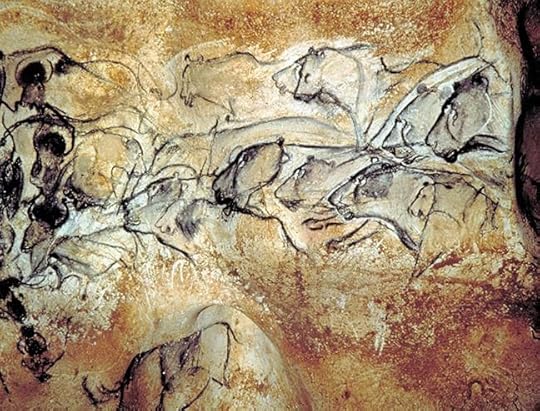
Amid the convoluted writing style we learn a bit about geology, bone fossilization, Carbon 14 dating and methods of cave paintings used in prehistoric times. Our narrator also performs some amateur archaeology by going through the stuff in drawers accumulated by his predecessors.
But the main fun is in the words: “…must certain men remain immobile, inert even, so as to serve as reference points for the active ones…and bad examples?“
“…digression really is the shortest distance between two points, the straight line being so very congested.”
“Whereas we are sure of absolutely nothing, when it comes to prehistoric times, we know nothing, or almost nothing.”
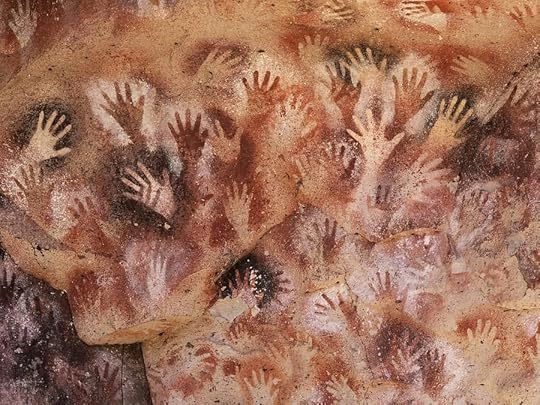
“In truth, everything is very simple and somewhat disappointing.”
We can see from these quotes why our narrator got into trouble. It’s an “interesting” book, but to be honest, I think you would have to be an archaeologist or, better, a graduate student in archaeology to really like it.
And in the latest news, we always think of caveMEN but perhaps women were responsible for many, even most, cave art? https://www.smithsonianmag.com/smart-...
And the oldest cave paintings may not be in Europe but in Indonesia https://www.nationalgeographic.com/sc...

The author is best known for his novel, The Crab Nebula, which has a fairly high rating on GR: 4.13.
Top photo from thumbs-prod.si-cdn.com...indonesiacavepaintings.com
Cave paintings in Patagonia, Argentina from i.pinimg.com/originals
Photo of the author from assets.letemps.ch
Edited, photos added 1/18/2020
Amid the convoluted writing style we learn a bit about geology, bone fossilization, Carbon 14 dating and methods of cave paintings used in prehistoric times. Our narrator also performs some amateur archaeology by going through the stuff in drawers accumulated by his predecessors.
But the main fun is in the words: “…must certain men remain immobile, inert even, so as to serve as reference points for the active ones…and bad examples?“
“…digression really is the shortest distance between two points, the straight line being so very congested.”
“Whereas we are sure of absolutely nothing, when it comes to prehistoric times, we know nothing, or almost nothing.”
“In truth, everything is very simple and somewhat disappointing.”
We can see from these quotes why our narrator got into trouble. It’s an “interesting” book, but to be honest, I think you would have to be an archaeologist or, better, a graduate student in archaeology to really like it.
And in the latest news, we always think of caveMEN but perhaps women were responsible for many, even most, cave art? https://www.smithsonianmag.com/smart-...
And the oldest cave paintings may not be in Europe but in Indonesia https://www.nationalgeographic.com/sc...
The author is best known for his novel, The Crab Nebula, which has a fairly high rating on GR: 4.13.
Top photo from thumbs-prod.si-cdn.com...indonesiacavepaintings.com
Cave paintings in Patagonia, Argentina from i.pinimg.com/originals
Photo of the author from assets.letemps.ch
Edited, photos added 1/18/2020

April 7, 2015
A bleakly human narrative, in blackly comic voice, a cynical Beckettian cast-off narrating his woes even as he resists conveying the narrative, his narrative, a narrative that proceeds in fits and starts in spite of itself (himself) pulling the listener in even as it shows its cards: that the voice, the digressions, are in fact the whole of the story here, the story itself but a line-tracing on a cavern wall to be filled in by our solemn and absurd intonations to echo endlessly through hallowed hollow space, repeating, refracting, multitudinally expanding with irresistible organic force, by midsentence digressions that derail another digression with a paragraph itself discursive, these somehow still coming together to map the whole of the human condition, or something like it, if only we could stop getting distracted by, at map's edge, that one red thumbtack amid yellow (and is the last yellow thumbtack in fact in the third drawer, beneath the detritus of human, or neanderthal? civilization, too much to properly sort through), or perhaps the gnat stuck in wet paint, whose legs will unnerve in perpetuity if not properly and carefully extracted, persisting to gnaw away and fill the mind with its murmurs, murmurs at once labyrinthinely convoluted, endlessly derailing, yet beautiful, oddly direct, completely understandable, a testament to precision of pen, of wit, of philosophic elegance however unwilling or self-defeating, and of course of translation, a translation so fine that the translator herself seems to step into the story, despite only arriving on the scene nearly a decade after this was written, and yet still a perfectly logical part of the overarching design that seems capable of engulfing any material and turning it into perfect and cohesive brilliance.

August 30, 2024
These wildly digressive, absurdly technical ruminations of a former archaeologist turned tour guide isolating himself in a cave serve up a brief, bewildering square of Chevillard’s patented absurdism, with fewer hilarious moments than in the barmy marvels On the Ceiling or Demolishing Nisard. The prose is as well-buffed as usual, with the translator chipping in a witty footnote as a cheeky garnish.

July 10, 2012
My first Chevillard reading, and he's up to some tricks that I loooove. The book is so short and divided into such short sections that it is both a fast read and a slow read - as I go back and re-read almost every line, the brevity of his style hides the power of his ideas and the playfulness of his language. A brilliant writer, subverting ideas of narrative structure or plot, Chevillard digresses his way through the narrative of a failed archaeologist who struggles with creating art that will last in time the same way that cave paintings last forever, despite "History" going on around them, they remain the same, trapped in "prehistoric time."
I couldn't help but think of Werner Herzog's documentary "Cave of Forgotten Dreams" the entire time I was reading . . . brilliance.
Highly recommended. Check this out and lose yourself in (prehistoric) time.
I couldn't help but think of Werner Herzog's documentary "Cave of Forgotten Dreams" the entire time I was reading . . . brilliance.
Highly recommended. Check this out and lose yourself in (prehistoric) time.
July 19, 2016
An excellent little book, with some real surprises, and very well translated. Chevillard gives us, to begin with, fairly standard post-Beckett stuff, as our narrator describes his uniform and his physical features and so on in a repetitive, unenlightening way. Soon enough, though, we get an actual backstory (he's an archaeologist who, thanks to an injured leg, can no longer be in the field and takes a job guarding prehistoric rock art in a cave), and then developments from there. What could have been amusing but light fare (meta-narrative stuff, what does it mean to make art and so on) ends up both much funnier than expected, and much more interesting.
Most importantly, the writing is glorious. Here are two sentences for you, about early hominids:
"Besides, these creatures did not disappear form one day to the next the minute exclusive and very selective humankind was picked out of the lot; life went on for them, too, their own evolution continued, they long remained contemporaries of Homo sapiens sapiens, and--I know this hypothesis will upset those of my fellow creatures who are my superiors--they may even have survived him; my opinion is that we ourselves are today the descendants of a species related to and rival of the human species that was annihilated and whose prestige and privileges we have usurped and whose civilized manners we ape; lice know what they're doing, so do I, everywhere I go I see only chimpanzees slogging away, and the more serious they are, the more ridiculous they are, dressed nonetheless as if they were men: religious, sentimental, domestic like men used to be, but awkwardly, brutally, unrelentingly carried away by their ape logic, exceeding all moderation, their smiles swallowed by grimaces, their gestures too brusque, and every word laboriously learned wasted in fits of rage. I am ready to defend this hypothesis as a true theory: we got rid of man, then took his place, and I can prove it: never would man, endowed with the aptitudes both to reason and to laugh, the latter to counteract the former, never would man thus enlightened have entered History."
Fabulous.
Most importantly, the writing is glorious. Here are two sentences for you, about early hominids:
"Besides, these creatures did not disappear form one day to the next the minute exclusive and very selective humankind was picked out of the lot; life went on for them, too, their own evolution continued, they long remained contemporaries of Homo sapiens sapiens, and--I know this hypothesis will upset those of my fellow creatures who are my superiors--they may even have survived him; my opinion is that we ourselves are today the descendants of a species related to and rival of the human species that was annihilated and whose prestige and privileges we have usurped and whose civilized manners we ape; lice know what they're doing, so do I, everywhere I go I see only chimpanzees slogging away, and the more serious they are, the more ridiculous they are, dressed nonetheless as if they were men: religious, sentimental, domestic like men used to be, but awkwardly, brutally, unrelentingly carried away by their ape logic, exceeding all moderation, their smiles swallowed by grimaces, their gestures too brusque, and every word laboriously learned wasted in fits of rage. I am ready to defend this hypothesis as a true theory: we got rid of man, then took his place, and I can prove it: never would man, endowed with the aptitudes both to reason and to laugh, the latter to counteract the former, never would man thus enlightened have entered History."
Fabulous.

March 1, 2012
Wow! What a great book! Seems like a sleeper; haven't heard many people talking about it. It deserves more attention. So many great lines. Equally funny as it is poignant and profound. Philosophical in the most fun way. Kind of Beckettesque and even a little Robert Lopezian. Definitely one for the reread pile. Damn. So good.

June 16, 2014
Talk about going from the absurd to the ridiculous, I should have thought about my next reading journey a little deeper than just picking up Chevillard and saying “this will do”, from Krasznahorkai to Chevillard, now there’s a journey. Quarterly have described Chevillard as “France’s foremost absurdist”, even Wikipedia says “postmodernist literature”, yep I’m in for a surprise.
Our novel opens with our unnamed protagonist/narrator telling us that he is unfit for the job of guard/guide of the Pales caves as the uniform is too small, the cap is too large and the shoes too big. The caves contain Palaeolithic paintings, and our protagonist has been “demoted” to the role of guide/guard as he injured himself falling whilst on an archaeologist tour (he’s is an archaeologist without a kneecap).
This is where our novel takes a turn into the land of “strange”, our writer doesn’t want to actually start our protagonist’s story, our guide doesn’t want to go to work as a guide, procrastination and delay are the themes, our hero is potentially unevolving (?), disevolving(?), evolving backwards, is he slowly becoming prehistoric?
No two skulls are alike, as any peasant growing his turnips on the site of an ancient necropolis can tell you; no two turnips either, even if an exhumed skull is sometimes so similar to a turnip that you can mistake one for the other. When you think about it, it might even be that our particular casts of mind – each unique – depend solely on the shape of our skull, individual thought testing itself first against the bone of its brainpan, like music molding itself to the geometry of a dome without regard for the musician’s intentions. Just a hypotheses I’m throwing out here. Indeed, I’m going beyond the call of my duties. But since I haven’t yet taken them up…Let’s grant for a moment that this hypothesis is correct, in which case we can legitimately claim that one’s thoughts will develop more freely in a huge-domed skull – but with the risk of getting lost or confused – than in a narrow, pointy skull, unless, on the contrary, they become sharper and burst forth, which is not impossible. My starting hypothesis thus branches out into diverging subhypotheses: this is how webs are woven; truth cannot be caught by the hand.
Our protagonist delays and delays his actual role as a guide – showing people through the caves – as well as his role as a guardian – protecting the caves – which causes no amount of angst amongst his superiors. Quite simply, they are not impressed. But then again he’s writing this book:
For my full review go to http://messybooker.blogspot.com.au/
Our novel opens with our unnamed protagonist/narrator telling us that he is unfit for the job of guard/guide of the Pales caves as the uniform is too small, the cap is too large and the shoes too big. The caves contain Palaeolithic paintings, and our protagonist has been “demoted” to the role of guide/guard as he injured himself falling whilst on an archaeologist tour (he’s is an archaeologist without a kneecap).
This is where our novel takes a turn into the land of “strange”, our writer doesn’t want to actually start our protagonist’s story, our guide doesn’t want to go to work as a guide, procrastination and delay are the themes, our hero is potentially unevolving (?), disevolving(?), evolving backwards, is he slowly becoming prehistoric?
No two skulls are alike, as any peasant growing his turnips on the site of an ancient necropolis can tell you; no two turnips either, even if an exhumed skull is sometimes so similar to a turnip that you can mistake one for the other. When you think about it, it might even be that our particular casts of mind – each unique – depend solely on the shape of our skull, individual thought testing itself first against the bone of its brainpan, like music molding itself to the geometry of a dome without regard for the musician’s intentions. Just a hypotheses I’m throwing out here. Indeed, I’m going beyond the call of my duties. But since I haven’t yet taken them up…Let’s grant for a moment that this hypothesis is correct, in which case we can legitimately claim that one’s thoughts will develop more freely in a huge-domed skull – but with the risk of getting lost or confused – than in a narrow, pointy skull, unless, on the contrary, they become sharper and burst forth, which is not impossible. My starting hypothesis thus branches out into diverging subhypotheses: this is how webs are woven; truth cannot be caught by the hand.
Our protagonist delays and delays his actual role as a guide – showing people through the caves – as well as his role as a guardian – protecting the caves – which causes no amount of angst amongst his superiors. Quite simply, they are not impressed. But then again he’s writing this book:
For my full review go to http://messybooker.blogspot.com.au/

January 26, 2014
from page 112
Birds change names whenever they change habitats, this is why they are at home wherever they go.Their flightiness does considerable harm to the notion of native land. Fortunately there are farmyards; nations are saved by their farmyards However, this would not be enough. Nations are above all mineral, at one with their soil…Inexhaustively rich in silicates, iron oxides, and manganese, the Pales region, birthplace of painting, is also reputed for its low grain yield, where the hens lay so rarely that storks hatch from their eggs. Art and hunger have thus belonged to one another since the beginning, shaped by the same dreams of abundance and sensual delight.’
About a 3.5, I think. But after a night’s sleep I'm revising my original decision to round it up; I’m going to take it down to 3.
Birds change names whenever they change habitats, this is why they are at home wherever they go.Their flightiness does considerable harm to the notion of native land. Fortunately there are farmyards; nations are saved by their farmyards However, this would not be enough. Nations are above all mineral, at one with their soil…Inexhaustively rich in silicates, iron oxides, and manganese, the Pales region, birthplace of painting, is also reputed for its low grain yield, where the hens lay so rarely that storks hatch from their eggs. Art and hunger have thus belonged to one another since the beginning, shaped by the same dreams of abundance and sensual delight.’
About a 3.5, I think. But after a night’s sleep I'm revising my original decision to round it up; I’m going to take it down to 3.

June 19, 2013
this won the translation prize for french into english for 2013.
ruptured and raptured novel of a tour guide and caretaker of a cave that has paintings in it. or a cave that is totally empty of any paintings.
said guide also was an archeologist in said cave but fell and snapped his leg off, so was put out to pasture as the ticket taker. very weird french novel, and frankly not that appealing to me.
ruptured and raptured novel of a tour guide and caretaker of a cave that has paintings in it. or a cave that is totally empty of any paintings.
said guide also was an archeologist in said cave but fell and snapped his leg off, so was put out to pasture as the ticket taker. very weird french novel, and frankly not that appealing to me.

January 23, 2013
Relentless, resistless; comically, cosmically sad.

April 10, 2015
"...[P]erhaps, if you think about it, digression really is the shortest distance between two points, the straight line being so very congested" (52).
I bought this book at Green Apple in San Francisco nearly a year ago for $2.98, and, for whatever reason, was never interested enough to pick it up and get into it. So, last week I finally picked it up because I had nothing else to read, and man alive am I happy I did!
This book is incredible! I hesitate to say I "enjoyed" reading it; at times it got a little too absurd for me to stay entranced during my daily commute. But it kept sticking to me like chewing gum under my shoes, so I kept reading it.
I'd say it's as much (if not more so) a treatise on poetics than a narrative about archaeology and cave paintings, but there's enough balance between the two for the thing to succeed. It's a book about ideas, a set of ruminations that just so happen to pop up in a narrator's head as he's slumping through a plot. Really, really worth checking out.
I bought this book at Green Apple in San Francisco nearly a year ago for $2.98, and, for whatever reason, was never interested enough to pick it up and get into it. So, last week I finally picked it up because I had nothing else to read, and man alive am I happy I did!
This book is incredible! I hesitate to say I "enjoyed" reading it; at times it got a little too absurd for me to stay entranced during my daily commute. But it kept sticking to me like chewing gum under my shoes, so I kept reading it.
I'd say it's as much (if not more so) a treatise on poetics than a narrative about archaeology and cave paintings, but there's enough balance between the two for the thing to succeed. It's a book about ideas, a set of ruminations that just so happen to pop up in a narrator's head as he's slumping through a plot. Really, really worth checking out.

July 13, 2014
From my review at TIR: "Under the influence of having just completed this book—and let me note at the outset that the influence is hard to resist—I feel like I could start just about anywhere in reviewing it, so why not a footnote. There is just one in the book, but what a footnote, extending over two pages, explicative, digressive, apt, entertaining, and, best of all, delivered in the voice of the translator, Alyson Waters. We can say more (since, too impatient to wait for the French book to arrive in the mail, I wrote to the translator to ask): what in the world could the author have written in French that would translate so well into such a translator’s note? Answer: nothing at all! Or next to nothing. The author merely opens a window in his text (here in Waters’s translation): 'Professor Glatt gave me the clef...'" and the rest of it is here: http://iowareview.org/blog/eric-chevi....

April 11, 2021
Last year I purchased a subscription to Archipelago Books, a nonprofit translator and publisher based in NYC. They send three or four books to me each month. I chose some of the titles when I subscribed, and agreed to let them fill in the others. Prehistoric Times is in the latter group. It’s a short story about an aging archaeologist. My first Eric Chevillard, I know nothing about him, but he reminds me of a slightly less maladaptive Knut Hamsun, and I see that as a good thing.
Before reading this, I’d recommend first watching Werner Herzog’s The Cave Of Forgotten Dreams in a dark, quiet room.
And definitely, check out archipelagobooks.org.
Before reading this, I’d recommend first watching Werner Herzog’s The Cave Of Forgotten Dreams in a dark, quiet room.
And definitely, check out archipelagobooks.org.

July 31, 2012
An archeologist loses his job after an accident lames him, only to be offered by the government a new job as tour guide of the the same archeological site. The archeologist, however, has different plans. . .

July 26, 2012
Like a French George Saunders, perhaps. Strange and funny with a touch of darkness held deftly in check.
August 15, 2017
Moves along with such blinding sharpness one walks away with well-earned slices, but oh how you love the stinging brilliance of it all. Chevillard never intended only to graze.

December 12, 2018
My favorite local bookstore, Myopic Books, has a section near the register consisting of Open Letter and Archipelago books, among other small presses, and this unknown title by an unknown author seemed promising - described as surreal and absurd with a comparison to Beckett, although I noticed more distinct ripples of Chejfec and Ugresic's novelistic essayism in her Museum stretching across the narrative pond. Echoing the Ugresic comparison, this brief novel is a sort of museum of *prehistoric* sorts - an archaeological excavation site; a cave turned museum full of paintings and earthenware centuries old, objects which prompt the narrator to ruminate over man's seemingly lifelong endeavors to document and archive his own existence - "Man will only ever address himself to man, in a closed circuit, man finishes in man. Let us add that the permanence of his fictive identity relies on a conscious effort that must not slacken at any cost, nothing objectively establishes it, it will remain fragile and contestable until the end."
The narrator contemplates particular paintings and the techniques and materials that have allowed them to be preserved for thousands of years. Rock formations are analyzed as well; the centuries-long evolution of the world and its geographical features alongside man's evolution as told through the gradual union of stalagmites and stalagtites forming a single unbreakable column.
The narrative is one of digression which interrupts the main theme (which is...?) told by a migratory mind who offers no clear thread to follow, although this isn't quite like Carole Maso's frustrating and directionless Mother & Child; the thread at some moments shimmers by light of Chevillard's flickering torch, promising to lead us deeper into the narrative cave.
The narrator contemplates particular paintings and the techniques and materials that have allowed them to be preserved for thousands of years. Rock formations are analyzed as well; the centuries-long evolution of the world and its geographical features alongside man's evolution as told through the gradual union of stalagmites and stalagtites forming a single unbreakable column.
The narrative is one of digression which interrupts the main theme (which is...?) told by a migratory mind who offers no clear thread to follow, although this isn't quite like Carole Maso's frustrating and directionless Mother & Child; the thread at some moments shimmers by light of Chevillard's flickering torch, promising to lead us deeper into the narrative cave.
August 23, 2026
Everything to me right now
“…because we only have shards, fragments of rock, a vision of chaos or apocalypse, no matter, it’s the same scene. Every human work as it is constructed also foreshadows what will be, but in reverse, its successive ruins, and each year of our life discreetly celebrates the anniversary of our death: time passed through here, it will go back through here.”
Only cave paintings seem made to last forever.
“…because we only have shards, fragments of rock, a vision of chaos or apocalypse, no matter, it’s the same scene. Every human work as it is constructed also foreshadows what will be, but in reverse, its successive ruins, and each year of our life discreetly celebrates the anniversary of our death: time passed through here, it will go back through here.”
Only cave paintings seem made to last forever.

November 17, 2022
Incomprehensible most of the time...
December 17, 2024
makes me wonder what the original in French is like

March 24, 2025
Absurd and silly - lots of digressions and very particular overly analytical rumination. I found this book charming and fun. It never quite made me laugh but it made me smile many times.

April 8, 2026
Like Kafkas little mole in his burrow

November 4, 2016
There’s not much of a story here but bit by bit a picture emerges. At first all we know about our narrator is that, following an injury at work, he’s taken over a job from someone called Boborikine who has recently died:
Chevillard is frequently described as an absurdist writer. According to François Monti he’s “France’s foremost absurdist, a modern day surrealist who revels in using popular catchphrases or clichés … and subverts them by means of his imagination and sense of humour.” Labels often do more harm than good. Waiting for Godot, for example, came to be considered an essential example of what Martin Esslin later called ‘Theatre of the Absurd’ but this was a term Beckett himself disavowed. I’m not sure labelling Chevillarddoes him any favours. He’s very much his own man from what I can see. Many novelists—Joyce, Beckett, Woolf—have dwelt on the idle and empty wanderings of consciousness and there’s definitely a touch of Thomas Bernhard here too. If long—sometimes meandering, mostly convoluted—sentences annoy the hell out of you then you might want to give this a miss; several times I got completely lost on a page and my eye desperately searched for a full stop to navigate by.
Absurd it (arguably) may be but silly it is not. There’s quite a bit of meat in between the covers here. I know it won’t be to everyone’s tastes but I enjoyed it.
I am his replacement. His uniform does not suit me, not in the least. I asked for a new one, made to measure. To be more efficient, I argued, convinced that this argument was sound; to be stricter, prompter, adding: and to represent the profession with greater dignity. I’d even go so far as to believe that my request will be heard on high and satisfied at long last, after all the dillydallying by the administration. Meanwhile, I am obliged to wear Boborikine’s uniform. It does not suit me at all.For the first few pages all our narrator does is whinge about his uniform and wonder what he can do to make it fit and look better:
[T]he left shoe is scruffy, cracked, practically useless, whereas the right still boasts a bit of chic, having been worn with much less frequency due to the infirmity of Crescenzo [whom Boborikine replaced], whose right foot was amputated following his accident.Gradually, however, we learn that he is actually an archaeologist. Following his accident and either out of pity or a sense of obligation he has been offered the job of caretaker to a cave housing prehistoric paintings but for some reason he proves dilatory in taking up his duties. Instead, starting with his ill-fitting uniform, he gets bogged down in minutia. For example, after being given to the key to the gate—or, possibly, grate (another topic that sidetracks him)—he hangs it next to the map of the cave, which is fixed to the wall with four thumbtacks, three yellow and one red. The red one bothers him and so off he sets going through Boborikine’s belongings—he’s also inherited the man’s flat—trying to find a replacement. And not getting on with his actual job:
[…]
Since I cannot repair the left, already stitched, glued, nailed, resoled, polished anew a thousand times, and a thousand and one times destroyed anew, now putrid like a dead animal, why not hasten the decline of the right, plunging it one day into a saltwater bath, sheltering a rat in it for a few days, ripping out its steel tips, replacing its black shoelace with some piece of string or other?
Professor Glatt steps in. This time I’ve gone too far, I’m not getting anywhere. Which one is it? Either I’ve gone too far or I’m not getting anywhere. The professor has to choose. How can I be going too far if I’m not getting anywhere? It’s either one or the other. One cannot, in all sincerity, reproach me for not getting anywhere and going too far at one and the same time – it would be disingenuous. I’m taking too long to open the cave, now that’s a criticism that could be levelled at me, that’s something I would have trouble denying. However, I have my reasons. It seems the way I am carrying out my duties is being judged more and more harshly on high. Even Professor Glatt, who usually takes my side, did not appreciate the thumbtack episode. Couldn’t I simply have pulled the plastic heads off the three yellow thumbtacks to find the requisite harmony? Obviously, yes; and if I didn’t do it, it’s because I had my reasons. What do they know on high about how my work is progressing? How do they measure progress?On and on it goes or mostly does not go. No, that’s not fair. He does go: backwards. Little by little we see our former archaeologist devolve in a… I suppose you’d call him a modern day caveman. He becomes obsessed with the cave drawings and starts to plan his own within his flat which he expects to last some forty or fifty thousand years.
Chevillard is frequently described as an absurdist writer. According to François Monti he’s “France’s foremost absurdist, a modern day surrealist who revels in using popular catchphrases or clichés … and subverts them by means of his imagination and sense of humour.” Labels often do more harm than good. Waiting for Godot, for example, came to be considered an essential example of what Martin Esslin later called ‘Theatre of the Absurd’ but this was a term Beckett himself disavowed. I’m not sure labelling Chevillarddoes him any favours. He’s very much his own man from what I can see. Many novelists—Joyce, Beckett, Woolf—have dwelt on the idle and empty wanderings of consciousness and there’s definitely a touch of Thomas Bernhard here too. If long—sometimes meandering, mostly convoluted—sentences annoy the hell out of you then you might want to give this a miss; several times I got completely lost on a page and my eye desperately searched for a full stop to navigate by.
Absurd it (arguably) may be but silly it is not. There’s quite a bit of meat in between the covers here. I know it won’t be to everyone’s tastes but I enjoyed it.

Read
June 12, 2014http://www.full-stop.net/2012/08/14/r...
Review by Helen Stuhr-Rommereim
[Ed. Note: Due to an internal error, two reviewers were assigned Eric Chevillard's Prehistoric Times. As it turns out, each review offered a unique perspective on Chevillard's novel, and so we've decided to publish both. You can find Elias Tezapsidis's take here.]
Prehistoric Times, the fifth novel of French absurdist Eric Chevillard’s to be translated into English, is about a lot of things, ranging from the mundane — a man, a cave — to the profound: art, death, and the cosmic scope of the history of the universe. But the plot of Prehistoric Times is confusing and almost non-existent. The ideas of the novel are clear and ever-present, but behind these ideas the experience of reading is as confounding as it is beautifully surprising. Chevillard’s prose flows forward with its own internal velocity, spinning out webs of thought, rarely stopping for spatial description, and leaving the reader struggling to keep apace.
Over the course of the book, the nameless narrator shape-shifts imperceptibly from a hapless employee to an artist of epic, fatal ambition. An archeologist by profession, he has been recruited to take over the position of a certain deceased Boborikine, guarding and giving guided tours of the Pales Cave, which is filled with prehistoric paintings. We learn a few things about this narrator: that he injured himself in a fall; that those “on high” to whom he answers do not have very much faith in him; that his mother had soft dresses and a soft voice. The facts are random, and do not add up to a full characterization. The narrator is hardly more than a disembodied voice, full of opinions and aphorisms.
Read more here: http://www.full-stop.net/2012/08/14/r...
Review by Helen Stuhr-Rommereim
[Ed. Note: Due to an internal error, two reviewers were assigned Eric Chevillard's Prehistoric Times. As it turns out, each review offered a unique perspective on Chevillard's novel, and so we've decided to publish both. You can find Elias Tezapsidis's take here.]
Prehistoric Times, the fifth novel of French absurdist Eric Chevillard’s to be translated into English, is about a lot of things, ranging from the mundane — a man, a cave — to the profound: art, death, and the cosmic scope of the history of the universe. But the plot of Prehistoric Times is confusing and almost non-existent. The ideas of the novel are clear and ever-present, but behind these ideas the experience of reading is as confounding as it is beautifully surprising. Chevillard’s prose flows forward with its own internal velocity, spinning out webs of thought, rarely stopping for spatial description, and leaving the reader struggling to keep apace.
Over the course of the book, the nameless narrator shape-shifts imperceptibly from a hapless employee to an artist of epic, fatal ambition. An archeologist by profession, he has been recruited to take over the position of a certain deceased Boborikine, guarding and giving guided tours of the Pales Cave, which is filled with prehistoric paintings. We learn a few things about this narrator: that he injured himself in a fall; that those “on high” to whom he answers do not have very much faith in him; that his mother had soft dresses and a soft voice. The facts are random, and do not add up to a full characterization. The narrator is hardly more than a disembodied voice, full of opinions and aphorisms.
Read more here: http://www.full-stop.net/2012/08/14/r...

February 22, 2014
The best book on cave paintings from a deranged archaeologist you'll read this year

January 27, 2015
I definitely want to read me from this author. The pacing in this book was a bit to slow.
Displaying 1 - 27 of 27 reviews