I think that idiot bosses are timeless, and as long as there are annoying people in the world, I won't run out of material.—Scott Adams
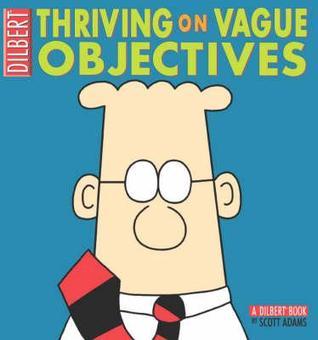
Dilbert and the gang are back for this 26th collection, Thriving on Vague Objectives.
Adams has his finger on the pulse of cubicle dwellers across the globe. No one delivers more laughs or captures the reality of the 9 to 5 worker better than Dilbert, Dogbert, Catbert, and a cast of stupefying office stereotypes--which is why there are millions of fans of the Dilbert comic strip.
Dilbert is a techno-man stuck in a dead-end job (sound familiar?). Power-mad Dogbert strives to take over the world and enslave the humans. The most intelligent person in Dilbert's world is his trash collector, who knows everything about everything.
Artist and creator Scott Adams started Dilbert as a doodle when he worked as a bank teller. He continued doodling when he was upgraded to a cubicle for a major telecommunications company. His boss (no telling if he was pointy-haired or not) suggested the name Dilbert. Adams is so dead-on accurate in his depictions of office life that he has been accused of spying on Corporate America.
Scott Adams was a defining voice of the American white-collar experience who transitioned from a prominent cartoonist into a polarizing political commentator. After earning an MBA from UC Berkeley and spending years in management at Pacific Bell, Adams launched the comic strip Dilbert in 1989. The strip’s sharp satire of corporate bureaucracy and the "Dilbert Principle"—the idea that incompetent employees are promoted to management to minimize their damage—resonated globally, eventually appearing in 2,000 newspapers and winning the prestigious Reuben Award. Beyond the funny pages, Adams explored philosophy and persuasion in works like God's Debris and Win Bigly, the latter of which analyzed Donald Trump’s rhetorical strategies during the 2016 election. His career took a dramatic turn during the mid-2010s as he shifted focus to his daily "Real Coffee" livestream, where he combined his background in hypnosis and corporate strategy to comment on the "culture wars." This period of independent commentary culminated in 2023 when he reacted to a poll regarding racial tensions with a series of inflammatory remarks. Labeling Black Americans a "hate group" and advocating for racial segregation, Adams faced immediate and widespread repercussions; hundreds of newspapers dropped his strip, and his publisher canceled his upcoming projects. Undeterred, he moved his work to the subscription-based platform Locals, rebranding his comic as Dilbert Reborn. In his final years, he faced severe health challenges, including stage IV prostate cancer and vocal cord issues, yet he remained a prolific presence on social media. He eventually announced the end of his hand-drawn work due to focal dystonia but continued to direct the strip's vision. Adams’s legacy remains a complex study in the power of branding, the evolution of digital influence, and the volatile intersection of creative genius and political provocation in the modern era.
Absolutely Hilarious! I just love the cynicism in Dilbert. In this installment, we follow Dilbert and co. as they deal with moronic bosses who can’t give them a basic task with definite start and end points. What seems like a sturdy project crumbles with various cuts and increased expectations until it becomes nothing more then, vague objectives. Sassy, sarcastic, slightly nihilistic, and obviously realistic, this series is a must read for all. You will not regret it.
I had to fight my son Ian for this one. I pointed out that since I paid for it I got to read it first. I was reminded of how my mom belonged to the Stephen King book club when I was about 13 and I used to read the books before she got home from work. She grew resigned to it. This one had some laugh out loud moments, and a Turing test reference.
Dilbert is always amusing. I found quite a number of standout strips in this book. Anyone who has worked in an office with a boss they aren’t very fond of, and a variety of co-workers can find something to relate to in these books.
The one thing that I find slightly annoying is that different sources have the Dilbert collections in different orders, and some of them even have them in 2 or 3 separate collections. I don’t really care —I’m reading them in the order that Amazon has them listed, and so far it hasn’t made much difference. All of the Dilbert books can be read as standalone books —they do not really build on each other except that there are some characters that were not in earlier collections, but that isn’t a big deal really.
Thriving on Vague Objectives is a more recent Dilbert collection, collecting comics from 2005. Notably less humorous than it was in the 90s, but I guess the cartoon had a toll on the comic.
Dilbert and his...colleagues...are desperate to find some sort of meaning in their work, but between the empty promises of their boss and the empty gaze of their fellow employees, the only meaning to their lives seems to come at lunch break. Adams speaks to all cubicle suffers in another funny, colourful and downright cruel splash of reality. Someday Dilbert may find more meaning than the one between two slices of bread...someday...
You just can't go wrong when it comes to work humor and Dilbert. Filled with tons of comics that will make you laugh out loud at all the crazy things we put up with on a daily basis. A great book for a laugh.
We all might have started out like Calvin with a great view of life. But after hitting the workforce we all somewhat become Dilbert. Everyone knows someone like one of the characters in the strips. Highly recommended