We are so familiar with nation-states; every country is supposed to have a native population that belongs to a single race or ethnicity, speaks a single language, follows a single religion (or professes nominal ties to it), and expresses itself through a culture produced by the synthesis of the above.
Western political discourse viewed the creation and consolidation of nation-states as the only logical grouping of people in modern times, one that all the societies in the world should aspire to, in order to make the necessary transition from the age of empires and kingdoms. Mark Mazower argues that this Western-Europe-centric political idea, although it eventually benefited Western Europe, has been a major source of death and destruction in the countries of the Balkans and Eastern Europe.
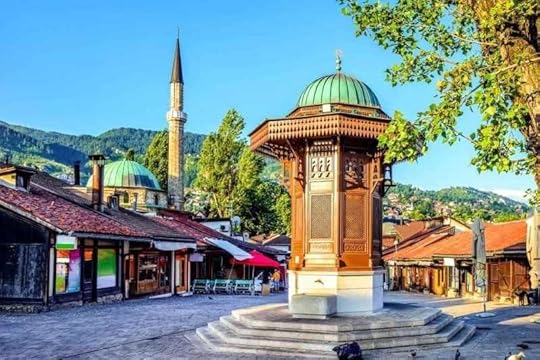
He expands on this thesis by taking stock of the politics and cultures of Balkan countries under the Ottoman-Turkish rule. His argument is two-fold: One, to show that the Ottoman-held Balkans were thriving societies, culturally, socially and economically, as opposed to miserable and backward ‘lost lands’ of Europe under the brutal rule of the barbarian Turks - a view famous with Western intelligentsia well into the second half of the 20th century.
Two, the roots of the political and social upheavals which have marked the Balkans in the 20th century (the latest being Serb-led genocide of Bosniaks and Croats in the 1990s) lay not in their "cultural barbarity" and intolerance borrowed from their Ottoman ex-masters, but rather spring from European ideology of race-based nationalism, whose ultimate aim was to create centralised, homogenous nation-states.
One marked difference between the Balkan peasant societies and their North European counterparts was that there was near absence of feudal holdings in the former. The land belonged to the Sultan, people tilled it and shared the produce in the shape of taxes with the imperial government. In North Europe, however, feudals literally owned peasants like land and chattel. Through this the writer concludes that peasants in Ottoman Europe had had far greater social and economic freedoms than their brethren in rest of the Europe. This fact allowed greater movement of people to areas with good agriculture and business, and with time, every Balkan country became ethnically and religiously diverse.
There was only one major tag that defined the subjects of the Ottoman empire: religion. Muslims, by virtue of being rulers, were first class citizens. Christian and Jews were 'protected religions' (Dhimmis) as per official view of Islam. This sanction allowed Christians to retain and preserve their religion, sects, languages, and by extension, their cultures. So neither the imperial religion nor the language was forced on the masses. So much so that at one point Christians serving in the imperial court in Constantinople were so numerous that Greek and Slavic languages were given preference over Turkish in official proceedings. In part due to geography, in part economy, and in part for the policies of the imperial state, the Balkans became racially, linguistically and religiously diverse.
The weakening hold of the Ottomans on their Balkan colonies coincided with the rising powers of Britain and France. As Balkan countries gained independence - starting with Greece - the new breed of linguistic/ethnic nationalists were posed with a question. How to create homogenous ethno-lingual nation-states on Western Europe model in a landscape so diverse and mixed? New nation-states that had sprung up through a long and painful political process still had significant minorities (Albanians and Turks in Greece, Albanians in Serbia, Bulgarians in Romania, Greek, Turks, Jews in Macedonia, Greeks in Turkish mainland). They didn’t know what to do with minorities except force mass population exchanges and in some cases go for ethnic cleansing. This, the writer asserts, is the direct consequence of remodeling the Balkans to conform to Western European ideals in a very short period.
After a brief flirtation with Western-imported free market democracy, the fissures and fractures induced by nationalistic ideas were swept under the carpet during the Communist period. Old animosities did not die away but were harshly controlled as Communism viewed itself as beyond race and religion. They resurfaced as soon as Communism crumbled. The experiment of Yugoslavia is an example to come to terms with the simmering question of nationalism; genocide in Bosnia and Kosovo was another sorry chapter of the same phenomenon.
Ironically, just as it appears that the Balkans have solved their nationalist and ethnic conflicts, the rest of Europe has moved on. The creation of multicultural societies in major Western countries is the exact opposite of what the Balkans have been fighting for all along, until a couple of decades ago. Diversity in Europe today mirrors the mixed societies of Ottoman-held Balkans; that is, London, Paris and Frankfurt today are as diverse as Istanbul, Athens and Belgrade were during the Ottoman times.
History repeats itself?
In conclusion, with all things considered, the book categorically rejects the idea that there is something fundamentally wrong with the cultures of the Slavs which, ‘cut off’ from the ‘civlised European motherland’, have been tainted and brutalised during five centuries of Muslim rule - a view which has been the mainstay of Western academia until recently.