

What do you think?

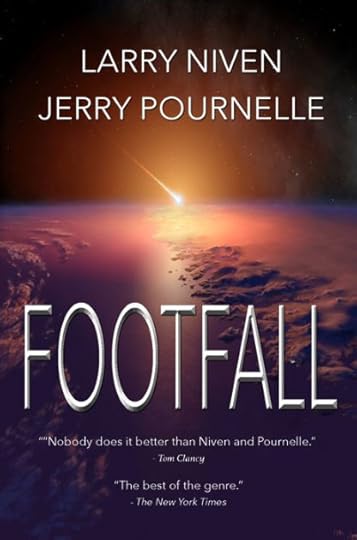
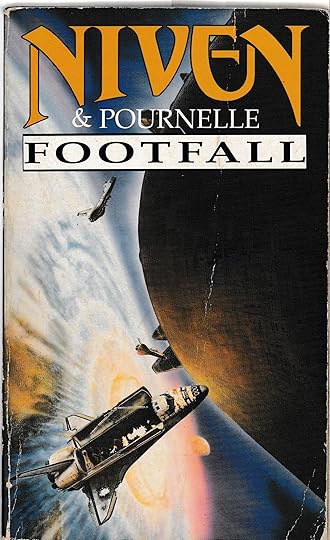
Footfall
They first appear as a series of dots on astronomical plates, heading from Saturn directly toward Earth. Since the ringed planet carries no life, scientists deduce the mysterious ship to be a visitor from another star.
The world's frantic efforts to signal the aliens go unanswered. The first contact is hostile: the invaders blast a Soviet space station, seize the survivors, and then destroy every dam and installation on Earth with a hail of asteriods.
Now the conquerors are descending on the American heartland, demanding servile surrender--or death for all humans.
The world's frantic efforts to signal the aliens go unanswered. The first contact is hostile: the invaders blast a Soviet space station, seize the survivors, and then destroy every dam and installation on Earth with a hail of asteriods.
Now the conquerors are descending on the American heartland, demanding servile surrender--or death for all humans.
524 pages, Paperback
First published January 1, 1985
About the author
Larry Niven
698 books3,384 followersLaurence van Cott Niven's best known work is Ringworld (Ringworld, #1) (1970), which received the Hugo, Locus, Ditmar, and Nebula awards. His work is primarily hard science fiction, using big science concepts and theoretical physics. The creation of thoroughly worked-out alien species, which are very different from humans both physically and mentally, is recognized as one of Niven's main strengths.
Niven also often includes elements of detective fiction and adventure stories. His fantasy includes The Magic Goes Away series, which utilizes an exhaustible resource, called Mana, to make the magic a non-renewable resource.
Niven created an alien species, the Kzin, which were featured in a series of twelve collection books, the Man-Kzin Wars. He co-authored a number of novels with Jerry Pournelle. In fact, much of his writing since the 1970s has been in collaboration, particularly with Pournelle, Steven Barnes, Brenda Cooper, or Edward M. Lerner.
He briefly attended the California Institute of Technology and graduated with a Bachelor of Arts in mathematics (with a minor in psychology) from Washburn University, Topeka, Kansas, in 1962. He did a year of graduate work in mathematics at the University of California at Los Angeles. He has since lived in Los Angeles suburbs, including Chatsworth and Tarzana, as a full-time writer. He married Marilyn Joyce "Fuzzy Pink" Wisowaty, herself a well-known science fiction and Regency literature fan, on September 6, 1969.
Niven won the Hugo Award for Best Short Story for Neutron Star in 1967. In 1972, for Inconstant Moon, and in 1975 for The Hole Man. In 1976, he won the Hugo Award for Best Novelette for The Borderland of Sol.
Niven has written scripts for various science fiction television shows, including the original Land of the Lost series and Star Trek: The Animated Series, for which he adapted his early Kzin story The Soft Weapon. He adapted his story Inconstant Moon for an episode of the television series The Outer Limits in 1996.
He has also written for the DC Comics character Green Lantern including in his stories hard science fiction concepts such as universal entropy and the redshift effect, which are unusual in comic books.
http://us.macmillan.com/author/larryn...
Niven also often includes elements of detective fiction and adventure stories. His fantasy includes The Magic Goes Away series, which utilizes an exhaustible resource, called Mana, to make the magic a non-renewable resource.
Niven created an alien species, the Kzin, which were featured in a series of twelve collection books, the Man-Kzin Wars. He co-authored a number of novels with Jerry Pournelle. In fact, much of his writing since the 1970s has been in collaboration, particularly with Pournelle, Steven Barnes, Brenda Cooper, or Edward M. Lerner.
He briefly attended the California Institute of Technology and graduated with a Bachelor of Arts in mathematics (with a minor in psychology) from Washburn University, Topeka, Kansas, in 1962. He did a year of graduate work in mathematics at the University of California at Los Angeles. He has since lived in Los Angeles suburbs, including Chatsworth and Tarzana, as a full-time writer. He married Marilyn Joyce "Fuzzy Pink" Wisowaty, herself a well-known science fiction and Regency literature fan, on September 6, 1969.
Niven won the Hugo Award for Best Short Story for Neutron Star in 1967. In 1972, for Inconstant Moon, and in 1975 for The Hole Man. In 1976, he won the Hugo Award for Best Novelette for The Borderland of Sol.
Niven has written scripts for various science fiction television shows, including the original Land of the Lost series and Star Trek: The Animated Series, for which he adapted his early Kzin story The Soft Weapon. He adapted his story Inconstant Moon for an episode of the television series The Outer Limits in 1996.
He has also written for the DC Comics character Green Lantern including in his stories hard science fiction concepts such as universal entropy and the redshift effect, which are unusual in comic books.
http://us.macmillan.com/author/larryn...
Ratings & Reviews
Friends & Following
Create a free account to discover what your friends think of this book!
Community Reviews
Displaying 1 - 30 of 566 reviews

February 18, 2017
In the vast reaches of the immeasurable cosmos, a tiny dot is traveling at immense speed in the background of the flickering lights, seen from the oblivious distant Earth, the unimaginable is arriving a small unimportant looking object, first not recognized by the people of the third planet, ( the preoccupied astronomers, for what it is) orbiting an average star, called Sol... Aliens, at last are coming we are not, is it good or bad who knows? Alone...the destination is our world, unprepared, divided full of great hate towards one another, almost helpless nevertheless an enormous struggle for survival ensues, millions will perish , the blue planet will never be the same...They call themselves these strangers from a nearby, dying star system a few light-years away, The FITHP led by wily Herdmaster, Pastempeh-keph, resembling...fantastic baby elephants with two snouts, henceforth the Earthlings speak of them disparagingly as "Snouts", their spaceship is not small either but huge , a mile long, carrying many thousands of aliens and tons of equipment in their long, endless journey, with generations living and dying in this gigantic, almighty craft... the callous aliens, have come to conqueror..Destroying a Soviet space station, ( written in 1985) welcoming them... they are not amused. President David Coffey of the United States flees Washington, goes deep underground to Cheyenne Mountain, Colorado Springs, Colorado. Maybe he'll be safe there as the aliens, hurl down a big asteroid, others will fellow hitting the Indian Ocean a tremendous splash occurs, a colossal tidal wave forms, crushing the people living near the coast, now dying there by the sea, India disappears other nations go dark, no lights no humans left the invaders land in Kansas, the local National Guard fights bravely, soon the U.S. Army intervenes but to no avail, these creatures from another world have too much... unknown arms, with superior technology which devastates the land, structures, roads, homes, dams, that give us electricity, refineries make precious gasoline especially now and the all important crops feed the country, the famous wheat fields gone the slaughter, smell, destruction cannot be visualized or comprehended...Still the Earth will not give up no matter how feeble their efforts seem, to save civilization the long upwards climb from the mud, to hopefully in the future the stars, will not be denied without an enormous resistance the history of humanity shows this... A splendid story, exciting with enough plot for a score of novels, one of the best alien invader books ever written, for readers that enjoy this type of entertainment they will not be disappointed...I wasn't.

March 21, 2021
I strongly suspect and freely admit that my expectations going into a book substantially impact my enjoyment and ratings. I seem to be unable to manage this. Well, I went into this particular book with low expectations. It’s a 1985 hard sci-fi dealing with first contact and alien invasion. I prefer my sci-fi with a little less science and a little more wonder and atmosphere than most hard sci-fi. But dang it if I didn’t enjoy the heck out of this one. Sure, it starts a bit slow, it’s mildly misogynistic, a tad bloated, and it features gun toting baby elephants as the invading aliens. That’s right, small elephant-like aliens with a bifurcated truck that splits again with creating four digits on each trunk. This is no spoiler as it’s shown on the front cover (at least on my hardbound). Even the book’s characters can’t help but laugh the first time they see the aliens. But like the plot, there’s more beneath the wrinkly skinned exterior.
Let’s start with the plot, on the surface, it’s straight-forward. Aliens are approaching with a large generation ship, and they haven’t just come for our peanuts. The authors (yes, plural - Niven and Pournelle) do a skillful job of slowly revealing the aliens and their motivation, culture, and capabilities. I appreciated how not only were humans confused about the alien’s herd thinking, but the aliens are equally confused about our individualistic approach. It takes a while to get beneath the alien’s thick skin and really understand their backstory, society, and ethos, which is well thought-out and helps to drive a number of plot points. This is what really kept me turning pages and make this book fun.
It’s also epic (sort of like the movie Independence Day was epic). There were over a hundred characters and dozens of locations. The plot has plenty of twists and turns, nothing mind-blowing, but satisfyingly unpredictable. With Niven and Pournelle as ringmasters, I assume the science is accurate enough, and takes on some big technical challenges (especially the ending). The story is also a good blend of intrigue, suspense, and action.
The book isn’t perfect. I think it could have been trimmed in some places and expanded in others. I would have love to experience things like how the aliens dealt with jungle warfare and meet their first earth elephant. Instead, we are told about these events briefly and second hand. Meanwhile, we get to experience much detailed and tedious government organization and decision-making firsthand. Also, the aliens come across a bit thick. This is somewhat cleverly explained, but I still was bothered balancing their impressive capabilities with their lackluster intelligence. Of course, aliens might say the same thing about us.
An alien invasion extravaganza, driven by a slow reveal of the alien race’s history, purpose, and abilities, that makes for an entertaining tale by putting the entire planet in peril. Four stampeding stars!
Let’s start with the plot, on the surface, it’s straight-forward. Aliens are approaching with a large generation ship, and they haven’t just come for our peanuts. The authors (yes, plural - Niven and Pournelle) do a skillful job of slowly revealing the aliens and their motivation, culture, and capabilities. I appreciated how not only were humans confused about the alien’s herd thinking, but the aliens are equally confused about our individualistic approach. It takes a while to get beneath the alien’s thick skin and really understand their backstory, society, and ethos, which is well thought-out and helps to drive a number of plot points. This is what really kept me turning pages and make this book fun.
It’s also epic (sort of like the movie Independence Day was epic). There were over a hundred characters and dozens of locations. The plot has plenty of twists and turns, nothing mind-blowing, but satisfyingly unpredictable. With Niven and Pournelle as ringmasters, I assume the science is accurate enough, and takes on some big technical challenges (especially the ending). The story is also a good blend of intrigue, suspense, and action.
The book isn’t perfect. I think it could have been trimmed in some places and expanded in others. I would have love to experience things like how the aliens dealt with jungle warfare and meet their first earth elephant. Instead, we are told about these events briefly and second hand. Meanwhile, we get to experience much detailed and tedious government organization and decision-making firsthand. Also, the aliens come across a bit thick. This is somewhat cleverly explained, but I still was bothered balancing their impressive capabilities with their lackluster intelligence. Of course, aliens might say the same thing about us.
An alien invasion extravaganza, driven by a slow reveal of the alien race’s history, purpose, and abilities, that makes for an entertaining tale by putting the entire planet in peril. Four stampeding stars!
September 11, 2013
Moderately entertaining artifact of the 1980s, predictably sociologically dated (and occasionally downright embarrassing in its treatment of sexual issues), but that isn't the biggest problem here. Footfall is a shining example of science fiction's general refusal to face up to the challenge of conceiving a plausible invasion by an extraterrestrial power without stacking the deck severely in humanity's favor through biology, psychology, or plain old stupidity. Here our species faces the peril of a world-beatingly superior technology, as commanded by an alien species too psychologically limited and developmentally disabled to actually beat us with it. John W. Campbell, Jr.'s famous exhortation was: “Write me a creature that thinks as well as a man or better than a man, but not like a man.” The aliens of Footfall meet the third criterion but conveniently fall far short of the first two, stumbling half-assedly through their attempted invasion until we take their high-tech toys out of their hands.
The appearance of a cadre of thinly fictionalized science fiction personalities from real life (Robert and Virginia Heinlein, Joe Haldeman, Niven and Pournelle themselves, plus several others whose counterparts aren't so readily apparent) is less embarrassing for its grandiose wish-fulfillment than for the astoundingly unscientific presumption these folks are allowed to get away with. Time and again, they correctly diagnose the intricacies of the alien civilization at a glance. For example, upon noticing that the alien mothership carries sixty-four smaller vessels, one of the writers proclaims that they must use a base-8 (octal) numerical system, which, in a universe where the contrivance of the authors wasn't pressing down firmly on the scales of probability, would be like trying to divine the human numerical system from one picture of assorted aircraft on the deck of the U.S.S. Nimitz. The number could mean everything or it could mean nothing... perhaps 64 was all the aliens had room or time to install. Perhaps it was simply the most convenient and symmetrical arrangement for the mass of the smaller craft.
Even more ridiculous is the way the Niven analog correctly deduces the deeply-ingrained herd mentality of the aliens by... well, by watching them move and fight in units for a few minutes. Because human beings certainly never move or fight in groups! Great and incontrovertible weight is given to purely circumstantial evidence, and for all that this sort of book is generally touted as "hard" science fiction, no justice is done here to the most basic aspects of scientific analysis.
There are occasional moments of grace, such as the "Jayhawk War" sequence where a rootin' tootin' band of National Guard go racing off with armor and helicopter support to kick some E.T. butt and are promptly flattened from orbit with no survivors; for a brief instant the vital question of "how does humanity answer the unanswerable?" seems to be in play. But don't worry, folks, the space invaders still turn out to be just conveniently handicapped enough for us to get the best of them in the end. I wonder if the real universe will be so generous to us if we ever spot a large dark mass decelerating toward us from the edges of our solar system...
The appearance of a cadre of thinly fictionalized science fiction personalities from real life (Robert and Virginia Heinlein, Joe Haldeman, Niven and Pournelle themselves, plus several others whose counterparts aren't so readily apparent) is less embarrassing for its grandiose wish-fulfillment than for the astoundingly unscientific presumption these folks are allowed to get away with. Time and again, they correctly diagnose the intricacies of the alien civilization at a glance. For example, upon noticing that the alien mothership carries sixty-four smaller vessels, one of the writers proclaims that they must use a base-8 (octal) numerical system, which, in a universe where the contrivance of the authors wasn't pressing down firmly on the scales of probability, would be like trying to divine the human numerical system from one picture of assorted aircraft on the deck of the U.S.S. Nimitz. The number could mean everything or it could mean nothing... perhaps 64 was all the aliens had room or time to install. Perhaps it was simply the most convenient and symmetrical arrangement for the mass of the smaller craft.
Even more ridiculous is the way the Niven analog correctly deduces the deeply-ingrained herd mentality of the aliens by... well, by watching them move and fight in units for a few minutes. Because human beings certainly never move or fight in groups! Great and incontrovertible weight is given to purely circumstantial evidence, and for all that this sort of book is generally touted as "hard" science fiction, no justice is done here to the most basic aspects of scientific analysis.
There are occasional moments of grace, such as the "Jayhawk War" sequence where a rootin' tootin' band of National Guard go racing off with armor and helicopter support to kick some E.T. butt and are promptly flattened from orbit with no survivors; for a brief instant the vital question of "how does humanity answer the unanswerable?" seems to be in play. But don't worry, folks, the space invaders still turn out to be just conveniently handicapped enough for us to get the best of them in the end. I wonder if the real universe will be so generous to us if we ever spot a large dark mass decelerating toward us from the edges of our solar system...

December 30, 2013

Footfall is an Independence Day (the movie) type book, about an alien invasion and a wide range of humans across the globe reacting to said invasion. I'm sure you've seen Independence Day and I hope you didn't like it because it sucked. but have you seen Mars Attacks? now that is a great alien invasion film. smart and hilarious. Footfall is much better than Independence Day but it is a far cry from Mars Attacks.
the first thing you should know about Footfall is that the aliens in question who are invading, sometimes slaughtering, and in general causing mass havoc across the earth look like baby elephants. that is fucking ingenious!
the second thing you should know about Footfall is that it features a bizarre and hilariously bad and hilariously awesome scene where some rural homespun types, a big city politician, some Soviet astronauts, and the baby elephant alien invaders screen and then discuss that classic film Deep Throat. what Deep Throat means about sex, about relations between the genders, about morality, and of course about whether anyone really gives blow jobs. then the whole thing degenerates into a hysterical argument about 'just us folks' types vs. 'big city feller' types and then the American way vs. the communist way. finally the baby elephants get frustrated and tell the humans that when they are in control, the humans will be able to live by their own rules - but the rules better be consistent and the humans better actually follow them. I literally could not believe what I was reading! that scene is a timeless classic.
I started off the review by comparing the book to a crappy mass-produced Hollywood special effects extravaganza because the issues of those kinds of products certainly plague Footfall. maybe because it was written by two authors, there is a certain blandness and an annoying repetitiousness to its writing. the prose, if you can call it that, is smooth and polished and utterly workmanlike. it indulges in all of the stereotypical character types of your typical lame Hollywood action movie. most of the ladies need to be rescued. most of the guys are strong and upright and dependable. there are annoying jerks who get what they deserve (especially that reporter, ha!) and there are wacky eccentrics who turn out to be heroic, of course. the Russians are often described as having 'crafty peasant' looks, which I did not know was a thing. everyone is white, white, white. after a while, I grew really weary of the humans and if this novel was all about that species, overall this would have been a tedious disappointment.
but then there are the baby elephants! Niven and Pournelle really outdid themselves on these aliens. fascinating, well-developed, by turns threatening and sympathetic, just beautifully rendered and utterly alien creations. a far cry from aliens who are basically humans in alien drag. these baby elephants turned Footfall into an often delightful and fascinating experience. and they are given vaguely Thai or Khmer names, which added a lot of color (cough) to their characterizations and which made it an odd experience to read while traveling around Cambodia. my companion was really disappointed that I was reading an alien invasion novel to fall asleep to after a whole day exploring Angkor ruins, but hey I'm a prosaic kind of guy.
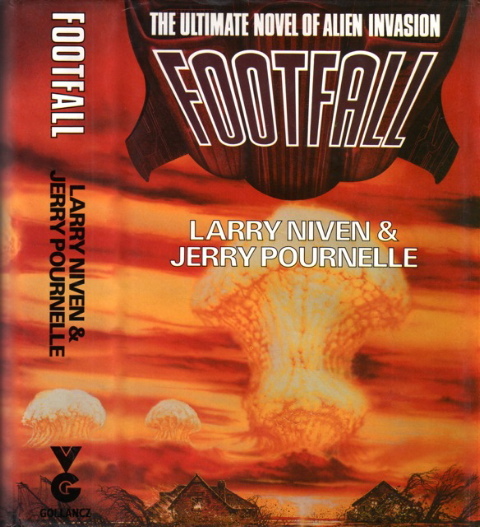
I've had this book since I was a kid and I'm not sure why I took so long to read it. it is an 80s style book, so it has one of those 80s fold-out covers:

that cover mesmerized me. but I think it also disturbed young mark monday because there was something so sympathetic about that alien. and so I avoided the book until now. here's a close-up of that image:

those humans look quite threatening. the alien looks intriguing, like someone I'd like to sit down and have some coffee with. plus check out his little backpack! and that mirror to spy on threatening humans. and that teddy bear! adorable. I hope he didn't take that off of a slaughtered human because that would be rather a bummer. let's just assume he found it somewhere and decided to keep it. aww!
March 8, 2012
Bad baby elephants in Spaace!
I still think this is the best alien-invasion story I've ever read. Granted, it's hard to write a sensible invasion story, given that:
a) it's hard to think of a reason for rational aliens to invade, and
b) if they did, they should win overwhelmingly. See rifles vs. spears.
But it makes a great *story*, and N&P have given probably as reasonable a backstory as anyone could. As an example of high-level page-turner storytelling, Footfall still rings my chimes. I've read it at least three times, plus the last time I picked it up some years back, to jog my memory about something, I got sucked in again and spent the afternoon rereading the good parts. "Orion will Rise" -- all right!
Footfall is dragged down a bit by dated political background: the USSR is alive and well in the book, and is portrayed as considerably stronger and healthier than it actually was in 1985. I'd skim over the Russian scenes; in fact the book is pretty slow-moving until the aliens arrive, so a quick skim of most of this early scene-setting material is all you need.
And make no mistake, once the action starts, you'll have no further complaints. Good stuff, folks. 4.5 stars.
I still think this is the best alien-invasion story I've ever read. Granted, it's hard to write a sensible invasion story, given that:
a) it's hard to think of a reason for rational aliens to invade, and
b) if they did, they should win overwhelmingly. See rifles vs. spears.
But it makes a great *story*, and N&P have given probably as reasonable a backstory as anyone could. As an example of high-level page-turner storytelling, Footfall still rings my chimes. I've read it at least three times, plus the last time I picked it up some years back, to jog my memory about something, I got sucked in again and spent the afternoon rereading the good parts. "Orion will Rise" -- all right!
Footfall is dragged down a bit by dated political background: the USSR is alive and well in the book, and is portrayed as considerably stronger and healthier than it actually was in 1985. I'd skim over the Russian scenes; in fact the book is pretty slow-moving until the aliens arrive, so a quick skim of most of this early scene-setting material is all you need.
And make no mistake, once the action starts, you'll have no further complaints. Good stuff, folks. 4.5 stars.

February 26, 2016
Well firstly, I have read it before, many moons ago (late 80s ? ), and I always have enjoyed both Niven solo and with Pournelle, so when it came time to grab a big fat book to take as hand luggage on a brief trip to southern France, thus seemed the ideal companion. Unfortunately I was enjoying it too much and despite it being exactly 700 pages, the book ran out before the 4 day break did, not really the books fault I suppose.
If you enjoy alien invasion and some good characterisation in a sci-fi environment, then this book is for you.
So yes, the book is really good and after about 300 pages I hardly had to look up who was who (put it down to age) so enjoyed it even more, I feel some of the loose ends could've been tied up more, hence if I could I would give it 4.5 stars, but as I'm back at home now and it was a great "holiday" read, 5 stars it is.
If you enjoy alien invasion and some good characterisation in a sci-fi environment, then this book is for you.
So yes, the book is really good and after about 300 pages I hardly had to look up who was who (put it down to age) so enjoyed it even more, I feel some of the loose ends could've been tied up more, hence if I could I would give it 4.5 stars, but as I'm back at home now and it was a great "holiday" read, 5 stars it is.

May 13, 2012
Although I generally enjoy Niven and Pournelle's work, this one was just too heavy handed. Footfall was everything I dislike about sci-fi condensed into one book: self-gratifying and self-absorbed writers writing themselves as heroes, ridiculous aliens, extreme nationalism, sexism up the whazoo, and a complete disregard for character development. Some of these are explainable (though not justifiable) from a context-sensitive reading. Indeed, maybe I wouldn't have hated this book if I'd read it in 1985. But that does not make it enjoyable now-- nor does it cover the plethora of flaws that can only be explained by shoddy craftsmanship. I read the entire book, yes. But I regretted it. Everything good about this book appears in other sci-fi, where it is done better.

October 24, 2025
This is the 4th book I have read from this duo of grand masters. As always and as expected it didn’t disappoint. Large cast of characters that are handled well within the story. Excellent telling of the classic alien invasion plot. Very recommended

October 22, 2015
A good alien invasion story with some fresh aspects to it. The enemy resemble small elephants and have a herd culture to match. This leads to many misunderstandings but also to some opportunities. I thought the opening was really good, with the introduction of some interesting characters. It was fun to learn about the enemy, called "snouts" by humans. The late middle sagged a bit for me but it picked up again at the end. SF writers become some heroes in this one. That was cool.
The book is long and I felt a bit longer than it needed to be. We are introduced to a whole lot of characters, but quite a few of these really have little to do with the story as it goes along. They might have been removed without harm to the book. There were a couple of places where the politics, which seemed to me to be worn on the sleeves of the writers, seemed out of place in a story about "humanity" facing an invasion. Probably many of the feelings expressed were accurate to the way humans would really be, but they certainly didn't show some of the characters in a good light. All in all, though, I enjoyed and it kept me reading.
The book is long and I felt a bit longer than it needed to be. We are introduced to a whole lot of characters, but quite a few of these really have little to do with the story as it goes along. They might have been removed without harm to the book. There were a couple of places where the politics, which seemed to me to be worn on the sleeves of the writers, seemed out of place in a story about "humanity" facing an invasion. Probably many of the feelings expressed were accurate to the way humans would really be, but they certainly didn't show some of the characters in a good light. All in all, though, I enjoyed and it kept me reading.

December 21, 2008
Elephant-like aliens attack Earth. Plucky Earthlings fight back. It's actually not at all bad if you like that kind of thing.
This book was described somewhere as "a rich tapestry". I recently read 99 Ways To Tell A Story , which has a witty page telling the story using the conventions of the Bayeux Tapestry, and I suddenly saw Footfall retold in the same way.
I think it would work quite well. To start off with, in a tapestry you expect all the characters to be two-dimensional. What else would they be? And I would so like to see some of the episodes rerendered à la Bayeux with Latin subtitles. For example, "Aliens Dump Meteorite Into Indian Ocean", "Humans Build Atom-Bomb Powered Spacecraft And Attack Alien Mother-Ship" and, the one which I for some reason thought of first, "Heroic Ecologist Kills Scummy Journalist And Buries Him In His Compost Heap". Come on... there must be a suitably crazy graphic artist out there who wants to do it?
This book was described somewhere as "a rich tapestry". I recently read 99 Ways To Tell A Story , which has a witty page telling the story using the conventions of the Bayeux Tapestry, and I suddenly saw Footfall retold in the same way.
I think it would work quite well. To start off with, in a tapestry you expect all the characters to be two-dimensional. What else would they be? And I would so like to see some of the episodes rerendered à la Bayeux with Latin subtitles. For example, "Aliens Dump Meteorite Into Indian Ocean", "Humans Build Atom-Bomb Powered Spacecraft And Attack Alien Mother-Ship" and, the one which I for some reason thought of first, "Heroic Ecologist Kills Scummy Journalist And Buries Him In His Compost Heap". Come on... there must be a suitably crazy graphic artist out there who wants to do it?

August 13, 2017
Footfall is a fun alien invasion story, full of up-tempo optimism and enthusiastic good feeling for humanity, science fiction, and The Right Stuff. It's a happy, fast-paced beach read in the spirit of Independence Day.

December 12, 2014
This book contains approximately 300 pages of embarrassing misogynistic crap, sad cliches, and stupid characters that ruin what could have been a great 250 page alien invasion story. Lucifer's Hammer was the same BS. And that's a damn dirty shame because The Mote In God's Eye was an incredibly vibrant story, which spurred me to read more Niven/Pournelle books. Move on...nuthin to read here :[

March 10, 2013
I thought long and hard about giving this one 4 stars. It was really a toss-up...I think on a different day, I might have done so. I really enjoyed this book, but sometimes it felt like there was a lot of "fluff" in it. I listened to the audio of the book, hoping to finish in time to discuss it with the SFF Audio crew. Unfortunately, I didn't quite finish in time. Their podcast episode was pretty good, it summed up a lot of my feelings.
One thing mentioned on the podcast was that this book wasn't particularly deep. There isn't any real allegory and aren't many "big ideas." I think that's part of why the book worked for me. When I read fiction books, I want to be entertained. Sure, it's a bonus if it makes me think with deeper meaning, but it's not my motivation. Sometimes, I find that "thinking" novels get too wrapped up in being thinking novels and forget about being entertaining. This one was mostly fun (though I admit, I did start thinking about the physics of a space war).
Footfall is a book about an alien invasion and earth's fight (mostly the fight of the US) against it. It was written in the mid-80's, when the Cold War was still in full swing, so for part of the book, it isn't so much the US vs. the aliens as much as it is the US with the possible help of the Soviets vs. the aliens...that is, if the Soviets don't double-cross the US. That's one reason that I ended up only giving the book 3 stars instead of 4: the plotline related to the international cooperation with the Soviets more or less abruptly ended about halfway through. I got to the end and wondered what had happened to that thread.
The first part of the book introduced a lot of characters...a LOT of characters, many that didn't matter by the end of the story. That's another part of the reason got 3 stars instead of 4. The characters seemed to be some of the fluff. Funnily, Tamahome's review, mentioning The Stand, made me also think of that book as I listened to this one. For some reason, I kept thinking of the Harry Red character in this book as very similar to Tom Cullen in The Stand. His role ended up somewhat similar, and while Harry wasn't mentally challenged, he did seem to be a character that many people underestimated.
After the characters (124, according to Tam?!?!) were introduced, the second part of the book dealt with the response on earth, a "joint response" of sorts requiring the US and the USSR to trust each other and work together. Given the time period when the book was written, this was a relatively unheard of idea. The third (and final) part of the book was about the response in space, culminating with a battle in the waning chapters. It's odd, I usually knock a book if the ending feels rushed; so many books have a final "battle" or other climax point and then do a very quick wrap-up of "everybody lived happily ever after" (or something). Though the most intense parts of the book were at the end, it didn't feel rushed. Heck, the book didn't exactly have a true ending or resolution. But it worked.
I haven't read any other books jointly written by Niven and Pournelle. The only other Niven book I've read is Ringworld (a book I didn't enjoy). When I used to listen to TWiT, I didn't enjoy Pournelle as a guest, he seemed out of touch. Needless to say, I was skeptical about reading this...but I found it surprisingly enjoyable, and I'm glad I read it.
Other things I jotted down while reading:
-As with most books, the president seemed "too perfect" (at least, for most of the book). The part at the beginning where he said something to the effect of, "I won't be a great president, but I'll be a very good president," was especially wishful thinking.
-Why did they call the time "H minus"? Most US launches use "T minus" (for time minus). French launches use H- for "heure" or "time."
-The comment about the "soaring structure" of the IAD terminal building was funny. You don't see that building as you leave the airport, once you're on the road to Washington, DC. As much as I fly into and out of that airport, I can't say I've ever paid much attention to the shape of the building.
-I cracked up when they mentioned that there was a sign for the "Bureau of Public Roads Research" marking the entrance to the CIA. It is true that the Federal Highway Administration is accessed via the same road as the one for the CIA.
-I thought it was funny (and wish it had been explored more) to see how the aliens interpreted human things, such as clothes (why do humans need clothes? To protect their fragile skin? For humidity control?). That said, for a race/entity that has received radio and TV transmissions from earth, it's surprising that they didn't have a better understanding of humans...
-The description of the traffic getting out of LA reminded me of The Stand.
-I think that Niven and Pournelle made a small nod to Douglas Adams and The Hitchhiker's Guide to the Galaxy when Harry was doing his back stretches using a towel on the side of the road. He was approached by another person who asked why he had a towel, and Harry said that a towel was a necessity for travel. I smiled at that.
-Why did the Soviet Union involvement in the story drop off so suddenly?
One thing mentioned on the podcast was that this book wasn't particularly deep. There isn't any real allegory and aren't many "big ideas." I think that's part of why the book worked for me. When I read fiction books, I want to be entertained. Sure, it's a bonus if it makes me think with deeper meaning, but it's not my motivation. Sometimes, I find that "thinking" novels get too wrapped up in being thinking novels and forget about being entertaining. This one was mostly fun (though I admit, I did start thinking about the physics of a space war).
Footfall is a book about an alien invasion and earth's fight (mostly the fight of the US) against it. It was written in the mid-80's, when the Cold War was still in full swing, so for part of the book, it isn't so much the US vs. the aliens as much as it is the US with the possible help of the Soviets vs. the aliens...that is, if the Soviets don't double-cross the US. That's one reason that I ended up only giving the book 3 stars instead of 4: the plotline related to the international cooperation with the Soviets more or less abruptly ended about halfway through. I got to the end and wondered what had happened to that thread.
The first part of the book introduced a lot of characters...a LOT of characters, many that didn't matter by the end of the story. That's another part of the reason got 3 stars instead of 4. The characters seemed to be some of the fluff. Funnily, Tamahome's review, mentioning The Stand, made me also think of that book as I listened to this one. For some reason, I kept thinking of the Harry Red character in this book as very similar to Tom Cullen in The Stand. His role ended up somewhat similar, and while Harry wasn't mentally challenged, he did seem to be a character that many people underestimated.
After the characters (124, according to Tam?!?!) were introduced, the second part of the book dealt with the response on earth, a "joint response" of sorts requiring the US and the USSR to trust each other and work together. Given the time period when the book was written, this was a relatively unheard of idea. The third (and final) part of the book was about the response in space, culminating with a battle in the waning chapters. It's odd, I usually knock a book if the ending feels rushed; so many books have a final "battle" or other climax point and then do a very quick wrap-up of "everybody lived happily ever after" (or something). Though the most intense parts of the book were at the end, it didn't feel rushed. Heck, the book didn't exactly have a true ending or resolution. But it worked.
I haven't read any other books jointly written by Niven and Pournelle. The only other Niven book I've read is Ringworld (a book I didn't enjoy). When I used to listen to TWiT, I didn't enjoy Pournelle as a guest, he seemed out of touch. Needless to say, I was skeptical about reading this...but I found it surprisingly enjoyable, and I'm glad I read it.
Other things I jotted down while reading:
-As with most books, the president seemed "too perfect" (at least, for most of the book). The part at the beginning where he said something to the effect of, "I won't be a great president, but I'll be a very good president," was especially wishful thinking.
-Why did they call the time "H minus"? Most US launches use "T minus" (for time minus). French launches use H- for "heure" or "time."
-The comment about the "soaring structure" of the IAD terminal building was funny. You don't see that building as you leave the airport, once you're on the road to Washington, DC. As much as I fly into and out of that airport, I can't say I've ever paid much attention to the shape of the building.
-I cracked up when they mentioned that there was a sign for the "Bureau of Public Roads Research" marking the entrance to the CIA. It is true that the Federal Highway Administration is accessed via the same road as the one for the CIA.
-I thought it was funny (and wish it had been explored more) to see how the aliens interpreted human things, such as clothes (why do humans need clothes? To protect their fragile skin? For humidity control?). That said, for a race/entity that has received radio and TV transmissions from earth, it's surprising that they didn't have a better understanding of humans...
-The description of the traffic getting out of LA reminded me of The Stand.
-I think that Niven and Pournelle made a small nod to Douglas Adams and The Hitchhiker's Guide to the Galaxy when Harry was doing his back stretches using a towel on the side of the road. He was approached by another person who asked why he had a towel, and Harry said that a towel was a necessity for travel. I smiled at that.
-Why did the Soviet Union involvement in the story drop off so suddenly?
April 30, 2008
More catastrophe survivalist misogyny from Niven and Pournelle. Maybe it's because I just recently read Lucifer's Hammer, or maybe I'm getting older, but I'm finding my earlier affection for Niven's work fading.
I'm sure there's a literary term for what the author's have done in Footfall and L.H., but I'm going to have to describe it- All of the characters we meet (and there are a lot) make the right decisions and are clearly superior to the common people who we don't ever really get to know. Put another way- the people we meet are great, and everyone else is either an idiot or a monster. It's like a superiority complex with an exception clause written in for your friends and family.
I'm sure there's a literary term for what the author's have done in Footfall and L.H., but I'm going to have to describe it- All of the characters we meet (and there are a lot) make the right decisions and are clearly superior to the common people who we don't ever really get to know. Put another way- the people we meet are great, and everyone else is either an idiot or a monster. It's like a superiority complex with an exception clause written in for your friends and family.

February 28, 2013
Audiobook is 24 hrs. About 4&1/2 hours in. There's a zillion (well 124) characters, lots of women and sexual intrigue, and it's set nearly in the present, with an oncoming alien attack. I guess they were going for a mainstream bestseller like Lucifer's Hammer (8 years earlier), and apparently they succeeded, back in the 80's. It starts slow. I'm listening in the car, and get confused as to who's talking. There's a lot of Russian/Cold War stuff that we don't worry about much these days. At least someone just got into space.
I wonder where that meteor over Russian recently in real life came from...
Ok, the crap really hits the fan in part 2 chapter 11 around 5&1/2 hours...
The audiobook chapters are 1 higher than the paper book because of the prologue.
I don't know if alien baby elephants talking with a lisp are going to be effective in a movie version...
Yes, there's an alien named 'Takpusseh'.
Maybe they're trying to be like Stephen King's The Stand (1978) with all these characters?
A problem with the audiobook: all alien names are pronounced with a lisp, making it hard to figure out who's talking.
On the positive side, a lot of cool sf ideas are discussed in chapter 20 (Schemes) ('Project Thor', 'Project Orion'), from 3 sf writers based on ('Tukerized'?) Niven, Pournelle, and Heinlein.
Well that spear chapter was unpleasant.
FINISH:
Not bad. Long on characterization. If you want short sf books bursting with ideas, this might not be the book for you. If you like mainstream thrillers this may be more your cup of tea. I'm told this is reminiscent of Tom Clancy, but I haven't read any. The 'device' they build at the end is the highlight. The story certainly continues to the last line. The print may be preferable to the audio, because of the lisping aliens. I'm told Lucifer's Hammer has less characters. Maybe I would prefer that.
Our podcast discussion with Paul Weimer (spoilers) http://www.sffaudio.com/?p=46207
DRAMATIS PERSONAE (124)
THE DISCOVERERS (5)
Linda Crichton Gillespie, a Washington debutante
Jeanette Crichton, her sister
Dr. Richard Owen, astronomer
Dr. Mary Alie Mouton, astronomer
Major General Edmund Gillespie, USAF astronaut
WASHINGTON (17)
David Coffey, President of the United States
Mrs. Jeanne Coffey, First Lady
The Honorable Wesley T. Dawson, a Congressman from California
Mrs. Carlotta Trujillo Dawson, his wife
Roger Brooks, Special Assignments Reporter, Washington Post
James Frantza, White House Chief of Staff
Henry Morton, Vice President
Dr. Arthur Hart, Secretary of State
Hap Aylesworth, Special Assistant to the President for Political Affairs
Ted Griffin, Secretary of Defense
Admiral Thorwald Carrell, National Security Advisor
Peter McCleve, Attorney General
Tim Rosenthal, Secretary of the Treasury
Connie Fuller, Secretary of Commerce
Arnold Riggs, Secretary of Agriculture
Jack Clybourne, Presidential Protection Unit, Secret Service
THE SOVIETS (13)
Academician Pavel Aleksandrovich Bondarev, Director, Lenin Institute
Lorena Polinova, his secretary and mistress
Marina Nikolayevna Bondarev, his wife
Boris Ogarkov, Party Secretary at the Institute
Andrei Pyatigorskiy, Assistant Director, Lenin Institute
General Nikolai Nikolayevich Narovchatov, Party Third Secretary, later
Party First Secretary
Chairman Anatoliy Vladimirovich Petrovskiy, Chairman of the Supreme
Soviet
Ilya Trusova, Chairman of the KGB
Dmitri Parfenovich Grushin, KGB officer
Marshal Leonid Edmundovich Shavyrin, Marshal of the Long Range Strategic
Rocket Forces
SURVIVORS AND OTHERS (22)
Harry Reddington, unemployed minstrel
Jeri Wilson, Senior Editor, Harris Wickes Press
Melissa Wilson, her daughter
William Adolphos Shakes
Kevin Shakes
Miranda Shakes
Isadore and Clara Leiber
George and Vicki Tate-Evans
Jack and Harriet McCauley
Martin Carnell, Show-dog breeder
Ken Dutton, Bookstore manager
Cora Donaldson
Sarge Harris, friends of Ken Dutton
Patsy Clevenger
Anthony Graves
Maximilian Rohrs, general contractor, Bellingham
Evelyn Rohrs, former Washington socialite
Ben Lafferty, Sheriff Whatcom County, Washington
Leigh Young, Deputy Sheriff
Whitey Lowenthal, welder
Carol North, citizens of Lauren, Kansas
Rosalee Neill
KOSMOGRAD (6)
Colonel Arvid Pavlovich Rogachev, Commander of Kosmograd
Nikolai, onetime Sergeant, Red Air Force
Allana Aleksandrovna Tutsikova, Deputy Commander
Dr. Giselle Beaumont, French scientist
The Honorable Giorge N’Bruhna, Nigerian politician
Captain John Greeley, USAFU astronaut
THE FITHP (22)
Herdmaster Pastempeh-keph
Advisor Fathisteh-tulk
K’turfookeph, the Herdmaster’s mate
Chowpeentulk, Advisor’s mate
Fookerteh, the Herdmaster’s son
Attackmaster Koothfektil-rnsp
Defensemaster Tantarent-fid
Breaker-Two Takpusseh (later Takpusseh-yamp)
Breaker-One Raztupisp-minz
Fistareth-thuktun, priest and historian
Koolpooleh, male assistant to Fistarteh-thuktun
Paykurtank, female assistant to Fistarteh-thuktun
Octuple leader Pretheeteh-damh
Tashayamp, female assistant to Takpusseh (later his mate)
Octuple Leader Chintithpit-mang, sleeper
Shreshleemang, Chintithpit-mang’s mate
Eight-cubed Leader Harpanet
Eight-cubed Leader Siplistepth
Rashinggith, warrior (Year Zero Fithp)
Birithart-yamp, warrior in Africa
Pheegorun, warrior in Africa, died by spear
Thiparteth-fuft, guard officer
COLORADO SPRINGS (10)
Sergeant Ben Mailey, U.S. Army
Sherry Atkinson
Robert (Robert Heinlein) and Virginia Anson
the Threat Team
Wade (Jerry Pournelle) and Jane Curtis
Bob Burnham
Lieutenant General Harvey Toland, U.S. Army
The Honorable Joe Dayton, Speaker of the House
Senator Alexander Haswell, President Pro Temps of the Senate
Senator Raymond Carr, Senator from Kansas
WARRIORS AND PRISONERS (29)
Nat Reynolds (Larry Niven)
Joe Ransom
John Woodward
Carrie Woodward, prisoners
Alice MeLennon
Gary Capehart
Ensign Jeff Franklin
Hamilton Gamble
Dr. Arthur Grace
“Tiny” Pelz, crewman
Michael Jason Daniels
Samuel Cohen
Roy Cuber, shuttle pilots
Jay Hadley
Commander Anton Villars, Captain, USNS Ethan Allen
Colonel Julius Carter, U.S. Special Forces
Lieutenant Jack Carruthers, U.S. Special Forces
Lieutenant Ivan Semeyusov, Soviet Expeditionary Force
Brant Chisholm, South African farmer
Katje Chisholm, his wife
Mvubi, Zulu warrior
Niklaus Van Der Stel, Afrikaner Commando
Juana Trujillo Morgan, wife of Major Morgan
Lieutenant Colonel Joe Halverson
Major David Morgan, Kansas National Guard
Captain Evan
Corporal Jimmy Lewis
Captain George Mason

February 12, 2019
Alien Invasion! Ruthless warriors want to conquer the Earth and will literally squash all opposition. They can do this because they are the size of elephants!
It started with lights in the sky.
Lights that moved towards Earth and powered down.
Some one was coming!
She followed them into a small, cluttered room. There was a big viewscreen in one corner. Dr. Mouton did things to the controls and a field of stars showed on the screen. She did something else, and the star field blinked on and off; as it did, one star seemed to jump back and forth.
“New asteroid?” Owen asked.
“That’s what I thought,” Dr. Mouton said. “Except … take a good look, Rick. And think about what you’re seeing.”
He stared at the screen. Jeanette came closer. She couldn’t see anything strange. You take the pictures on two different nights and do a blink comparison. The regular stars won’t have moved enough to notice, but anything that moves against the background of the “fixed stars,” like a planet or an asteroid, will be in two different places on the two different photos. Blink back and forth between the two plates: the “moving” body would seem to jump back and forth. That was how Clyde Tombaugh discovered Pluto. It was also a standard photo reconnaissance technique, to see what had changed in the interval between two satellite photos.
“What’s the problem?” Owen asked.
“That’s moving too far for the interval.”
“It’s close …”
“Not that close,” she said. “I got the plates from a few weeks ago. Rick, I had to trace back damn near night by night, it’s moving so fast! It’s in a hyperbolic orbit.”
“Come on, it can’t be!”
“It is,” Dr. Mouton said.
“Excuse me,” Jeanette said. They both turned to look at her. They’d obviously forgotten she was there. “What’s a hyperbolic orbit?”
“Fast,” Owen said. “Moving too fast for the sun’s gravity. Objects in a hyperbolic orbit can escape from the solar system altogether.”
She frowned. “How could something be moving that fast?”
“Big planets can make it happen.” Richard said. “Disturb something’s orbit …”
“It’s under power,” Mary Alice Mouton said.
“Aw, come on!”
“I know it’s silly, but it’s the only explanation I can think of. Rick, I’ve followed that thing backward for weeks, and it has decelerated most of the way.”
“But …”
“Jupiter can’t do that. Nothing can.”
“No, of course it — Mary Alice?”
“The computer plot fits perfectly if you assume it’s a powered spacecraft.” Dr. Mouton’s voice had taken on a flat, dry note. “And nothing else does.”
The Aliens had landed in Kansas.
Would nuclear bombs be enough to remove them?
Nuke Kansas - it is the only way!
War in Heaven.
Cast out the evil one - with human technology!
“Orion,” Curtis said. “Old bang-bang.”
The President looked puzzled, and Jenny thought Curtis looked pleased as he turned to the blackboard. Not too often a writer gets to lecture to the President of the United States .
“Take a big metal plate,” Curtis said. “Big and thick. Make it a hemisphere, but it could even be flat. Put a large ship, say the size of a battleship, on top of it. You want a really good shock absorber system between the plate and the ship.
“Now put an atom bomb underneath and light it off. I guarantee you that sucker will move.” He sketched as he talked. “You keep throwing atom bombs underneath the ship. It puts several million
pounds into orbit. In fact, the more mass you’ve got, the smoother the ride.”
Admiral Carrell looked thoughtful. “And once in space—”
“The tactics are simple,” Curtis said. “Get into space, find the mother ship, and go for it. Throw everything we have at it. Ram if we have to.”
“Hard on the crew,” the President said.
“You’ll have plenty of volunteers, sir,” Ed Gillespie said. “The whole astronaut corps for starters.”
True enough. Most of them had friends at Moon Base. Odd, they did use nuclear weapons there, but nowhere on Earth.
“Is this-Orion-feasible?” Admiral Carrell asked.
Curtis nodded. “Yes. The concept was studied back in the sixties, Chemical explosive test models were flown. It was abandoned after the Treaty of Moscow banned atmospheric nuclear detonations. As far as I know, though, Michael is the only quick and dirty way we have to get a battleship into space.”
“Michael?” the President asked.
“Sorry, sir. We’ve already given it a code name. The Archangel Michael cast Satan out of Heaven.”
Better than War of the Worlds - these aliens are mean, but they have not beaten the even meaner human race!
Enjoy!
It started with lights in the sky.
Lights that moved towards Earth and powered down.
Some one was coming!
She followed them into a small, cluttered room. There was a big viewscreen in one corner. Dr. Mouton did things to the controls and a field of stars showed on the screen. She did something else, and the star field blinked on and off; as it did, one star seemed to jump back and forth.
“New asteroid?” Owen asked.
“That’s what I thought,” Dr. Mouton said. “Except … take a good look, Rick. And think about what you’re seeing.”
He stared at the screen. Jeanette came closer. She couldn’t see anything strange. You take the pictures on two different nights and do a blink comparison. The regular stars won’t have moved enough to notice, but anything that moves against the background of the “fixed stars,” like a planet or an asteroid, will be in two different places on the two different photos. Blink back and forth between the two plates: the “moving” body would seem to jump back and forth. That was how Clyde Tombaugh discovered Pluto. It was also a standard photo reconnaissance technique, to see what had changed in the interval between two satellite photos.
“What’s the problem?” Owen asked.
“That’s moving too far for the interval.”
“It’s close …”
“Not that close,” she said. “I got the plates from a few weeks ago. Rick, I had to trace back damn near night by night, it’s moving so fast! It’s in a hyperbolic orbit.”
“Come on, it can’t be!”
“It is,” Dr. Mouton said.
“Excuse me,” Jeanette said. They both turned to look at her. They’d obviously forgotten she was there. “What’s a hyperbolic orbit?”
“Fast,” Owen said. “Moving too fast for the sun’s gravity. Objects in a hyperbolic orbit can escape from the solar system altogether.”
She frowned. “How could something be moving that fast?”
“Big planets can make it happen.” Richard said. “Disturb something’s orbit …”
“It’s under power,” Mary Alice Mouton said.
“Aw, come on!”
“I know it’s silly, but it’s the only explanation I can think of. Rick, I’ve followed that thing backward for weeks, and it has decelerated most of the way.”
“But …”
“Jupiter can’t do that. Nothing can.”
“No, of course it — Mary Alice?”
“The computer plot fits perfectly if you assume it’s a powered spacecraft.” Dr. Mouton’s voice had taken on a flat, dry note. “And nothing else does.”
The Aliens had landed in Kansas.
Would nuclear bombs be enough to remove them?
Nuke Kansas - it is the only way!
War in Heaven.
Cast out the evil one - with human technology!
“Orion,” Curtis said. “Old bang-bang.”
The President looked puzzled, and Jenny thought Curtis looked pleased as he turned to the blackboard. Not too often a writer gets to lecture to the President of the United States .
“Take a big metal plate,” Curtis said. “Big and thick. Make it a hemisphere, but it could even be flat. Put a large ship, say the size of a battleship, on top of it. You want a really good shock absorber system between the plate and the ship.
“Now put an atom bomb underneath and light it off. I guarantee you that sucker will move.” He sketched as he talked. “You keep throwing atom bombs underneath the ship. It puts several million
pounds into orbit. In fact, the more mass you’ve got, the smoother the ride.”
Admiral Carrell looked thoughtful. “And once in space—”
“The tactics are simple,” Curtis said. “Get into space, find the mother ship, and go for it. Throw everything we have at it. Ram if we have to.”
“Hard on the crew,” the President said.
“You’ll have plenty of volunteers, sir,” Ed Gillespie said. “The whole astronaut corps for starters.”
True enough. Most of them had friends at Moon Base. Odd, they did use nuclear weapons there, but nowhere on Earth.
“Is this-Orion-feasible?” Admiral Carrell asked.
Curtis nodded. “Yes. The concept was studied back in the sixties, Chemical explosive test models were flown. It was abandoned after the Treaty of Moscow banned atmospheric nuclear detonations. As far as I know, though, Michael is the only quick and dirty way we have to get a battleship into space.”
“Michael?” the President asked.
“Sorry, sir. We’ve already given it a code name. The Archangel Michael cast Satan out of Heaven.”
Better than War of the Worlds - these aliens are mean, but they have not beaten the even meaner human race!
Enjoy!
November 27, 2008
This is an excellent "invasion from outer space" book. The kind of good, old fashioned slam-bang adventure that was very prevalent in SF at one time.
One quirk of these elephantine invaders is: they will fight but if they surrender, they belong to the winning side permanently. So they are confused when humans surrender--and then fight back. They consider those humans to be dangerously "rogue", and kill them instead of conquering them.
Also, one of the aliens is captured by our side--and becomes a part of a think-tank against his fellows. And he remains on our side--in thier culture, once you yeild, you yeild totally.
Interesting battles and ideas; lots of fun and excitement. Not incredibly deep or philosophical but well worth reading.
Recommended for any science fiction fan. It will especially appeal to those who like "war of the worlds" type stories.
One quirk of these elephantine invaders is: they will fight but if they surrender, they belong to the winning side permanently. So they are confused when humans surrender--and then fight back. They consider those humans to be dangerously "rogue", and kill them instead of conquering them.
Also, one of the aliens is captured by our side--and becomes a part of a think-tank against his fellows. And he remains on our side--in thier culture, once you yeild, you yeild totally.
Interesting battles and ideas; lots of fun and excitement. Not incredibly deep or philosophical but well worth reading.
Recommended for any science fiction fan. It will especially appeal to those who like "war of the worlds" type stories.

September 28, 2009
In this day of wonderful, kind, helpful aliens or omnipotent, unstoppable, tree hugging, environmentalist aliens a nice old fashioned "invaders from outer space" story is kind of nice. I like it. I enjoyed it. Not only a good "yarn" (like the word??? okay, "a good story"...sigh) but also some nice insights into the way people think. While I can't quite give a blanket recommendation to Larry Niven's works, this is one I really like. So, prepare for the worst...and ready yourself for aliens who want to dominate the world.
Although, I find it hard to believe aliens who resemble elephants as bad guys. :)
Although, I find it hard to believe aliens who resemble elephants as bad guys. :)
June 8, 2012
I was hooked on Niven and Pournelle ever since I read A Mote in God's Eye, which hit every right button for a space-based alien contact epic. Footfall told a story closer to home, asking what if the aliens came to us at Earth, what would we really do, how would different groups of people react, and how would the aliens respond to the alien-ness of us?
Though it's familiar territory, Footfall really delves into the human aspect, extrapolating from hard science and politics to paint a very plausible scenario. I loved the characters, I cheered for them and shouted at them, and sat on the edge of my seat through the epic conflict at the end. Though the politics were from the Soviet era, the story itself did not feel that dated, and I moved along at the fast pace the authors set. The alien names were a bit much to pronounce at first, but I got used to them, and came to cheer for some of the aliens as much as the humans.
For any science fiction fan or fan of alien invasion thrillers, I'd highly recommend.
Though it's familiar territory, Footfall really delves into the human aspect, extrapolating from hard science and politics to paint a very plausible scenario. I loved the characters, I cheered for them and shouted at them, and sat on the edge of my seat through the epic conflict at the end. Though the politics were from the Soviet era, the story itself did not feel that dated, and I moved along at the fast pace the authors set. The alien names were a bit much to pronounce at first, but I got used to them, and came to cheer for some of the aliens as much as the humans.
For any science fiction fan or fan of alien invasion thrillers, I'd highly recommend.

October 29, 2007
Just good, old fashioned alien invasion, action, science. What else would you want for a good summer read!

May 19, 2012
Compulsively readable page turner. Perhaps the most "realistic" aliens invasion of earth novel I have ever read. My second time around reading this, 15 years later, left me with nearly the same high level of delight as last time.
And the importance of science fiction writers to the war effort? Maybe less realistic, but still a lot of fun.
Of course, aliens invading earth is really the perfect setup for what is a pro-military somewhat "conservative" world view. Endless accumulation of nuclear weapons? Wish we had more. Military capable space technology? More. High environmental impact of human activity? When the aliens come, they will be much harder on our biosphere.
So while I reread this us vs. them classic with great pleasure, there was also a bit of a bad taste in my mouth from the political slant of the writing. Still worth 5 stars of fun, though, and hardly dated at all despite being written before the breakup of the Soviet Union and the Challenger disaster.
And the importance of science fiction writers to the war effort? Maybe less realistic, but still a lot of fun.
Of course, aliens invading earth is really the perfect setup for what is a pro-military somewhat "conservative" world view. Endless accumulation of nuclear weapons? Wish we had more. Military capable space technology? More. High environmental impact of human activity? When the aliens come, they will be much harder on our biosphere.
So while I reread this us vs. them classic with great pleasure, there was also a bit of a bad taste in my mouth from the political slant of the writing. Still worth 5 stars of fun, though, and hardly dated at all despite being written before the breakup of the Soviet Union and the Challenger disaster.

August 18, 2012
1995 - The first and best Science Fiction I ever read. I loved every second.
2016 - I thought it was time for a revisit to one of the best books I'd ever read and the book that taught me 'big & busy' was nothing to fear when picking a book. The cast of characters were many. Wes Dawson is wonderful, one character makes me mist up near the end, we're offered better female characters from Niven, there are aliens I could hate and even care about a few. A word of note to readers: When 'Archangel Michael' is launched give yourself a large hunk of time to sit and let the momentum build to the end. It's worth it! This was originally published in 1985 and I didn't feel like this was a dated story at all because people are just people.
I want to give this three more stars for standing the test of time and making me want to skip work to read.
2016 - I thought it was time for a revisit to one of the best books I'd ever read and the book that taught me 'big & busy' was nothing to fear when picking a book. The cast of characters were many. Wes Dawson is wonderful, one character makes me mist up near the end, we're offered better female characters from Niven, there are aliens I could hate and even care about a few. A word of note to readers: When 'Archangel Michael' is launched give yourself a large hunk of time to sit and let the momentum build to the end. It's worth it! This was originally published in 1985 and I didn't feel like this was a dated story at all because people are just people.
I want to give this three more stars for standing the test of time and making me want to skip work to read.
January 23, 2014
When I picked up this book I wasn't expecting great literature. It was, after all, about an alien invasion. I was looking for something light and fun. But I found it so irritating, it finally took a sheer act of will for me to finish it.
I could write pages about what made the book so bad. This is only an outline:
1.) Characterizations. The characters were cartoons. They had no depth. That was perhaps inevitable, given the fact that the novel's dramatis personae, listed in the front of the book, consists of four pages! That's too many characters, even for a novel of over 500 pages. A reader can't get a sense of any of them. Do any of them have emotional lives? Hard to tell, given that the premise of the book is literally earth-shattering, and there's no indication that anybody's carries any trauma over it. A lot of people die, but is anyone devastated, even when losing friends, family, mates? All just seem to shake it off and life goes on.
Worst are the characterizations of women. One of the major characters is a major in Army Intelligence who becomes adviser to the President. Yet she's portrayed as a real nitwit who giggles all the time in the middle of meetings and flirts with the head of the President's Secret Service detail even the most important things are going on.
The portrayals of the alien females are no better. The aliens apparently have an even stronger patriarchal civilization than the Earthlings do. (Must be a universal law of nature in Niven-Pournelle's view?
2.) Dialogue. When the characters are cartoons, I suppose you can't expect them to talk like real people. But did the "sound" of it have be so painful? Which leads to . . .
3.) The writing in general. Who can take this kind of writing seriously:
[SCENE: The aliens have invaded Kansas by parachuting in. Reports are coming in to the President and his advisers, and they are curious to know what they look like.]
The Admiral lifted the phone. "Carrell . . . Yes, put the photographs up on the big screens. Let everyone see what we're up against."
There were five screens. One by one they filled with pictures of baby elephants. Some hung from paper airplanes and wore elevator shoes. Others were on foot. All carried weirdly shaped rifles.
Laughter sounded on the floor below, but it soon died away as the screen showed photographs of ruined buildings and wrecked cars, with alien shapes in the foreground. Bodies lay at the background of most of the pictures.
Jenny studied the photographs. They were quite good; the photographer who'd taken them said she'd sold to Sports Illustrated and other major magazines. That's the enemy.
"They do look like elephants," Admiral Carrel said.
"Yes, sir," Jenny said. "But they're not really elephants."
"No. They're invaders," General Toland said.
Even when Niven-Pournelle happen upon a happy turn-of-phrase, they botch it. When the alien mothership suffers significant damage, they write that sounds from its hull sounded like that of a "smashed banjo." That's a clever metaphor. And Niven-Pournelle must have themselves also thought so, because they then use the same metaphor three more times in the next few pages!
And if there were a word I could eliminate from their vocabulary, it would be "grin." Everybody's prompted to grin in this book for one reason or another. (Funny reaction, in the midst of an alien invasion.) If you excised all the times the word, "grin," is used in the book, there would be significant gaps in the text. Get Niven-Pounelle a thesaurus!
4.) Gratuitous ridiculousness. If the above quote isn't enough to illustrate this point (baby elephants riding parachuting under paper airplanes while wearing elevator shoes?), note that among the heroes are a swashbuckling Congressman and a bevy of science fiction writers. The SF writers are brought in to advise the President because they would seemingly know more about planning strategically against aliens than Pentagon types who have spent thousands of hours gaming all sorts of scenarios against possible invaders. Just because SF involves speculative thinking, who says that the SF writers speculations in this case are going to be better than anyone else's?
5.) An intriguing idea squandered. There is an idea at the center of the novel, but it remains seriously unexplored. The idea is that much of the carnage that is created between the aliens and the humans results basically because of fundamental cultural misunderstanding. Because the two civilizations carry different assumptions about interpersonal interactions, including conflict, they essentially kill what they don't understand. This is a important insight, having echoes in human history from ancient imperialism to US involvement in SE Asia and the Middle East. Maybe it was too uncomfortable for Niven-Pournelle to explore too deeply (as I understand they hold pretty right-wing beliefs), so they just let it go.
I could write pages about what made the book so bad. This is only an outline:
1.) Characterizations. The characters were cartoons. They had no depth. That was perhaps inevitable, given the fact that the novel's dramatis personae, listed in the front of the book, consists of four pages! That's too many characters, even for a novel of over 500 pages. A reader can't get a sense of any of them. Do any of them have emotional lives? Hard to tell, given that the premise of the book is literally earth-shattering, and there's no indication that anybody's carries any trauma over it. A lot of people die, but is anyone devastated, even when losing friends, family, mates? All just seem to shake it off and life goes on.
Worst are the characterizations of women. One of the major characters is a major in Army Intelligence who becomes adviser to the President. Yet she's portrayed as a real nitwit who giggles all the time in the middle of meetings and flirts with the head of the President's Secret Service detail even the most important things are going on.
The portrayals of the alien females are no better. The aliens apparently have an even stronger patriarchal civilization than the Earthlings do. (Must be a universal law of nature in Niven-Pournelle's view?
2.) Dialogue. When the characters are cartoons, I suppose you can't expect them to talk like real people. But did the "sound" of it have be so painful? Which leads to . . .
3.) The writing in general. Who can take this kind of writing seriously:
[SCENE: The aliens have invaded Kansas by parachuting in. Reports are coming in to the President and his advisers, and they are curious to know what they look like.]
The Admiral lifted the phone. "Carrell . . . Yes, put the photographs up on the big screens. Let everyone see what we're up against."
There were five screens. One by one they filled with pictures of baby elephants. Some hung from paper airplanes and wore elevator shoes. Others were on foot. All carried weirdly shaped rifles.
Laughter sounded on the floor below, but it soon died away as the screen showed photographs of ruined buildings and wrecked cars, with alien shapes in the foreground. Bodies lay at the background of most of the pictures.
Jenny studied the photographs. They were quite good; the photographer who'd taken them said she'd sold to Sports Illustrated and other major magazines. That's the enemy.
"They do look like elephants," Admiral Carrel said.
"Yes, sir," Jenny said. "But they're not really elephants."
"No. They're invaders," General Toland said.
Even when Niven-Pournelle happen upon a happy turn-of-phrase, they botch it. When the alien mothership suffers significant damage, they write that sounds from its hull sounded like that of a "smashed banjo." That's a clever metaphor. And Niven-Pournelle must have themselves also thought so, because they then use the same metaphor three more times in the next few pages!
And if there were a word I could eliminate from their vocabulary, it would be "grin." Everybody's prompted to grin in this book for one reason or another. (Funny reaction, in the midst of an alien invasion.) If you excised all the times the word, "grin," is used in the book, there would be significant gaps in the text. Get Niven-Pounelle a thesaurus!
4.) Gratuitous ridiculousness. If the above quote isn't enough to illustrate this point (baby elephants riding parachuting under paper airplanes while wearing elevator shoes?), note that among the heroes are a swashbuckling Congressman and a bevy of science fiction writers. The SF writers are brought in to advise the President because they would seemingly know more about planning strategically against aliens than Pentagon types who have spent thousands of hours gaming all sorts of scenarios against possible invaders. Just because SF involves speculative thinking, who says that the SF writers speculations in this case are going to be better than anyone else's?
5.) An intriguing idea squandered. There is an idea at the center of the novel, but it remains seriously unexplored. The idea is that much of the carnage that is created between the aliens and the humans results basically because of fundamental cultural misunderstanding. Because the two civilizations carry different assumptions about interpersonal interactions, including conflict, they essentially kill what they don't understand. This is a important insight, having echoes in human history from ancient imperialism to US involvement in SE Asia and the Middle East. Maybe it was too uncomfortable for Niven-Pournelle to explore too deeply (as I understand they hold pretty right-wing beliefs), so they just let it go.

April 12, 2019
“They mean to be the dominant but not the only intelligent species on Earth” (p. 344).
The alien invaders in Footfall have a benevolent-dictator mindset, and I love that. I also love that the government uses a team of alcoholic, science fiction writers to determine military strategy. But my favorite part is the aliens’ and humans’ attempts to figure each other out, which are sometimes insightful (“You will teach us your laws. Then you will live by them,” p. 289) and other times funny (“Herdmaster, that isn’t the female’s genital area at all … Might humans need instruction on how to mate?” pp. 282-283).
My overall verdict: Footfall is a keeper; it is a great alien invasion story that is unique in the genre. However, there are two things that some readers might have a hard time with. The first is that Niven and Pournelle start by introducing a lot of characters in a lot of detail. Consequently, there is almost no momentum early on. The second is that the aliens look like baby elephants—no surprise here, given the book cover on the 1985 edition. This is fine with me—emphasizing with them is easier because of their elephant likeness, and it allows for interesting plot lines and scenes (“I hate mud. Why couldn’t they like swimming in something sensible, like lime Jell-O” (p. 352)—but it may put off some readers.
Here is my scoresheet:
1) Story (4/5)
2) Writing (4/5)
3) Originality (5/5)
4) Characters (4/5)
5) Set pieces (5/5)
6) Suspense (3/5)
7) Ending (4/5)
8) Relationships (romantic or otherwise) (4/5)
9) Dialogue (4/5)
The alien invaders in Footfall have a benevolent-dictator mindset, and I love that. I also love that the government uses a team of alcoholic, science fiction writers to determine military strategy. But my favorite part is the aliens’ and humans’ attempts to figure each other out, which are sometimes insightful (“You will teach us your laws. Then you will live by them,” p. 289) and other times funny (“Herdmaster, that isn’t the female’s genital area at all … Might humans need instruction on how to mate?” pp. 282-283).
My overall verdict: Footfall is a keeper; it is a great alien invasion story that is unique in the genre. However, there are two things that some readers might have a hard time with. The first is that Niven and Pournelle start by introducing a lot of characters in a lot of detail. Consequently, there is almost no momentum early on. The second is that the aliens look like baby elephants—no surprise here, given the book cover on the 1985 edition. This is fine with me—emphasizing with them is easier because of their elephant likeness, and it allows for interesting plot lines and scenes (“I hate mud. Why couldn’t they like swimming in something sensible, like lime Jell-O” (p. 352)—but it may put off some readers.
Here is my scoresheet:
1) Story (4/5)
2) Writing (4/5)
3) Originality (5/5)
4) Characters (4/5)
5) Set pieces (5/5)
6) Suspense (3/5)
7) Ending (4/5)
8) Relationships (romantic or otherwise) (4/5)
9) Dialogue (4/5)

July 14, 2015
I think one of the things I like best about Footfall is the sheer scope of the story. It's fitting, I think, for an end-of-the-world story to have a giant cast and a universal reach -- in this case, outside of the galaxy and spanning 15+ years between when the story starts and when the invasion of Earth begins.
I like big sprawling books that you can really sink into. People talk about "world building" and I vaguely understand/care about what they say, but world building like Larry Niven does in Footfall is rare. There are characters and interrelationships and sidebars and dead-ends and all of it, somehow, serves the novel.
That's really a testament to the writing. Take two side characters, John Fox and Marty something-or-other. Originally, John is introduced when one of the characters, Roger, a reporter, is looking for someone to interview at the time the spaceship that ultimately invades Earth has been discovered. Fox talks to the reporter about his concerns over a dam or something that threatens the Death Valley area, and the reporter listens more out of politeness than interest; he even says as much, given that the big story is An Alien Ship Is Headed To Earth.
That's kind of a throwaway moment, almost, except that later on John Fox shows with Marty. Marty is first introduced as a dog-show breeder who is on the fringes of a survivalist group that ends up making their shelter right outside of the town located [SPOILER ALERT!] in the same place the US decides to pick to build its spaceship to fight back against the invaders. Marty drifts back into the story later on, leaving some friends in Los Angeles to go hide in the desert with John Fox. This all leads to a scene where [SERIOUS SPOILER ALERT] Fox and Marty drive up to a ridge right after the invaders drop a 'dinosaur killer' asteroid that causes a salt water downpour in Death Valley. They watch the rain fill in what used to a be a sea bed and Fox makes a brief speech about how he fought nuclear power and was a fool, because had he allowed science to progress then the humans might have been able to fight back against the invaders, and he wouldn't be watching all the fragile, perfectly-adapted creatures of Death Valley drowning.
It's the kind of moment that could be preachy or overdone; it's essentially Larry Niven and his co-author Jerry Pournelle being almost didactic: they're hard-science guys who want people to be pro-scientific advances. But it doesn't come across that way. Instead, the message Fox and Marty convey is buried within a story, because it was chapters and chapters ago that Fox was even introduced, and Marty's just there as a sort of avatar of the reader, watching Fox.
That kind of large-scale writing is tough to do. What Niven and Pournelle do so well here doesn't work as well in other books -- I gave up on Niven's Building Harlequin's Moon, as it was more science lecture than story -- but when it does work it's incredible to read. The story keeps threading through these new characters and overlapping subplots and winding back, and even for a guy like me who has a hard time keeping track of characters, it's easy to follow.
I like big sprawling books that you can really sink into. People talk about "world building" and I vaguely understand/care about what they say, but world building like Larry Niven does in Footfall is rare. There are characters and interrelationships and sidebars and dead-ends and all of it, somehow, serves the novel.
That's really a testament to the writing. Take two side characters, John Fox and Marty something-or-other. Originally, John is introduced when one of the characters, Roger, a reporter, is looking for someone to interview at the time the spaceship that ultimately invades Earth has been discovered. Fox talks to the reporter about his concerns over a dam or something that threatens the Death Valley area, and the reporter listens more out of politeness than interest; he even says as much, given that the big story is An Alien Ship Is Headed To Earth.
That's kind of a throwaway moment, almost, except that later on John Fox shows with Marty. Marty is first introduced as a dog-show breeder who is on the fringes of a survivalist group that ends up making their shelter right outside of the town located [SPOILER ALERT!] in the same place the US decides to pick to build its spaceship to fight back against the invaders. Marty drifts back into the story later on, leaving some friends in Los Angeles to go hide in the desert with John Fox. This all leads to a scene where [SERIOUS SPOILER ALERT] Fox and Marty drive up to a ridge right after the invaders drop a 'dinosaur killer' asteroid that causes a salt water downpour in Death Valley. They watch the rain fill in what used to a be a sea bed and Fox makes a brief speech about how he fought nuclear power and was a fool, because had he allowed science to progress then the humans might have been able to fight back against the invaders, and he wouldn't be watching all the fragile, perfectly-adapted creatures of Death Valley drowning.
It's the kind of moment that could be preachy or overdone; it's essentially Larry Niven and his co-author Jerry Pournelle being almost didactic: they're hard-science guys who want people to be pro-scientific advances. But it doesn't come across that way. Instead, the message Fox and Marty convey is buried within a story, because it was chapters and chapters ago that Fox was even introduced, and Marty's just there as a sort of avatar of the reader, watching Fox.
That kind of large-scale writing is tough to do. What Niven and Pournelle do so well here doesn't work as well in other books -- I gave up on Niven's Building Harlequin's Moon, as it was more science lecture than story -- but when it does work it's incredible to read. The story keeps threading through these new characters and overlapping subplots and winding back, and even for a guy like me who has a hard time keeping track of characters, it's easy to follow.

June 2, 2008
“Footfall” is perhaps the finest alien invasion novel ever written. Nonetheless, in some ways it looks like the result of a bet between Sci-/fi authors. “ OK, you write a best seller alien invader novel, and I’ll go out with your sister - oh, yeah, and the invaders must be elephant men. Yeah that’s it, elephant men.”
Lesser writers couldn’t have pulled it off, but Niven and Pournelle jointly have several really fine works to their credit such as “A Mote in God’s Eye” and “Lucifer’s Hammer.” And Niven by himself is the author of “The Integral Trees” and the “Ringworld” books. These guys are good.
So how do you make an invasion of double trunked “Snouts” more than tongue-in-cheek interesting? One way is to start with the risks of misunderstanding upon first contact. When the unknown alien ship first approached Earth, the humans messages of welcome and peace were met with no answer. Switch to the alien point of view, where there was nothing to discuss yet, since they didn't yet have any sense of each others relative strengths. So far, the Snouts didn’t know if they were going to be conquerors or mere refugees on their new world. From their herd mentality, combat is just the initial diplomatic step, more about posturing than crushing their opponents. The aliens attack the unprepared and outraged human welcoming delegation, and after an initial series of clear victories, the technologically superior aliens expected surrender to their herd master, and a subsequently peaceful coexistence as fellow citizens of earth. So, by the time the aliens are ready to start negotiating, they become increasingly baffled by the outraged humans who are still fighting with no-holds barred ferocity, including Kamikaze bombings. The snouts simply can not understand, and decide that the suicidal humans are simply insane.
This fascinating psychological contrast is quite credibly portrayed . . . despite the double trunks. Of course in the end, the humans find the seemingly invincible invader’s weakness, and with admirable courage and incredible fortitude exploit it to a classically heroic conclusion.
Despite a few dated 1980s references to ecologists, survivalists, anti-nuke, anti-gun, and anti-human politicians, I think it is still a terrific yarn, well told.
Favorite line from the book?
“Nuke 'em 'till they glow, then shoot 'em in the dark.”
Lesser writers couldn’t have pulled it off, but Niven and Pournelle jointly have several really fine works to their credit such as “A Mote in God’s Eye” and “Lucifer’s Hammer.” And Niven by himself is the author of “The Integral Trees” and the “Ringworld” books. These guys are good.
So how do you make an invasion of double trunked “Snouts” more than tongue-in-cheek interesting? One way is to start with the risks of misunderstanding upon first contact. When the unknown alien ship first approached Earth, the humans messages of welcome and peace were met with no answer. Switch to the alien point of view, where there was nothing to discuss yet, since they didn't yet have any sense of each others relative strengths. So far, the Snouts didn’t know if they were going to be conquerors or mere refugees on their new world. From their herd mentality, combat is just the initial diplomatic step, more about posturing than crushing their opponents. The aliens attack the unprepared and outraged human welcoming delegation, and after an initial series of clear victories, the technologically superior aliens expected surrender to their herd master, and a subsequently peaceful coexistence as fellow citizens of earth. So, by the time the aliens are ready to start negotiating, they become increasingly baffled by the outraged humans who are still fighting with no-holds barred ferocity, including Kamikaze bombings. The snouts simply can not understand, and decide that the suicidal humans are simply insane.
This fascinating psychological contrast is quite credibly portrayed . . . despite the double trunks. Of course in the end, the humans find the seemingly invincible invader’s weakness, and with admirable courage and incredible fortitude exploit it to a classically heroic conclusion.
Despite a few dated 1980s references to ecologists, survivalists, anti-nuke, anti-gun, and anti-human politicians, I think it is still a terrific yarn, well told.
Favorite line from the book?
“Nuke 'em 'till they glow, then shoot 'em in the dark.”
This entire review has been hidden because of spoilers.
March 27, 2013
This is probably the best alien invasion book I have ever read. This involves an alien ship that arrives in earth orbit and immediately starts a war with humanity, and they have far superior technology. The aliens are similar to Earth's elephants, but not really the same. That's probably the only thing I do not like about the book, because the book never really comes up with any good explanation (unless I missed it) of how that evolved. But aside from that, this makes for a really cool alien enemy for humans, because they just don't think anything similar to how humans do, and the book explores that in detail about how things keep getting escalated because each race just completely misunderstands the motivations and cultures of the other. The ending is one of the best endings of any book I've ever read. There is a lot of action in this book, as much of the book is about the war survival stories of several characters that end up meeting up near the last part of the book.
If you liked this try Mote in God's Eye which is another detailed exploration of an alien species by Niven and Pournelle, but it's a first contact where humans arrive at the alien's world instead.
If you liked this try Mote in God's Eye which is another detailed exploration of an alien species by Niven and Pournelle, but it's a first contact where humans arrive at the alien's world instead.
December 22, 2012
Niven and Pournelle are one of the seamless entertainment teams that makes it look a great deal easier than it is. That is because Larry Niven is a quality writer and Jerry Pournelle was an established scientist. When they bring their talents together the effect is fantastic and, in my opinion, very re-readable.
Footfall is the story of alien invasion. Before you say to yourself, "yeah, I saw that movie", let me tell you this: that movie (which ever one, you pick!) was probably based off this book or elements of it. Niven/Pournelle are what I like to call an artist's artist, similar to Tom Waits and Nick Lowe. Those who have found success with their art will usually point to subject matter written by an artist's artist.
With that in mind, I consider most Niven/Pournelle books to be the fully fleshed version of what ever story they wish to tell. In this case it is alien invasion and they choose to tell every facet that particular story could possibly have. Their versatility of character and situation is truly remarkable and this book is no exception.
Footfall is the story of alien invasion. Before you say to yourself, "yeah, I saw that movie", let me tell you this: that movie (which ever one, you pick!) was probably based off this book or elements of it. Niven/Pournelle are what I like to call an artist's artist, similar to Tom Waits and Nick Lowe. Those who have found success with their art will usually point to subject matter written by an artist's artist.
With that in mind, I consider most Niven/Pournelle books to be the fully fleshed version of what ever story they wish to tell. In this case it is alien invasion and they choose to tell every facet that particular story could possibly have. Their versatility of character and situation is truly remarkable and this book is no exception.

August 18, 2017
By the time I got over the novelty of the aliens' taxonomy and swallowed the bait on their main weapon of war, I was deep into the quagmire of tedious detail and heavy-handed dialogue of the innumerable shallow characters. The sexism was palpable but after realizing the book was written in 1985 it's gratifying to realize how far we've come. I enjoyed the challenge to my preconceived notions of winning and losing at war, and as a science fiction book should, it opened my mind to the possibility of motivations and patterns of behavior entirely outside my experience. Good book.

April 11, 2019
An impressive, sprawling, engaging alien invasion story—from the eighties.
Characters
I always tense up when a book starts with a Dramatis Personae listing. In part that's because I don't enjoy keeping track of that many characters, and in part because with so many characters, it can be hard to make them distinct.
In Footfall, despite the sheer number of characters, they're well drawn, with good variety and distinctiveness. Characters are fleshed out and well-described. Motivations are reasonable and the dialog is believable.
This does need to be read as a book from the eighties, though. Actually—as someone who was an adult in the eighties—sometimes I had to read it as a book from the sixties or seventies.
It's a world where men mostly laugh, and women mostly giggle. Where even an army intelligence officer on the President's National Security Council is described as a "pretty girl." In fact, most women are described as being pretty or, if they're not pretty, then it's clear something has gone wrong. (The only physical description of an astrophysicist, very early in the book: "She was about Jeanette's age, and she would have been pretty if she'd washed her face and put on some lipstick.")
So I ignored that as best I could, bearing in mind that even in the eighties, parts of it would have come across as a little retro.
Setting
A well realized world. The alien civilization is well thought out and detailed, along with all the ways that they could misunderstand humans and vice-verse. As is the case with Niven and Pournelle, the hard science aspects of the story are impressively constructed.
I didn't find it very believable that aliens like this could exist. Among other things,
But credible aliens aren't the draw here. The story and the science are the draw. Besides, assuming that such aliens existed, their actions and culture are put forth in a way that's believable and internally consistent.
Plot
Good setup, inertia, and resolution. Hard to put down by the end.
There's a good deal of people sitting around bars or living rooms, holding forth in ways that don't seem to advance the story. Losing some of that would make the story feel tighter.
But beyond that, the story's arc held up very well to the end.
Prose
Clean, clear, and enjoyable. No major distractions with the writing itself. People, places, and gadgets are generously described without burying us in details.
Overall
It's been years since I read a Niven & Pournelle novel. I'm glad I came back to them. I was able to set aside my distraction with the aliens and gender descriptions. It was fun settling in and enjoying this book.
Characters
I always tense up when a book starts with a Dramatis Personae listing. In part that's because I don't enjoy keeping track of that many characters, and in part because with so many characters, it can be hard to make them distinct.
In Footfall, despite the sheer number of characters, they're well drawn, with good variety and distinctiveness. Characters are fleshed out and well-described. Motivations are reasonable and the dialog is believable.
This does need to be read as a book from the eighties, though. Actually—as someone who was an adult in the eighties—sometimes I had to read it as a book from the sixties or seventies.
It's a world where men mostly laugh, and women mostly giggle. Where even an army intelligence officer on the President's National Security Council is described as a "pretty girl." In fact, most women are described as being pretty or, if they're not pretty, then it's clear something has gone wrong. (The only physical description of an astrophysicist, very early in the book: "She was about Jeanette's age, and she would have been pretty if she'd washed her face and put on some lipstick.")
So I ignored that as best I could, bearing in mind that even in the eighties, parts of it would have come across as a little retro.
Setting
A well realized world. The alien civilization is well thought out and detailed, along with all the ways that they could misunderstand humans and vice-verse. As is the case with Niven and Pournelle, the hard science aspects of the story are impressively constructed.
I didn't find it very believable that aliens like this could exist. Among other things,
But credible aliens aren't the draw here. The story and the science are the draw. Besides, assuming that such aliens existed, their actions and culture are put forth in a way that's believable and internally consistent.
Plot
Good setup, inertia, and resolution. Hard to put down by the end.
There's a good deal of people sitting around bars or living rooms, holding forth in ways that don't seem to advance the story. Losing some of that would make the story feel tighter.
But beyond that, the story's arc held up very well to the end.
Prose
Clean, clear, and enjoyable. No major distractions with the writing itself. People, places, and gadgets are generously described without burying us in details.
Overall
It's been years since I read a Niven & Pournelle novel. I'm glad I came back to them. I was able to set aside my distraction with the aliens and gender descriptions. It was fun settling in and enjoying this book.
Displaying 1 - 30 of 566 reviews