"Absoliutno blagopoluchnoe ozero Baikal!" the Russian scientist looking out over the great lake says. "Lake Baikal is Perfect!" And humans can never harm it.
For a man cut loose from his life in the U.S., Lake Baikal-Siberia's sacred inland sea-becomes a place of pilgrimage, the focal point of a 25,000-mile journey by land and sea in search of connection, permanence, restoration and hope.
Following a difficult divorce, veteran environmental journalist Peter Thomson sets off from Boston with his younger brother for one of nature's most remarkable creations, in one of the farthest corners of the planet. Lake Baikal, a gargantuan crack in the Siberian plateau, is the world's largest body of fresh water, its deepest and oldest lake, and a cauldron of evolution, home to hundreds of unique creatures, including the world's only freshwater seal. It's also among the most pristine lakes on earth, with a mythical ability to protect itself from the growing human impact-a "perfect," self-cleansing ecosystem.
A trip halfway around the world by train, cargo ship and rubber raft brings the brothers to a place of sublime beauty, deep history and immense natural power. But at Baikal they also find ominous signs that this perfect piece of nature could yet succumb to the even more powerful forces of human hubris, carelessness and ignorance. They find that despite its isolation, Baikal is connected to everything else on Earth, and that it will need the love and devotion of people around the world to protect it.
On their trek to and from Siberia the author and his brother also encounter a stream of people who are also lonely, displaced and yearning for something beyond the limits of their own lives, but many of whom are also big-hearted and deeply connected to their own communities and the world around them. What begins as a search for restoration in nature becomes as well a discovery of the restorative power of trust, faith and human connection.
Apparently when OUP goes slumming, they find authors who write sentences like: "But of course, I knew there was no way I'd ever get there. I filed the thought away for another life. A life in which I'd be President, father Kim Basinger's kids, and go to Lake Baikal."
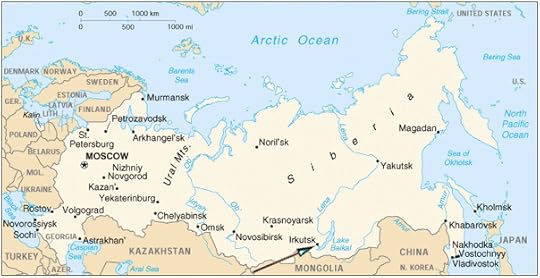
I bailed on p. 41 when the author referred to the tiny shrimp Epischura baicalensis, unique to Lake Baikal, as "these little guys." It was an early bad sign that, in the map at the beginning of the book, the Baltic Sea was labelled Caspian Sea. (The Caspian Sea was also labelled Caspian Sea.)
I've rarely had such a dual reaction to a book; the sections on Baikal itself were fascinating, but the personal memoir parts had me cringing. Peter Thomson was the founding editor and producer of NPR's program "Living on Earth". As the dust jacket says, "In nearly a decade at the program his work was honored with nearly twenty awards for excellence in broadcast journalism." He leaves in 2000 to take an around-the-world trip with his brother James, planning to see Baikal on the way.
So I expected an in-depth story of a pilgrimage to Lake Baikal. Instead, while he has some excellent sections on Baikal, this is really a tale of an attempt to deal with his own psychological trauma. He goes on at length in various parts of the book about having to deal with his mother's death, with being 40 and going through a divorce, etc. On p. 165, he says, "This nagging fear and anxiety is the backdrop of my life, ebbing and flowing through travel, work, relationships." When he lets that anxiety talk for him, the book flounders, and I would have given it 1 star. When he lets Baikal take center stage, the book soars into the 5 star range, so I compromised on 3 stars.
That being said, the chapters I could have done without are chapters 6, 7, and all of Part Two (chapters 10-15). At the end, chapter 21 is almost whining, and he finally says, "What a couple of sorry excuses for travelers we are." (p. 257)
But the rest of the book--when Thomson gets outside of his own problems--is both a tribute to Baikal and a warning about the lake's future. In Chapter 3, he gives some of Baikal's background, which is breathtaking. Located in Siberia, the lake is 25 MILLION years old, formed by a crevice as the earth's plates shifted. It is 70 km wide and 600 km long (the distance from Los Angeles to San Francisco) and opens an inch each day. It's depth wasn't known until 1959 and is more than a mile deep (with sediment added, it's almost 6 miles deep). It's 1000 times older than the Great Lakes, which were formed by glaciers.
Thanks to a small shrimp-like creature "epischura baicalensis", the lake is self-cleaning--they live nowhere else. Baikal is the only lake with seals, called "nerpa". One of Thomson's best quotes is: "You want to understand it all, and you're in love with the fact that you can't understand it all--that part of all this beauty is the very existence of mystery." (p. 51)
He does a good journalist's job of describing all the people he meets, especially Andrei who is their guide at the beginning and then comes back in the Epilogue. Andrei has a vision of creating hiking trails around Baikal, maintained by volunteers and tourists. (He was inspired by seeing Gore and Clinton working on the Appalachian Trail). One of the best moments in the book is when you read in the epilogue that Andrei has stuck to that dream; by 2006 1500 volunteers from 18 countries had built 475 km of hiking trails for the Great Baikal Trail.
Chapter 16 is devoted to the infamous paper mill that opened on Baikal in 1966, using chlorine bleach. When he speaks with the woman in charge and asks her about the pollution issue, she really puts him in his place, asking what the U.S. has done(thousands of factories have dumped millions of tons of pollutants into the Great Lakes).
The plant is an ongoing problem, but people like Andrei and Jennie Sutton (called the "Jane Goodall of Siberia") hope that low-impact tourism can make the plant obsolete. Sutton is one of my favorites in the book--a Brit, she runs the Baikal Environmental Wave, founded in the 1990's. Like Andrei, she is included in the epilogue and while still pessimistic about the lake's future, she won't give up trying.
Thomson tries to get a handle on the Russian "spirit", but never really accomplishes true empathy with the people or the country. He "gets" that they are a proud people and nation, who don't feel appreciated by the world--but he misses the whole point of a country whose soul still has the melancholy passion of a Dostoyevsky. He and James don't even talk to the other passengers on the train back to Moscow at the end of the Baikal visit--and he pictures Moscow as "a few hustlers selling cheap junk to nostalgic tourists." I was pretty appalled.
However, I do believe Thomson cares about Baikal, and sees the lake as part of the global community. "Within the last generation, geography has become almost meaningless as a barrier--to people, capital, pollution, almost anything." He recognizes that "many observers now believe that the biggest threat to the Baikal ecosystem is climate change."
So I'm glad I read this interesting, frustrating book--Thomson gives an extensive "Source Notes and Further Reading" section which I plan to use.
I love reading stories about unusual journeys, and this is certainly an unusual journey. Peter Thomson is a brilliant reporter, who makes complicated political and scientific issues easy to understand. He also reports compelling and honestly on his relationship with his brother and his heartbreak over his failed marriage.
I've had a desire to travel to Lake Baikal, so I anticipated a read that would inform. I wasn't disappointed. Thomson, an NPR journalist, is a fabulous wordsmith, and he keeps the reader interested with stories of his journey around the world and in-depth telling of his research of what's really happening in and around Lake Baikal. A travel story with depth, always my favorite. Not a page turner late at night, but a book that you want to give your attention because the information gleaned from it will live inside you as you consider climate change, the impact of tourism around the world. The book is personal enough -Thomson makes the journey after a break-up of a long term relationship - to pull you along with the deeper questions of life he poses. Highly recommended for the mature reader.
As a resident of the Great Lakes basin, I'm particularly drawn to know more about the other temperate-zone lake that contains as much water (tho much less surface) as the 5 lakes I've called homeland for much of my life. Peter Thomson's impression of Baikal shows it to be under threat, yet somehow resilient (depending on your informer). This is a memoir, as well, and does a good job of balancing a personal interest story with travelogue and descriptive science.
Fine and competent enough travel writing but nothing crazy to write home about... this is of course a review of the book and not the lake itself which I find geographically incredibly fascinating and want to visit one day. Think the book was more for the coffee table than for those with geography-oriented autism.
There are many enjoyable elements of this book for anyone who has been or plans to go to Lake Baikal. As a member of the former category (and one who harbors hopes of an eventual return visit) I could relate to many of the author's travel experiences. I share his reverence of Baikal and appreciated the many common Russian travel experiences we hold in common.
If the book had been had primarily consisted of his travel stories, I probably would have rated this 4 stars. However, much of the book covered the environmental issues facing Lake Baikal. This shouldn't be a major surprise since the author is an environmental report. Still, I found the difference between his travel writing and his environmental writing to be substantial--the tone, flow, and style were completely different. I think the book also suffered from the fact that Thomson only decided to write a book about his travels well after the fact--he had originally tried to publish smaller articles based on his travels and environmental findings.
For the Baikal vet or those who long to get there, or for those interested in a good travel story, half of this book is satisfying. If you have a strong interest in protecting the environment of one of earth's most fascinating and unique places, the other half of this book is satisfying. The subset of people who will enjoy the book in its entirety, however, I think is small.
I want to see a nerpa someday. I would also like to go on a crazy journey like like this. I started reading the book because I have a soft spot for enviro lit, but my favorite parts were the descriptions of the crazy travel experiences from Alaska through Korea and Japan, and of course the Trans-Siberian. What an epic journey!
I am guilty of personal attachment here. The book is by my brother. It is also a really interesting travelogue to a part of the world I will probably never get to - Siberia -..... and I like those kinds of reads.