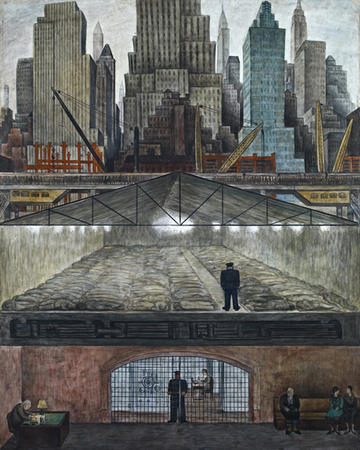
The compelling story of how an art celebrity and icon of the Mexican left came to New York in 1931 to paint eight murals at The Museum of Modern Art In 1931, Diego Rivera was the subject of The Museum of Modern Art's second monographic exhibition, which set new attendance records in its five-week run. The Museum brought Rivera to New York six weeks before the show's opening and gave him on-site studio space. There he produced five “portable murals” --large blocks of frescoed plaster, slaked lime and wood that feature bold images drawn from Mexican subject matter and address themes of revolution and class inequity. After the opening, to great publicity, Rivera added three more murals, now taking on New York subjects through monumental images of the urban working class and the city during the Great Depression. Published in conjunction with an exhibition that brings together key works made for Rivera's 1931 show, this catalogue casts the artist as a highly cosmopolitan figure who traveled between Russia, Mexico and the United States and examines the intersection of artmaking and radical politics in the 1930s. Illustrated with reproductions of each panel as well as related paintings, drawings, prints and documentary photographs, the book's essays investigate the international politics of muralism, Rivera's history with MoMA, the iconography of the portable murals and technical aspects of the artist's working process.
Diego Rivera (1886-1957) was a central figure in the development of Mexican muralism, an ambitious public art initiative intended to relay Mexico's ideals after the Revolution (1910-1920). A highly cosmopolitan artist, Rivera had spent many years in Europe before returning to Mexico in 1921, and in 1927 he traveled to the Soviet Union where he met Alfred Barr, the soon-to-be founding director of The Museum of Modern Art, New York. Rivera's artistic celebrity benefitted from major commissions in the United States, including murals for the Pacific Stock Exchange, the California School of Fine Arts in San Francisco, MoMA and the Detroit Institute of Arts. By the 1930s, he enjoyed an unrivaled status at the center of international debates about public art and politics..
The purpose of this book is to outline the artistic work Diego Rivera did for the newly opened Museum of Modern Art (MOMA) in New York City in the early 1930’s. These were large murals (fresco’s) – five depicted Mexico’s turbulent history (as opposed to a flowery presentation in vogue during that time period), and three others on urban New York. Diego Rivera was overwhelmed by the endless construction and growth he witnessed in New York City during his visit – and put this in his murals.
These were not subtle works and several themes and messages would coalesce into his crowded paintings. There is also a discussion of the work Diego Rivera did for the newly built Rockefeller Centre, which was later destroyed by John D. Rockefeller Jr, because Lenin was one of the many characters featured in his large montage. Or, perhaps, as the author suggests, there is another alternative, that of disparaging caricatures of the Rockefeller family in the murals.
The book has interpretations of the paintings – some overly embellished like below (a common pattern in art discussions)
Page 55 (my book)
And modern pictorial conventions conflates more naturalistic styles with distinctly abstracted forms, creating a politicized form of realism.
It would seem that Diego Rivera liked to overplay his leftist political leanings – and the authors of this book do so as well. There is one short chapter analyzing the physical-chemical properties of the frescoes (murals) that Diego Rivera made for the MOMA exhibition.
Viewed this exhibit earlier this year and picked up the book recently form the library. I've never been much of a fan of Rivera's work. I find it very static and full of too much propaganda. Regardless, this book was very educational on how the original exhibit was organized and what inspired a recreation of the original 1931 MoMA restrospective. Great beginning essay regarding all of the above. The book then discussed each fresco individually. The end of the book discussed the actual fresco process and Rivera's contribution as a modern-day innovator to an ancient technique. I also like how the book discusses the political influence on art in the 1930s during a time of much worldwide political upheaval and the advent of evolving political systems, especially focusing on Rivera's Communist affiliations and the American art world, primarily being financed by American capitalists.
In-depth analysis of the eight, portable frescoes that Diego Rivera created for his one-man show at New York’s Museum of Modern Art in 1931 ... published upon the 80th anniversary of that event, generously illustrated, the book covers the many facets of these works against the backdrop of Rivera’s career as a muralist ...
Si quiere conocer porque Diego Rivera tuvo tan importante impacto en la pintura de inicios del sigo XX, éste es un libro que lleva de la mano al lector para entender su fuerza, su ideología, el valor de las pinturas y la historia de diferencias sociales que el pintor quiere mostrar en cada una de sus obras. Se basa en la exposición exclusiva que le dedicó el MOMA en los años treinta —la segunda después de haber dedicado una a Matisse—, en sus siete murales portátiles— el guerrero indígena, la caña de azúcar, la liberación del peón, le líder agrario Zapata, la revuelta, la perforación neumática, el poder eléctrico y los activos congelados— que desarrolló para la misma; en la relación que mantuvo con la familia Rockefeller y que le permitió en buena parte exponer sus obras aunque cayó en desgracia de ellos al final cuando en el mural que le contrataron para el edificio de la RCA! En el complejo del Rockefeller Center —en construcción en esa época—incluyó como parte de la muchedumbre una imagen clara de Lenin. Es un tratado muy elaborado, con bases históricas y que deja una gran impresión. Muy recomendable