'Utterly engrossing. I found myself drawn into Schiele's reeling world with its reek of wet paint and sex.' Jon McGregor, author of If Nobody Speaks of Remarkable Things
'Doesn't shrink from depicting the squalor of Schiele's existence and powerfully evokes his uncompromising talent' Guardian
The son of a railway inspector, Schiele rejects his bourgeois upbringing and flees in pursuit of artistic fulfilment. When he gains admission to the prestigious Academy of Fine Arts in Vienna, it seems that a glittering career lies ahead of him. But Schiele's talent drives him to portray the moral and physical squalor of the Habsburg capital, and he is rejected by an indignant and hypocritical art world. Forced to endure acute poverty and even imprisonment, Schiele continues to pursue his artistic mission, and in the last months of his life finally finds acclaim with those who had shunned him. In a lavish first novel of rare descriptive power and empathy, fuelled by a blend of research and literary imagination, Crofts succeeds in evoking the man as well as the artist. The result is a masterful, at times heartbreaking portrayal of Austria's most decadent and most misunderstood painter, and of the city which both inspired and destroyed him.
Often a novel’s success depends on how intimately the author knows his characters and how successful he is in conveying this intimacy. Though this novel is well researched and decently written I never really felt Croft got under Schiele’s skin.
It’s dangerous (though perhaps commercially not a bad idea) to write a fictional account of a historical figure. You either conform to all the preconceived notions and join those dots or you start from scratch with the available information and perform an imaginative act of empathy. Much of the novel is written in dialogue, almost like a screenplay. There’s little of his painting methods; almost no attempt to fathom Schiele’s inner life, his motivations and demons. The novel is very visual, an aspect I liked. But Croft rather shoots himself in the foot because anyone who admires Schiele will be irritated by his rather unsympathetic portrait of the artist. Sure Schiele wasn’t a model of ethical high standards but a novel surely should give us a rounded picture of a character. For example, it doesn’t really matter how much verisimilitude there is in Mantel’s Cromwell. Fact is she created a living breathing compelling human being and seemed to have access to every corner of his heart and soul. I certainly didn’t feel that about Croft’s Schiele. Shame.
This was such a poor match for me as a reader that I'm actually embarrassed that I read it.
I don't remember how I came to have this book, but I've given a few talks about Schiele and I thought it would be fun to read a literary account that took seriously the ways his heart provoked his contemporaries. I was wrong.
I do think Schiele is worth reading about. If you're looking for a place to start, this is free: www dot laphamsquarterly dot org/roundtable/unwitting-monument will take you to a lovely essay by Stassa Edwards called "An Unwitting Monument: On Egon Schiele's Pandemic Year."
For a view of Schiele that takes a critical look at some artworks featuring pregnant women, you could read the relevant chapter of The Naked Truth: Viennese Modernism and the Body by Alys George.
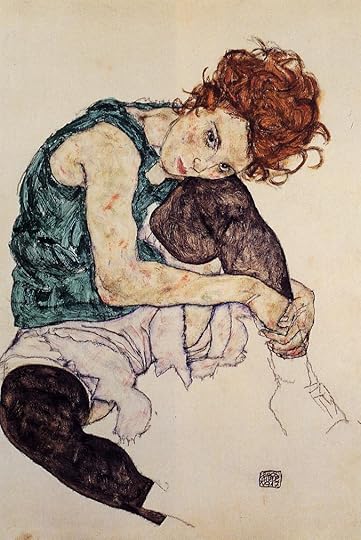
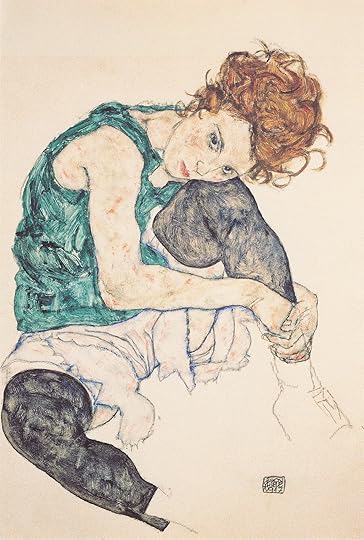
Of course, what you really want to do with Schiele is look at his art (I've put in links below -- none of them is to a nude, they're all safe to look at). Browsing through the online collection of the Leopold Museum in Vienna allows you to observe the transformation of an artist who could paint this in 1910: "https://onlinecollection.leopoldmuseu..." and then painted this in 1912: "https://onlinecollection.leopoldmuseu..." My favorite will always be [Sitzende Frau mit hochgezonenem Knie, at the National Gallery in Prague] even though it would be cooler to have a favorite that wasn't so well known, maybe one of the landscapes, like this: https://onlinecollection.leopoldmuseu... and or a still life, like this: https://onlinecollection.leopoldmuseu...
Schiele is most famous for nudes, including self-portraits, some of which have garishly colored sexual characteristics, but there's a lot more to his art than those.
Interesting things to know about Schiele: He was supported by Gustav Klimt and for a time his art was highly derivative of Klimt's but by 1910 he was forging his own path. He was arrested for having nude images in his studio where they could be seen by children who had come into the studio, possibly as models, or just as visitors - hence the title of the novel. He left his first muse (Wally) to marry another woman (Edith) who became his preferred model because Wally didn't offer him an "advantageous" union, as he put it to a friend. He thought Wally would continue to be his lover after his wedding to Edith, but instead Wally left him, studied nursing, provided comfort and care to countless men from her station in a hospital in Dalmatia (on the Adriatic coast) before dying in 1917, age 23. Egon and Edith only survived her by a year, dying in a flu epidemic in 1918. Edith was pregnant at the time. Someone could write a novel about Schiele's life for sure. But this, at least for me, wasn't it.
Ora, prima di iniziare il libro, a me le sue opere non piacevano, e neanche adesso a dir la verità. Ma qualcosa è comunque cambiato. A partire dalla comprensione della vena ironica del titolo.
Se avete dato uno sguardo molto generico ai quadri di Schiele vi sarete accorti che un chiodo fisso ce l’aveva. Fino a metà libro sarete convinti che è il sesso, arrivati alla fine vi convincerete invece che è il degrado, lo sfruttamento, lo squallore morale opposto al perbenismo della Vienna di fine ‘800. Così, terminata la lettura ci si accorge anche che l’etichetta di “pornografo” non indica il punto di vista dell’artista, né del lettore o turista volenteroso che si è informato sul credo del pittore. E’ la bocca della Vienna ipocrita, contro la quale Schiele si batteva ogni giorno.
Mi rendo conto di una cosa: è estremamente superficiale pensare di poter andare in un museo, e apprezzare delle opere senza sapere il chi, il come, il perché dell’autore.
Tutti gli artisti, quelli seri, sono lo specchio della fede intesa nell’accezione pura del termine. Sono persone con una sensibilità diversa, che vedono oltre le cose e credono con tutte le loro forze nella loro personale versione dell’arte. Combattono e si ingegnano tutta la vita nel tentativo di farla “vedere” anche a chi li circonda, ma siccome liberi dalle convenzioni sociali al contrario di noi, finiscono per morire dimenticati o incompresi. Non dev’essere una vita comoda, come non lo è per chi ha il malaugurato compito di vivere al loro fianco, e cadere nel facile tranello, di prendere il loro disinteresse per la vita “dentro i canoni”, come una forma elevata di egoismo e stravaganza.
In un mondo migliore, il bigliettaio davanti al museo o alla mostra di Pinco Pallino, prima di farci entrare ci darebbe il libro sulla vita dell’artista,e ci direbbe: “Torna quando hai capito”. E noi, torneremmo carichi del nostro entusiasmo e con gli occhi presi in prestito dall’artista, finalmente capaci non solo di guardare, ma di vedere. Ma non è così: al mondo ci sono troppi Schiele, e pochissimi Crofts che si prendono la briga di spiegarci cos’è che “tutto muove” dentro la testa dell’ideatore. E noi, privi dell’ideale vademecum del turista perfetto, abbiamo un’unica arma a disposizione. La curiosità, o che dir si voglia, la volontà di informarci. E se usata bene, può bastare anche quella.
So I'm reading this book, sitting outside eating at Whole Foods, minding my own business. A guy sits down at the other end of the table, and I think nothing of it since I assume that he also intends to mind his own business. Instead, however, he abruptly asks: "What are you reading about?" First, why, since he has obviously noticed that I'm reading, hasn't he also assumed that I'd like to continue reading and am not interested in talking? Second, did his mother teach him to presumptuously interrogate strangers in this way? Third, the pick-up line goes "what are you reading" and not "what are you reading about." Meanwhile, what can I answer? This is a novel that I've just started. So I pull the universal "I'd actually rather keep reading and not talk thank you" move and just hold the book up for him to read the cover, simultaneously realizing that this will be AWKWARD, as he reads out "pornography... in Vienna?" Then he has the nerve, or the social-maladroitness, to ask "Is it erotic?" I said "no," thanked God I don't visibly blush, counted to sixty, and walked as quickly as I could to my car. Lesson learned: I'll be reading this book hidden in a copy of Us Weekly in future.
Having just finished a biography of Egon Schiele, I found this remarkably close to the facts of Schiele's life. Crofts manages to evoke a suitably decadent atmosphere for pre-First World War Vienna and sets his character loose in it. An excellent read.
Interesting narrative nonfiction about the life of Egon Schiele. I do wish it focused a bit more on the art, there really wasn’t any mention of his work with the vienna secession or some of his more famous works, but it was interesting to learn more about this very divisive figure. though as a person he was like 1000% in love with his sister and hated by many, i think he paints people so realistically grotesque. he definitely saw the world differently than most, and i still really love his work
Shortly after I finished reading Lewis Crofts’ novel, The Pornographer of Vienna, I saw an article in The Sydney Morning Herald reporting that the Australian photographer, Bill Henson, was to be charged for showing photographs of naked adolescent girls. Shades of Schiele! Not much seemed to separate reactions to Bill Henson’s work in Australia in 2008 from those to Egon Schiele’s work in the Vienna of the early 1900’s.
When I first saw paintings by Egon Schiele at Vienna’s Belvedere Palace back in 1969, I hadn’t heard about the painter, nor had I heard about Cesky Krumlov, or Krumau where he had lived and worked for a time. Today, Schiele postcards and posters are part of the Viennese tourist scene and exhibitions of his work run relays throughout Europe while Cesky Krumlov is on any Australian backpacker’s itinerary.
In the Vienna of his time, Egon Schiele was considered a rising talent but also a pornographer, hence the title of Lewis Crofts’ debut novel, The Pornographer of Vienna, Old Street Publishing, UK (2007).
Lewis Crofts became fascinated with Egon Schiele while living in Prague and followed Schiele’s traces to Vienna and Cesky Krumlov/Krumau. Crofts researched Schiele’s writings and papers, as well as his paintings, to create a “bio-novel” which draws the reader into Schiele’s creative processes and shows how they interacted with his times. Even then the effect of the market place exerted its influence, juxtaposing “sex sells” against portraiture to be hung in stately homes. Crofts captures the standards of the times with a “draussen hui, innen pfui” (clean on the outside, dirty on the inside) flavour which Schiele, arriving in Vienna in 1906 to attend the Academy of Fine Arts, also perceives “The city […] rancid, pregnant with squalor behind its Imperial veil.” Sketching in a morgue in red and black, “God’s primary colours,” Schiele is drawn to showing the dirty underbelly of Viennese society.
Crofts’ “bio-novel” traces Egon Schiele’s life from his birth in 1890 in Tulln to his death at 28 during the Spanish flu epidemic in 1918. I felt like I was sitting on the narrator’s shoulders as we accompanied the young Egon from Tulln to Vienna, its Academy of Fine Arts and its claustrophobic double standards. We were there to see Schiele share with Gustav Klimt hearth and muse in the person of the young Wally who later became Schiele’s lover. We were able to appreciate the loyalty of Roessler, the art buyer; and experience the need to flee stifling Vienna for the innocence of Krumau.
When the residents of Krumau drive Schiele and Wally from the town because of his alleged use of young girls as models, Schiele’s predicament is brought into our time. When Schiele insists he no longer paints people, young Jana says: “But I want you to paint me. I want a nice big painting of me in my Sunday dress.” (In the light of the kafuffle about the cover of Art Monthly, I can’t help thinking: plus ça change …) Schiele and Wally move closer to Vienna and in 1912 in Neulengbach scandal erupts once more: Schiele is arrested for mishandling children and the villagers burn the works of the “Satan with a paintbrush”. The magistrate, however, is forced to concede that there was insufficient proof for the mishandling of the children and sentences the 21-year old Schiele to four weeks’ jail for the crime of distributing amoral works. “You are the criminal,” Schiele cries. “Art should be free. To restrict the artist is a crime; it is murdering life in the bud.”
In the war years, Schiele left Wally to marry the bourgeoise Edith Harmes, never saw fighting at the front, and continued to sketch and to paint, producing more than fifty works which were exhibited in Vienna’s Secession in 1918. Towards the end of the same year at the age of 28, Schiele died alone, like Edith his wife, a victim of the Spanish flu epidemic.
Lewis Crofts has closely researched Egon Schiele’s life and works; he has also added a good dose of literary imagination to his “bio-novel” which draws the reader into Schiele’s world in Tulln, Krumau and Vienna during the fading years of the Hapsburgs. This was a time when members of a society, preferring to ignore the horrors of war, revelled in the alternating praise and damnation of an artist bold enough to hold up a mirror for them to see what they would.
If you are familiar with the works of Egon Schiele you will see them again as the novel follows the stages of Schiele’s life seen through the lens of his creative process. If you are not familiar with the paintings of Egon Schiele, Crofts’ descriptions will be a good introduction to an appreciation of the work of Austria’s most misunderstood painter.
I bought this a couple of years ago at the National Gallery's shop, in Dublin, but only recently discovered it and read it over the last two or three days. God help me but I thought I had bought a biography - and God help me further but I reached page 95 before I realised I was reading a novel ... not sure how I managed that but there it is; admittedly, I'd always avoid novels about famous figures so my mistake was a fortunate one. What probably helped me enjoy it so much was the fact that I knew not one single thing about the painter Egon Schiele so I could give myself over to this fictional account. It's immensely readable though I did feel somewhat rushed to the end, and was left with more than a few questions. Also, I wondered if it would have been better to have had it narrated by the character of Schiele as I felt slightly detached from him during the last couple of chapters. In any case, I thoroughly enjoyed it and will now check out Schiele's art online.
This book read more like a screenplay to me than an actual novel. At times it was difficult to distinguish who was saying what, but re-reading a certain passage usually cleared that up (which I hate- I like things to flow). This hardly flowed. I did enjoy the vignettes into the life of Schiele. Intriguing. Successfully depicted an insightful look into an egregarious and often misunderstood artist- which was rather enjoyable. All in all, not bad- but sadly did not leave that empty pit in my stomach I so enjoy after a good- no, GREAT, book.
All the above aside, Crofts is a remarkable writer. Quite eloquent and beautiful. His prose instantly drew an image in my mind. I could actually see the movie of Schiele's life he was trying to depict. Astounding.
Maybe I am being a little harsh. This book has a weirdly sentimental but also jilted love story that coincides with the end of an era. The fall of the Austrian-Hungarian Empire fits encapsulates the era of this time period, when Europe entered into the industrial era. The decadence and hypocrisy of this time feeds into the stupid Ego of one artist with incestual entanglements. He does a cruel thing, he seeks to aspire in his hypocrisy and thus there are three love stories sorted into a single narrative.
Perhaps we have three different faces for inspiration; his depictions of the women in his life strike no one; although the one he chooses is also the most fake.
I am not sure how to feel about this book as there doesn't seem much at stake. I don't feel much for the characters although his injustice is painful for me because it is the loss of romantic story that apparently I identify with and long for. Instead, he seems to reach an artificial wisdom at too young an age to die in perhaps the worst condition, becoming both a respected widower/painter, loyal brother and jilted lover.
In a sense, the place and time of this book are too enfolded into the characters for the story to last longer than the era. This reads like a ex-post-facto retelling of a simpler time that never was, one we fantasize about in our literature about Bohemian artists living in decadent industrial Europe.
While I had heard of Gustav Klimt and was familiar with his artwork, I hadn't heard of Egon Schiele. Lewis Croft made the introduction. I have to admit, it took me a while to pick this novel up just because of the title of the book. I was intimidated. The book had landed on my shelf from one of Mary's college classes.
This is the steamy underbelly view of the people of Vienna, beyond and below the aristocracy. You step through this world through the eyes and life of Egon, Klimt, and their models. The scene is the same as the debauchery of the Paris art scene - starving artists, no heat, alcohol, bars, artists garret, prostitutes, models... Here you are in Vienna and the scene repeats itself. So much from this time period boils down to the misunderstood, struggling, visionary artist trope.
That being said, Crofts delivers an introduction to Schiele and his works. I had the internet beside me so I could see his creations as well as those of Klimt. Those two really turned the art world on its head.
Stories within the story carried weight too. The conflict between Egon and his father as Egon chose art instead of engineering, between the art academy and a student who defied the conventions, between Egon and himself as he joined the ranks of those he mocked, ...
In this history you are a witness to the collapse of the Austro-Hungarian empire, WWI, and the Spanish flu all as it impacted the life of Egon Schiele.
Vienna & its atmosphere of impending doom in the years around the First World War has always interested me, as a historian trying to make sense of the madness & mayhem which brought-up both Freud & Hitler. This graphically-written novel in English, tells the story of controversial & provocative artist Egon Schiele & his lurid view of the female form in art & his headlong descent into notoriety & premature death in squalid circumstances. His friend & mentor, Gustav Klimt, acts as a catalyst on Schiele's youthful talent & his sister, Gerti & favourite model, Valerie, are willing recipients of his attentions, both intimate & artistic. The novel throbs with an energy that is often unhealthy but seems to capture perfectly the sense of approaching disaster which will destroy the Austro-Hungarian Dual Monarchy, Vienna's complacence & the avant-garde artists including Schiele, the pornographer, & leave the German-speaking parts of Europe in a state of purgatory. Hitler himself was made mad by Vienna; that was not a coincidence it seems to me. The city was a festering sore in the early 1900s & this novel is not squeamish about showing it as such.
Despite the attention-grabbing title, this is a nonetheless poetic and sensitive piece of historical fiction about Egon Schiele. There’s no getting around the excesses of his life, which are depicted with surprising nuance, but its primary strength is in its contextual depiction of him against the ragged lure of Vienna itself, which is raw in its occasional squalor. It’s certainly a brisk jaunt through his short life but the pivotal relationships in it are given suitable heft and impact, and it instils a renewed appreciation for his work.
This book brought me into the abyss of despair by its end. I genuinely want to reread it one day once I become more stable mentally as it impressed me this much. I love the painter though I can't really say how trustworthy this book is, I felt like I could believe everything the author was describing every single detail, dialogue, hands touching as if mr. Lewis was Schiele's pocket friend, always hiding, listening, watching. I enjoyed reading this tragic story and the way it's written a lot. It was quite a journey (as I said) into the abyss of despair. *sobs*
Not entirely sure how I felt in the end about the fictionalisation of the historical figures (especially the women). I feel like I would have got more out of a straight biography or, even better, an hour-long documentary on BBC Four with lots of B-roll footage of Vienna and voice actors reading out Schiele's correspondence. Considering I read this on holiday without access to a television, this was a passable substitute.
I love books about painters but I didn’t like this one. May be the translation was weak and didn’t catch the particularity of the writer’s style… I don’t know. But something was very wrong. And I realised that I felt nothing for Egon Schiele, I even couldn’t stand him! I love his paintings, but because of this book I don’t like his personality… 😞
I discovered the work of Egon Schiele at the Belvedere on a visit to Vienna several years ago: I went for Klimt and emerged fascinated by this artist I had never heard of before. Fictionalised historical biography can be wonderful, insightful, informative, capturing the subject in a way that makes you feel as though you can see through window into the past. Equally, if not well done these books can taint whatever interest drew you to them in the first place. Well, I am pleased to say Lewis Croft's 'biopic' account of Egon Schiele falls, resoundingly, into the Good category.
I loved this novel, couldn't put it down; the way Croft shows Schiele from childhood to his sad end, his creative processes, deep flaws that make him unsympathetic even unlikeable, his passions, his relationships with friends, family, fellow artists, patrons, critics, and the authorities. The writing is very good, with beautiful, painterly imagery and a pace that sometimes leaves you breathless.
Crofts captures the atmosphere of early 20th C Vienna very well indeed, its decadence, decline, and decay, its bourgeois hypocrisy, the dark underbelly hidden by imperial pomp and glamour. He is particularly fine on the final part of Schiele's short life, vividly, unsettlingly taking us through the terrible years of the First World War and the devastating influenza pandemic of 1918.
Schiele dominates, naturally, but Crofts does a good job, too, with secondary characters such as his mentor Gustav Klimt, his lover and muse 'Wally', publisher and friend Arthur Roessler.
If you know Schiele's work then you will enjoy the insight this novel gives into his often troubled and tempestuous life, and if you don't then it will make you want to take a good look at his art, and it is truly wonderful how the internet makes that possible even if you can't view the actual paintings and drawings.
Schiele was known to scandalised Vienna as 'Satan with a paintbrush". There was an element of truth in that for he could be horrible to those close to him- who really wants to have to live with a genius who must put art before everything including friends, family, lovers, wife? A man who understood and captured human sexuality in all its uncomfortable reality showing polite society that which it preferred not to see, in public at least. Schiele's more overtly erotic images are unsettling still, no small achievement.
Schiele got into trouble over his use of children and underage girls as models. Artists still do, more so than ever. Some readers might, therefore, find aspects of the novel problematic. Crofts' depiction of Schiele's relationship with his sister Gertrude, for e.g., and Valerie known as Wally, who modelled at a very young age for Klimt before being 'passed over' to Schiele, engaging in sexual activity with both artists before puberty. So this is not an easy read, but the novel moved me and made me feel as if I understood Schiele a little better than before. Now I want to spend time looking at his art again.
A nice romanced biography of this underrated painter. I love the way the author explored the subconscious of Schiele in his own way. I read the book after studying and seeing the paintings in Wien, and it brings me back there.
My thoughts waver on this book. On one hand I'm happy to have any material on Egon Schiele, an artist whose work I adore, and of which there's not nearly as much material as there could/should be. On the other hand, this is a fictionalized biography, and that is something I normally would dive in a razor-filled ditch to avoid.
This time I didn't avoid it, and so I course could not avoid the reasons I normally avoid these things in the first place, and that's that they either have too little character (because the author didn't want to in any way foster a false look at the subject) or else they have too MUCH character, because the author HAS developed a false look at the subject. So, it's a no win situation, and, not surprisingly, readers don't win with this novel either.
There are times, instances, though, where I felt some connection with Egon's fervor, and the decadence of Klimt, so everything wasn't a total loss, and if someone were to do a fictionalized biography of Otto Dix than I'd probably make the same mistakes all over again.
I seem to be having bad luck since I started on goodreads, reading books that I like less and less each time. This one just seems to have no point to it. Art-historical fictionalized biography is a really difficult genre, and despite my perseverance in it, I can't say I've ever read one that is successful as either a novel or a biography. The Pornographer of Vienna is a particularly hard slog--the main character has no redeeming or interesting qualities (not even artistic ones in the book), and the plot is one long stream of grime, violence, and disease--again with no apparent point. The book added nothing to my understanding of an artist whose work I really like, and I think if someone read it without knowledge of Schiele's work, he would have a very misleading idea of it and what is interesting about it. One star awarded for insight into early 20th century Vienna and good bit at the end about the effect of WWI and the influenza epidemic on Vienna.
This was an enjoyable portrait of the Jugendstil/Secessionist painter, Egon Shiele. Before reading this, I knew next to nothing about him, but through well-written account of his life, liberally flavoured with Croft's imagination. I learned of his life and the time period he was in. The pace of the book was rather quick, barely skimming over many aspects of his life, delving briefly into his humble beginnings as the son of a railway operator, glossing over his training and rise to fame and notoriety for his "pornographic" work, quickly sketching is foibles and mistakes. Egon Shiele, as depicted in this novel, was a bit pathetic. He blundered around, uncaring of what others thought or who he hurt in what he thought was right.
A book filled with good, solid writing and good, solid Fin de siécle Vienna, that just didn't get there. It could have been so much more, and there is a lot of beauty in the prose, but it felt like I was reading through smoked glass, which might very well have been the intent, which, if it was, didn't work. The middle of the book seemed held up by the beginning and the end, like a sagging power line. We needed more insight into Schiele's character-more of his inner life-and we needed a bit more description on the Kaffeehauskultur in order to be able to contrast them with the whores in the alleyways.
Still, a basically good read, lots of research, lots of flavor. I'd read it again.