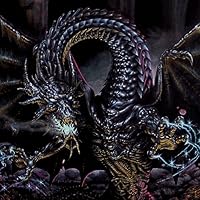
One of Fighting Fantasy's most innovative titles now in a brand-new edition. Can YOU defeat the nightmare army of the undead? Agglax the Shadow Demon is amassing an army of undead warriors to conquer Allansia. Having survived the perils of Deathtrap Dungeon you set off from Fang with over two hundred veteran soldiers to fight his army. But the Shadow Demon is not of this world and special powers are needed to destroy him. And the longer you spend searching for these powers, the stronger he will become...
Sir Ian Livingstone is an English fantasy author and entrepreneur. Along with Steve Jackson, he is the co-founder of the Fighting Fantasy series of role-playing gamebooks, and the author of many books within that series. He co-founded Games Workshop in 1975 and helped create Eidos Interactive as executive chairman of Eidos Plc in 1995.
I guess one of the reasons that the authors of the Fighting Fantasy Gamebook series are exploring new concepts is because they need to experiment and change to continue to produce a viable product. The new idea that comes into this particular book is the concept of the skirmish, or the mass army battle. Unlike the other books, where you are generally on your own, in this one you are leading an army to go out and fight an army. Okay, there are other books where you are a commander (such as Starship Traveller) but this one experiments with the concept of the army and skirmish battles.
Basically a demon has raised an army and is threatening to destroy the freedom that exists within the land of Alansia (though since this is a medieval fantasy world, I suspect this concept of freedom really only extends to the freedom of the cities to rule themselves, though I have never found that the Fighting Fantasy books are either deep or philosophical in that regard). You, being the hero, and also as is indicated, being the one that succeeded in Deathtrap Dungeon (or Trail of Champions, it is not clear which) you are the obvious one to lead the army, though it is not as if you are tasked to do so, because you simply decide to do it yourself.
An interesting thing to note is that the idea of the army that is raised here is generally how armies worked before the development of the modern professional soldier. Armies were made up of ordinary people who were paid to pretty much give up their jobs and to go and fight a war. In some cases they were not even paid, or given the option, they were simply recruited. I have heard that Alexander the Great created the first standing army, which meant that he would have an army at his beck and call as opposed to having to recruit from the peasantry. However the problem with standing armies is that the farmers need to be able to produce excess food to be able to feed those who are not producing food. That means that if there are 50 farmers, and 50 non farmers, the farmers need to produce enough food to feed them and one other person.
However, in the world of Fighting Fantasy armies only exist while a war was in progress, and once the war was over, people would return to their normal lives. This was the case in Ancient Greece, though the Athenians tended to pride themselves on their democracy meaning that they would be more than willing to drop their ploughshares and go to fight. I guess that is also where the idea in the Psalms about beating swords into ploughshares come from, namely because once the war was over, and the farmer returned to his farm, he no longer needed his sword and would rework it back into a farming implement.
This book is different to the other adventure books in one major way: you have an entire army at your disposal. If you have read any of the other fighting fantasy books before, you will know how this goes.
A long dead king has summoned an army of dead soldiers to defeat your city! you and your gathered army must march together to destroy the Army of death
NB: your soldiers are considerably weak against the enemy
I don't particularly like the fighting fantasy series, i just read it.
This entire review has been hidden because of spoilers.
Armies of Death plays with the formula of a Fighting Fantasy gamebook, while still delivering something that feels very, very much like an Ian Livingstone gamebook, for good and bad.
The premise is that you are an unnamed adventurer, but not just any unnamed adventurer--you are the winner of the Deathtrap Dungeon (see book 6), and thus a very rich adventurer. After using some of your winnings to buy some land and build a castle (smart), you decide to use the rest to build up an army of mercenaries to fight a demon amassing its own army (less smart). Thus, in addition to all of the usual elements of an FF book, you also are keeping track of your total army and its individual components, to fight skirmish battles. Skirmish battles are basically simplified fighting battles--instead of skill, the advantage is entirely who has the larger army. (And to keep you from walking over everything leading up to the final fight, you're usually limited in how much of that army you can field.) In practice, there aren't really that many of them. There's about seven unique skirmishes in the entire book, and the actual final fight is more drawn out. It does give the feel of a larger scale, though. There are occasional choices to be made on which types of soldiers you deploy, and checks to see if you recruited specific groups (and in fact, you'll get an instant death at one point if you don't have certain people present to save you). This is when the system is at its best--it feels like you're being rewarded for diligent recruitment, and for clever battle calls. But neither case happens very often.
It is most definitely an Ian Livingstone gamebook, which means there's lots of checks that you've obtained very specific items. The setting kind of works against this. In the confined state of a dungeon, or even a city, you can kind of justify some item hunts, in that the various villains would want to keep the keys to their traps nearby, just in case. A tromp around a country feels expansive, but it gets harder to justify finding the items in the middle of nowhere. The book has two major checking points: first, there's an oracle you have to visit to learn how to defeat the demon, then there's the actual demon. You can survive the oracle encounter without certain items, but you're basically in a walking dead state without its advice. The oracle asks for a long list of items and pieces of trivia, though this encounter is somewhat mollified by luck rolls where it'll accept not submitting something or ask for simpler trivia. However, it absolutely requires you to have a pet hopper and remember the command to turn invisible for it; it requires you to have purchased a green vase AND remember the price of that vase from a random pawn shop. And worst, it requires you to have a gold brooch. That's the worst because to get the brooch, you have to make a bet with a man in a tavern on which bit of jelly a fly will land on, a bet that is determined entirely randomly, and not influenced by a luck roll. So you basically have a 50/50 chance of just losing the book right there.
And then there's the final battle. First, you have to have either Max's Mercenaries or the hillmen; depending on which set of foes you face, one will be required to save your life. (And as an aside, I don't like that Max dies saving you but the hillman leader survives and thrives; for a series that has a gender problem, it kind of suggests Max is the lesser fighter.) Second, you have to have all the knowledge from the Oracle. And third, you need a crystal of light. The crystal of light can only be obtained from a box held by a kobold like creature that you run into. The box can only be open by a special ring. There's no particular indication that the creature has this box; you just find the ring randomly on the ground in town, with no indication of its greater purpose. Again, it's an indication of how an outdoor setting can feel very disconnected and random. (It doesn't *have* to--if the story had clues or filled in these gaps, it'd still feel a bit random, but much better.) I do like thematically that the other thing you need to do is throw away all of your money to distract the enemy army. It's a bit of a silly move, but a nice piece of symbolism. Throughout the story, your wealth is a sort of safeguard, differentiating you from other FF stories. To win, you have to sacrifice your sense of security. It feels silly, because it's not particularly a sound tactic, but whatever. It's a nice moment. I like that this is survivable under lower skills levels too--the final boss isn't directly attackable, and the actual last opponent is a somewhat misplaced ninja with a skill of 10.
Some quick random points: I hate the Oracle. Absolutely hate it. I think Livingstone is leaning into its annoyingness a bit, but its neutrality in the face of impeding evil doom is not as endearing as I feel like I'm supposed to find it.
The aforementioned kobold-like creature above is officially called a blog, which amuses me. I guess that didn't have its current meaning in 1988.
The first choice is whether to take the army by river or across land. In some gamebooks, even in other Livingstone gamebooks, such choice would include must have items. Here, it's more just a different set of encounters. I like that approach a lot--it gives replay value without forcing the player reader.
To sum up, it still leans a bit heavily into the collectathon tropes and the outdoor setting comes off feeling a bit too expansive. It's got some interesting variations on the FF formula that are welcome, and I kind of wish it went further.
This entire review has been hidden because of spoilers.
Really enjoyed this one, but be warned!! this is an Ian Livingstone book, so you must pay attention, write down notes and make sure you collect everything you need otherwise you will FAIL!! The New Skirmish battle is somewhat of a gimmick, but never the less, i really enjoyed this one!
Armies of Death is another fantastic adventure written by Ian Livingstone!
This book's a weird one because you have an army and that feels like the main selling point. It's a neat concept and it's fun and not overly complicated.
The adventure itself is great. You've got a nice mixture of the traditional gameplay and managing your army and what they do. For instance, an early encounter has you choosing whether to let your Elven Archers shoot down on some enemies or not. You'll be deciding on what you want to do and then on what you want your army to do during this adventure.
The story is nice. You've got some fun cameos and callbacks, enjoyable characters, a menacing and creepy threat, and some nice trials and tribulations to deal with along the way. This book definitely feels as if it's a part of the Fighting Fantasy world rather than a one-off.
The only real downside is that the army mechanics weren't quite as I expected, really. Instead of having Army A vs Army B battle it out in the same way that you would fight an orc with some modifications, the army combat felt a lot less involved.
All in all, a great read, a fantastic story, and a book that's well worth a read.
Armies of Death (FF #36) is a sequel of sorts to Deathtrap Dungeon (FF #6) and Trial of Champions (FF #21), in that you are someone who has beaten Sukumvit’s labyrinth, which featured in the other two. Like those books, this one is penned by series co-founder, Ian Livingstone himself and, as such, the story and atmosphere are very strong. Armies of Death is unique in the series (I think) in that you’re accompanied by an army (whom you recruit, in one of the best-drawn scenes in the series, in a pub). In addition to the standard personal combat, you fight ‘skirmish battles’ with your army, and the combat system is quietly ingenious in its simple intuitiveness.
I died of malaria first time around, after being bitten by a mosquito (!!); and the second time around I got all the way to Agglax but hadn’t picked up along the way what I needed to defeat him.
It’s a big, open-feeling world you play in and there’s lots of variety of action and setting. In its internal consistency and as a result of its top-quality prose, it has the feeling almost of a novel rather than a gamebook. This is a great entry in the FF series.
This is one that I loved as a kid and revisited now as a, much older, adult reader. It's decent enough, and the army mechanic makes it seem a little fresh and different from other FF entries, but it certainly isn't a classic. For a book about armies, you spend very little time actually fighting with your army (my favourite is the bit where you can die inside a hut while your army is outside and does nothing!). It's a fun entry, but not one of the best. Recommended for the FF fan but wouldn't win over the unconverted.
The central gimmick of the book feels underused - you are a commander of an army and must use your wealth to build a larger army. But the book meanders around town for a while, wasting paragraphs on sections like "do you go inside this shop" when really you should just be going from shop to shop anyway basically.
Maybe I'm just a little burned out on the generic fantasy ones.
I'm giving this one 5 stars for the writing, the story and the worldbuilding. Ian Livingstone always writes well. At the same time, success here depends on the same thing that Livingstone gamebooks always depend on, namely having collected specific random objects that you happened to come across. It gives the book something of the feel of a scavenger hunt. Still, the introduction of mass combat is a nice, novel touch.
Having an army at your disposal in a Fighting Fantasy is just a ridiculous amount of power, Ian Livingstone is a genius but also insane hahah. This one feels like an epic film with exciting action sequences.
Bit of an oddity - a sequel to Deathtrap Dungeon where you use your winnings to raise an army to fight a fairly unmemorable Big Bad's evil army. The mass combat mechanic doesn't work, and while an interesting idea, it doesn't come together. Artwork is uninspired.
I wish I could give this one four stars. The story is interesting, the exploration and progression compelling, and the army-building fun. Sadly, you don't get to use your army in interesting ways. More tactical usage at the end would have been fun. The skirmish battle system is also poorly designed and utilized. You also must collect an endless number of random objects and details, which is a cheap way to make the book more difficult. Lastly, there are many mandatory and difficult battles and several do or die, necessary 50/50 luck checks to win. Lame. Still, it's got a lot of character and sense of place and progression, which made two-thirds of the book very fun reading.