From the author/illustrator team that produced the bestselling Reading the Forested Landscape : a fascinating and beautiful natural history of North American granite summit balds. In The Granite Landscape Tom Wessels synthesizes history, geology, biology, and personal narrative to enhance our understanding and appreciation of these high, wild placesthe granite summit balds of North America. He explores the unique and fragile ecosystem that is common to exposed granite expanses from Acadia to Yosemitehow it evolved slowly over millennia, and how it is threatened today by foot traffic and overuse. Wessels' wonderfully informative and accessible text combine with his dramatic photographs and Brian Cohen's beautifully detailed illustrations to bring the denizens of the granite bald to life. The mountains they celebrate Acadia National Park in Maine; the White Mountains of New Hampshire; the Adirondacks of New York; the Wind River Range of Wyoming; the Beartooths of Montana; the Enchantments of Washington; and Yosemite National Park in California. 18 photographs, 30 illustrations, 1 map, glossary, index.
I've hiked the bald granite domes of Acadia National Park, as well as some in southern Vermont, and their beauty is always inspirational. Geology is so interesting; I think if I started life over again, I might be a geologist. Or a mail carrier! It's so hard to say.
Tom Wessels writes for a lay audience, and he often uses the first person, describing a particular hike he took. He briefly covers the background needed to understand what granite is, where it came from, why it looks the way it does: plate tectonics, orogeny (mountain building), ice sheets and glaciation. Just as interesting is the flora that grow on granite. He gets a little into forest succession (although he has another book on that) and topics like forest fires (and the way plants adapt to them) and seed production. He only covers the bald granite domes of the American north, because they have been scoured and sculpted by glacial ice, unlike those in the south.
My complaints about the text are few and niggling. But I have an issue with the book's illustrations. There are some black and white photographs, but also a series of drawings, which are simply not helpful. You wouldn't be able to identify alpine larch, or pinemat manzanita, by comparing these drawings to any actual plant. Neither are they attractive enough, frankly, for an arty type of nature book. It's a little annoying to have to google a plant or a rock structure to figure out what it really looks like, when the text is pretending to inform you of its appearance.
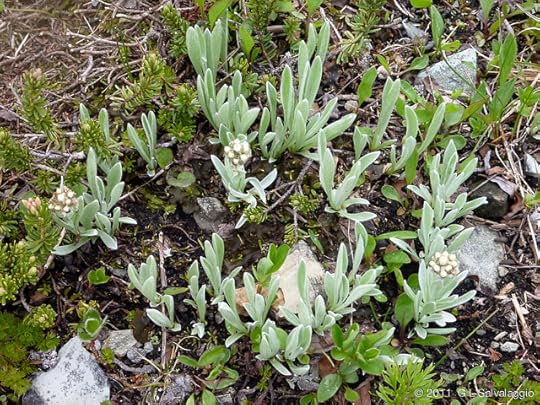
There's a decent glossary. (Not in it: "crevice communities" and "moist depression communities", which sound repulsive but refer to the plant life that grows in the cracks, crevices, and scoured out areas of granite domes.) Best plant names: alpine pussytoes,
A wonderful mix of geology, botany, and narrative, Tom Wessels draws the reader into the beauty of the various places where granite domes can be found. It is accessible for the lay-person with little to no training in geology. A fine read.
I read it in an afternoon, digging into the parts about the basics and blitzing through all the national parks, so I'm a bit of a cheater.
Great explanation of plate tectonics and how plants disperse into an ecosystem. Could not be clearer or more compelling.
Note: I also read one more book in the cabin called "The story of Rocks" by Dorothy Shuttleworth from 1956 and 1966. Good over new of rock types for children.
I have considerable interest in geology, so this travelogue about various regions with granite domes intrigued me. Wessels clearly knows the relevant geology, but his deeper passion seems to be for the plants that grow on or near granite outcrops. Unfortunately, the book has no photographs to help the reader appreciate the plants over which he waxes so rhapsodically. Much of the reading consists of his excitement over seeing this or that plant without visual insight that could be appreciated by the reader. I realize that to include color photographs would have changed both the character and cost of such a book. Accepting that caution, I still wish he had opted for more visual info.
I learned everything I know about Granite from this book. Since I don't know much, I guess that wasn't hard. Wessels makes it interesting and the opening chapter is about a short mountain in Vermont that I've hiked. Since I'm from the midwest, knowing a mountain like that doesn't come along very often in my life. Yup, once again, Wessels does a great job making information accessible to layfolk. I guess he's sort of reminiscent of John McPhee.
Awesome read about the formation of the best examples of granitic landscapes, from original formation through ecological establishment. Favorite section: Primary succession of the abiotic granite surfaces through various stages of lichen and mosses.
really interesting review on the geologic history of granite and how many of the u.s. mountain ranges were formed. fascinating exploration of their ecology



 .
.