Jump to ratings and reviews
Rate this book

Idea Man: A Memoir by the Co-founder of Microsoft

Rate this book
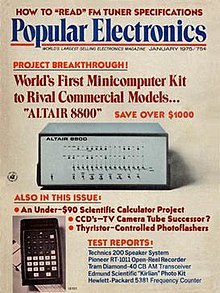
“The entire conversation took five minutes. When it was over, Bill and I looked at each other. It was one thing to talk about writing a language for a microprocessor and another to get the job done….If we’d been older or known better, Bill and I might have been put off by the task in front of us. But we were young and green enough to believe that we just might pull it off.” Paul Allen, best known as the cofounder of Microsoft, has left his mark on numerous fields, from aviation and science to rock ‘n’ roll, professional sports, and philanthropy. His passions and curiosity have transformed the way we live. In 2007 and again in 2008, Time named him one of the hundred most influential people in the world. It all started on a snowy day in December 1974, when he was twenty-one years old. After buying the new issue of Popular Electronics in Harvard Square, Allen ran to show it to his best friend from Seattle, Bill Gates, then a Harvard undergrad. The magazine’s cover story featured the Altair 8800, the first true personal computer; Allen knew that he and Gates had the skills to code a programming language for it. When Gates agreed to collaborate on BASIC for the Altair, one of the most influential partnerships in the digital era was up and running. While much has been written about Microsoft’s early years, Allen has never before told the story from his point of view. Nor has he previously talked about the details of his complex relationship with Gates or his behind-closed-doors perspective on how a struggling start-up became the most powerful technology company in the world. Idea Man is the candid and long-awaited memoir of an intensely private person, a tale of triumphant highs and terrifying lows. After becoming seriously ill with Hodgkin’s lymphoma in 1982, Allen began scaling back his involvement with Microsoft. He recovered and started using his fortune—and his ideas—for a life of adventure and discovery, from the first privately funded spacecraft (SpaceShipOne) to a landmark breakthrough in neuroscience (the Allen Brain Atlas). His eclectic ventures all begin with the same simple question: What should exist? As Allen has written: To me, that’s the most exciting question imaginable….From technology to science to music to art, I’m inspired by those who’ve blurred the boundaries, who’ve looked at the possibilities, and said, “What if…?” In my own work, I’ve tried to anticipate what’s coming over the horizon, to hasten its arrival, and to apply it to people’s lives in a meaningful way…The varied possibilities of the universe have dazzled me since I was a child, and they continue to drive my work, my investments, and my philanthropy.  Idea Man is an astonishing true story of ideas made real.

350 pages, Kindle Edition

First published January 1, 2011

375 people are currently reading
6608 people want to read

About the author

Paul Allen

3 books37 followers
Paul Allen was an American business magnate, investor, and philanthropist. He co-founded Microsoft alongside Bill Gates in 1975. He was the company's chief technologist until he left in 1983.


Librarian's note: There is more than one author in the Goodreads database with this name.

Ratings & Reviews

What do you think?
Rate this book

Friends & Following

Create a free account to discover what your friends think of this book!

Community Reviews

5 stars
1,344 (32%)
4 stars
1,465 (34%)
3 stars
996 (23%)
2 stars
256 (6%)
1 star
136 (3%)
Displaying 1 - 30 of 279 reviews
Profile Image for Mutasim Billah .
112 reviews229 followers
May 30, 2020
“In my experience, each failure contains the seeds of your next success—if you are willing to learn from it.”

It is very difficult to discuss the contents of this book. What's most amazing is how a man can visualize ideas that would shape the world years later. What Gates and Allen achieved with Microsoft is a household story now. To spend hours at a computer terminal, coding for 20 hours straight and praying that the program doesn't screw up. In an interview, Allen said Gates and Allen used to go dumpster-diving outside the laboratory just to find the secret inner codes that made the computer do its thing. Gates would sleep for 18-20 hours and have a container of Tang by his side, he'd wake up and pour some of the orange powder on his palm and lick it off for a pure sugar-high, and get back to work for 2-3 days straight.


Image: The Altair 8800


To pitch the idea of demonstrating software that would allow the Altair 8800 to to work like one of the large bulky machines of that time, despite not having a single of code written was among the single most important gambles in the history of modern technology.

To continue writing of his achievements during those years will need a book in itself. The book chronicles the Eureka moment when GUI (Graphical User Interface) happened, the first time a pointer moved across a computer screen.

The book also chronicles the fiery dynamic between Gates and Allen which involved multiple altercations and at one point, when Allen was diagnosed with Hodgkin lymphoma, that Gates was discussing behind his back of diluting Allen's shares in the company to virtually nothing. This pretty much marked the end of his tenure with Microsoft. Allen was going through radiation therapy at the time and his workload was significantly reduced.


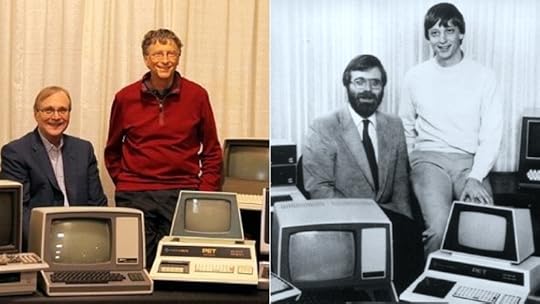
Image: The famous Mircrosoft photo and its recreation


Post-Mircosoft, Allen worked on what he called the "wired world". Concepts such as AoL, broadband Internet, OTT media services and streaming became a reality from these ideas. He also writes fondly of his days as the owner of the Seattle Seahawks and Portland Trailblazers.


But possibly his most fondly written pages were about his contribution to aerospace. Allen was the sole investor behind aerospace engineer and entrepreneur Burt Rutan's SpaceShipOne suborbital commercial spacecraft on October 4, 2004. The craft was developed and flown by Mojave Aerospace Ventures, which was a joint venture between Allen and Rutan's aviation company, Scaled Composites. SpaceShipOne climbed to an altitude of 377,591 feet (115,090 m) over the Mojave Air and Space Port and was the first privately funded effort to successfully put a civilian in suborbital space. It won the Ansari X Prize competition and received the $10 million prize.


SpaceShipOne at the National Air and Space Museum


The book also mentions his contribution to film-making with Vulcan Productions and his contributions to research with Allen Institute for Brain Science. His love for music is also prominently featured in his writing, particularly the time he discovered Hendrix and how playing guitar helped his creative process.


Feel free to read up on the extraordinary life of Paul Allen.

End of review.
Profile Image for Otis  Chandler.
412 reviews116k followers
Want to read
October 22, 2024
Great story about the founding of Microsoft from it's cofounder Paul Allen. I've read a few books about Microsofts history before (such as Gates), but it was fascinating to hear it from the horses mouth.

What stuck out for me was that Paul and Bill were on the cutting edge of software ever since they first saw a computer as teenagers. Malcolm Gladwell in Outliers mentioned the fact that having access to a computer at that time was a huge advantage, and Paul's story confirms that. The world only changes massively so many times, and the age of computing has certainly been one of them - and Paul and Bill were in the right place, at the right time, and with the right drive to succeed.

What was impressive was how Paul and Bill executed like crazy. They had the edge, and they worked really hard, long hours to keep it. It was sad that Paul burned out so early - but also understandable given that Bill had such a strong personality.

Paul prides himself on being a forward thinker. He gives multiple stories of always following the latest technology and trying to look forward and think about what is coming next. Indeed, it's that trait that led to Microsoft being formed as they were certainly at the forefront of the software revolution. In one part of the book Paul even predicts that Mobile is the next big platform and that the PC is dying.

I've always worked at startups, which tend to innovate more than they follow. So it was interesting to hear Allen talking about how Microsoft's strategy went from being on the cutting edge of technology in it's infancy to being a 400 pound gorilla that used a approach of copying innovative products and using it's cash reserves and muscle to out-execute on an idea. I suppose this is what a big company has to do - but it's a hard position to win from. An Microsoft really hasn't had a lot of wins lately. They haven't innovated enough on Hotmail. Bing is nice but not better than Google in any significant ways. And even the high and mighty Internet Explorer is really losing ground to Chrome/Firefox/Safari. Paul is right - you have to look to what is ahead.

Since Microsoft, Paul has certainly stayed busy: owning sports teams, investing in lots of different companies, building a space program, and touring around on his 400 foot yacht. Most of his investments have been in the vein of improving technology and trying to predict the next big things, especially in his particular interests.

I think his brain mapping project and the Digital Aristotle projects stand out - they sound really interesting and important. The appendix lists a few of the current challenges issues with getting a computer to understand human language, which was fascinating. Allen even alludes to the oft-mentioned Singularity, but says that he doesn't think it will occur in our lifetimes, as despite Moore's law advancing computing power fast enough, we are lightyears away with AI.

Some useful tidbits:
- p65 Even Bill Gates wasn't the best at Math in college at Harvard. There are all kinds of smarts!
- Lesson: decentralize or don't distract the ceo: http://www.goodreads.com/quotes/show/...
- It was interesting that Allen said that his biggest mistakes were not finding the right people to help him execute his visions. It's all about people.

Update: my interview with Paul Allen is now live!
Profile Image for Sharon Orlopp.
Author 1 book1,144 followers
February 7, 2023
Paul Allen's memoir, Idea Man, is a fascinating memoir. Paul Allen and Bill Gates were childhood friends who co-founded Microsoft in 1975. Their friendship and working relationship journey was filled with peaks and valleys, including a spectacular rise and fall of a tech startup.

Allen left Microsoft as an employee in 1983 after a HOdgkin lymphoma diagnosis. He was on the Microsoft board and also became a senior strategy advisor to the company.

Allen left a huge impact on the Pacific Northwest as well as the world, particularly in the fields of science, education, environmental sustainability, healthcare and community services.


Profile Image for Richard Guion.
551 reviews55 followers
June 28, 2011
Paul Allen's memoir made me nostalgic for the early days of the computer industry. Finding the love of programming with mainframes like DEC's PDP series, using punched cards with assembly language, long nights in the computer lab. In high school Allen started learning about computers and programming along with his freckle faced buddy, Bill Gates. The story of how they went from programming on timeshared mainframes in Seattle to working on BASIC for the Altair Computer is fascinating. While Gates and Allen were matched technically, when it came to cutthroat business saavy, Gates was ultra competitive. He talked Allen out of his 50-50 ownership of the company, down to a 60-40 split in Gates' favor. The details of Microsoft's early history are fascinating, especially around the deal with IBM to create PC-DOS. I had forgotten there were 2 flavors, PC-DOS and MS-DOS (licensed by Microsoft to other manufacturers which was like a cash machine). There is also some talk about early employees such as Charles Simonyi and Steve Ballmer. I could have read many more chapters about early Microsoft days, but these are cut short after Allen leaves Microsoft in 1982-84 to fight Hodgkin's lymphoma. After Microsoft goes public, the memoir and Allen's life turns into Richie Rich. He buys a basketball team, a football team, starts off countless companies to grab hold of the "Wired World", builds his musuems for Jimi Hendrix and Science Fiction, and hobnobs with celebrities like Bono and Dave Lennox. Strangely enough for a man with an amazing life, apparently there was no girlfriend or significant relationship that he felt like including in the book.
Profile Image for Mik Chernomordikov.
63 reviews223 followers
June 29, 2012
Биографии известных деятелей ИТ-индустрии в последнее время становятся все более популярными. И у этого есть в том числе объективные причины - пионеры индустрии и новых технологий достигают более чем зрелого возраста, а некоторые увы нас покидают. Если вы вдруг не читали биографию Стива Джобса, то очень рекомендую, там по-моему максимально объективно рассмотрены и его достижения, и методы работы, и взаимодействие с сотрудниками, коллегами и конкурентами.

Однако на этот раз мне в руки попала автобиография, где про свою бурную деятельность рассказывает сам автор - Пол Аллен. Пол основал Microsoft вместе с Биллом Гейтсом, до сих пор является одним из крупных акционеров компании, однако десятилетия назад покинул компанию как место работы и попробовал себя в совершенно разных ролях - в том числе владельцем баскетбольного клуба Portland Trail Blazers, футбольных Seattle Sounders и Seattle Seahawks, управлял проектом первого в мире частного полета в космос SpaceShipOne и основал институт мозга. Про все эти важные и видимые части своей жизни Пол и рассказывает в своей автобиографии.

Скажу сразу, что 50% книги написано про создание и работу в Microsoft. Детальное описание знакомства, совместной работы и сложностей взаимодействия с Биллом Гейтсом должно быть интересно каждому, кто любит или ненавидит нашу прекрасную компанию :) Здесь можно узнать, как Пол и Билл сами программировали на перфокартах, придумывали Бейсик для первых компьютеров, задумали вместе с IBM новую операционную систему, параллельно с этим переезжаю в Альбукерк и обратно в Сиэтл, основывая кампус в Редмонде и участвуя в зарождающихся ИТ-тусовках. Интересно было почитать про первое знакомство и дальнейшую работу со Стивом Баллмером и другими современными лидерами индустрии.

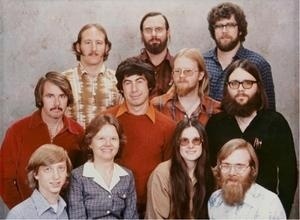
Вообще конечно странно, что сооснователя Apple Стива Возняка знает почти ��аждый, а вот про Пола Аллена многие никогда не слышали. Хотя Пола легко найти на знаменитой фотографии первых сотрудников Microsoft - он на ней справа снизу, тогда еще с бородой


Пол действительно никогда не останавливался. Несмотря на перенесенную серьезную болезнь, чуть не стоившую ему жизни, он активно пошел в новые области деятельности - иногда не только для себя, но и для всего человечества.

Тут и частные полеты в Космос, и продажа билетов через Интернет (ticketmaster долго считал, что никто покупать ничего через сайт вообще не будет), и конечно колоссальная научная работа в деле изучения внутренностей человеческого мозга.

Параллельно с этим Аллен, например, владел четвертью холдинга AOL (America Online), вкладывался в ИТ-стартапы, баскетбольные и футбольные клубы, строительство уникального музыкального музея в центре города.

Мне, как сотруднику Microsoft и временному жителю Сиэтла в прошлом, было особенно близко читать про развитие и компании, и города, и про другие проекты. Мне повезло лично быть и на матче Portland Trail Blazers, и на игре Seattle Sounders (европейский футбол в Сиэтле действительно популярен), и праздновать корпоративный новый год в Experience Music Project.

Это прекрасная книга, которую я рекомендую прочитать всем, кому интересна история ИТ, Интернета и роли личности в новых направлениях человеческого прогресса.

"Альпина" проделала отличную работу по переводу книги на русский язык. Единственной ложкой дегтя стало названия - от оригинального Idea Man почему-то получился миллиардер из Кремниевой Долины, хотя Пол Аллен жил и работал в Сиэтле, который находится в противоположной от Долины части Западного побережья США. Так что не верьте названию - эта книга именно про Аллена, и именно про компанию и жизнь Сиэтла и его окрестностей. Никакой связи с Кремниевой Долиной тут нет, кроме разве что запуска частных космических аппаратов с близлежащей пустыни Мохаве.

Информация о книге доступна на официальном сайте “Альпины”. Купить электронную версию можно например на "Озоне".
Profile Image for Christopher Lewis Kozoriz.
827 reviews272 followers
November 9, 2018
"In my experience, each failure contains the seeds of your next success-if you are willing to learn from it." (Paul Allen, Idea Man, Page 68)

As most of you know, Paul Allen, the co-founder of Microsoft died recently at the age of 65. Therefore, I decided to pull his autobiography from my bookshelf and study this man. Of course, everyone knows the success of Microsoft and this caused Paul Allen to become a mutlibillionaire and one of the richest men in the world.

Paul Allen, was born into a middle class family. His mother loved books and so did he. He was particularly attracted to popular science and read all the issues he could get his hands on. An unknown fact that Paul shares in this book is that Bill Gates was fond of reading Fortune Magazine. He tells of his relationship with Bill Gates and how they both dropped out of school to code and program. They became friends in school when both of them were interested in the potential of computers. Both of their visions was "a computer on every desk and in every home". Their dream is pretty much a reality today as I type this on my Surface Pro 3.

So, after he gained all this wealth, he quit his role in Microsoft (He does mention that Bill Gates was a tough business person and could lose his cool and his days were numbered at Microsoft). He pursued other interests like travelling, cable networks, mobile networks, a building in Seattle to display Jimmi Hendrix memorabilia (Museum of Pop Culture), brain research...

There were some business lessons woven throughout this book and he did make many a mistake with his finances when investing in companies, especially research companies. He had some successes as well like SpaceShipOne, which sent a man to space twice in two weeks. Richard Branson, another well known billionaire apparently licensed this from him, in order to exploit it for marketing purposes.

He said that great wealth did not generally change him that much, it only magnified the person who he was.
Profile Image for Lucas.
332 reviews62 followers
August 30, 2020
Khi tự do nghỉ hưu, Paul làm được nhiều hơn cho bản thân và nhân loại, nhưng không hiểu sao tôi thấy khi làm cho Microsoft, ông mới cống hiến được nhiều hơn. Sáng tạo nên được đặt trong khó khăn và vì một mục tiêu thực tế chăng?
Profile Image for Jean.
1,816 reviews803 followers
June 20, 2016
This is not the history of the Microsoft company but the memoir of Paul Allen one of the founders. The narration is first person and freestyle; he tells it like he saw it.

Apparently Allen had been fighting cancer when he left Microsoft. He continued on the Board of Directors and retained 28% share in the Company. Allen goes over the BASIC programming language that he and Bill Gates developed for the Altair computer. Allen’s major contribution was in developing the tools for building their program. He adapted codes and built the simulator that tested the BASIC without having access to the actual machine. Allen’s contribution to the founding of Microsoft was great but his impact on future Microsoft products was nil.

Allen tells how he failed as a NBA and NFL owner but learned the hard way. He had poor negotiating skills and lost $500 million as owner of the Portland Trailblazers. He lost money in DreamWorks movie studio and lost 8 billion dollars in Charter Communication. Allen chased ideas to predict the future direction of technology via his Vulcan Ventures Investment Company.
Allen’s Sister Jody helped him manage his many ventures and runs the Allan family Foundation. Allen’s philanthropy has stayed mostly in the Seattle area. Allen enjoys playing music, scuba diving and exploring the ocean with his small submarine he keeps on board his yacht. He is now fighting a second bout with cancer and is enjoying his life while he can.

The book is well written and was published in 2011 by Portfolio Penguin and is 358 pages. I read the hard book edition because it has larger print size. There are many pictures included in the book.
Profile Image for Brinton.
44 reviews5 followers
April 29, 2011
This book on paper seems like the perfect match for me:

-My Industry
-My Town
-My High School
-My Sports teams

But the story just didn't satisfy. The backstory of Microsoft is mildly interesting but not detailed enough to really stand on its own. Plus Allen's open contempt for Gates seems a bit overdone; even if he is just being completely honest I'm not sure why he pays Bill so many back-handed complements and outright jabs. What's in it for Paul except a desperate attempt to claim his rightful place in history? It comes off a bit spoiled grapes to me. In my mind Paul Allen already had his place alongside Gates in history - it's not like he was the silent partern of the group who got zero credit. So why complain now about his former partner? Sure it sells more books but he certainly doesn't need the money. As I said he already had the credit he deserved. I think this part of the book was ill-advised.

As for the rest of his adventures and investments I was most intrigued by the Seahawks section being a big fan myself. Other than that there is not much here. Brain mapping is pretty cool.

This should have been titled Paul Allen: Billionaire child and self-proclaimed Idea Man.

Really I have great respect for Allen - just didn't love the book.
Profile Image for Denise Spicer.
Author 16 books70 followers
November 12, 2021
This is an interesting memoir by a Microsoft co-founder. There are lots of details, heavy on computer stuff of course. Also includes lots of sports, music, and space stuff. Not a lot of information on his personal life but some celebrity info. For the general reader too much of these kinds of detail but some will love it. Some photos, Appendix, and Index.
48 reviews
June 18, 2011
I enjoyed parts of this book, other parts I found to be lacking in direction and structure, but, perhaps that was Allen's goal (a free-flowing of his consciousness) it is, after all, partly auto-biographical.

I have to confess I enjoyed the sections with Bill Gates the most. This seems to be an honest, objective approach of Gates (Paul pointed out his talents as well as his flaws).

Paul grew up in a middle-class setting. He was precocious and his parents noticed his innate ability in science and math at an early age. They encouraged him to take a test that would determine admission to a very prestigious private school in Seattle called Lakeside.

Paul didn't want to transfer so he had the intention of doing well in the first section of the test then purposely do poor on the latter section; however, it wasn't designed as he originally thought. The test was only for a very brief time. The first few problems Paul thought were interesting. He worked those with a genuine effort. He was going to slack off later in the test but they called time and his plan didn't work. He was admitted to Lakeside. He admitted, later in life, that a perceived setback can be an opportunity. He also admitted his parents were right. He wouldn't be challenged at his public school as he would at Lakeside.

Paul's assessment of Bill Gates when he they first met was his extraordinary intelligence. I'm going off of memory but he said he noticed 3 qualities about Bill-who was 13 at the time-1)he was (in addition to being brilliant) very persistent; 2) he wanted to show you that he was very smart and 3) he was very competitive. Indeed, later in the book, after Paul left Microsoft and bought a couple of basketball teams, he spoke with Clyde Drexler after a game where Clyde stripped Jordan in the 4th quarter of the NBA Finals. Paul was very impressed but Clyde look dejected. He told Paul he guessed the direction Michael was going and got lucky, he also said most players have 2 to 3 go to moves but Michael has 9. Paul said the two most competitive people he ever met were Michael Jordan and Bill Gates.

I was very impressed with Gates' work ethic. Bill said in a recent interview that he never took one day off in his 20's. Paul seems to confirm that. He said Bill would stay up for days and then he would start leaning his head towards the keyboard and be out for a couple of hours then his head would come up and he wouldn't miss a beat and start programming as if nothing happened.

Paul would be described by the vast majority of objective people as very hard working but he simply didn't compare to Bill. This was ultimately the undoing of their partnership and, as a consequence, their friendship to some degree; however, the friendship was rekindled relatively soon and today they are very close. Paul said no one visited him more in the hospital than Bill.

Bill, on more than one occasion, would ask Paul to go for a walk and then declare he deserves more equity. Paul doesn't like confrontation (Bill, on the other hand, thrives on confrontantion) and he thought about Bill's argument from his perspective and acquiesced. The breaking point came when he overheard Bill and Steve Ballmer discussing diluting Paul because he isn't 1) contributing much and 2) isn’t working very hard.

Bill is the definition of demanding. Paul recounted a story when an employee at Microsoft worked 81 hours in 4 days. Bill proceeded to ask him what he was doing the next day and he responded he was planning to take the day off. Bill was completely taken aback and challenged him about not working.

There is no doubt that Bill and Paul made a great team. Paul was the more (possibly) visionary of the two but there is no question that Bill was unquestionably the business talent behind the partnership. I personally think Bill might be underrated in this area because his business acumen is so acute. When Bill and Paul met at 13, Bill asked Paul what he thought it would be like to run a Fortune 400 company. Paul responded he had no idea. Bill religiously read Forbes and responded, "perhaps one day we'll get our chance."

Paul had several business endeavors after Microsoft but they all seemed like failures to me. Charter was an abject failure; he outspent the Lakers by more than $60 million and his team still lost, there were others as well. Paul simply isn't practical and seems to thrive in the creative aspect but he needs someone to "check him" at certain points. The absence of Gates was certainly felt in his other endeavors.

Paul loves to indulge in other facets of life. He appears to be a decent musician (although I don't have the education/training to make an informed judgment). He is very passionate about space travel, nanotechnology and other fields.

I think about 1/3rd to 1/2 of the book most people in business and computer science would enjoy and the other fraction readers may want to ration their time to skimming and move on to another book.
119 reviews
January 23, 2019
One of the most enjoyable books I have read in a while, I admire Paul Allen a lot after reading this book
Profile Image for Kate Morton.
329 reviews
Read
February 6, 2019
The man was a generous genius. Not the quickest read but a good insight to a man we all wished we knew better.
13 reviews14 followers
February 6, 2019
I thought this memoir was tragic. I'm very glad that Paul Allen had the courage to write this and will try to not screw up in the same way with my tech career.

It is a Shakespearean tragedy in three acts. Let's analyze this with George Valliant's model of adult development (an extension of Erikson's model) which is more flexible. He calls them tasks rather than stages; they're not sequential and happen asynchronously but it's pretty important that they get done eventually.
1) Identity vs Identity Diffusion: To separate from social, economic and ideological dependence on parents.
2) Intimacy: To have some sort of committed, emotionally attached and interdependent relationship with another for 10+ years
3) Career Consolidation vs Role Diffusion: Commitment, compensation, contentment, and competence in work. Having something that gets you up in the morning that you believe in.
4) Generativity vs Stagnation: The wish and capacity to foster and guide the next generation to independence. Mentoring 1:1 or other hands-on paying it forward type stuff. Caregiving.
5) Guardianship vs Hoarding: Taking responsibility for the cultural values and riches we all share in. Caretaking, curation, wisdom.

Act I
Paul has a warm childhood as a precocious gifted kid with parents who go out of their way to support his intellectual adventures and introduce him to people working in STEM. He gets mentored by a bunch of brilliant hackers at private school/university. He meets Bill, they make BASIC for the Altair which is the best work they've ever done. They start MSFT together. Here he achieves 1 since his parents weren't entrepreneurs and 3 since he figures out his career and has the time of his life. He likely does 4 here since there are some junior hires that probably learn a thing or two from working for/with him.

Act II
Paul gets sick and re-evaluates his life and decides it's too short to spend getting into arguments with Bill which sometimes leave him upset for weeks since he isn't much of a callous jerk who thrives on conflict. He does a bunch of billionaire bucket list stuff like buy a yacht with a submarine and a basketball court, buy a bunch of sports teams and hang out with random celebrities he admires. At this point 1 & 3 are probably failing tasks and 2, 4 and 5 are absent. Guy used to work on things that he enjoyed that felt meaningful. Here he's hanging out with random rich people on his giant boat because they’ve got the sense to not set that much money on fire.

Act III
Paul kind of gets his act together and does philanthropy with a small % of his net worth despite knowing that he is going to die and priding himself his entire life on being a far-seeing visionary so a bit of 5. 1&2 are kind of OK. 3 you can make a weak argument he hangs out with his sister. 4/5 I am shocked/disappointed that he didn't work on STEM exposure for children, only college level. Despite his exposure as a child/teen being so key. Really something of a red flag/tragedy.

I feel like he never recovered from Act I and Bill ruining his life.
Profile Image for Tiffany.
1,020 reviews99 followers
January 26, 2019
When I first heard about this book, I think I thought, "Oh, that's nice. The quiet one from Microsoft wrote a book. There are also probably some good thoughts on leadership in it. I'll read it someday." I might have also thought, "And he started EMP... I should know more about him other than Microsoft/EMP/Seahawks. I should read the book." Then I got a job working for a company related to one of Paul Allen's companies and I thought, "Hmmm... I should move that up my to-read list," then felt guilty when I didn't.

Then Paul Allen died. Many of the people I work with met or at least saw Paul Allen at our work, and I was jealous and sad because I was the only one who never got to meet/see him, and now I never would. Over the past few years, we (the public) have learned a lot about his endeavors outside of Microsoft, like The Allen Institute for Brain Science and The Allen Institute for Artificial Intelligence (and when a PBS show about AI spent a lot of time interviewing Allen Institute scientists, I felt pride that the big time was coming to Seattle), and sometimes we'll even hear about his sea explorations discovering sunken ships. But in the memorials and news stories that followed his death, we learned so much more about him. Yes, he was a computer guy who co-started Microsoft, and he owned the Seattle Seahawks and Portland Trailblazers, and started Experience Music Project, which began as a tribute to Jimi Hendrix because Paul Allen played the guitar; but he also funded all that brain research, and the discovery of those ships seems not so much like accidents but targeted searches for war wreckage and recovery, and his computer museum and war planes museum, and money to combat the Ebola crisis, and he didn't just "play" the guitar but was apparently pretty hot stuff...

I knew even before I started reading this that I was going to feel sad reading it, because I never got to meet him and we lost a great thinker, leader, and humanitarian. Sure enough, by the end of page 1, I was sad. But it's such a good book!

Paul Allen talks a LOT about the early days of Microsoft, including his controversial retelling of how things fell apart between him and Bill Gates. He also writes about his philanthropic/save-the-world endeavors, such as the Brain Institute; has quite a bit about his admiration for Jimi Hendrix and the creation of EMP; and touches on a number of his other projects, such as SpaceShipOne and Stratolaunch. Many of the chapters also pose questions about the future of that particular endeavor, almost as if they were to get the next generation going on what to explore and discover.

HOWEVER, the one thing I didn't like was all of the name-dropping. I suppose when you're this rich and know that many people, it might be commonplace, or an honest recounting of his adventures with his friends. But to an outsider nobody, OH MY GOD. I swear, one section is basically this: "So I was hanging out with my good friend Dave Stewart from the Eurythmics, and Paul McCartney was coming over to record his next single, and as I'm sitting in the control room listening to Paul McCartney record his song, I said to Dave Stewart from the Eurythmics, 'Hey, that needs a piano there at the end,' and so a piano was added and that's how the song was released. Yay me." We get it: you know famous people. There were also a couple of times of "Bono this" and "Bono that." Yes, yes. Rich and famous, rubbing elbows with other rich-and-famous. *sigh*

But that's just a minor gripe, and it was still a pretty good book.
Profile Image for Tom Schulte.
3,426 reviews77 followers
September 7, 2021
I really enjoyed this overview of Allen's life from innovative coder and visionary at Microsoft to rock-n-roll fan and scientifically inclined investor. Besides Microsoft, this includes details on the Seattle EMP institution, difficulties in trying to chart a way to a "wired" world in the early cable/internet days, space ventures, and mapping the human brain. Dated a bit and containing a lot of sports entrepreneur bits this culminates in a way with Project Halo including open problems detailed in an appendix.

While this is Allen's memoir, a lot of Bill Gates' apparent character comes across. Rather than a stereotypical nerd, there emerges a thrill-seeking behavior that borders on self-destructive (reckless driving, dangerous sports) and a selfish, inconsiderate sharing of credit and profit. This makes more sensible to me reporting like "Long Before Divorce, Bill Gates Had Reputation for Questionable Behavior" with quotes like "Melinda French Gates voiced concerns about her husband’s relationship with Jeffrey Epstein and a harassment claim against his money manager."
Profile Image for Simon T.
7 reviews1 follower
November 28, 2025
Sheesh, this dude loves to talk about how awesome he is, did some interesting and well timed things (mostly b/c money allows for risk/reward) but 90% wrote a book so he can jerk it to his own greatness — pass on this… I spent my time, please dont spend yours ⚰️
Profile Image for Nasos Kladakis.
67 reviews11 followers
April 6, 2025
One of the best books I read this year! Paul Allen was a great man who left his mark in many areas.
Also his story is a proof that every Paul needs his Bill and vice versa to succeed.
Profile Image for Lanre Dahunsi.
177 reviews16 followers
March 27, 2022
In Idea Man: A Memoir by the Cofounder of Microsoft, Paul Allen describes the early fun days of discovering the personal computer, his love for programming at an early age, meeting Bill Gates at Lake side private school, the origin story of Microsoft, the partnership dynamic between him and Bill.

Idea Man is a great memoir about innovation, vision, partnerships, sacrifice, compromise, conviction, consistency, and the power of self-belief. Lots of lessons learned from pioneering the computer revolution, seizing opportunity, making bold moves, and executing relentlessly. Allen was diagnosed with lymphoma in 2009, leading to a renewed sense of urgency for life and sharing his story. Allen was vulnerable about his successes, failures, dealing with cancer, his thorny roller-coaster relationship with Bill Gates. Idea Man is a must-read for co-founding a tech company.

Bill Gates – Restlessness

The one constant in my life those days was a Harvard undergraduate named Bill Gates, my partner in crime since we’d met at Lakeside School when he was in eighth grade and I was in tenth. Bill and I learned how to dissect computer code together. We’d started one failed business and worked side by side on professional programming jobs while still in our teens. It was Bill who had coaxed me to move to Massachusetts with a plan to quit school and join him at a tech firm. Then he reversed field to return to college. Like me, he seemed restless and ready to try something new.

Voracious Reader

In fifth grade, I read every science book I could find, along with bound issues of Popular Mechanics that were hauled home from the university library, to be devoured ten or twelve at a gulp. The magazines commonly had futuristic cars or robots on the cover. The whole culture back then was charged with schemes and speculation about technology, some of which wound up coming true.

The Power of Timing

As usual, the timing was crucial. If I’d been born five years earlier, I might have lacked the patience as a teenager to put up with batch-processing computers. Had I come around five years later, after time-sharing became institutionalized, I would have missed the opportunities that come from trying something new.

Bill Gates – Persistence, Smart and Competitive

You could tell three things about Bill Gates pretty quickly. He was really smart. He was really competitive; he wanted to show you how smart he was. And he was really, really persistent. After that first time, he kept coming back. Many times he and I would be the only ones there.

Naming Microsoft

Now our partnership needed a name. We considered Allen & Gates, but it sounded too much like a law firm. My next idea: Micro-Soft, for microprocessors and software. While the typography would be in flux over the next year or so (including a brief transition as Micro-Soft), we both knew instantly that the name was right. Micro-Soft was simple and straightforward. It conveyed just what we were about.

Luck

AS I LOOK back at my life, I’d propose that my successes were the product of preparation and hard work. Yes, I was lucky to get early programming opportunities in high school and at C-Cubed; to have a father with the keys to a major library system; to find a partner in Bill who could take my ideas and magnify them; to cross paths with Ed Roberts, who needed to buy what we were able to build, just at the right time.

Running man syndrome

Picture a man running uphill toward a goal. He gets tired and thirsty, but he’ll keep running until management applies a fitness test and winnows out ideas without promise.

I’ve learned that creativity needs tangible goals and hard choices to have a chance to flourish.

Prescience is a double-edged sword. If you’re a little early, you might hit the jackpot with Altair BASIC or Starwave. But if you’re too far ahead of technology or the market, you can wind up with something like Metricom.

Travel through Books

I wasn’t raised as an adventurer. As a child, I traveled through books, the way my mother did. The piles of National Geographic in our basement depicted the larger world out there, but I didn’t envision myself as a globetrotter. Then, as a young man at Microsoft, I simply lacked the time to explore. All that changed when I became ill at twenty-nine.

Profile Image for Scott.
67 reviews4 followers
October 21, 2018
Paul Allen passed away about a week ago and I was a bit surprised at the outpouring of messages and anecdotes in the technical circles I run in, because all I knew of Paul Allen is that he was the cofounder of Microsoft and that he was frequently compared to Steve Wozniak. I didn't even know how long he was or wasn't with Microsoft; just that he had been there in the beginning and that that's where his money came from.

So I decided to read this book to learn more about the man.

"Idea Man" is the perfect title. I was really amazed to see his ideas about a connected world back in the 70s. If Allen had a flaw, it seems to be that he was too far ahead of his time at times. He even acknowledges this when talking about his investments in Charter.

The first half or so of the book covers his years with Bill Gates in various enterprises and the eventual formation of Microsoft. I found Allen's personal story so interesting that when he would talk about Gates, I often found myself thinking "Yeah, that's great, but what about you? Tell me more!"

I don't think this is a book for people who want to know more about Paul Allen, the man. It doesn't talk much about his relationships outside of business and certainly doesn't approach the territory of a sordid "tell-all," whether about Allen, Gates, or anyone else in his social circle -- not that Allen himself seems to have any skeletons in his closet.

It's more of a memoir of what he did and why. Allen comes across as being fairly honest, admitting his own shortcomings multiple times. If I were to nitpick, I'd say that when he, multiple times, says that investments failed because he couldn't find the right management, I have to admit that by the third or fourth time, it started sounding a little like he was pushing the blame down the chain.

The best part of this book was easily just seeing Allen's ideas from 30-40 years ago and marveling at how prescient they were. Even more impressive in a way was seeing his ideas from 20 years ago. It really becomes clear how important timing is (Allen even admits this multiple times, from his own childhood with computers to his entry into cable internet infrastructure) and how much of a moderating influence Gates was in their partnership.

The second half of the book covers Allen's post-Microsoft years and his explorations into his own ideas. Some of them didn't pan out for various reasons, but almost everything anyone's mentioned him doing or accomplishing seems to be mentioned here, so it seems fairly thorough.

The book ends on a slightly sour note of Allen dealing with cancer again; one can only imagine how he felt when the cancer that finally took his life popped up for a third time. It's such a shame too, because he clearly had many more ideas he wanted to explore and share with the world.
Profile Image for Tulip.
188 reviews57 followers
January 28, 2021
Phần đầu đọc thời khởi nghiệp với Bill Gates mà máu chảy rần rần luôn. Phần sau thì nhạt nhẽo.

Cuộc đời Paul có thể chia làm 2 giai đoạn: khởi đầu và tạo lập MS cùng Bill Gates, và giai đoạn sau khi rời MS.

Sau khi rời MS, ông trải nghiệm nhiều thứ hơn, nhưng chẳng để lại thành quả gì, thuần tuý là bỏ rất nhiều tiền ra trải nghiệm thôi. Tuy ông cho rằng cuộc đời ông đã phong phú hơn rất nhiều, nhưng mình cho rằng thật là nhàm chán. Cuộc phiêu lưu lớn nhất của ông đã qua, nhưng vấn đề cũng gần như Woz và Apple vậy, tới những chặng phiêu lưu sau bước chạy đà, thì ông hụt hơi, nấp mình phía sau, không còn là người đứng đầu chiến tuyến nữa (và khi đó thì Gates vừa làm đủ việc, vẫn còn đọc và sửa code tất cả mọi người mãi cho tới khi công ty >80 người).

Nếu như so sánh nửa đời sau của ông nhiều màu nhưng cứ nhờ nhờ, so với thời kỳ ở MS. Tất nhiên, có rất nhiều tiền, sống thoải mái (mua du thuyền cả vạn m2, du lịch khắp nơi, thi thoảng bỏ tiền rủ idol về nhà hát cho nghe,...) thì dễ là vui hơn cái hồi nghèo khổ, cày cuốc rồi stress vkl stress rồi.

Mình nghĩ cuốn sách tương đối thành công trong việc mô tả rõ hình tượng Bill Gates và Paul Allen.

Mình không nghĩ những ý tưởng ở mức sơ khai là cái gì vĩ đại. Có những tương lai rất dễ dự đoán, rất nhiều người dự đoán, nhưng số người sống sót để tạo nên tương lai đó rất ít và họ mới là con người đáng kể. Có hàng tỷ đô la, lại tự hào mình là người có tầm nhìn vượt thời đại, nhưng Paul Allen liên tục thất bại, vậy thì nên đánh giá thế nào?
Profile Image for Jim Razinha.
1,530 reviews90 followers
April 27, 2014
Excellent. I want to adopt him as my eccentric rich uncle and hope he sends a little my way. What does a very wealthy person do when he's no longer driving the technical side of Microsoft? Well, pretty much anything. He lived for himself - Portland Trailblazers and Seattle Seahawks, plus a 414 foot yacht that has a minisub and two helos - and others. Unlike the Koch brothers who only know how to destroy with their wealth, Allen helped so many people, including villages in Africa. Mapping the brain? No problem. Commercial flights into space when the US can't put it's own astronauts up there? No problem. Hodgkin and non-Hodgkin lymphoma? No problem for the first and so far so good on the second.

I liked his candor...he paints Bill Gates fairly as a conqueror, regardless of the cost, but also acknowledges that there is still a friendship after the hurt. Steve Jobs is treated almost as an afterthought. And then the fun starts. I was almost put off by the title, because after Microsoft, what was there in the way of ideas? Well... quite a lot. Allen has vision to spare and he puts his not inconsiderable money in support of those visions, even at losses unimaginable to pretty much all of us, but he persists.

So, I've read Isaacson's bio of the miserable excuse for a human that was Jobs; Woz's autobio (which was as equally low key as Allen's); and this. I suppose something from Gates is next.
26 reviews
May 1, 2014
Interesting memoir from Microsoft co-founder Paul Allen. The chapters in which he discusses the company that made him billions are, predictably, the most interesting, but Allen has been involved in a variety of projects since he left Microsoft in the '80s. His adventures as a pro sports owner (Trailblazers, Seahawks), involvement in private space exploration and funding of genetic brain research, among others, are enjoyable reads, even if they do have a glossed over gee-whiz element to them. Allen is most compelling when discussing the things he can't control, such as his complex relationship with Microsoft and Bill Gates, the time he lost billions in the cable industry, and his struggles with cancer. Those chapters and their honesty make up for some of the overly earnest entries. Allen might not be a emotionally complex and dynamic genius like Steve Jobs, or even Gates, but he deserves more credit for the world we live in than he's given. His intense curiosity for a diverse range of subjects speaks to a deep intelligence and sets him apart from the generation of tech founders he emerged grew up with. He writes just as confidently and knowledgeably about mapping the brain's genes, tackling payload specifications for spaceflight or developing a draft day strategy as he does writing about BASIC and Windows. It's hard to imagine many iconoclasts in his field walking so comfortably in so many different pairs of shoes.
Profile Image for Ethan J.
365 reviews11 followers
August 11, 2019
Sorry, I could not finish.

I respect Paul a lot but his way of writing is just so tedious, unstructured, and undirected. He needs to be a better writer!! I felt it time consuming and wasting to read his writings.

This book would probably make me prefer biography much over autobiography in the future...
Profile Image for Kevin.
29 reviews14 followers
November 28, 2018
First half is a suspenseful story of Microsoft's founding from the perspective of cofounder Paul Allen. Bill Gates ruthless business savvy with Paul's futuristic ideas made a magic combination. I loved listening to the programming constraints for the time and risky business moves like claiming to have a compiler ready for hardware they didn't even have access to.

The second half is about Paul's other diverse life pursuits after Microsoft. The jarring change starts with sports and I couldn't stop thinking, did this billionare retire early to throw all of his money away on overpriced player contracts? I was a little disappointed, especially when you compare to nobler interests like the Bill and Melinda Gates foundation. But he went on to fund a new stadium, invest in music (made me listen to Purple Haze by Jimi Hendrix), internet, space flight and many other things. Paul was a truly fascinating and one of a kind person.
Profile Image for Dan.
29 reviews8 followers
May 9, 2019
What I'd seek most from a biography is how it felt to be that person throughout his life. While we do get glimpses on the early years of Microsoft and how it felt to work with Bill Gates, there is something about autobiographies, that they strive hard to create sympathies to the subject due to first person narrative, and they often fail. This one too fails in that regard, especially after the Microsoft part ends.

While I did enjoy and relate to much of early days young hacker programming experience, what is missing greatly from this autobiography is his non-technical and non-hobbies-related personal relationships as a recluse—I find it hard to believe that there were no issues around that.
125 reviews2 followers
December 8, 2020
Really loved the book for as it replicates the approach of the author in life..being deep into whatever he does be it coding, buying NBA NFL teams, exploring antarctica on a yacht and scuba diving with his submarine.
Amazed on simplicity by which he defines the pivotal events in his life and the thoughts behind them - be it becoming the co founder of microsoft or leaving it, and relationship with bill gates.
5 stars for the content and style of writing

It may not be suited for all audiences, you have to have interests in Engineering, Music and Sports to a deeper level to resonate with Paul.
Profile Image for Piyush Sharma.
17 reviews
February 17, 2023
It's a good book but a few of the chapters are very boring where he talks about his interests in basketball, football, music, etc. But then, since it's his biography so we can't complain much.

I would say that this book has some really nice pieces of information in it and one should give it a read if they are from the technology side.
5 reviews
July 27, 2024
Bill Gates is a very public figure, but I knew less about Paul Allen before reading this book. The book provides details about the pre-Microsoft and early-Microsoft days.

Because of the mom's club, Paul and Bill had access to computers while they were in high school. That was unprecedented at the time. The mothers club leased a teleprinter that was connected to an early mainframe. A small group of geeky students got in the independent study group and taught themselves how to program BASIC. Paul and Bill found it mesmerizing and they soaked it up like sponges. They busted the budget, several times. The "Lakeside kids" were in and out of each other's partnership for the following decades. Bill and Paul established a working relationship from those early days. Paul was more visionary, and Bill was more driven. They complemented each other, but also got on each other's nerves.

They were hired to test an early time-share system, and Paul ended up diving into the OS. Those were the days when the OS source code was part of the delivery, and you could hack (improve) it. The OS was written in machine language, so Paul extended his learning down to the bare hardware. They got access to many different mainframes and mini computers. Paul really liked the PDP-10. Paul frequented UW's computer science lab (those were the days before passwords). Paul was known by the students as someone who could help them understand. One day a professor pulled Paul aside and asked if he were a student. Even though he wasn't, the professor said he could continue to use the lab as long as he helped students.

Paul was a visionary, and followed the work of people like Doug Engebart. Throughout the book he cites predictions he made during interviews that came true, sometime decades later. He was out there.

The book documents the "origin story" of Microsoft, at least from Paul's perspective. They were perfectly positioned for micro computers by their early work in high school, their deep dives into OSs and languages, and their persistent interest in the evolution of small computing. They were waiting for a powerful enough micro computer, which turned out to be the Intel 8080, and they jumped. They developed a BASIC for the 8080. One remarkable thing about the story is the development was accomplished without them having access to an 8080 CPU. They couldn't afford one. Paul wrote an 8080 simulator based on the 8080 CPU specs which ran on a PDP-10. The BASIC worked the first time it hit an actual CPU on a MITS computer. The first test was "PRINT 2 + 2" and the computer printed "4". Eureka moment. Their BASIC was ported to most of the other micro computers of the day, including the Radio Shack TRS-80. MS was becoming the industry giant quickly.

Staying on top was not easy. Piracy was a big problem. Small computers had been mostly a hobby, with hobbyists having a sharing culture. Bill pushed MS to develop OS upgrades (eventually Windows) and many apps. VisiCalc was the first spreadsheet. It ran on the Apple II, and was called the first "killer app" by one of the industry giants - a single app that would drive a computer sale. They were also competing against other apps like WordStar. Paul details many of the business deals, and there were many. In the prior mainframe era, the customer paid for the hardware, and the software was almost free. They were creating the industry for software.

Eventually IBM entered the fray with their IBM PC architecture, which the industry standardized around. Paul details the conversations and licensing details that eventually led to MS DOS becoming the OS for the IBM PC. A few people felt they had been ripped off, and several lawsuits ensued. Eventually MS won and became the default OS for the IBM PC and all its clones. The industry evolved quickly. Some of the pervious giants, like DEC, declined. Paul loved PDP computers, but they went no longer on top. He saw many companies go out of business. They had a great idea that went viral (a term not yet invented), and shortly after were no longer essential.

Bill was the face of Microsoft and drove people hard. Paul had a close call with cancer. Afterwards, the relationship between he and Bill seems to have spiraled down. He did a few more developments like the MS Mouse, which had 2 buttons. Paul and Bill had diverged. He left MS in 1983.

Paul had a great relationship with his parents. His dad was a librarian, and Paul had an addition to the UW library named after him.

Paul was interested in music and basketball. His super yacht had a recording studio, music performance spaces, and a basketball court. He went on to play music with giants and own sports teams.

Paul contributed to SETI and the development of Rutan's SpaceShip One. I followed that development closely, so am familiar with many of the details he provides.

I have always marveled at the influence companies like Microsoft and Apple have on people's lives. Those companies produce tools that we use every day. They become part of the fabric of our lives, and we don't notice them until something breaks. I lived through the era Paul documents, so have the personal historical context to understand the significance of what they accomplished. Paul was a big player in the evolution of the industry that provides those tools. What a life.

I highly recommend this book to everyone.
This entire review has been hidden because of spoilers.
Profile Image for Lenny.
427 reviews6 followers
March 24, 2017
The story of an exceptionally smart guy, who made a lot of money with his friend Bill Gates and then left and went his own way. Being rich enough to buy or do anything you want is an interesting concept.
Displaying 1 - 30 of 279 reviews

Can't find what you're looking for?

Get help and learn more about the design.