Rough and quick sex with a book. That's what it was like.
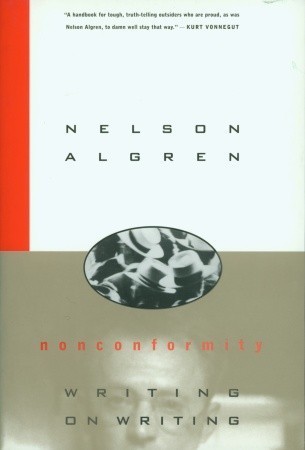
The essay “Nonconformity: Writing on Writing” by Nelson Algren, edited by Daniel Simon, is an engaging, energetic read.
Nelson Algren, an American writer who lived in Chicago and died in 1981, was one of Simone de Beauvior’s lovers. He wrote a first draft of the essay “Nonconformity” while he and Simone were in the process of ending their long distance relationship and he was in the process of reuniting with his former wife, Amanda. Daniel Simon, the force behind bringing “Nonconformity” to light, speculates that Algren wrote the essay to prove to Simone that he was worthy of her, a equal to Simone’s husband, Sartre. Ultimately, Simone and Sartre remained loyal to their marriage in spite of their infidelity to each other.
“Nonconformity” was worked on from 1950 - 1953. Doubleday was scheduled to publish it in 1953, but backed out when Algren was accused of being a McCarthy era Communists. Daniel Simon found the manuscript in Algren’s papers at Ohio State University Library in Columbus in 1986 and after ten years of work, had it published in 1996; Algren used many quotes in the manuscript and did not provide sources; it took time and a great amount of research for Simon, C. S. O’Brien and friends to identify the sources in the endnotes. A more complete explanation of the process that finally brought Algren’s essay to publication is described in the Historical Notes and Acknowledgements section (pp. 98-112).
Algren’s essay is about what in his mind literature should be. It’s about the corruption of the novelist – “. . . tribal pressures toward conformity have been brought to bear so ruthlessly upon men and women seeking to work creatively. . . . the young men and women writing today has forgotten the problems of the human heart in conflict with itself . . .” (p. 4) His essay is a response to the 1940s and 50s and the political pressures put on creative people to produce unrealistic, silly content for movies, TV and books.
In Algren’s essay he calls for rigorous, realistic, intelligent writing that challenges the apolitical, romantic, comedy pabulum Hollywood produced and Joe McCarthy and much of the government supported. He circles and circles around the fear instilled in intellectuals by the House Un-American Activities Committee (HUAC) and its investigations. Algren was well read, he endlessly quotes writers who support his position and gives examples of those who caved into political and social pressures and produced work without substance.
Algren believed novelists should struggle that their goal shouldn’t be comfort; for once reached the inspiration for good writing is lost. He didn’t believe novelists should travel in packs and that they should avoid living in New York in close proximity to other writers; for doing so tames them, causes them to think the same and take safe writing jobs for Life magazine.
Algren’s essay is multi-disciplinary. It reflects the sociology, politics, literature and popular culture of the time. It’s angry, passionate and cynical. Algren fears governmental interference, its goal to control people’s thoughts and actions and turn citizens back into children, with threats of imprisonment. Government as dictator of taste, brain control for the masses.
Algren believes successful writers should have nastiness and honesty, a mind like that of a criminal. “Compassion is all to the good, but vindictiveness is the verity . . . the organic force in every creative effort . . . that gives shape and color to all dreams.” (p. 33) “A certain ruthlessness and a sense of alienation from society is as essential to creative writing as it is to armed robbery.” (p. 34) He quotes Leo Durocher, “. . . Nice guys finish last.” (p. 34) “If you feel you belong to things as they are, you won’t hold up anybody in the alley no matter how hungry you may get. And you won’t write anything that anyone will read a second time either.” (p. 34)
While it is no longer true of some literature, I find this observation about the 1% relevant and poignant: “The stranger from Mars who spent a day in the public library came away knowing that a few Americans possessed wealth that was virtually incalculable, that a hundred-odd million others had more than just enough. But gained barely an inkling into the lives of those who live their hand-to-mouth hours without friendship or love.” (p. 35)
Algren admired Fyodor Dostoevsky and his focus on criminality, the poor and the dispossessed. He quotes from him frequently to support his point about what should be topics for novelists.
Algren has rigorous standards for how people should live their lives. Most do not live up to his expectations: “. . . the spiritual desolation of men and women made incapable of using themselves for anything more satisfying than the promotion of chewing gum . . .” (p. 45)
Excerpts not included in the original essay are inserted between some chapters. The excerpt from Simone de Beauvoir’s “America Day by Day” on pp 52-53, for example, is included to support other references Algren makes to de Beauvoir. Algren met de Beauvoir during her four-month trip around the United States. The excerpt is a description of the Bowery of Chicago, an area of the city Algren showed her.
Algren knows the Bowery well. In the middle of his essay he includes dialogue from Bowery-like characters, “morally corrupt” addicts – cats –scraping together an existence and challenging the desires of cops and squares – the middle class. Some of the dialogue in included in “Entrapment,” a novel Algren never finished. After this section he goes on about the legal system and who is really “guilty” of what? Further demonstrating his identification with the poor.
Algren ends with a rant condemning the American people for their complacency and primary goal: to make enough money to be comfortable. This and government controls are the reasons for hapless novels with unsubstantial narratives.
In the Afterword on pages 81-97, Daniel Simon profiles Algren and analyzes his work and intellect, putting them in context. He also questions why more attention hasn’t been paid Algren’s work. Algren had ten books published. He received the first National Book Award for “Man with the Golden Arm” in 1950, which was his last book to be published. It appears as though the paranoia of the McCarthy Era destroyed his spirit and will to publish.