We sell Rare, out-of-print, uncommon, & used BOOKS, PRINTS, MAPS, DOCUMENTS, AND EPHEMERA. We do not sell ebooks, print on demand, or other reproduced materials. Each item you see here is individually described and imaged. We welcome further inquiries.
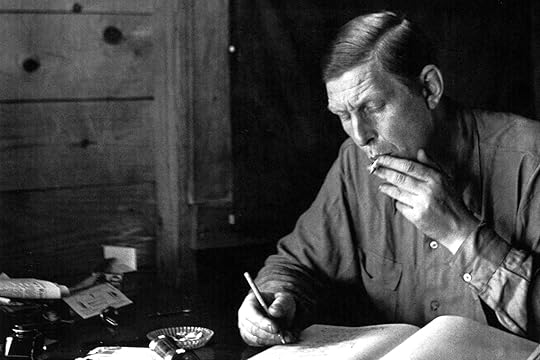
Poems, published in such collections as Look, Stranger! (1936) and The Shield of Achilles (1955), established importance of British-American writer and critic Wystan Hugh Auden in 20th-century literature.
In and near Birmingham, he developed in a professional middle-class family. He attended English independent schools and studied at Christ church, Oxford. From 1927, Auden and Christopher Isherwood maintained a lasting but intermittent sexual friendship despite briefer but more intense relations with other men. Auden passed a few months in Berlin in 1928 and 1929.
He then spent five years from 1930 to 1935, teaching in English schools and then traveled to Iceland and China for books about his journeys. People noted stylistic and technical achievement, engagement with politics, morals, love, and religion, and variety in tone, form and content. He came to wide attention at the age of 23 years in 1930 with his first book, Poems; The Orators followed in 1932.
Three plays in collaboration with Christopher Isherwood in 1935 to 1938 built his reputation in a left-wing politics.
People best know this Anglo for love such as "Funeral Blues," for political and social themes, such as "September 1, 1939," for culture and psychology, such as The Age of Anxiety, and for religion, such as For the Time Being and "Horae Canonicae." In 1939, partly to escape a liberal reputation, Auden moved to the United States. Auden and Christopher Isherwood maintained a lasting but intermittent sexual friendship to 1939. In 1939, Auden fell in lust with Chester Kallman and regarded their relation as a marriage.
From 1941, Auden taught in universities. This relationship ended in 1941, when Chester Kallman refused to accept the faithful relation that Auden demanded, but the two maintained their friendship.
Auden taught in universities through 1945. His work, including the long For the Time Being and The Sea and the Mirror, in the 1940s focused on religious themes. He attained citizenship in 1946.
The title of his long The Age of Anxiety, a popular phrase, described the modern era; it won him the Pulitzer Prize in 1947. From 1947, he wintered in New York and summered in Ischia. From 1947, Auden and Chester Kallman lived in the same house or apartment in a non-sexual relation and often collaborated on opera libretti, such as The Rake's Progress for music of Igor Stravinsky until death of Auden.
Occasional visiting professorships followed in the 1950s. From 1956, he served as professor at Oxford. He wintered in New York and summered in Ischia through 1957. From 1958, he wintered usually in New York and summered in Kirchstetten, Austria.
He served as professor at Oxford to 1961; his popular lectures with students and faculty served as the basis of his prose The Dyer's Hand in 1962.
Auden, a prolific prose essayist, reviewed political, psychological and religious subjects, and worked at various times on documentary films, plays, and other forms of performance. Throughout his controversial and influential career, views on his work ranged from sharply dismissive, treating him as a lesser follower of William Butler Yeats and T.S. Eliot, to strongly affirmative, as claim of Joseph Brodsky of his "greatest mind of the twentieth century."
He wintered in Oxford in 1972/1973 and summered in Kirchstetten, Austria, until the end of his life.
After his death, films, broadcasts, and popular media enabled people to know and ton note much more widely "Funeral Blues," "Musée des Beaux Arts," "Refugee Blues," "The Unknown Citizen," and "September 1, 1939," t
W. H. Auden was born in Britain. He began his higher education journey looking towards engineering, but received recognition for his poetry and changed courses. He became a teacher while he wrote poems, plays, and literary reviews. In 1939, he immigrated to America, became a citizen, and taught at universities. Many of his works are political, religious, and psychological in nature. I found many of them to be genius and true.
Following are poems read and reviewed and a few read but not reviewed. AS I WALKED OUT ONE EVENING
This is a such a true poem. Ouch!
The poet was out walking the city streets one evening, about the crowds - as "fields of harvest wheat," - when he overheard a singer declare that "Love has no ending."
The singer promised to love his "dear" until the impossible occured (like "China and Africa meet") or until "the end of the world."
Then Auden intervenes with a dose of reality..."BUT..." as the clocks chime in.
The clocks called out: "O let not Time deceive you, You cannot conquer Time."
And the clocks together proceed to tell the truth about life and living, aging and growing old. Love doesn't last. We become distracted by our worries and anxieties until we wonder where did life (and love and time) go? Time always wins in the end.
Sometimes life on earth feels worthless and purposeless, even corrupt! (It is!!) And yet, the clocks say (to everyone listening): Face it! Life, though short, is a blessing. You still have to rise up and love your neighbor. You, corrupt as you are, must love your corrupt neighbor.
By the time the clocks were done chiming, the lovers were gone and the river flowed on as before.
THE COMMON LIFE
This was a little difficult at first, but after the second read, it became clearer. It is a poem about relationships or rather roommates living together or just a common space shared between two people, with a spiritual or religious tone. It seeks to tell how two people navigate or exist in the same space. But unfortunately, I did NOT understand the ending:
The ogre will come in any case: so Joyce has warned us. Howbeit, fasting or feasting, we both know this: without the Spirit we die, but life
without the Letter is in the worst of taste, and always, though truth and love can never really differ, when they seem to, the subaltern should be truth.
???
EPITAPH ON A TYRANT
Epitaph on a Tyrant is a short poem written in 1939, the eve of WWII. One thinks of Hitler, though the poem does not say.
Auden describes the kind of society the tyrant is seeking: perfection. His policies to achieve such are straightforward. The tyrant (or dictator) knows human nature is foolishness (easy to fool). Obviously, the dictator is interested in arms and war, probably to spread his ideas and to obtain more power. When he is in high spirits, the government officials laugh with him; but when he is in a tyrannical mood, people suffer at his hands.
THE FALL OF ROME
The Fall of Rome is an interesting poem.
It begins general and broad, about nature and nothing that seemed related to the topic of Rome.
The next several stanzas demonstrate the ways in which a society falls: through tax evasion, mental apathy, sexual perversion (I added the perversion part) -- maybe more like sexual fixation, educated citizens not very intelligent or smart, armies rebelling, government employees discontent.
Then the final two stanzas return back to topics unrelated to the demise of a city. Birds are patiently waiting for the time they may return to the empty city, and reindeer are moving swiftly over a landscape. Obviously, reindeer do not belong in Rome, and it is an indication that this poem isn't only about the fall of Rome, but rather is indicative of many civilizations throughout time. They all seem to follow the same prescription for demise.
IN MEMORY OF SIGMUND FREUD
Auden wrote a personal memorandum about Sigmund Freud after his death in 1939, to the general public. It was the year Hitler invaded Poland, and with this and other world events in mind, Auden brought attention to several of Freud's ideas and his own ideas about poetry.
Auden did not agree with everything Freud wrote about, but he respected him and many of his concepts. He juxtaposed the date of Freud's death with that of the invasion of Poland as polar opposites. Freud's thoughts represented creativity, freedom, and individuality, while the Nazi machine embraced authoritarianism, conformity, and death.
Incidentally, Freud, a Jew, fled Nazi-controlled Vienna to London, where he later died from cancer.
One of my favorite lines is this:
...all he did was to remember like the old and be honest like children.
He wasn't clever at all: he merely told the unhappy Present to recite the Past like a poetry lesson...
This is a really honest and upright poem. I will probably read it a few more times. It's the kind of poem you have to read for yourself because I can't put it into fair words without butchering it.
IN MEMORY OF W. B. YEATS
This is a pleasant poem in memory of the poet W. B. Yeats.
It was frigid winter the day Yeats passed away. Outdoors, nature still did it's thing, but the news spread about Yeats decline. He was surrounded by nurses, and he was losing consciousness. His glorious working mind shut down.
However, his legacy lives on through his readers, throughout the world and generations. Unfortunately, younger generations will interpret his words through their own lens, as they usually do.
Tomorrow, as life goes on, only a few of Yeats fans will remember his death.
Again, this event was the eve of WWII, and misery was magnified. Poetry cannot really effect any change in the world -- there is still darkness everywhere; but poets can create hope, like springtime.
Therefore, Auden makes a last request of Yeats to work his magic with his words, to bring goodness into the world. Lastly, he calls on Yeats' words to heal people.
LULLABY
This was a difficult poem to discern; I needed a little help. Basically, Auden paints a picture of two lovers in each other's arms. He expresses that life and love are fleeting, but lovers should enjoy the moment they have together, even though it will not last forever. Everything transforms -- the whole world changes, childhood is brief, and faithfulness passes away. But the moment is lovely, and we should embrace it nonetheless.
THE MORE LOVING ONE
This poem uses the love of stars to represent unrequited love. Auden recognizes that the stars we admire know nothing about us, nor do they care. And when they appear, we did not miss them. If they disappeared forever, we would get over it eventually. Loving stars is his motif for loving another person who cannot or will not return his love.
Auden's argument is that if he had to choose between the one to receive love verses the one who gave love, he would rather be the more loving one than the one who cannot or will not return love.
ON THE CIRCUIT
In this poem, a writer is controlled by his publishing company and must make the circuits (or go on his pilgrimage) to sell his works. He doesn't like it very well, and his flesh would rather be at home in bed, but he has been conditioned to believe that the people need to hear him/see him in order to sell his writing. So he reluctantly travels via plane from city to city (or holy sites). He doesn't get to know anyone long enough, though they are friendly towards him.
The writer admits he is grouchy and doesn't like to fly because there is never anything good to drink on the plane. He sneaks his own drink on the plane. (Bet you can't do that today!) He says the fancy hotels do not impress him. He'd rather read the Bible.
And finally, seeing the same scene again, incoming rooftops on the ground of a city, another show exactly like the last one, he asks God to bless the people of the USA, a rich country that now he contributes.
SEPTEMBER 1, 1939
Oh, this is such a great poem.
It is the eve of WWII, again, and Auden is hanging out in a NYC bar pondering all that is happening in the world. A madman is threatening war and everyone is quietly minding his own business. Even the City with its facade pretends all is well.
But War is iminent and the writer can feel it, and he knows the people worry, albeit silently to themselves. They rather focus on important things, like themselves.
Look at history: the writer traces the present back to Martin Luther, the Father of the Reformation -- he caused Hitler! (Seriously, let's give Hitler some credit for Hitler.) Hitler was mistreated, and everyone knows bullies typically were bullied themselves.
Look at Thucydides who knew about democracy and its dictators. Dictators lie to the people and talk them out of logic and reason; soon the people become accustomed to oppression. And the cycle repeats itself over and over again.
America pretends to be blameless, but how long will the people fall for it? The people are just as guilty, I suppose. They stick their head in the sand and ignore the truth, focused only on what is important to them.
We really are selfish, and only want what we want, instead of what is best for all people. Out of guilt they promise to be good and do good to others. How can they escape the cycle?
Then the writer exclaims that he has a voice to use to break through the lie that only government has power to solve man's problems. People are not powerless. The State is just a facade. The State is made up of men like us, and we can use our voices to speak up.
The writer knows he has a responsibility to use his voice to speak up and in this way increase hope.
***
I can see how this poem has become popular at different times in history (even right now) as so many people live in uncertainty bc of tyrants and terrorists who threaten war and conflict. Most of us just want to live in peace, but all these events seem out of our hands.
Audent writes that people need to think outside ourselves and help others -- think of what is best for others, instead of only focusing on ourselves. That's called: Helping your neighbor, and that is a good thing. If people were more kind, compassionate, empathetic, and loving, maybe we could prevent the creation of more bullies, especially those who end up in positions of heads of state.
THE SHIELD OF ACHILLES
Again, another poem reflecting war -- in this case, post WWII.
The Shield of Achilles is written from the POV of the goddess Thetis as she oversaw Hephaestus create the armor her son, Achilles, who would carry this with him into the Trojan War. She imagined the images displayed on his shield -- images of beauty and courage and strength and hope; yet, what she saw horrified her. This was a glimpse into the future. Near and far, far future.
Where she hoped to see bounty, she saw barren land, no food, and nowhere to rest. Where she thought she would see religious tradition, she saw men being executed. And no one cared. Where she thought she would see images of feats of strength and courage, she saw abuse and destruction and death.
Images of armies marched to battle, waiting to be told what to do. Girls raped and boys hurting one another carelessly. No one cared about anyone else.
At the very end, Hephaestus walked away from him assignment, despondent, and Thetis could only look into the shield and admit her son was destined to die young.
Although the reader knows he is reading about Achilles' shield, the images are described in modern terminology, demonstrating the hopelessness of battle and war, destruction of land, and the growing selfishness of the human heart. Thetis was able to get a glimpse of the future, and we can look back through history and see that nothing has changed for the better.
THE SHIELD OF ACHILLES HUNTINGTON GARDENS
UNDER WHICH LYRE
In this poem, Auden contrasts two men or two ideologies. The setting is the United State post WWII, but this poem is universal, now that our world is much smaller, and these ideas have spread everywhere.
Using Greek mythology, Auden sets Apollo against Hermes. Both gods represent ideas of men. Apollo is about law and order, an authoritarian and establishment type, and Hermes is more creative and artistic. The conflict is between the education or propaganda of commercialism (in the universities) and the creative freedom of art (truth).
Apollo pushes knowledge, what the universities are now teaching, including the commercial side of art, manufactured passionless art -- propaganda. But Hermes knows that true art (literature, poetry, music, etc.) rejects mediocrity and propaganda and commercialism.
Auden saw the changes post WWII in America, particularly at the higher institutions of learning, and this was his warning to the West.
THE UNKNOWN CITIZEN
The Unknown Citizen is about the perfect model citizen who lived the way he was expected to live, according to society. He served the greater good, worked satisfactorily in the factory, paid his union dues, read the paper, responding to ads as expected (and this was before Google!), paid his insurance, owned all the popular gadgets, and reserved the right opinions at the right times. He had five kids and never complained about their education.
BUT
"Was he free? Was he happy? The question is absurd: Had anything been wrong, we should certainly have heard."
There was no individuality about him. He blended with the masses. Had he been anything else, complaints would have been made, and it would have been known, and this little elegy would have never been written.
Other poems by Auden, read but not reviewed:
~ COMPLINE
~ PROSPERO TO ARIEL
~ A WALK AFTER DARK
* * *
This is the FINAL poet from TWEM poetry section that I am going to read. The remaining poets are called Modernists. There is a suggested list of poets to read from, but I am going to stop here on my WEM poetry journey.
In general, Auden is not to my taste. Maybe it’s the challenge of understanding most of his poems. The ones I do like are shorter, especially the elegiac “Two songs for Hedli Anderson,” of which the first poem was featured in the movie “Four Weddings and a Funeral”:
Stop all the clocks, cut off the telephone Prevent the dog from barking with a juicy bone Silence the piano and with the muffled drum Bring out the coffin, let the mourners come.
Wryly comic, trenchant, and wearily wise - Auden astonished me. Horae Canonicae alone is worth the price of admission ten-fold. Mid-century-modern Christology, but preaches nonetheless.