

What do you think?
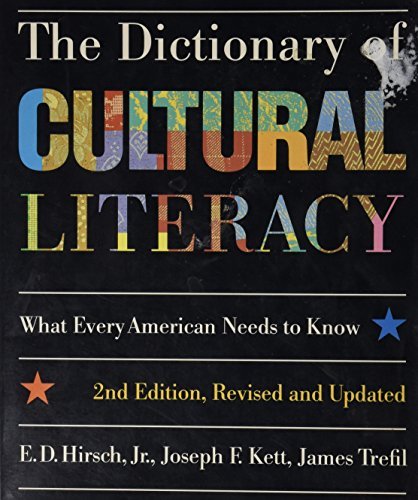
The Dictionary of Cultural Literacy, 2nd Edition, Revised & Updated
A national bestseller, The Dictionary of Cultural Literacy has been widely acclaimed for identifying and defining the core body of knowledge that no literate American should be without. Now in this newly revised and updated edition, the authors provide a comprehensive look at cultural literacy for the nineties. New entries reflect suggestions from hundreds of readers. The dictionary takes into account the growing consensus over the specifics of multiculturalism, the political and geographic changes in the world, and the new ideas and terms that flow constantly from scientific research and technological development. The Dictionary of Cultural Literacy challenges us to find out more about what we know and helps us make sense of what we read, hear, and learn. It is a "must have" book for every home.
619 pages, Paperback
First published September 26, 1988
About the author
E.D. Hirsch Jr.
112 books118 followersE. D. Hirsch, Jr. is the founder and chairman of the Core Knowledge Foundation and professor emeritus of education and humanities at the University of Virginia. He is the author of several acclaimed books on education in which he has persisted as a voice of reason making the case for equality of educational opportunity.
A highly regarded literary critic and professor of English earlier in his career, Dr. Hirsch recalls being “shocked into education reform” while doing research on written composition at a pair of colleges in Virginia. During these studies he observed that a student’s ability to comprehend a passage was determined in part by the relative readability of the text, but even more by the student’s background knowledge.
This research led Dr. Hirsch to develop his concept of cultural literacy—the idea that reading comprehension requires not just formal decoding skills but also wide-ranging background knowledge. In 1986 he founded the Core Knowledge Foundation. A year later he published Cultural Literacy: What Every American Needs to Know, which remained at the top of the New York Times bestseller list for more than six months. His subsequent books include The Schools We Need, The Knowledge Deficit, The Making of Americans, and most recently, How to Educate a Citizen: The Power of Shared Knowledge to Unify a Nation.
In How to Educate a Citizen (September, 2020), E.D. Hirsch continues the conversation he began thirty years ago with his classic bestseller Cultural Literacy, urging America’s public schools, particularly in Preschool – Grade 8, to educate our children using common, coherent and sequenced curricula to help heal and preserve the nation.
A highly regarded literary critic and professor of English earlier in his career, Dr. Hirsch recalls being “shocked into education reform” while doing research on written composition at a pair of colleges in Virginia. During these studies he observed that a student’s ability to comprehend a passage was determined in part by the relative readability of the text, but even more by the student’s background knowledge.
This research led Dr. Hirsch to develop his concept of cultural literacy—the idea that reading comprehension requires not just formal decoding skills but also wide-ranging background knowledge. In 1986 he founded the Core Knowledge Foundation. A year later he published Cultural Literacy: What Every American Needs to Know, which remained at the top of the New York Times bestseller list for more than six months. His subsequent books include The Schools We Need, The Knowledge Deficit, The Making of Americans, and most recently, How to Educate a Citizen: The Power of Shared Knowledge to Unify a Nation.
In How to Educate a Citizen (September, 2020), E.D. Hirsch continues the conversation he began thirty years ago with his classic bestseller Cultural Literacy, urging America’s public schools, particularly in Preschool – Grade 8, to educate our children using common, coherent and sequenced curricula to help heal and preserve the nation.
Ratings & Reviews
Friends & Following
Create a free account to discover what your friends think of this book!
Community Reviews
Displaying 1 - 30 of 33 reviews

May 12, 2015
for a combined review of this and two related books associated with the concept of Cultural Literacy, see https://www.goodreads.com/review/show...
Cultural Literacy
“Cultural Literacy” was a term introduced by E.D. Hirsch in the late 1980s with his book of the same name: Cultural Literacy (1987).
By this term, Hirsch referred to knowledge of a detailed and particular sort, not general knowledge. Here’s an example that illustrates.
Suppose you’re a younger person, or a person from a minority sub-culture (American Indian, inner city migrant, etc) or a not very culturally literate older person, and people you know, or have recently met at a new school or a new job, throw around terms like “reconstruction” (they seem to be talking about something political? that happened in the past); and “moma”, or “the moma” (you’re like huh?; or make a joke about “babe ruth” (a dame? movie star? candy bar?);none of which you really understand. Well, in these instances, because of your ignorance about these terms and names, you are excluded (unless you’re willing to ask) from the conversation, the plans for going to an art museum, the laughter.
So Hirsch propounded this theory about people needing to know a lot of facts, terms, names from an amorphous set of same. That if one knows enough of this stuff they can function in the culture as other people do, but if they don’t know enough they’re excluded from participating, even if they want to.
Hirsch is certainly given credit for the introduction of the term into the social sciences, and it’s generated a large amount of interest, commentary, probably criticism, in the past quarter century, at least in the U.S. And Hirsch himself has remained quite visible in the area, being the founder and chairman of the Core Knowledge Foundation. (Not to be confused with the U.S. “Common Core” initiative in public school education – though obviously there is a close connection between the theories involved in both cases.)
See http://en.wikipedia.org/wiki/E._D._Hi... for Hirsch, and http://en.wikipedia.org/wiki/Cultural... for Cultural Literacy (the term and the area of study in the social sciences).
The review
The subtitle of the book is “What Every American Needs to Know”. Two comments on that.
By the way, the book does have an index, which facilitates looking up the cross reference terms, or just any old name or whatever which a reader might not know. And though that latter function is supplied by the internet nowadays, it really is true that not everyone has access to the internet, at least not all the time like I do.
Cultural Literacy
“Cultural Literacy” was a term introduced by E.D. Hirsch in the late 1980s with his book of the same name: Cultural Literacy (1987).
By this term, Hirsch referred to knowledge of a detailed and particular sort, not general knowledge. Here’s an example that illustrates.
Suppose you’re a younger person, or a person from a minority sub-culture (American Indian, inner city migrant, etc) or a not very culturally literate older person, and people you know, or have recently met at a new school or a new job, throw around terms like “reconstruction” (they seem to be talking about something political? that happened in the past); and “moma”, or “the moma” (you’re like huh?; or make a joke about “babe ruth” (a dame? movie star? candy bar?);none of which you really understand. Well, in these instances, because of your ignorance about these terms and names, you are excluded (unless you’re willing to ask) from the conversation, the plans for going to an art museum, the laughter.
So Hirsch propounded this theory about people needing to know a lot of facts, terms, names from an amorphous set of same. That if one knows enough of this stuff they can function in the culture as other people do, but if they don’t know enough they’re excluded from participating, even if they want to.
Hirsch is certainly given credit for the introduction of the term into the social sciences, and it’s generated a large amount of interest, commentary, probably criticism, in the past quarter century, at least in the U.S. And Hirsch himself has remained quite visible in the area, being the founder and chairman of the Core Knowledge Foundation. (Not to be confused with the U.S. “Common Core” initiative in public school education – though obviously there is a close connection between the theories involved in both cases.)
See http://en.wikipedia.org/wiki/E._D._Hi... for Hirsch, and http://en.wikipedia.org/wiki/Cultural... for Cultural Literacy (the term and the area of study in the social sciences).
The review
The subtitle of the book is “What Every American Needs to Know”. Two comments on that.
1. This book, as well as the other two reviewed here, is very much U.S. oriented. However, it’s fair to add to that comment that Hirsch is not someone who believes that only information about the U.S. is needed by U.S. citizens. There is a large body of knowledge about other nations, other histories, people, art, literature from places other than the U.S. All these things Hirsch believes are needed for participation in American culture.Okay, that said, what’s in this book? It’s divided into 23 chapters, from The Bible to Technology, including such as: Proverbs; Literature in English; World Literature, Philosophy, and Religion; World History since 1550; and Physical Sciences and Mathematics. Each chapter, in turn, has a short introductory essay on why that area of human endeavor/knowledge is important. Then follow an alphabetical list of specific terms and names, each with a brief explanation and cross references. For example, in the chapter on American History to 1865, the entry Douglas, Stephen A. is
2. There is an unstated assumption, clearly indicated by this subtitle, that “every American” needs to participate in the “American culture”. This can certainly be argued about. Why can’t an American citizen opt out of American culture? Does someone doing work with the poor or the homeless in the inner city need to participate in American culture? How about a tribal elder on an Indian reservation? Or a musician fully participating in the African American sub-culture in America? Do all these people need to participate in the “American” culture, which one would suppose is predominantly defined by the groups holding power in America?
A political leader of the nineteenth century, known for twice running against Abraham LINCOLN – for a seat in the SENATE from ILLINOIS in 1858, which he won, and for the presidency in 1860, which he lost. The two engaged in the LINCOLN-DOUGLAS DEBATES over slavery and other issues in 1858.Note that this very brief explanation, while far less informative than the Wiki entry for Douglas, is enough for cultural literacy purposes, especially if the capitalized terms are already known, or looked up if not known.
By the way, the book does have an index, which facilitates looking up the cross reference terms, or just any old name or whatever which a reader might not know. And though that latter function is supplied by the internet nowadays, it really is true that not everyone has access to the internet, at least not all the time like I do.

January 1, 2009
After I graduated from high school I went back and ask my rounded and extremely well-read English teach for advise on where to go from there (getting the information I felt I'd missed along the way). He tentatively suggested this book as a starting point, but strongly cautioned that it has been strongly criticized for telling "Dead White Males" history. I haven't read this cover to cover, but what I have read confirms what he said.
I still have to say that, for what it is, I like this book. For a reference book on "general knowledge" it is very well organized and easy to read. Information is organized well by subject. Topics cover many topics likely to come up in casual or formal conversation, at least in some circles or about some topics. Definitions are relatively brief and to the point, just as with any dictionary; this is not an encyclopedia. I guess it might be useful as a tool to follow conversation at a cocktail party.
My problem with the book is its obvious cultural bias. The definitions aren't deceptive or contorted. This is bias by omission. Setting aside scientific or technical information, the book definitely feels like it was written for white, suburban upper middle class Americans that don't want to be caught not being able to follow a conversation or have something to say. Hence the title: cultural literacy. It's Shakespeare for people that don't actually want to read Shakespeare, but just want to know the bare bones details to "pass" in society. Perhaps you can call it a Cliff Notes for Western culture. The literacy is the culprit here; unless it is meant tongue in cheek (and it's not) it implies that this is more or less the education that makes the rounded man, a man of letters. The title makes the implicit argument. Once again, it's not a matter of the information being incorrect or unimportant. The problem is that this information is packaged and presented to people who want to be "culturally literate," but culture is majority culture - dead white American, formally educated, upper middle class men of letters.
I still have to say that, for what it is, I like this book. For a reference book on "general knowledge" it is very well organized and easy to read. Information is organized well by subject. Topics cover many topics likely to come up in casual or formal conversation, at least in some circles or about some topics. Definitions are relatively brief and to the point, just as with any dictionary; this is not an encyclopedia. I guess it might be useful as a tool to follow conversation at a cocktail party.
My problem with the book is its obvious cultural bias. The definitions aren't deceptive or contorted. This is bias by omission. Setting aside scientific or technical information, the book definitely feels like it was written for white, suburban upper middle class Americans that don't want to be caught not being able to follow a conversation or have something to say. Hence the title: cultural literacy. It's Shakespeare for people that don't actually want to read Shakespeare, but just want to know the bare bones details to "pass" in society. Perhaps you can call it a Cliff Notes for Western culture. The literacy is the culprit here; unless it is meant tongue in cheek (and it's not) it implies that this is more or less the education that makes the rounded man, a man of letters. The title makes the implicit argument. Once again, it's not a matter of the information being incorrect or unimportant. The problem is that this information is packaged and presented to people who want to be "culturally literate," but culture is majority culture - dead white American, formally educated, upper middle class men of letters.
Read
November 17, 2008No bathroom is complete without it.

December 23, 2015
The The Dictionary of Cultural Literacy is an excellent place to start if you're looking to brush up on some now-rusty knowledge that you picked up in high school and college. It's like the Cliff Notes for Western Culture, covering genres such as Mythology, Philosophy, Literature, History, Politics, Geography, Economics, Sciences, and Technology. The chapters make the entries within easily accessible, and you can use it as a reference book only, if you choose.
I read the book straight through to get an idea of where all the gaps in my knowledge are. I was pleasantly surprised to realize that most everything was at least familiar to me, and I credit my teachers for that. I made notes on people, things, and events that either intrigued or confused me, so that I could follow up with later research elsewhere, as the entries in the book were necessarily short. As said, this book is a good starting point- not an ending point.
I read the book straight through to get an idea of where all the gaps in my knowledge are. I was pleasantly surprised to realize that most everything was at least familiar to me, and I credit my teachers for that. I made notes on people, things, and events that either intrigued or confused me, so that I could follow up with later research elsewhere, as the entries in the book were necessarily short. As said, this book is a good starting point- not an ending point.

January 3, 2021
This is the 2nd ed, published in 1993, and is what I had on hand after owning it for years.
It has some serious problems, only the first of which is that it is outdated. Perhaps a newer edition would be better, but I suspect only on that count.
Its editors lay out their intent in the Introduction and The Theory Behind the Dictionary and, oh boy, is it nationalistic, paternalistic, white-centered, .... I could go on but, to say the least, the intent, much less the execution, is highly problematic.
The execution is also flawed. They frequently fail to understand the act or purpose of a definition. And they are also simply bad at it.
It has some serious problems, only the first of which is that it is outdated. Perhaps a newer edition would be better, but I suspect only on that count.
Its editors lay out their intent in the Introduction and The Theory Behind the Dictionary and, oh boy, is it nationalistic, paternalistic, white-centered, .... I could go on but, to say the least, the intent, much less the execution, is highly problematic.
The execution is also flawed. They frequently fail to understand the act or purpose of a definition. And they are also simply bad at it.

February 11, 2024
“Dictionary of Cultural Literacy: What Every American Needs to Know” by E. D. Hirsch, Jr.; Joseph F Kett, James Trefil
BIBLIOGRAPHIC DETAILS:
*Print: COPYRIGHT: 1988; ISBN 0395437482; PUBLISHER: Houghton Mifflin Company; PAGES: 586; Unabridged (Hardcover info from hardcover print copy.)
-Digital: COPYRIGHT: 7/2006; PUBLISHER: Harper-Collins eBooks; ISBN 9780061760907; PAGES 400; Unabridged (Kindle edition info from Amazon.com and Libby app version from LAPL)
-Audio: COPYRIGHT: 1/20/2005; PUBLISHER: Books in Motion; DURATION: 6:16:00; Unabridged (Audio info from Amazon.com)
-Feature Film or tv: No
SERIES: N/A
SUMMARY/ EVALUATION:
-SELECTED: I saw this at the Newport Beach Public Library used book sale, and was thrilled to think I might get to learn what every American should know about The Bible; Mythology and Folklore; Proverbs; Idioms World Literature, Philosophy, Religion; Literature in English; Conventions of Written English; Fine Arts; World History to 1550; World History since 1550; American History to 1865; American History since 1865; World Politics; World Geography; Anthropology, Psychology, and Sociology; Business and Economics; Physical Sciences and Mathematics; Earth Sciences; Life Sciences; Medicine and Health; & Technology. Of course, for me, being exposed to, and retaining all that information is not the same thing.
-ABOUT: The book contains approximately 5,000 terms related to the above topics.
-OVERALL: It was a bit dry reading, so hard to get more than a few pages read at one time, but it was fun. Since this version is 1988 though, it’s out of date. It would be useful if writing a historical fiction book to be reminded that a CRT (cathode ray tube) was in your television and computer monitors. Some day maybe I’ll read a current one, but since it took more that a couple of years to get through this one, that won’t be any time soon….maybe the audio version would go faster.
AUTHOR:
E. D. Hirsch, Jr.: (Excerpt from Wikipedia)
“Eric "E. D." Donald Hirsch Jr. /hɜːrʃ/ (born March 22 1928) is an American educator, literary critic, and theorist of education.[1] He is professor emeritus of humanities at the University of Virginia.[HirschPublications 1]
Hirsch is best known for his 1987 book Cultural Literacy, which was a national best-seller and a catalyst for the standards movement in American education.[2] Cultural Literacy included a list of approximately 5,000 "names, phrases, dates, and concepts every American should know" in order to be "culturally literate."[3][4] Hirsch's arguments for cultural literacy and the contents of the list were controversial and widely debated in the late 1980s and early '90s.[5]
Hirsch is the founder and chairman of the non-profit Core Knowledge Foundation, which publishes and periodically updates the Core Knowledge Sequence, a set of unusually detailed curriculum guidelines for Pre-K through 8th grade.
In 1991, Hirsch and the Core Knowledge Foundation put out What Your First Grader Needs to Know, the first volume in what is popularly known as "the Core Knowledge Series."[6] Additional volumes followed, as did revised editions. The series now begins with What Your Preschooler Needs to Know and ends with What Your Sixth Grader Needs to Know. The "series" books are based on the curriculum guidelines in the Core Knowledge Sequence. The books are used in Core Knowledge schools and other elementary schools. However, they have also been popular with homeschooling parents.
Before turning to education, Hirsch wrote on English literature and theory of interpretation (hermeneutics). His book Validity in Interpretation (1967) is considered an important contribution to hermeneutics.[7] In it, Hirsch argues for intentionalism—the idea that the reader's goal should be to recover the author's meaning.[8][9]”
AUTHOR:
Joseph F Kett: (Excerpt from Wikitia)
"Joseph F. Kett (born March 11, 1938) is an American historian."
"Kett completed his bachelor's degree in history at Holy Cross University in 1959; his masters degree in history at Harvard University in 1960; and his PhD in history at Harvard University in 1964.[1]"
"He is the James Madison professor emeritus of history at the Corcoran Department of History of the University of Virginia.[1]"
AUTHOR:
James Trefil: (Excerpt from Wikipedia)
“James Stanley Trefil (born September 10, 1938) is an American physicist (Ph.D. in physics at Stanford University in 1966) and author of nearly fifty books. Much of his published work focuses on science for the general audience. He has served as Professor of Physics at the University of Virginia and, since 1988, as Robinson Professor of Physics at George Mason University. Among his books is Are We Unique?, an argument for human uniqueness in which he questions the comparisons between human intelligence and artificial intelligence. Trefil has also given presentations to judges and public officials about the intersections between science and the law.”
GENRE:
Nonfiction; Dictionary
SUBJECTS:
United States; Civilization; Dictionaries; English Language
TIME FRAME:
Contemporary (1988)
DEDICATION:
None
EXCERPT: “The Theory Behind the Dictionary”
"The conceptions that underlie this dictionary are outlined in my book Cultural Literacy, published in 1987. But in fact, the dictionary project was begun before I thought of writing a separate book, and the book itself was first conceived merely as a technical explanation of the ideas that led us to undertake the dictionary. The scope of the book outgrew that aim, but no one even considered the possibility that the book would become a a best-seller or that it would be read outside the field of education. Although it did become a best-seller and its ideas have been widely discussed, many users of this dictionary may not be familiar with the concept of cultural literacy. So here, in brief compass, is why this project was undertaken, and why we hope it will help improve American public education and public discourse.
One good way of explaining the cultural literacy project might well be to list the points of strong agreement that have appeared in reviews of the book and in the hundreds of letters I have received from teachers and nonteachers alike. All these reviews and letters endorse the proposition that achieving high universal literacy out to be a primary focus of educational reform in this country. They all accept the evidence that our national literacy had been declining since 1965, not only among disadvantaged children but also among our top students. They agree that the decline has occurred at a time when truly functional literacy is becoming ever more important to our economic well-being. And they have usually stressed the idea that providing everyone with a high level of literacy is important in holding together the social fabric of the nation.”
RATING:
5 stars
STARTED READING – FINISHED READING
10/3/2021 to 2/10/2024
BIBLIOGRAPHIC DETAILS:
*Print: COPYRIGHT: 1988; ISBN 0395437482; PUBLISHER: Houghton Mifflin Company; PAGES: 586; Unabridged (Hardcover info from hardcover print copy.)
-Digital: COPYRIGHT: 7/2006; PUBLISHER: Harper-Collins eBooks; ISBN 9780061760907; PAGES 400; Unabridged (Kindle edition info from Amazon.com and Libby app version from LAPL)
-Audio: COPYRIGHT: 1/20/2005; PUBLISHER: Books in Motion; DURATION: 6:16:00; Unabridged (Audio info from Amazon.com)
-Feature Film or tv: No
SERIES: N/A
SUMMARY/ EVALUATION:
-SELECTED: I saw this at the Newport Beach Public Library used book sale, and was thrilled to think I might get to learn what every American should know about The Bible; Mythology and Folklore; Proverbs; Idioms World Literature, Philosophy, Religion; Literature in English; Conventions of Written English; Fine Arts; World History to 1550; World History since 1550; American History to 1865; American History since 1865; World Politics; World Geography; Anthropology, Psychology, and Sociology; Business and Economics; Physical Sciences and Mathematics; Earth Sciences; Life Sciences; Medicine and Health; & Technology. Of course, for me, being exposed to, and retaining all that information is not the same thing.
-ABOUT: The book contains approximately 5,000 terms related to the above topics.
-OVERALL: It was a bit dry reading, so hard to get more than a few pages read at one time, but it was fun. Since this version is 1988 though, it’s out of date. It would be useful if writing a historical fiction book to be reminded that a CRT (cathode ray tube) was in your television and computer monitors. Some day maybe I’ll read a current one, but since it took more that a couple of years to get through this one, that won’t be any time soon….maybe the audio version would go faster.
AUTHOR:
E. D. Hirsch, Jr.: (Excerpt from Wikipedia)
“Eric "E. D." Donald Hirsch Jr. /hɜːrʃ/ (born March 22 1928) is an American educator, literary critic, and theorist of education.[1] He is professor emeritus of humanities at the University of Virginia.[HirschPublications 1]
Hirsch is best known for his 1987 book Cultural Literacy, which was a national best-seller and a catalyst for the standards movement in American education.[2] Cultural Literacy included a list of approximately 5,000 "names, phrases, dates, and concepts every American should know" in order to be "culturally literate."[3][4] Hirsch's arguments for cultural literacy and the contents of the list were controversial and widely debated in the late 1980s and early '90s.[5]
Hirsch is the founder and chairman of the non-profit Core Knowledge Foundation, which publishes and periodically updates the Core Knowledge Sequence, a set of unusually detailed curriculum guidelines for Pre-K through 8th grade.
In 1991, Hirsch and the Core Knowledge Foundation put out What Your First Grader Needs to Know, the first volume in what is popularly known as "the Core Knowledge Series."[6] Additional volumes followed, as did revised editions. The series now begins with What Your Preschooler Needs to Know and ends with What Your Sixth Grader Needs to Know. The "series" books are based on the curriculum guidelines in the Core Knowledge Sequence. The books are used in Core Knowledge schools and other elementary schools. However, they have also been popular with homeschooling parents.
Before turning to education, Hirsch wrote on English literature and theory of interpretation (hermeneutics). His book Validity in Interpretation (1967) is considered an important contribution to hermeneutics.[7] In it, Hirsch argues for intentionalism—the idea that the reader's goal should be to recover the author's meaning.[8][9]”
AUTHOR:
Joseph F Kett: (Excerpt from Wikitia)
"Joseph F. Kett (born March 11, 1938) is an American historian."
"Kett completed his bachelor's degree in history at Holy Cross University in 1959; his masters degree in history at Harvard University in 1960; and his PhD in history at Harvard University in 1964.[1]"
"He is the James Madison professor emeritus of history at the Corcoran Department of History of the University of Virginia.[1]"
AUTHOR:
James Trefil: (Excerpt from Wikipedia)
“James Stanley Trefil (born September 10, 1938) is an American physicist (Ph.D. in physics at Stanford University in 1966) and author of nearly fifty books. Much of his published work focuses on science for the general audience. He has served as Professor of Physics at the University of Virginia and, since 1988, as Robinson Professor of Physics at George Mason University. Among his books is Are We Unique?, an argument for human uniqueness in which he questions the comparisons between human intelligence and artificial intelligence. Trefil has also given presentations to judges and public officials about the intersections between science and the law.”
GENRE:
Nonfiction; Dictionary
SUBJECTS:
United States; Civilization; Dictionaries; English Language
TIME FRAME:
Contemporary (1988)
DEDICATION:
None
EXCERPT: “The Theory Behind the Dictionary”
"The conceptions that underlie this dictionary are outlined in my book Cultural Literacy, published in 1987. But in fact, the dictionary project was begun before I thought of writing a separate book, and the book itself was first conceived merely as a technical explanation of the ideas that led us to undertake the dictionary. The scope of the book outgrew that aim, but no one even considered the possibility that the book would become a a best-seller or that it would be read outside the field of education. Although it did become a best-seller and its ideas have been widely discussed, many users of this dictionary may not be familiar with the concept of cultural literacy. So here, in brief compass, is why this project was undertaken, and why we hope it will help improve American public education and public discourse.
One good way of explaining the cultural literacy project might well be to list the points of strong agreement that have appeared in reviews of the book and in the hundreds of letters I have received from teachers and nonteachers alike. All these reviews and letters endorse the proposition that achieving high universal literacy out to be a primary focus of educational reform in this country. They all accept the evidence that our national literacy had been declining since 1965, not only among disadvantaged children but also among our top students. They agree that the decline has occurred at a time when truly functional literacy is becoming ever more important to our economic well-being. And they have usually stressed the idea that providing everyone with a high level of literacy is important in holding together the social fabric of the nation.”
RATING:
5 stars
STARTED READING – FINISHED READING
10/3/2021 to 2/10/2024

June 20, 2019
I love this book. I think this needs to be on every family's shelf. I actually use this to study for my language arts and social studies endorsements. I found it very helpful, and passed the first time around on both tests. Beyond that, it contains a plethora of information essential to being culturally literate, super important in my field, helpful in social situations. It's it's on our coffee table, and I pick it up from time to time and read a section.

October 7, 2017
I have owned this reference title for decades and still love to peruse this volume occasionally.
March 5, 2016
The Dictionary of Cultural Literacy does a great job of defining the knowledge of “What Every American Needs to Know”, as the subtitle suggests. It teaches us about the ideas and people that shape our culture. Hirsch explains cultural literacy as falling between the lines of specialized and generalized. Specialized means specific topics, and generalized means widespread, well known topics.
The average person has a memory of about 15 years, that is why the information in this book dates back to 15 years ago. Since things are always changing because new things are being discovered, Hirsch wrote this book in hopes that his readers would continue expanding and writing new information as time goes on.
Hirsch explains that the human race is expected to know certain things. You are told to go through life not questioning these things, so the author wants to explain the background information of certain phrases and words so people are well aware. Knowing these things will build on our culture and expand it.
I gave this book 4 stars because it is not a book that will collect dust on your bookshelf, it is a book that you will reference again and again for new ideas.

October 15, 2015
I love to dive into Culture and what it means and how it affects people. I had never really thought much previously about Cultural Literacy. I think Hirsch says it best himself, "Community is built up of shared knowledge and values -- the same shared knowledge that is taken for granted when we read a book or newspaper, and that is also taken for granted as part of the fabric that connects us to one another."
As I read the book I became more and more aware that part of what disconnects me with others is when there isn't much overlap in Cultural Literacy. I find this often when working in a diverse environment where co-workers are from another country. I am sure this book will piss many people off in it's thoughts about how to go about teaching Cultural Literacy, but there is little denying the power of a shared language/culture.
If you are wanting to find good books to read or topics to engage in to broaden your ability to connect this sucker is full of them.
As I read the book I became more and more aware that part of what disconnects me with others is when there isn't much overlap in Cultural Literacy. I find this often when working in a diverse environment where co-workers are from another country. I am sure this book will piss many people off in it's thoughts about how to go about teaching Cultural Literacy, but there is little denying the power of a shared language/culture.
If you are wanting to find good books to read or topics to engage in to broaden your ability to connect this sucker is full of them.
February 19, 2013
LOVED this book!!!!!!!!!!! I remember using it as a great jumping-off point for all kinds of writings and research projects, pre Internet
The info it gives are only short blurbs, but they were so useful, pertinent, and about things of which I knew nothing. How sad to me that the power of the web may have rendered such a book obsolete. I still enjoy paper in my hand, pages to turn ... I never want a Kindle. Just like actual books too much.
The info it gives are only short blurbs, but they were so useful, pertinent, and about things of which I knew nothing. How sad to me that the power of the web may have rendered such a book obsolete. I still enjoy paper in my hand, pages to turn ... I never want a Kindle. Just like actual books too much.

November 21, 2011
I will be slowly reading this book forever. I just leave it by my chair and get it every so often.
2/11/12 past the bible and mythology sections.
This is a great book. It is a small study of our culture thru literature. I'm not really "finished" I find myself referring to it but I wanted to get it off my "reading" shelf.
2/11/12 past the bible and mythology sections.
This is a great book. It is a small study of our culture thru literature. I'm not really "finished" I find myself referring to it but I wanted to get it off my "reading" shelf.

August 1, 2013
Title gives the subject matter: Entries are based on an assessment of what "Americans" should know to follow literate discourse.
Entries are concise, sometimes too much so as some of the ideas are not explained well. Still, it was interesting to read this book from cover to cover over a period of several months.
Entries are concise, sometimes too much so as some of the ideas are not explained well. Still, it was interesting to read this book from cover to cover over a period of several months.
May 27, 2015
You don't exactly "read" this book in the same sense as some, but I've gone through it multiple times as I've grown up. It's a great mix of relevant content in tiny, bite-sized pieces. An excellent resource to help develop your overall knowledge and to serve as a jumping-off place to dive into topics of interest in more detail.

March 21, 2007
Best book to keep by your bed.
Read
October 12, 2007This is paperback in very good condition.

October 29, 2007
My family and I call this "the book," (ie: "Let's play The Book game!") Like the BOM, every home should have a copy....and then you'll want all your friends to have one, too.

January 9, 2008
Everybody should read this once and keep it around forever and then read it to your children and grandchildren

April 23, 2008
Bought this book 20 years ago, and still refer to it. I believe they have updated editions now.

Read
May 29, 2008Remember days of flipping through pages of this book with my sisters back in grade school.

Read
January 15, 2010trivia
Read
April 28, 2011Everyone needs this.

May 5, 2011
Kind of an encyclopedia of all kinds of subjects. All the things we should have learned in school at some point.
I'm a knowledge junkie, and this was an enjoyable read.
I'm a knowledge junkie, and this was an enjoyable read.

March 17, 2012
This is more a reference book vs. a cover-to-cover read. I'm keeping it in my classroom. Had fun w/ idioms section and the students.

August 17, 2012
Companion piece to Hirsch's book on Cultural Literacy. This is an excellent reference book for anyone who wants to be "a part of Western civilization"

Read
February 8, 2015I read this many years ago and really liked it. Thought I would skim through it again for some inspiration.


Want to Read
December 30, 2016I registered a book at BookCrossing.com!
http://www.BookCrossing.com/journal/14341322
http://www.BookCrossing.com/journal/14341322
Want to Read
April 4, 20247 slegte

May 16, 2011
This is a great teaching tool in my class room!
Displaying 1 - 30 of 33 reviews