Journalist, ecologist, conservationist & bestselling novelist Frank Herbert captured the imagination of entire generations. Novels like The Dosadi Experiment & The White Plague explored science's effect on society. The Green Brain & The Dragon in the Sea introduced Herbert's main how societies & individuals respond to changing or threatening environments. In Dune, winner of both Hugo & Nebula awards, he expanded this theme to create a series that has fascinated more readers than any other contemporary work of the imagination. Among his other works were The Eyes of Heisenberg; Santaroga Barrier; Whipping Star; Project 40; Threshold; five additional novels in the Dune series & two anthologies of short fiction.Eye features the startlingly original collaboration "The Road to Dune," a walking tour of Arakeen narrated by Frank Herbert & illustrated by acclaimed British artist Jim Burns. Also included is an introduction by Herbert describing his personal feelings about the filming of David Lynch's movie version of Dune; Herbert's own favorite short story, "Seed Stock"; & tales from throughout his career, some never before collected.
Franklin Patrick Herbert Jr. was an American science fiction author best known for the 1965 novel Dune and its five sequels. Though he became famous for his novels, he also wrote short stories and worked as a newspaper journalist, photographer, book reviewer, ecological consultant, and lecturer. The Dune saga, set in the distant future, and taking place over millennia, explores complex themes, such as the long-term survival of the human species, human evolution, planetary science and ecology, and the intersection of religion, politics, economics and power in a future where humanity has long since developed interstellar travel and settled many thousands of worlds. Dune is the best-selling science fiction novel of all time, and the entire series is considered to be among the classics of the genre.
I'm reading Frank Herbert's only short story collection for the second time simply because I feel like I may have given it too little credit back in the day.
How, you ask? Because despite having a picture of a Fremen on the cover, there is VERY LITTLE in here that represents Dune. I was obsessed, as I remain obsessed, about Dune, so the first few stories that were so/so and the excerpt from Dragon in the Sea DID make me a little annoyed. You know, fanboys want fanatical stuff to chew on.
Fortunately, the intro has a very cool insight into the making of Lynch's movie and Herbert's reaction to it. (Believe it or not, he was pretty cool with the changes, having bought-in to the industry's reasons for so much, but he really held out hopes for turning it into a mini-series. And I do, too.)
BUT, here's the really cool bit. A handful of these stories are better than just okay. A few are freaking amazing.
My personal favorite is Try to Remember.
For anyone who has seen Arrival or read Ted Chiang's story, they might point to Frank Herbert's much earlier story and go, HEY! THAT'S!!! but then settle down and see how they both diverge in different, but no less awesome, directions. It's now one of my favorite SF short stories. :)
Seed Stock happens to be Frank's own favorite story -- and for great reason. It is a wild future with some impressively creative quantum physics effects coupled with great action and better special effects. On a personal note, I can't help but try to fit it into Herbert's extensive worldbuilding and future history, thinking of the first time someone might have jumped across spacetime. The Heisenburg Effect. But either way, this story would fit just fine in any new SF movie with a big effects budget. :)
I think about 5 of the stories in the collection justifies all of them. Just don't expect a ton about Dune. :)
Frank Herbert writing talent shines like supernova and even the shortest, just several pages long (or 12 minutes long in audio version) novella or longer short stories creates whole worlds. Fantastic talent indeed. My favorite? ALL OF THEM.
Interesting. My favorite part of this book of short stories is the introduction. The introduction is mostly focused on the movie version of Dune. I'm not a huge fan of the movie. In fact I did not read the novel until university primarily because of the movie. A friend of mine advised me to read the novel and wow was I surprised. Still I found the introduction significant. For many reasons. One he kind of explains what his purpose was in creating Paul and the storyline of the original novel. Also he clearly explains that his novels are a contract with intelligent readers and he has an abhorrence of spoon feeding fans, he finds it demeaning and manipulative. I often wondered how he would feel about how his son and KJA have altered his universe. I don't think he would be pleased at all. The novels themselves are a form of sell out, they are written not because they have anything to say but inorder to milk an award wining franchise. This is especially painful considering how the prequel "McDune" novels have suggested the original canon was manipulation by Irulan. Why didn't BH and KJA confine their non-writing abilities to his original storyline? Their writing is much worse and I kinda thinjk FH would not appreciate his legacy tampered with like this. 'That's how I wrote the novel, wanting you to participate with the best of your own imagination. I did not aim for the lowest common denominator and "write down" to anyone. You and I have a compact and my responsibility is to entertain you as richly as possible, always giving you as much extra as I can. I assume you are intelligent and will enlist your own imagination.'
I must say I enjoyed this added reading a great deal more. Perhaps the many years passing have given me new insights into Herbert's visions as he wrote these short stories. Hard for me to say, though I think I'd probably credit my life experiences and broader samplings of literature.
There is some very good reading here, if you like Herbert. I'm inclined to bump this up a star, but will leave my original rating to be fair to the other authors I've only read once.
Frank Herbert's short story collection. Only two are related to Dune: the introduction, which is neither an introduction nor a short story but Herbert's thoughts on the 1984 Dune movie (he liked it), and Road to Dune, effectively consisting of a couple of brief captions to a set of Elfwood-tier drawings; the conceit is that it's a travel guide, but it's really nothing. The only other notable entry is Try to Remember, which isn't particularly good but very clearly inspired the movie Arrival (or at least Ted Chiang's 1998 short story Story of Your Life, which it's based on), even if Wikipedia doesn't acknowledge it—it's just slightly dumber and about as racist. Most of the rest really shouldn't even have made it to print; they're the sort of drabble a writer might type up as a warm-up exercise, but then discards.
Having read this, I can say I don't dislike Frank Herbert, but in the immortal words of Anakin, "I don't like sand." The thought of reading another Dune book is about as appealing as chewing that hated substance, but I found all of these stories at least okay, and several good to great. Even the one Dune story in here isn't so bad, since it's illustrated and has only a couple hundred words.
Herbert demonstrates his usual preoccupations - perfection being the enemy of the good, and homogeneity and predictability the ultimate dangers. Several of the stories are about planetary colonization, from several different perspectives. Other more particular ones are visible. "Cease Fire" and "Murder Will In" both elaborate concepts that would later be enfolded into Dune in slightly altered forms. Frogs, alien or otherwise occur in two stories and were a major part of the Dosadi Experiment. Red hair comes up in several different stories. I expect that when/if I read more of Herbert's oeuvre I'll be able to see more. This is one of the chief joys of reading for me, spotting and watching the evolution of those strange idiosyncrasies and obsessions of an author across their body of work. Unfortunately my flightiness prevents me from knuckling down and just reading all of an author's works most of the time.
The later stories show improvement over the earlier, though "Dragon in the Sea" would probably be better if it were an actual full story with a real conclusion.
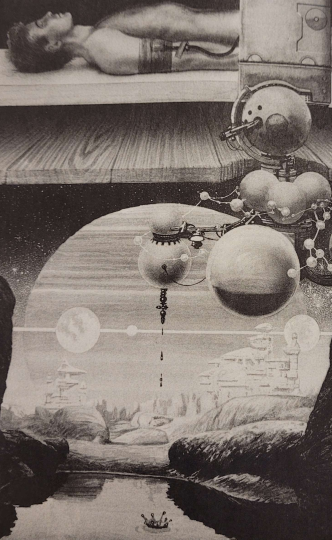
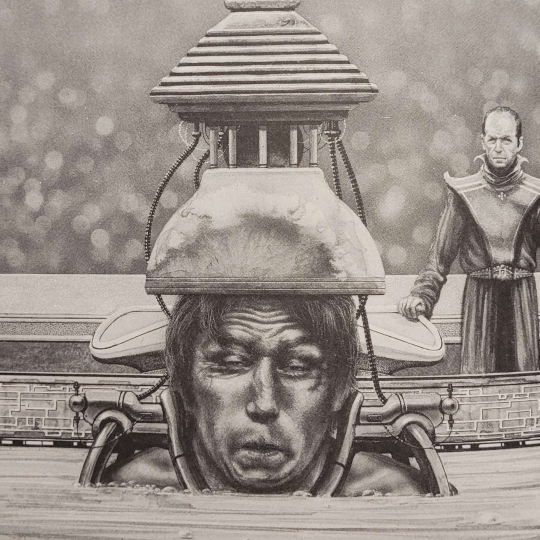
Several stories have an illustration by the cover artist, Jim Burns, beforehand, and "The Road to Dune" has several within. Each illustration actually depicts something specific within the story, whether literal or figurative. I found most a little creepy.
Introduction (1985) - Frank Herbert reflects on the making of the Lynch Dune movie, which he ranks highly (both the experience and the translation of book to screen). He laments the sheer amount of cutting needed to get it down to size, and hoped it might eventually be shown in a re-edited TV series. This never happened. He also expected it would survive into future memory. Kind of? Lynch's star continued to rise, so it has retained a place of dubious honour as the black sheep of his filmography. The movie's visuals are memorable, I don't think anyone can forget the floating cubes shield duel scene. It's something of a cult classic by now, and it has a three hour fan-edit combining deleted scenes and TV-edit scenes (with touched up effects), so clearly some people care about it.
"Rat Race" (1955) - A hard boiled detective investigates strange goings on at a mortuary, and discovers Uninspiring.
"Dragon in the Sea" (1955) - John Ramsey, cybernetic psychologist, is tapped to act as a spy on a nuclear submarine sent to steal oil from the "Eastern Powers". Twenty previous missions have been sunk, and sleeper agents on board are suspected. The captain of this mission is suspected of having paranoid tendencies that will need to be managed. While technically science fiction (the first nuclear submarines didn't actually launch until 2 years after the serial), this seems much more psychologically oriented. Bafflingly, this not only isn't a full story, it isn't even a full segment of the original serial. It ends on a cliffhanger. I suppose I'll have to track down the novel version because this was intriguing enough for me to want more. Ramsey is part of a Bureau of Psychology, or BuPsy, echoing the ConSentiency series BuSab, Bureau of Sabotage. Much like the chairdogs of the ConSentiency and later Dune book, this seems to be a Nihei-esque reuse of names and concepts rather than actual continuity between all three stories. No evidence yet Herbert had full-blown expanded universe disease (notable sufferers: Stephen King, Michael Moorcock, CLAMP).
"Cease Fire" (1958) - A man has a brilliant idea that could end all war, which is now dependent on detecting life signals for targeted artillery strikes. Though a cornerstone of Dune, on its own this isn't a great or even good story.
"A Matter of Traces" (1958) - A transcript of a proceeding of the Intergalactic Senate of the ConSentiency universe, this is short and comical, with most of the story being the yarns of an old colonist. Jorj X. McKie makes a brief appearance. Okay.
"Try to Remember" (1961) - A spaceship arrives on Earth and demands that earthlings learn to communicate with them, or die. Teams of linguists are assembled from across the world to observe the speech and dances of five frog-like aliens. Paranoia mounts among Earth's governments, and a linguist begins to suspect that the aliens meant more than verbal communication.
★ "The Tactful Saboteur" (1964) - The other ConSentiency story, McKie sabotages his boss and investigates a Pan-Spechi he suspects of trying to sabotage the Bureau of Sabotage. Half of the story is a ludicrous trial scene much like The Dosadi Experiment, in which McKie is once again allowed to twist things around. Lighthearted and comic, with the story culminating in I dearly, dearly wish the ConSentiency books had become Herbert's cash cow rather than Dune. They're so weird and off-kilter, they feel like there's infinite potential for having Jorj navigate the bizarre cultural hangups of strange aliens, pull off ludicrous pranks, and grandstand during trials.
"The Road to Dune" (1985) - A pilgrim's guidebook to the Messiah-era Arrakeen palace, each short segment has an accompanying illustration, emphasizing the size and opulence of the palace. About as much Dune as I can stand at this point.
"By the Book" (1966) - A multi-kilometre beam of energy is used to "whip" messages and momentum faster than light, pushing small seed ships to new colonies. An old repair tech is brought in to diagnose the decreasing reliability of such a beam, The blue-collar sensibility of the story and absurd density of the technobabble makes it stand out. Still missing something, but it's a fine read.
★ "Seed Stock" (1970) - A fisherman on a struggling colony reflects on the adaptations and degenerations they have needed to survive on a subtly "wrong" world. Atmospheric, and manages to combine an air of despair with a simple love story and a ray of hope. A nice vignette but thin as a story.
★ "Murder Will In" (1970) - Tegas/Bacit, an eons-old bodyhopping mental parasite finds himself in a desperate situation, transferring to a host who is immediately spotted by investigators tailing him. The story is mostly description of Tegas' being, his way of life and mental processes, and his relationship to his subconscious/shadow/cumulative other-self Bacit. This is wrapped in a lightly sketched dystopian-future, Some concepts from this ended up being used in Children of Dune and God Emperor. Loved it. It's very weird, and it tells a full and compelling story with an unusual protagonist.
"Passage for Piano" (1973) - A family scheduled to leave for a new colony hatches a scheme to bring along their grand piano. Very straightforward and feel-good for Herbert. Okay.
"Death of a City" (1973) - A City Doctor investigates an exceedingly beautiful city from a distance, attempting to determine why it is deeply sick, and whether it must die for the sake of humanity. At the same time, he tests whether his protege, a native of said city, is capable of one day assuming the mantle of City Doctor. Very short, I like the implied extremely weird setting, but it leaves me wanting more than this.
"Frogs and Scientists" (1985) - Two page story about frogs observing human courtship. Okay.
Well this was pretty much a waste of time. I expected more from the author of Dune. Many of the stories are either pointless, fizzling out without a proper ending, or are needlessly complicated to the point of being incomprehensible (can anyone explain to me what happens in The Tactful Saboteur?). Things pick up a little towards the end, and there are interesting tales of ego parasites and ecology, but it was a struggle to get there.
This book mostly contains a representative sampling of stories previously published by Herbert. There are a few exceptions detailed in the appended description. I was personally most interested in his remarks about the David Lynch film version of Dune.
this is an awesome collection of some of Frank Herbert's best short stories. It also includes some beautiful drawings to go along with them as well as a short oral walking tour of Araknas(sp?) worth reading at least twice!
Anyone who’s even dipped a toe in the immense waters of science fiction literature is no doubt aware of Frank Herbert’s seminal masterpiece Dune. Those who have read the book will have recognized the theme of ecological conservation central to the plight of the Fremen (David Lynch’s film, while lovingly rendered and massively entertaining, does little justice to this aspect of the novel). The reciprocal shaping of each other by sentients and their environment is also a major thread throughout many of the stories in this collection of Herbert’s short fiction.
Because of the antics, posturings, and outright lies of the environmentalist movement, many of us have developed a knee-jerk reaction against anything that smacks of any sort of hippyish tree-hugging. This is unfortunate, because the core issues driving the debates behind conservationism and sustainability are becoming more vitally important with each rotation of this amazing orb we call earth, and here, as in, well, just about everything, the right has made just as much a mess of things as the left. Thus prose like Herbert’s, with its careful consideration, multifaceted viewpoints, and obvious passion, is not only refreshing but necessary. Case in point: the short story Seed Stock, which the back cover of the book tells me is Herbert’s own favorite. A group of planetary colonists struggles to survive on their new homeworld; their imported livestock has sickened and died, and the transplanted earth produce isn’t fairing much better. What does grow is ugly and barely edible; the native plants are mildly poisonous and must be chemically treated before consumption. The bizarre biochemistry of the native environment wreaks havoc on windmills, turbines, generators. The colony is reduced to subsistence living, stunted and sickened by the combination of unseen forces. The collection of scientists is at a loss; their carefully laid plans come to naught and their former methods useless. If the colonists are to survive, they must come to realize that they cannot create another earth. They must adapt their plants, and themselves to their new environment, not seeking to fight the changes the new planet forces, but embracing and cultivating them, integrating their needs with those of the ecosystem as a whole while keeping the guiding hand of reason firmly on the tiller. Now of course, an epiphany of this sort won’t stop the environmental debate, as the outworkings thereof are more than a little complicated, but as most of the major players haven’t even gotten this far it’d be a good start.
The conservationist theme is at its most overt in the aforementioned story, and is strong in a few others as well, but this is far from the only issue Herbert tackles. His most consistent thread in this collection is to study how entities (usually human, but this is still sci-fi) react to challenging situations and pressures. These take all forms, from the struggle to survive in a harsh environment to the subtle but consequential nuances inherent in everyday conversation. Indeed, language and the ways we use it provide the plot impetus in Try to Remember, the only story in the collection that I found too heavy-handed. The message, that truly communicating is more than just saying words, is again an important one, but Herbert’s handling of the resolution seems forced and a little trite.
Herbert’s study of humanity might be more properly termed a study of identity, a theme very thoroughly probed in both Murder Will In and The Tactful Saboteur, the latter a well-dialogued courtroom drama and one of my favorites of the bunch. Other standouts include the tense but ultimately optimistic By the Book, and the poignant but ultimately optimistic Death of a City. If you’re noticing another theme here, it’s because a sense of hope and being able to change one’s life and surroundings for the better pervade most of the stories here. This is nowhere more evident than in my favorite story in the collection, Passage for Piano. In it Herbert is not delving into the depths and limits of the human psyche, nor constructing elaborate worlds and intricate plots. The characters are rather stock and the plot resolution comes off exactly as expected; in fact the whole thing is wholly unremarkable except for the satisfying sense of shared humanity it leaves with the reader, a sense that there is beauty in the things that we humans craft and create, a beauty that compliments that of our natural environment and is both ubiquitous to our species and unique to each individual, a beauty that changes from moment to moment with each new experience, and yet stands as a timeless monument. Let this volume of Frank Herbert’s work stand among the vast pantheon that bears testimony to this fact.
This is a must-read for fans of Herbert’s other work, especially the Dune series, and should be entertaining for any sci-fi fan. Some of the stories set on earth are a bit dated, as our concept of what the future might entail has shifted somewhat, but that doesn’t detract at all from their central themes. I’d also recommend this collection to anyone who’s passionate on either side of the environmental debate; closed-minded, one-sided idealism is antithetical to critical evaluation, and Herbert’s thorough, open searching of the matter will provide to the careful reader a much-needed antidote.
A varied collection covering the fifties through to the eighties. The introduction gives some interesting insights into the making of the 1984 David Lynch adaption of Dune, there's a long excerpt -though it's never stated as such - it just abruptly ends- from the fifties novel Dragon Under the Sea (also known as Under Pressure), there's a sort of illustrated tourist's introduction to the planet Dune, and then there are the stories themselves.
Rat Race could easily have been a Twilight Zone episode - an entertaining enough variation on the aliens are already amongst us trope. Dragon In the Sea is an enjoyable near-future submarine thriller... it's just a pity it’s only the first third of it. Cease Fire is an unlikely story of the invention of a means to explode any ordnance before it is fired (yes, the "science" is very iffy). A Matter of Traces is a somewhat dated sort-of Space Operatic comedy. Try To Remember could very well have been an inspiration for Ted Chiang's Story of Your Life (filmed as Arrival), but it's less subtle and fond of explosions (in fact, perhaps Denis Villeneuve read TTR, as his film also leans more toward pyrotechnics than its source material). The Tactful Saboteur was at first annoying, as its approach and concepts are so bizarre and incompressible... until I realised that weirdness was the point... or at least part of the fun. By the Book is an enjoyable take on one of my favourite SF tropes - the experienced engineer fixing the incomprehensible matter transportation device (Jack Vance did one of these, though the title presently escapes me). Seed Stock is a beautifully written story of adapting to rather than conquering a planet, and probably the best here. Murder Will In is an entertaining variation on space-alien energy vampires flitting from host to host for thousands of years (think Michael Shea's exemplary The Autopsy, but with considerably less Horror). Passage For Piano is a somewhat touching tale of family folk destined to colonise another world... but what if your child can’t take his beloved grand piano along? Death of A City is another strange one, sort of a Sapphire and Steele but for future cities, and very C. J. Cherryh. Frogs and Scientists was rather pointless, but at a page long hardly outstayed its welcome.
Overall, I think Herbert is better at novel length - but there are some stories here that show themselves to be the work of a master.
A note on this NEL paperback copy: would benefit from a more thorough proofread. There is no contents page. The black and white renderings of Jim Burns’ beautiful -and doubtless glossy- illustrations are hardly well served – surely colour plates were a possibility (I’m guessing the first publication sported them)?
I've had this book on my shelf for something like fifteen years, and I'm only just now reading it. I distinctly remember at the time that I bought it (at the height of my Dune mania) that I did so because of the awesome illustration of a Fremen on the cover (drawn by Jim Burns, who has several pieces appearing throughout this collection). My younger self, seeing this cover, likely thought it would be a collection full of Dune stories, but this is not the case. In fact, only one of the stories herein is Dune related, and it is not what Dune fans may expect (or even want, considering it's a very short simulation of a walking tour through the Arrakeen Palace; cool, but forgettable.) So I'm sure that I picked it up back then and realized it wasn't actually more Dune material and quickly put it down. I guess it took me fifteen years to be ready for it.
Some of the stories in this collection are stronger than others, but each of them is unique, and interesting conceptually. Herbert excels at this type of storytelling. His work in short fiction and serialized fiction is what first birthed Dune after all, and in those short-form stories you really don't have time to waste explaining every little piece of your world to the reader. So your idea has to be structurally sound, it has to be interesting, and most importantly it has to hint at deep, established world in which the story exists, and of which the reader is only privy to a small, tantalizing section. This, I think, is what Frank does so well, and it shows in stories like "Try to Remember", "By the Book", and "Murder Will In", my favorite of the bunch, and the weirdest.
And maybe weird is the word. Frank loved to examine culture, government, ecology, communication and language... But at the end of the day he loved weird science-fiction ideas. And it's a treat to have so many of them on display here. — [3.5]
Frank Herbert is famous for Dune. The remaining book of the series make people divisive. Some people enjoy and some people find them boring. Another anthology read and I can safely say , overall I Didn't enjoy them...
First of all, if you are looking for short stories connected with Dune - well there are two that I would say they are BUT probably more. As you know Dune is in the future. Death of a City is connected to Dune but could not be... the only reason I notice was the way it was written (all those internal monologues) and because of "ornithopter", there is also the introduction by Frank where he talks about the movie Dune plus "The Road to Dune" that containts some more information about the palace of Dune with several beautiful drawings.
Rat Race is also interesting about alien species using humans as lab rats... it's funny because imagine some beings so intelligent that would see us nothing more that rats and treat us like we treat lab rats. Dragon in the Sea I think it's a short version of the book with the same name... I didn't enjoy.
One of the stories I enjoy although I thought it ended rather abruptly was Cease Fire, about a solider who invents a weapon to end all wars.
For what I know there are two stories in the same universe as ConSentiency (Whipping Star & Dosaid Experiment) which are a matter of traces & Tactful Saboteur... didn't enjoy them that much
Finally I also enjoy Seed Stock about the colonization of a new world...
Overall there are a lot of stories, some written back in the 50's way before Dune while others more recently (80's) and you can feel the difference between them. Since there were several I didn't care and only a couple I enjoy I would rate 4 out 10. Therefore 2 stars in goodreads
Clearly compiled to cash in on the David Lynch adaptation, this collection is a real mixed bag. There are some fun ideas in here but nothing to give you any idea of the sheer madman creativity and scope of the Dune novels. Most fun is probably the hard-boiled detective pastiche so over the top I genuinely don't know if Herbert was joking when he wrote it. The Road to Dune is so thin an offering to the canon as to be worthless, consisting of little more than a few annotations for some poorly printed and not-that-great illustrations. More illuminating are Herbert's impressions on the film and the process of its making that are laid out in the collection's introduction. A so-so grab-bag.
I liked a couple of the stories, and really enjoyed Road to Dune, but I don't feel like short stories do Herbert's approach justice. He's a deep thinker and it takes time to build his visions. I found in some of these shorts that the ending could be abrupt or overall come across as incomplete. 6/10
A few of the stories here were good, but frankly I expected more from this author. He seemed to let his imagination run wild and while that is a wonderful thing in science fiction, there should also be a respectable store that goes along with the fantasy otherwise it just seems unbelievable. When the personalities don't make sense creditability lacks and that turns me off.
All the stories were solid except the last two, which were also the shortest. These two seem to be attempts at philosophy by way of story, something like Borges. But I think they end up just being kindof strange in a incoherent way, and I also think Frank Herbert is probably a perv. Best story is Passage for Piano, which is wonderful.
Oof! I was let down by this book. Outside of the Dune introduction and the short story the majority of these stories were lackluster. They felt like rough drafts or even warm up exercises. If you are a massive Frank Herbert fan I would recommend this. Otherwise this is a unnecessary read.
Pleasantly surprised by Frank Herbert's ability to craft a short story. Plenty of good gems in here. "Cease Fire", "Try To Remember", and "Passage For Piano" were some of the notable ones that I enjoyed immensely.
This collection of short stories really only has one good story: Try to Remember. The introduction about Frank Herbert's experience making the original Dune movie is insightful. But the short story "The Road to Dune" isn't really a story at all. It's just a few brief descriptions of places.
Um livro de contos muito inconstante e por vezes com alguns deles pouco apelativos e demasiadamente complexos. Mas apesar dissso tem algumas surpresas agradáveis