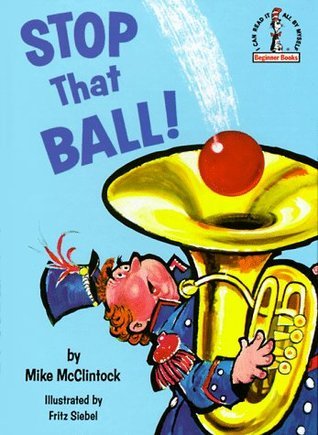
A Confidently Incorrect Review, brought to you by Gilbert Waddington
Mike McClintock’s Buddhist allegorical tale, Stop that Ball!, is a penetrating examination of desire and how striving harms our innermost selves.
In the opening scene, we meet the narrator whose name is never revealed. This is a clear indication that the protagonist could be any of us, indeed is all of us. Simultaneously, we are left with the notion that the unnamed boy is also no one, a more subtle pointer to the eventual erasure of the ego and achievement of Nirvana by those who can overcome worldly attachment and craving.
We find the narrator engaged in a task that is immediately recognized as futile. He is striking the story’s eponymous ball while it is tied to a central pole. Each strike sends the ball out, only to see it rebounding again. We see the futility of the effort in the first lines of the story
It went around and then came back. I gave my ball another WHACK!
The boy continues in his work, increasing his efforts until he hits the ball so hard the string lets go.
At this point, we note that the world has changed and effort has led to a result other than its prior futility. It would seem that striving has paid off. In the background the smile on the enigmatic girl’s face—more on her later—shows that some positive step has been taken.
However, rather than progress, we find that—from the narrator's point of view—the situation has regressed to a dreadful state. The ball, the sole object of his striving and desire has been removed “out past the wall.”
The boy’s immediate aim is to retrieve the object of his desire.
We follow him and his “dog of mine” as they chase the ball down holes, across dangerous construction sites, nearly onto a hill set to be dynamited, over a burning house, through a baseball game (where the role of sport and entertainment as distractor from our lowly unenlightened state is driven home), to a bandstand, and finally into the mouth of a cannon.
Here we see the lengths to which the narrator is willing to subject himself to injury in his quest to obtain the object of his desire. As emphatically stated by the uniformed man who drags the boy away, the narrator is only moments from mortal death, and yet his only thought is to continue the striving which experience has already told him is futile.
Finally, we see the ball launched across the town, clearing at once all the prior obstacles it traversed.
When the narrator at last reaches his home, he finds the ball not only returned to his yard within the walls he earlier overcame, but even tied securely to the string from which it was originally launched. The enigmatic girl, a quiet fixture throughout the story’s background is seen here, smiling contentedly as the boy marvels at the object of his desire.
It is at this point that the reader is invited to consider that all of the narrator’s many efforts have in no way altered the course of events. The ball’s journey was, in all fundamental essences, independent of his actions and the result achieved is the same as would have been realized should he have stayed home. In this we see that, even the greatest of striving does not achieve its object, and is merely a manifestation of the false self that separates us from Nirvanna.
Only by quenching this desire can we be truly at peace.
Sadly, we see the narrator pick up his bat and resume the game that enflames his striving and distracts him from true bliss. In the final scene we see “the string let go” and the ball once more sail beyond the wall.
The reader is left with the haunting message:
Could this go on all day and night?
It could, you know, and it just might!
Words of warning. To those caught in the web of their own striven suffering, even extreme intervention is not enough to move them toward a state of enlightenment. If enlightenment is to come, the journey must begin within.