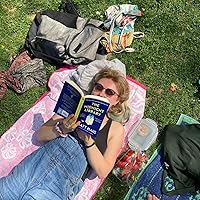
Eschbach's Lord of All Things is a weave of nearly every major genre you could search out--though a science fiction novel at heart (at least by the end), it includes elements of romance, mystery, drama, horror, suspense, adventure, and even some small element of the supernatural. Probably, the book will lose some readers exactly because of this variety, but for many readers, I think it is exactly this variety that makes the book so impossible to walk away from. Perhaps because I read so little science fiction, this mix was especially effective for me, and might be most appealing to readers who have truly eclectic tastes...but one way or another, I'd expect any reader to find some entertainment here. And, importantly, the book is also a careful and believable exploration of day-to-day struggles--crazy as some of the events are, and extraordinary as some of the characters are, Eschbach never forgets that normal struggles and fears are at the base of any individual, and he does an admirable job of allowing those concerns to make his work all the more powerful and believable without ever losing the drive that comes from dipping into the genres noted above.
Following the lives of a man and woman whose lives boomerang against each other time after time, and taking its seed from a young boy who lives in poverty and dreams of fixing the world and, most importantly, eliminating poverty, the novel is magnificent in scope. Moving across the globe and landing in such settings as Boston, Tokyo, Scotland, the Arctic, and Buenos Aires, as quickly as the novel moves, it never becomes tedious or predictable--or rather, when you think it might be predictable, Eschbach takes an unprecedented turn that, in hindsight, fits perfectly, even as much as readers wouldn't have seen it coming.
On the whole, this is one of those works which, long as it is, can barely be put down for sleep once a reader has really begun, and there's something here for nearly everyone. True, it has some faults. Some scenes seem more tangent than necessity (especially in the first portion of the book), developing characters and motivations that only become clear much later and giving time to perhaps one too many subplots. And, really, only the two primary characters in the book are fully fleshed out and developed as much as one might hope for all of the characters. But, while some readers may end up seeing Eschbach as attempting too much...I have to say that I'll read anything else of his which I can find in translation. Whether you read this and become fascinated by the scientific drive, the politics of achievement, or the simple drama of living, there'll be something here to keep you involved.
Absolutely recommended.
Oh, and on a sidenote, I also need to mention that this book was received through the Goodreads First Reads Giveaway Program. I signed up for it on a whim, and I'm not sure how I lucked into getting it, but I am so glad that I did!