

What do you think?

Sejanus His Fall
This edition of Jonson's great Roman tragedy is more intensively researched than any that has previously appeared. The text is based on extensive collation of the 1605 and 1616 versions and takes the earlier version as "copy-text." The introduction offers a radically new assessment of Jonson's "historiography" and his treatment of sources. It provides an explanation for the charge of treason leveled at Jonson over Sejanus and for which he had to answer to the Privy Council. Explanatory notes to the text provide much new information to facilitate a properly informed reading of the play.
304 pages, Paperback
First published January 1, 1603
About the author
Ben Jonson
1,497 books194 followersBenjamin Jonson was an English Renaissance dramatist, poet and actor. A contemporary of William Shakespeare, he is best known for his satirical plays, particularly Volpone, The Alchemist, and Bartholomew Fair, which are considered his best, and his lyric poems. A man of vast reading and a seemingly insatiable appetite for controversy, Jonson had an unparalleled breadth of influence on Jacobean and Caroline playwrights and poets. A house in Dulwich College is named after him.
See more at http://en.wikipedia.org/wiki/Ben_Jonson
See more at http://en.wikipedia.org/wiki/Ben_Jonson
Ratings & Reviews
Friends & Following
Create a free account to discover what your friends think of this book!
Community Reviews
Displaying 1 - 20 of 20 reviews
January 29, 2009
read at college, a searingly brilliant read, about political machinations of course, and with no illusions. The play of language is just perfect. You come away battered. Is that good? Yes.

maybe
September 12, 2019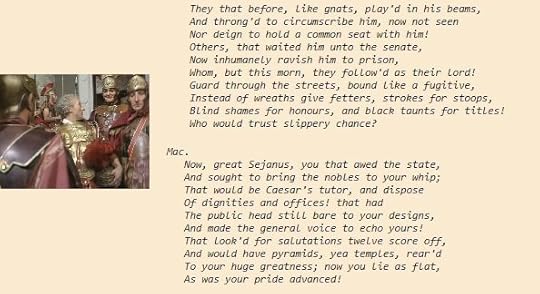
Nick Holland: "I love 17thC drama - just finished re-reading 'Sejanus, His Fall' about the unelected advisor to a tyrannical emperor who is even more power crazed, but whose attempts at 'disposing of dignities and offices' seals his own downfall. Highly recommended, it's by B. Jonson"
August 29, 2017
Best read accompanied by The account of Tacitus.

March 19, 2026
This much-maligned Ben Jonson play is decidedly overwritten, but whatever. All Ben Jonson plays are overwritten! This has some really great aspects to it, including some fantastic villainous revenge speeches, a lot of political plotting, some noble Roman suicide activity, one ancient Roman religious performance staged for the benefit of this Jacobean audience, and a lot of Seneca.
The only real issue is that the play is overwritten. One also does wish that Jonson had decided to stage Sejanus's beheading, at the very least. (It is quite clear that his gruesome dismemberment by the Roman mob needed to be offstage.) Otherwise, this is a play about political corruption, the fickleness of the populace, and naked, craven ambition. And I actually think Sejanus's Fall works a lot better as a problem play about this subject matter than Coriolanus, which has a different structure but really similar material.
PS I'm calling this play Sejanus's Fall, which is the modernized English way of writing this Early Modern title. Sejanus: His Fall—or, alternatively, Sejanus, His Fall—make no sense to me.
The only real issue is that the play is overwritten. One also does wish that Jonson had decided to stage Sejanus's beheading, at the very least. (It is quite clear that his gruesome dismemberment by the Roman mob needed to be offstage.) Otherwise, this is a play about political corruption, the fickleness of the populace, and naked, craven ambition. And I actually think Sejanus's Fall works a lot better as a problem play about this subject matter than Coriolanus, which has a different structure but really similar material.
PS I'm calling this play Sejanus's Fall, which is the modernized English way of writing this Early Modern title. Sejanus: His Fall—or, alternatively, Sejanus, His Fall—make no sense to me.

August 17, 2018
Some very good poetry that did not make up a very good play.

March 22, 2014
Those with a keen interest in the ups and downs of Imperial Rome, or the heedless comparison between this age and King James' England (even our own oily oligarchies) might find something of interest in this play. Others who have a fixation on line-for-line adaptation of classical historians like Tacitus would have a field-day here. Yet the poor unfortunate few who have stumbled upon this play and seek to be entertained have an uphill battle before them, almost as if Jonson wrote this history so as not to be enjoyed, as educative as it appears to be.

June 27, 2019
Very long indeed, even by Ben's standards, and with little redeeming lightness about it. Some very good speeches, but I'll stick to "I, Claudius" for my history of this period, thanks.

October 19, 2024
This was better than I expected. I kinda liked it, even when I was struggling to keep up with characters and dated language.
I previously read Jonson's Every Man in His Humor, a play I found almost unreadable, one I'd be surprised could be staged in an entertaining way. I hated so much about it. (This is one of those "Everyone is unlikable" situations, and I'm one of those people who can't stand books and plays and movies where I don't like anybody.) Anyway, I put off reading anything else by him for fear of hating it. But I finally decided to try Sejanus, and it was a complete 180 from the other play.
This reads a lot like a Shakespeare tragedy or history play, definitely in the vein of a Julius Caesar or Richard III. I didn't identify any part as humorous, which you can find even in the most serious Shakespeare plays, so that's a contrast, but that's okay with me, as the elevated tone of the play matches its seriousness. Shakespeare does more with subplots, too, IMO--though I'm willing to be talked around on this if someone wants to argue.
The main type of action in this play is plotting, spying, and gossiping. Most of the real action--like poisoning, arresting, putting to death--happens offstage, reported by others. But we're privy to the pro-Sejanus plotters, which included Caesar at the start of the play, putting together trumped-up charges to remove rivals from government, and the anti-Sejanus plotters, which includes all the people who lost loved ones to his machinations, trying to counter his plans. A lot of scenes have overlapping dialogue, where the main conversation continues upstage between those supporting Sejanus, while downstage (in my imagination) a couple old guys, members of the party supporting Agrippina and her sons, comment on the underhanded stuff they're hearing. They read sorta like the old guys in the Muppets, mocking what they see, casting everything the audience is hearing in a different light. (It may be that some of these exchanges do come off as humorous for those who understand sufficiently. I'm not in that group, alas.) I found this approach very effective.
The conclusion comes quick. After sending many people off to their deaths through lies and straight-up murder, Sejanus thinks he's walking into a meeting of the senate where he will be elevated to Tribune, but instead it's a plot to arrest him and convict him. I'm not clear where Caesar changed his opinion, tbh, but he turned, and that was the end of ambitious Sejanus.
The language throughout, mostly delivered in blank verse, is emotionally charged and elevated but not unnatural or stiff. A nice example of this is the scene where Sejanus first worries that he's walking into a trap but then is satisfied that all is well:
This passage shows his pride, which would normally prevent him giving any respect to anyone else, and basically daring the gods to try to hurt him, presaging his downfall in the final act. But it also shows the kind of language Jonson was capable of, and I think it's pretty fine.
I like this play, and I really didn't expect to. I would have liked a little more real action on stage, and would have given it 5 out of 5 if it had included more of that, but even without I would recommend this play for those who enjoy older drama. Plenty of drama and lots of tragedy.
I previously read Jonson's Every Man in His Humor, a play I found almost unreadable, one I'd be surprised could be staged in an entertaining way. I hated so much about it. (This is one of those "Everyone is unlikable" situations, and I'm one of those people who can't stand books and plays and movies where I don't like anybody.) Anyway, I put off reading anything else by him for fear of hating it. But I finally decided to try Sejanus, and it was a complete 180 from the other play.
This reads a lot like a Shakespeare tragedy or history play, definitely in the vein of a Julius Caesar or Richard III. I didn't identify any part as humorous, which you can find even in the most serious Shakespeare plays, so that's a contrast, but that's okay with me, as the elevated tone of the play matches its seriousness. Shakespeare does more with subplots, too, IMO--though I'm willing to be talked around on this if someone wants to argue.
The main type of action in this play is plotting, spying, and gossiping. Most of the real action--like poisoning, arresting, putting to death--happens offstage, reported by others. But we're privy to the pro-Sejanus plotters, which included Caesar at the start of the play, putting together trumped-up charges to remove rivals from government, and the anti-Sejanus plotters, which includes all the people who lost loved ones to his machinations, trying to counter his plans. A lot of scenes have overlapping dialogue, where the main conversation continues upstage between those supporting Sejanus, while downstage (in my imagination) a couple old guys, members of the party supporting Agrippina and her sons, comment on the underhanded stuff they're hearing. They read sorta like the old guys in the Muppets, mocking what they see, casting everything the audience is hearing in a different light. (It may be that some of these exchanges do come off as humorous for those who understand sufficiently. I'm not in that group, alas.) I found this approach very effective.
The conclusion comes quick. After sending many people off to their deaths through lies and straight-up murder, Sejanus thinks he's walking into a meeting of the senate where he will be elevated to Tribune, but instead it's a plot to arrest him and convict him. I'm not clear where Caesar changed his opinion, tbh, but he turned, and that was the end of ambitious Sejanus.
The language throughout, mostly delivered in blank verse, is emotionally charged and elevated but not unnatural or stiff. A nice example of this is the scene where Sejanus first worries that he's walking into a trap but then is satisfied that all is well:
How vain and vile a passion is this fear?
What base, uncomely things it makes men do?
Suspect their noblest friends, as I did this,
Flatter poor enemies, entreat their servants,
Stoop, court, and catch at the benevolence
Of creatures, unto whom, within this hour,
I wouldn't have vouchsafed a quarter-look,
Or piece of face? By you, that fools call gods,
Hang all the sky with your prodigious signs,
Fill earth with monsters, drop the scorpion down
Out of the zodiac, or the fiercer lion,
Shake off the loosened globe from her long hinge,
Roll all the world in darkness, and let loose
The enraged winds to turn up groves and towns;
When I do fear again, let me be struck
With forked fire, and unpitied die;
Who fears is worth of calamity.
This passage shows his pride, which would normally prevent him giving any respect to anyone else, and basically daring the gods to try to hurt him, presaging his downfall in the final act. But it also shows the kind of language Jonson was capable of, and I think it's pretty fine.
I like this play, and I really didn't expect to. I would have liked a little more real action on stage, and would have given it 5 out of 5 if it had included more of that, but even without I would recommend this play for those who enjoy older drama. Plenty of drama and lots of tragedy.

February 2, 2026
A long, slow, Jonsonian retelling of Roman history at his most didactic, with a cast of more than 40. A recent Red Bull staged reading cut the cast and the text in half, found wonderful moments of humor, and underscored disturbingly apt parallels to some of the horrors of today's power politics.
Jonson paints a vivid picture of the turning of Fortune's wheel: lowborn Sejanus, after being raised to Rome's pinnacle as surrogate emperor, is startled when suddenly brought low at the very moment he anticipates his greatest triumph. The playwright shows the upstart plotter outwitted or at least overpowered by an even greater Machiavel; the advice that confident Sejanus offers at mid-play for bringing down rivals is exactly the petard that Emperor Tiberius employs to hoist his would-be successor. Though the play can feel didactic, sometimes Jonson seems more intent to pontificate than to dramatize or entertain or instruct. Several lengthy speeches slow the pace, the numerous characters are hard to keep straight, there is almost no action (mainly a slap and a suicide), and the final violence - though described rather than enacted - is unbearable.
The cast is dichotomized into two extreme camps - gleeful sycophants who rival each other in outflattering whoever is in power, and heartsick patriots who despair at the state of the state. One highlight is the awkwardly comic peripeteia when the horde of flatterers suddenly realizes the winds have shifted and must switch sides in mid-yell. Another is the emergence of a clear-eyed minion who is at once contriver and commentator, gleefully remarking on the counter-plotting even while enacting it. Act two offers little motivation for a princess to betray her husband, succumb to the charms of the overreacher, and plot with him to poison her royal spouse. Yet this scene also features a physician's cosmetics lesson, almost an early botox application.
The big take-away, and the reason for the Red Bull revival, is the sobering relevance of the play to today's struggles between democracy and tyranny. Lines like these leaped off the page and stage:
"Sejanus hath plots on all: No tree that stops his prospects but must fall." (2.500)
"This boast of law is but a form, A net of Vulcan's filing, a mere engine, To take that life by pretext of justice, Which you pursue in malice?" (3.244-7)
"Come, do not hunt, and labour so about for circumstance, To make him guilty, whom you have foredoomed." (3.295-7)
"A prince's power makes all his actions virtue." (3.717)
"The senators all struck with fear and silence, Save those whose hopes depend not on good means, But force their private prey from public spoil!" (4.238-40)
"- Who would not spend his life and fortunes, To purchase but the look of such a lord?
- He, that would nor be lord's fool, nor the world's." (5.321-2)
Jonson paints a vivid picture of the turning of Fortune's wheel: lowborn Sejanus, after being raised to Rome's pinnacle as surrogate emperor, is startled when suddenly brought low at the very moment he anticipates his greatest triumph. The playwright shows the upstart plotter outwitted or at least overpowered by an even greater Machiavel; the advice that confident Sejanus offers at mid-play for bringing down rivals is exactly the petard that Emperor Tiberius employs to hoist his would-be successor. Though the play can feel didactic, sometimes Jonson seems more intent to pontificate than to dramatize or entertain or instruct. Several lengthy speeches slow the pace, the numerous characters are hard to keep straight, there is almost no action (mainly a slap and a suicide), and the final violence - though described rather than enacted - is unbearable.
The cast is dichotomized into two extreme camps - gleeful sycophants who rival each other in outflattering whoever is in power, and heartsick patriots who despair at the state of the state. One highlight is the awkwardly comic peripeteia when the horde of flatterers suddenly realizes the winds have shifted and must switch sides in mid-yell. Another is the emergence of a clear-eyed minion who is at once contriver and commentator, gleefully remarking on the counter-plotting even while enacting it. Act two offers little motivation for a princess to betray her husband, succumb to the charms of the overreacher, and plot with him to poison her royal spouse. Yet this scene also features a physician's cosmetics lesson, almost an early botox application.
The big take-away, and the reason for the Red Bull revival, is the sobering relevance of the play to today's struggles between democracy and tyranny. Lines like these leaped off the page and stage:
"Sejanus hath plots on all: No tree that stops his prospects but must fall." (2.500)
"This boast of law is but a form, A net of Vulcan's filing, a mere engine, To take that life by pretext of justice, Which you pursue in malice?" (3.244-7)
"Come, do not hunt, and labour so about for circumstance, To make him guilty, whom you have foredoomed." (3.295-7)
"A prince's power makes all his actions virtue." (3.717)
"The senators all struck with fear and silence, Save those whose hopes depend not on good means, But force their private prey from public spoil!" (4.238-40)
"- Who would not spend his life and fortunes, To purchase but the look of such a lord?
- He, that would nor be lord's fool, nor the world's." (5.321-2)

September 13, 2022
Apparently booed off the stage on its first performance (with one William Shakespeare playing the Emperor Tiberius), this is Jonson's go at Senecan poetic tragedy, and, while there are some great bits, it feels a bit lacking in something. Whereas one kind of gets behind Marlowe's antiheroes, and finds Shakespeare's Vices and evildoers strangely sexy, Sejanus is a tad bland as a baddie, as if Jonson had written a Putin His Fall, or a tragedy of Rex Tillotson: apart from the power, and the cruelty, there's not much to him.
Sure, he's very Machiavellian (one gets the impression Jonson knew enough Italian to read The Prince); and his fall in Act Five seems very Boris Johnson (all those people publicly supporting him strongly suddenly turn against him and say they had no idea what he was doing - though one does hope that what happened to Sejanus' children doesn't happen to Johnson's), but it's the incidental details, and the metaphors used by characters who know they're being watched, that make this play clever.
Tiberius, dodgy as hell, not quite accused of being a paedo in this play but very clearly so accused in Jonson's sources, subtle and manipulative while appearing senile and pervy, is brilliantly written, and some of the verbose goodies are superbly done (though one is surprised they lived as long as they did).
This play is, though, a clear reminder that the Elizabethans lived in a Stasi-like police state, where everything they said (and lots of things they didn't) could put them in prison or get them tortured. Was Jonson making reference to older playwrights such as Marlowe or Kyd? Or did he not need to?
Sure, he's very Machiavellian (one gets the impression Jonson knew enough Italian to read The Prince); and his fall in Act Five seems very Boris Johnson (all those people publicly supporting him strongly suddenly turn against him and say they had no idea what he was doing - though one does hope that what happened to Sejanus' children doesn't happen to Johnson's), but it's the incidental details, and the metaphors used by characters who know they're being watched, that make this play clever.
Tiberius, dodgy as hell, not quite accused of being a paedo in this play but very clearly so accused in Jonson's sources, subtle and manipulative while appearing senile and pervy, is brilliantly written, and some of the verbose goodies are superbly done (though one is surprised they lived as long as they did).
This play is, though, a clear reminder that the Elizabethans lived in a Stasi-like police state, where everything they said (and lots of things they didn't) could put them in prison or get them tortured. Was Jonson making reference to older playwrights such as Marlowe or Kyd? Or did he not need to?

April 26, 2018
This play has an interesting plot, but it's so difficult to understand because Jonson's writing is so entrenched in the era and antiquated.

September 7, 2018
Really enjoyed this, looking forward to more Jonson and drawing all of the comparison between this and the Annals :)

July 2, 2024
Interesting rather than thrilling

August 4, 2014
This is a moderately entertaining play to read. It moves quickly and features some nice poetry as well as a crescendo of action that leads to a surprise twist at the end. Overall, though, its purpose outweighs its art. Jonson’s theme is painted with a blunt brush. Sejanus is a stock villain. There’s little subtlety or nuance in his portrayal.
Where another artist may have been ambiguous about Sejanus’ purposes, Jonson leaves no gray. Shakespeare’s Roman plays, Julius Caesar and Coriolanus, by comparison present a more nuanced picture. Was Caesar’s intent to name himself a god? Was Coriolanus’ betrayal of his nation justified? And yet if Jonson wanted to create a Richard III type of villain, he needed to bring Sejanus more to the front.
But this is social play, and Jonson’s Rome is a bleak place. There is no promise of a better world after Sejanus. In fact, it is practically certain that Sejanus will not be replaced by anyone better. This would have been a great opportunity to present an ambiguous environment, driven by fear, spies and lust for power. But Jonson chose to essentially create flat characters.
If you’re interested in reading a Ben Jonson play, I’d suggest starting with Bartholmew Fair. You could, however, do worse than reading Sejanus. The Revels Plays edition is an excellent version to choose.
Where another artist may have been ambiguous about Sejanus’ purposes, Jonson leaves no gray. Shakespeare’s Roman plays, Julius Caesar and Coriolanus, by comparison present a more nuanced picture. Was Caesar’s intent to name himself a god? Was Coriolanus’ betrayal of his nation justified? And yet if Jonson wanted to create a Richard III type of villain, he needed to bring Sejanus more to the front.
But this is social play, and Jonson’s Rome is a bleak place. There is no promise of a better world after Sejanus. In fact, it is practically certain that Sejanus will not be replaced by anyone better. This would have been a great opportunity to present an ambiguous environment, driven by fear, spies and lust for power. But Jonson chose to essentially create flat characters.
If you’re interested in reading a Ben Jonson play, I’d suggest starting with Bartholmew Fair. You could, however, do worse than reading Sejanus. The Revels Plays edition is an excellent version to choose.
May 22, 2019
Sejanus was the first full play of Ben Jonson's that I have read and it is certainly an unorthodox choice. Jonson was best known for his comedies having written little tragedy.
The storyline itself follows a familiar Renaissance arc. We see an overreaching achiever humbled by a precipitous fall. As with much of the best of Shakespeare, the plot itself was lifted from history.
Jonson's verse is less ornamented than Shakespeare's and flows very naturally. The lack of ornamentation is probably a bit of a weakness in this genre. Tragedy is pathetic by nature so the melodrama of Marlowe or Shakespeare works better in exciting desires pathos.
The best part of this play is its commentary on the nature of politics. Many of the comments are insightful and deal well with the human psyche.
Overall, a very respectable play.
The storyline itself follows a familiar Renaissance arc. We see an overreaching achiever humbled by a precipitous fall. As with much of the best of Shakespeare, the plot itself was lifted from history.
Jonson's verse is less ornamented than Shakespeare's and flows very naturally. The lack of ornamentation is probably a bit of a weakness in this genre. Tragedy is pathetic by nature so the melodrama of Marlowe or Shakespeare works better in exciting desires pathos.
The best part of this play is its commentary on the nature of politics. Many of the comments are insightful and deal well with the human psyche.
Overall, a very respectable play.

November 4, 2010
Much better than I expected: the story of a Caesar and the power mad General who seems to help him. It is a theme Jonson also visited in his comedies. Strongly drawn characters, an OK story, and Jonson's wit pervade. We would probably not read this play if Jonson did not write his comedies, but it is worth seeking out.
August 1, 2020
Read as part of the "Extra Mile" Shakespeare Institute readathon in the summer of 2020.
Four hours! It's not really surprising its first public performance was a flop, though there are some fine speeches in it.
Again in 2024. You wouldn't do it to a dog. Yes, there are some really good bits, but Ben really needed a good editor.
Four hours! It's not really surprising its first public performance was a flop, though there are some fine speeches in it.
Again in 2024. You wouldn't do it to a dog. Yes, there are some really good bits, but Ben really needed a good editor.

April 9, 2011
With powerful language and intense scenes, Jonson is not as wonderful as his admired Shakespeare (and I think he knew it at heart) but he's nonetheless one of the greatest playwrights I've read. His interpretation of the terrible fall of emperor Tiberius' favourite is both poetical and shocking.

May 2, 2014
The play is perhaps not the best *drama* (its first performance was a disaster apparently and it isn't too hard to guess why), but it's a good read, especially if you've read Tacitus' Annals or other works of Roman history.

Want to Read
January 5, 2019Text https://www.gutenberg.org/files/5232/...
It has a long introduction to Jonson and not all of it necessarily useful. Yet some part of it was good.
It has a long introduction to Jonson and not all of it necessarily useful. Yet some part of it was good.
This entire review has been hidden because of spoilers.
Displaying 1 - 20 of 20 reviews