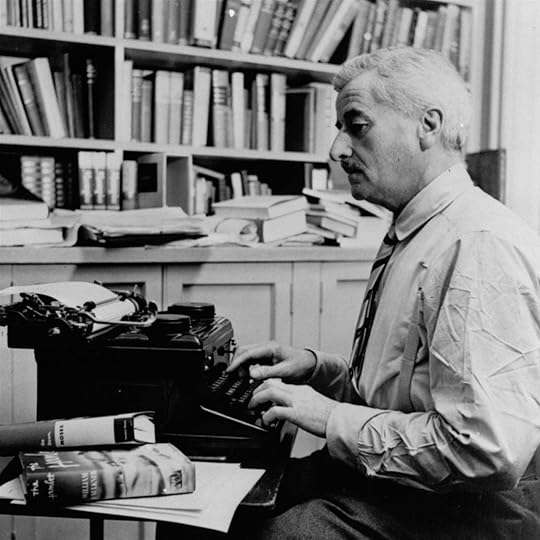
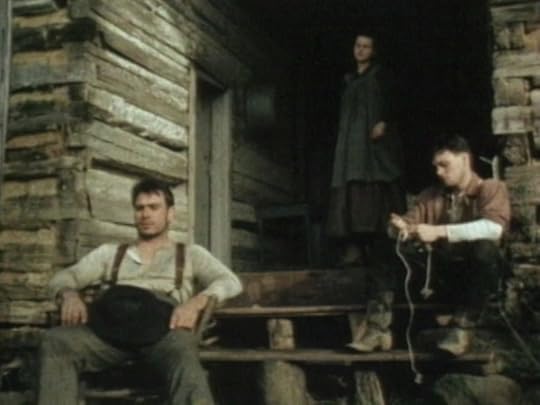
In my experience, one does not become a reader of William Faulkner so much as a student of William Faulkner. Reading his work is, well, a lot of work. I’m reminded of a person who is forced to attend an opera which is performed in a foreign language, in a historical setting, without the benefit of subtitles and the evening’s program. Faulkner’s art is similarly inaccessible, and I must admit that his stories initially irritated me in the same way a fat lady in a Viking costume, screeching on a stage in a foreign language, might annoy our novice opera-goer.
To this day, I still read Faulkner with a pen and paper in hand, diagramming character relationships and the chronology of events as if I were a trying to an answer a question on the LSAT. More times that not, I find that I actually enjoy the second reading of his stories because I’m not so busy trying to figure such basic elements as who is speaking to whom.
While Faulkner doesn’t write in Italian or German, he does like to make up his own English on occasion. Before you read his novels or Collected Stories, I recommend that you become familiar, if you aren’t already, with the words “anathema,” “apotheosis,” “sibilant,” and “effluvium.” He loves those. Also, please exercise extreme patience with his use of floating pronouns—that is, pronouns without apparent antecedents—especially in the opening pages of each story. It might take a few thousand words for you to discover the person whom “he” or “she” refers to, if you’re lucky. Finally, consider interjecting your own punctuation in sentences that last for more than a page or two. Remember that rule about limiting a sentence to one or two ideas? Neither does Faulkner.
Part of the fun about Faulkner, and I’m not kidding, is figuring out what the hell is happening in the story; it’s seldom obvious. He creates this challenge both purposely and unintentionally. His stream-of-consciousness and nonlinear plotlines are, of course, intentional mystical effects. But his lack of dialogue attribution and his inability to visually orient a scene tend to nonplus the reader. Consider the opening of “The Leg.”
The boat—it was a yawl boat with a patched weathered sail—made two reaches below us while I sat with the sculls poised, watching her over my shoulder, and George clung to the pile, spouting Milton at Everbe Corinthia. When it made the final tack I looked back at George. But he was now but well into Comus’ second speech, his crooked face raised, and the afternoon bright on his close ruddy head.
“Give way, George,” I said. But he held us stationary at the pile, his glazed hat lifted, spouting his fine and cadenced folly as though the lock, the Thames, time and all, belonged to him, while Sabrina (or Hebe or Chloe or whatever name he happened to be calling Corinthia at the time) with her dairy-maid’s complexion and her hair like mead poured in sunlight stood above us in one endless succession of neat print dresses, her hand on the lever and one eye on George and the other on the yawl, saying “Yes, milord” dutifully whenever George paused for a breath.
The yawl luffed and stood away; the helmsman shouted for the lock.
“Let go, George,” I said. But he clung to the pile in his fine and incongruous oblivion.
It goes without saying, then, that enjoying Faulkner isn’t a passive activity, at least not on the first reading (or diagramming). Before tackling his Collected Stories (a nine-hundred-page volume of veritable code) you should be forewarned that all of his novels, except one, were out of print until he was awarded the Nobel Prize for Literature in 1949. Such irony underscores the premise that most people don’t read Faulkner so much as they study and appreciate him. Or perhaps they study him before they read him. I know I did. I didn’t truly enjoy Faulkner until I took a graduate class in which we slowly digested five of his novels: The Sound and The Fury (1929); As I Lay Dying (1930), Light in August (1932); Absalom, Absalom (1936); and Go Down Moses (1942).
Collected Stories is comprised of forty-two short stories. In today’s publishing world, I dare say more than half of these short stories wouldn’t have made the final cut. Some of them, such as “A Justice,” “Red Leaves,” and “A Courtship,” might have worked better parceled together as a novella, since they focus on the same characters and story. Others, quite simply, are poorly crafted with unrealistic dialogue (in the sense that it replicates Fraulkner’s southern gothic narrative style and not how people speak) and too many characters, nameless and otherwise, for the medium of a short story, if not a novel. It’s like trying to conduct Mahler’s 8th Symphony in a public restroom. For example, his story “Fox Hunt” has no central character, yet there are several ancillary figures playing counterpoint to this nothingness, including “the old dame,” “the boy,” “the white man,” the youth,” the older man,” “the woman,” the man,” the man at the bay.” My God, Faulkner, give me somebody I can care about.
Yet there are stories that are exceptionally well done, too. And while I don’t think any modern reader with a cable and internet subscription would attempt this entire volume without either 1) Having a gun at his head, or 2) an English paper due, I suspect that many of these stories, if anthologized or reduced to a compendium, might win Faulkner a few converts. I can safely recommend eleven of these stories: 1) “A Rose for Emily,” 2) “Dry September,” 3) “Victory,” 4) “The Evening Sun” 5) “Dr. Martino” 6) “Artist at Home,” 7) “The Brooch” 8) “Golden Land” 9) “Crevasse,” 10) “Two Soldiers,” and 11) “Barn Burning.” Contrary to popular thought, not all of Faulkner’s stories are set in the deep South. Of this collection, one is actually set in Beverly Hills and several others are set in Europe during the World War I era.
What makes the above mentioned stories exceptional? What, in other words, allows them to overcome the dead weight of more than half of this volume to win the National Book Award?
For one, Faulkner illuminates the psychological and moral depth and the emotional and intellectual complexity of many people who were previously stereotyped and marginalized, such as African Americans and Native Americans, if not southerners in general, be they poor or wealthy. That’s an award-winning service to America in and of itself. Secondly, Faulkner’s a damn good story-teller when he doesn’t let his writing get in the way. He reminds me of so many tragic heroes who have such outstanding strengths and weaknesses that the effect is nearly bipolar, like going on a trip with Dr. Jekyll—Mr. Hyde as your guide.
Consequently, I both love and hate Faulkner, depending on whether the genius can hold the monster at bay. Sometimes the reader is mesmerized with phrases such as “old women dropsical with good living” or “the iron silence of winter.” At other times he pulls along so many adjectives and clauses that the meaning of his run-on sentence eventually derails whenever the plot takes a sharp turn. For example:
“But the man did not seem to notice this, so they soon were talking in undertone, watching with bright, alert, curious eyes the stiff, incongruous figure leaning a little forward on the stick, looking out a foul window beyond which there was nothing to see save an occasional shattered road and man-high stump of shattered tree breaking small patches of tilled land whorled with apparent unreason about island of earth indicated by low signboards painted red, the islands inscrutable, desolate above the destruction which they wombed.”
And that’s one of the small ones. Since some of Faulkner’s sentences run the length of a short story, I’m tempted to generalize that his rococo, serpentine style is more of a liability in the short story medium than in long fiction. I certainly enjoy his novels more than his short stories.
Overall, Collected Stories has many gems, but you’ll have to dig for them. I think you’ll enjoy the story about Emily Griersen, a pitiful anachronism in the New South. You’ll like the irony found in “Victory,” and the genteel evil of “Dry September.” You’ll fear Jesus, a man with a razor, in “The Evening Sun,” and marvel at the psychological grip of physically frail characters such as Dr. Martino and Mrs. Boyd. Finally, you’ll be touched by the bond of brothers in “Two Soldiers” as well as the moral dilemma faced by a young boy in “Barn Burning.”