On the inside cover of the front and back of "Starry Messenger: Galileo Galilei," there is a beautiful illustration by author Peter Sis. It shows an ancient Italian city at night, the battlements and spires of the buildings are saturated in a deep inky blue, with stars glimmering in the sky. The city itself is dark except for an arched window that glows yellow with light and inspiration. A small, distant figure appears to be peering through a telescope, which is pointed toward the heavens.
That figure, of course, is Galileo, the visionary who discovered that the earth was not the center of the universe, but rather revolved around the sun. It was one finding among many that would bring him great fame and ultimately the ire of the Catholic Church, which declared him a heretic. The book eloquently discusses that heartbreaking injustice, but also explores Galileo's formative years.
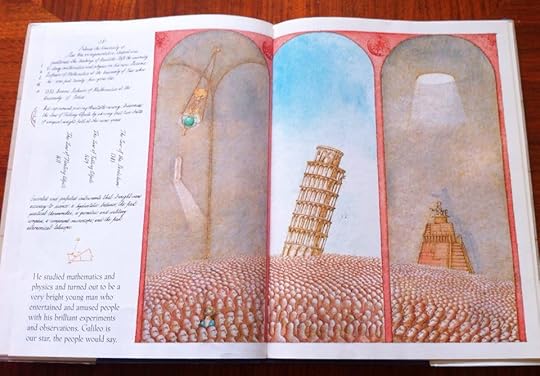
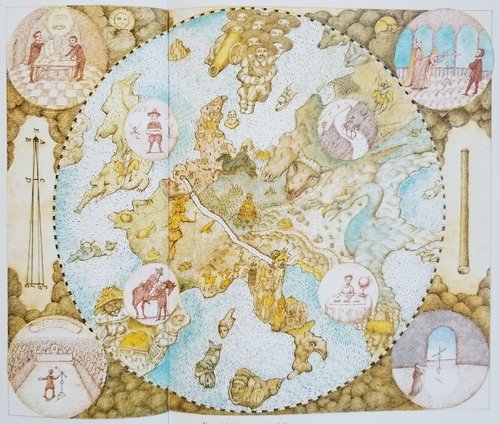
Mr. Sis adds details that put Galileo's life in the context of his times, using small cursive script (there is also text written in a more readable font). The Catholic Church, he writes, was the unifying force in Italy because each city-state had its own government. One fact that I find interesting is that Galileo was born the same year as William Shakespeare - 1564. That's quite a year! Other bits of knowledge are not so lovely, though. Diseases such as typhus and the bubonic plague were a scourge then. We're lucky he survived infancy!
Also in the slanted cursive are further descriptions of his accomplishments and beliefs. For instance, one passage shows how keen Galileo's intelligence was. "1581: Entered the University of Pisa. Was an argumentative student and questioned the teachings of Aristotle. Left the university to study mathematics and physics on his own. Became Professor of Mathematics at the University of Pisa when he was just twenty-five years old."
Still when Mr. Sis quotes Galileo himself,again in that handwritten style, the story is at its most heartrending. When the astronomer is brought before the papal court on heresy charges, he writes, "I do not feel obliged to believe that the same God who has endowed us with senses, reason, and intellect has intended to forgo their use...He would not require us to deny sense and reason in physical matters which are set before our eyes and minds by direct experience or necessary demonstrations." To not use one's mind to advance science, Galileo so movingly explains, would be a denial of God's gift.
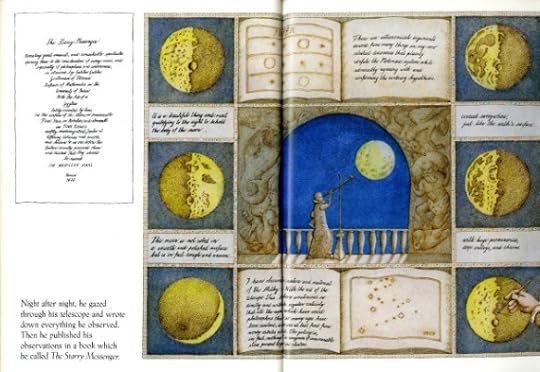
You'd have to assume that Galileo would be thrilled his story was in a children's book, reaching curious, young seekers, like himself, centuries later. The drawings and some of the text, while recalling the great thinker's time, are so detailed and small it can be hard to read them (one paragraph disappears into the binding), but it is worth the effort. One should always strive to learn more, as Galileo did.