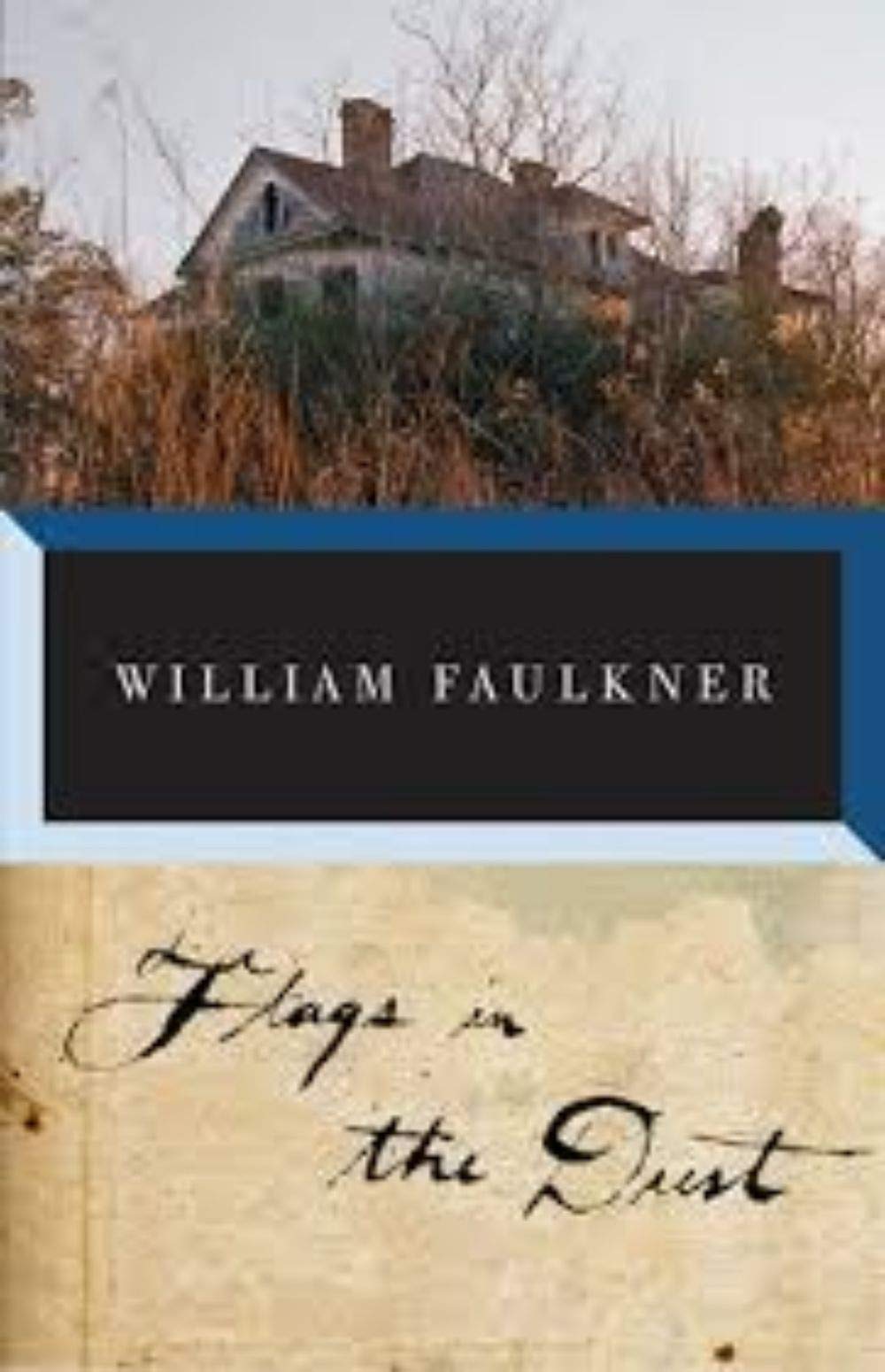
I finished Faulkner’s “Flags in the Dust” this (warm January) morning, in a quiet house. This review will hopefully be narrowly focused, since it was personally meaningful to me, and I write these reviews believing, as I do, that proper reading will illume something of myself (to myself, or to my progeny in future generations). Perhaps a reason this book resonated is that it is haunted with the past and fearful of the future, yet rendered so beautifully. I will file this in Goodreads which may or may not exist in the future in any meaningful format for discovery (will this program have any future?). But I will print this and tuck it into the pages, perhaps never to be seen again or perhaps to be found and mused over.
My reading is amateur; I claim no research or serious thinking to make it anything other. My reading is purely for entertainment and the sensations of joy and pain through what is truthfully rendered. My opinion is unsullied by those of others, and I’ve avoided the opinions of others on this website. As before, I hope to receive Faulkner purely, as he may have imagined his reader, in this case 90 years after the fact. I note that he was 29 years when he wrote this book, and set it in a place like his home, with a main protagonist of 27 years of age – so he must have felt viscerally this male character (the young Bayard). Writing the first draft in 1926, this book was 8 years after the horrors of the first World War, at a time with Faulkner and the world could not even imagine the repeat performance of worldwide terror that was to follow as the second world war in that series. The age of Bill (William) at his writing of Flags was 25 years my junior, astonishing with its remarkable and seemingly miraculous skill and knowledge of ancient literature. I mourned quietly the loss of this knowledge in our current educational systems – of course we are doomed to repeat history again and again – and this book itself is about the seemingly inescapable fate of our birthright (and genetic makeup which Bill understood esoterically – certainly without any biochemistry!).
This is my 4th Faulkner, whom I’ve sampled randomly, and represents the first in the fictional town of Jackson. As such it represents bedrock from which I will read the rest of his works (The Sound and The Fury comes next, I believe) in sequence. It would seem criminal not to follow his development of genius in the proper order. It must be intentional that Bill steadfastly avoids giving the reader the simple plot lines, he is a scene setter and reveals the relationship between characters (in bloodline and in time) in drabs, at first irritating to the reader but ultimately the purpose emerges as the intentionality allows the readers’ brain to absorb what is necessary in its purpose (trust the master, like a great chef, who understands my palette in ways I’ve yet to know) of putting the reader in a state of mind necessary for what is to come. I did have to make a cheat sheet, as the family members’ have the same name (the Bayard and John Sartorius’s are aplenty). Perhaps the greatest character is the sharp-witted Aunt Jenny who’s seen it all, being the most senior and having married into the family long ago, and who bemoans the infuriating Sartorius males who seem hell-bent on destruction in wars and mischief from birth. This is a book about war, those flags quiet now in the dust, from the (vain)glory of the civil war (the original John Sartorius fought gallantly with distinction along with the confederate Jeb Stuart – a swashbuckler himself). The young Bayard, jousting with Aunt Jenny and her nephew (his grandfaterh, the deaf, colorful, “old” Bayard) is a continuum – starting with his return from the first world war and ending with a foolish unheroic act. We call it post traumatic stress disorder now, and it is remarkable the Faulkner describe those symptoms with perfection so many years before it was given common definition. Make no mistake, this family is haunted by untimely death and tragedy – few male Sartorius’s remain and only one small child is left at the end.
But this is not a sad tale; it has long sojourns of trifling tea parties and languor in sweet gardens, sun-stroked yards and gentle afternoons in quiet rooms. It describes the earth, the sky, the land, the people and the animals with delicate care and authenticity. This is a great gift Faulkner has given us, a time and place of a people which cannot be captures (and certainly obscured) by photography and historical accounting. Bill’s is great literature that gives of itself, not seeking consequence in his time (I can imagine) other than to create the art necessary for life. This edition is the “original” since it is close to what he originally submitted for publication that was rejected (keep this in mind, ye authors, the futility of human understanding so flawed) and later came out as Sartorius (an edition he did not actively supervise, according to my edition) – so I will not read that one. There are flaws in Flags In the Dust, that an editor would catch, and likely weren’t missed in his future books – overuse of terms (Bill kind of ruined the word “sibilant” and its derivations for me for some time). It reminds me that every version is unique, and even the greatest literature, is but that construct as it existed at that time. Like those authors’ who lost final manuscripts and promptly re-created them (sometime the best of our literature) – young Bill was just channeling here, in the zone, doing his thing in 1926…. When Henry Ford’s automobiles were just emerging and ravaging the countryside, alongside horse-drawn carriages and the other beasts of burden used for transportation. Modernization was coming, frightfully, in the roaring 20’s, even in the quiet idyllic countryside of the old south.
It is ironic that today we celebrate Martin Luther King and I finished this book which has so much to say (intentional and otherwise) about race relations in 1920’s deep south America and the author himself. A main character, Simon, is the old “servant” – descended from the slave family owned by the wealthy Sartorius (the most senior built the railroad that comes through town). The unique language offered by Simon and his family (son, daughter, grandson) that take care of the be-spoiled “white folks” is no doubt rendered accurately, and carefully, but the descriptions of their bodily shapes and smells suggest the racism of the time (Bill might be horrified to think himself unenlightened, but it is real and reminds me of our current unconscious bias about race and the silly “color-blind” statements we hear today). The “free” servants are paid workers, but their expectations and hope are so tamped down from the days of slavery that their station in Jim Crow America is only marginally grasped by Bill. One might say the novel is dated, in this regard, but the accurate depiction of life around the manor is what allows the reader to grasp this – so again Bill’s great care has created great literature that informs. Of course the “N” word is aplenty, which can be shocking, but that’s the way it was used in this time in this little corner of the world. And this is Bill’s world, and I suspect when I read more about this book I will realize it is one of his most autobiographical.
I’m going to wrap this up without editing myself (the tedium tells me I’d never be a writer) by describing the beauty of the final scene as the lovely old withered, dried up, 90+ year old Jenny is wandering the tombstones, revealing names and reveling in history. She is still angry yet awed by the Sartorius fate, and sharp-witted, even as her mind wanders and confused the newborn Sartorius with all the ghosts about the shadows and the encroaching pines and slatted sunlight. Absolutely stunning, she is, and reminds me of my beautiful grandmother somehow, with her spry and opinionated views, yet lovingly so, in every way…… a great book evokes such connections. Thank you Bill, RIP.