It's 1809 and the powerful French juggernaut is sweeping across Spain. Lieutenant Sharpe is newly in command of the demoralized, distrustful men of the 95th Rifles. He must lead them to safety--and the only means of escape is a treacherous trek through the enemy--infested mountains of Spain.
Cornwell was born in London in 1944. His father was a Canadian airman, and his mother, who was English, a member of the Women's Auxiliary Air Force. He was adopted and brought up in Essex by the Wiggins family, who were members of the Peculiar People, a strict Protestant sect who banned frivolity of all kinds and even medicine. After he left them, he changed his name to his birth mother's maiden name, Cornwell.
Cornwell was sent away to Monkton Combe School, attended the University of London, and after graduating, worked as a teacher. He attempted to enlist in the British armed services at least three times but was rejected on the grounds of myopia.
He then joined BBC's Nationwide and was promoted to become head of current affairs at BBC Northern Ireland. He then joined Thames Television as editor of Thames News. He relocated to the United States in 1980 after marrying an American. Unable to get a green card, he started writing novels, as this did not require a work permit.
As a child, Cornwell loved the novels of C.S. Forester, chronicling the adventures of fictional British naval officer Horatio Hornblower during the Napoleonic Wars, and was surprised to find there were no such novels following Lord Wellington's campaign on land. Motivated by the need to support himself in the U.S. through writing, Cornwell decided to write such a series. He named his chief protagonist Richard Sharpe, a rifleman involved in most major battles of the Peninsular War.
Cornwell wanted to start the series with the Siege of Badajoz but decided instead to start with a couple of "warm-up" novels. These were Sharpe's Eagle and Sharpe's Gold, both published in 1981. Sharpe's Eagle was picked up by a publisher, and Cornwell got a three-book deal. He went on to tell the story of Badajoz in his third Sharpe novel, Sharpe's Company, published in 1982.
Cornwell and wife Judy co-wrote a series of novels, published under the pseudonym "Susannah Kells". These were A Crowning Mercy, published in 1983, Fallen Angels in 1984, and Coat of Arms (aka The Aristocrats) in 1986. (Cornwell's strict Protestant upbringing informed the background of A Crowning Mercy, which took place during the English Civil War.) In 1987, he also published Redcoat, an American Revolutionary War novel set in Philadelphia during its 1777 occupation by the British.
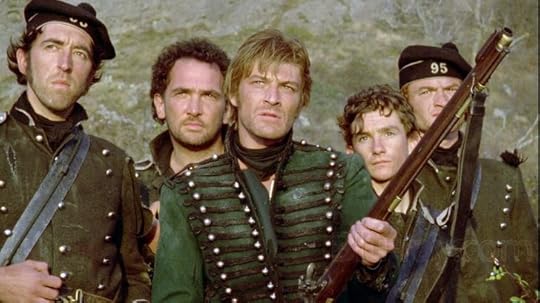
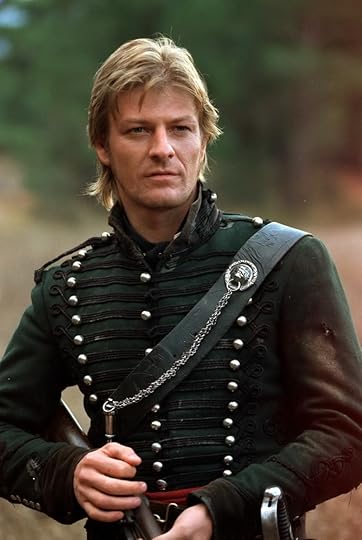
After publishing eight books in his ongoing Sharpe series, Cornwell was approached by a production company interested in adapting them for television. The producers asked him to write a prequel to give them a starting point to the series. They also requested that the story feature a large role for Spanish characters to secure co-funding from Spain. The result was Sharpe’s Rifles, published in 1987, and a series of Sharpe television films staring Sean Bean.
A series of contemporary thrillers with sailing as a background and common themes followed: Wildtrack published in 1988, Sea Lord (aka Killer's Wake) in 1989, Crackdown in 1990, Stormchild in 1991, and Scoundrel, a political thriller, in 1992.
In June 2006, Cornwell was made an Officer of the Order of the British Empire in the Queen's 80th Birthday Honours List.
Cornwell's latest work, Azincourt, was released in the UK in October 2008. The protagonist is an archer who participates in the Battle of Agincourt, another devastating defeat suffered by the French in the Hundred Years War. However, Cornwell has stated that it will not be about Thomas of Hookton from The Grail Quest or any of his relatives.
Испания, 1809 година. Голяма част от страната вече е овладяна от войските на Наполеон и населението е подложено на произвол и терор от безмилостните завоеватели. Испанските армии са разбити и разпръснати, положението изглежда неспасяемо.
Изпратеният от англичаните експедиционен корпус също е победен и е принуден да се оттегли, за да бъде евакуиран по море. Малък английски гарнизон е останал да защитава столицата на Португалия, но не се знае до кога...
В този момент, на Шарп който е все още лейтенант и забит на незавидната позиция като интендант на рота от 95-ти полк, все още предстои отново да се сблъска с французите - безспорните владетели на европейските бойни полета в тази епоха.
Стрелците са оставени в ариегарда при отстъплението и естествено, когато нещо може да се обърка, то неизменно се обърква. Още първата схватка в книгата е бърза, кървава и безмилостна. Като резултат, Шарп се оказва най-старши на откъснати от основните сили петдесетина стрелци. Той трябва да си извоюва уважението на мъжете и да успее да ги спаси, в една разкъсана от война и междуособици Испания.
В сюблиминя момент на неговите проблеми (физическа разправа с бъдещия сержант Харпър), се появява една ярка фигура, която ще помогне много за формирането му като боен офицер - испанският кавалерист и идалго, майор Блас Вивар. Вивар има малко хора, а трябва да изпълни съдбовно поръчение, което може да спаси родината му. Шарп няма избор и се прсъединява към него, за да започнат едно стремително и лудо приключение...
This eventful historical adventure, originally from 1988, is the 6th volume chronologically of the wonderful "Richard Sharpe" series.
At the beginning of the book you'll find a well drawn map of Spain and Portugal, with at the heart of this story Santiago de Compostela in Galicia, while at the back you'll notice some useful historical info concerning this book.
Storytelling is excellent, all characters, real historical and fictional, are very believable and lifelike, while the battles and skirmishes are very well described and pictured.
The story starts off in January in 1809, and Quartermaster Lieutenant Richard Sharpe finds himself on the retreat from the French and heading towards Corunna under the supervision of Sir John Moore, but they will lose somehow contact with the main army and get lost in the Spanish hinterland, and its now to Richard Sharpe to take the lead of the Greenjackets, the 95th Rifles.
In a bitterly cold winter Sharpe and his Greenjackets will come into contact with a Spaniard, Don Major Blas Vivar, who's a believer of the old Spanish ways of belief and honour, and who carries with him a strongbox containing a big miracle secret, and that secret is getting the full attention of the French with in their midst a Spaniard who's Blas Vivar's older brother, who's a believer of the French and their new ways, and that brotherly animosity will come to final reckoning at the battlefield around Santiago de Compostela.
What is to follow is a very entertaining historical adventure that will come to a temporary conclusion at Santiago de Compostela, insofar that the Spanish will continue to fight a guerrilla war against the French, while the British will regroup in Portugal and start their battles against the French forces of Emperor Napoleon Bonaparte anew.
Very much recommended, for this is a wonderful addition to this excellent series, and that's why I like to call this episode: "A Very Enjoyable Miracle Rifles"!
When people ask about the Sharpe series I usually refer them to this title. It's not the best but is very good. All the elements of the series are there. You get a good sense of Sharpe as a character. there's good character development non stop action and Cornwell patiented battle writing style.
"He might not be a born officer, but by God he was a born soldier. He was the son of a whore, bereft of God, but a God-damned soldier."
I've decided that the best way to approach the Sharpe series -- in which the publication order differs so radically from the publication order as to seem all but an exercise in randomization -- the way one does when reading stories about Conan the Cimmerian. There might be some narrative carry-over from novel to novel, but it's best to just regard them as discrete stories that happen to be about a guy with the same name and more or less the same character.
I say this because Sharpe's Rifles is the point where a lot of people who have chosen to read these books in chronological order start complaining about inconsistencies. The book was written some half a dozen years after those of the original core series, but cast as a prequel to them -- and the books I've read so far were written many, many years after this one, but take place earlier in Sharpe's career.
So in a lot of ways, the Richard Sharpe in Sharpe's Rifles bears little resemblance to the character I've grown to love through his adventures in India, at sea, and in Denmark, except in the ways described in the ur-Cornwellian sentence I quoted at the beginning of this post. He's still pretty uncouth and brutal, still an all but conscience-less and cold-blooded killer, but he seems only to have honed those qualities from his prior adventures* but not to have experienced the character building that came with them. To wit: he is unsure in his authority (though it could be argued that the years he has spent as a downtrodden Quartermaster for the 95th Rifles might have eroded the confidence he gained in India and Denmark), a complete sucker for anything in a skirt (see my asterisk below) and taking lessons in leadership from the Spanish major Bias Vivar that he really ought already to have absorbed from the good examples of his protectors in India like McCandless.
But these are small quibbles, and become meaningless once one has agreed to treat the novels as things outside of time and narrative continuity. Especially when the material at hand is so good, as it is here. For Sharpe's Rifles has everything I've come to expect from a Sharpe story: over-the-top adventure (here a ragtag band of survivors of a famous retreat across Spain is teaming up with a small-but-elite cadre of the Spanish army commanded by the aforementioned Don Bias on a mission to bring a Holy McGuffin to the Cathedral at Santiago de Compostella and thus create a new legend to inspire the Spanish peasantry to rise up against the hated French invaders), internecine bickering, inspired combat tactics, cold chivalry among enemies, and all the fighting, drinking and swearing (if not, this time, the whoring) one might expect from a good piece of military fiction.
Here, too, is an origin story of sorts, though its significance is lost to chronological readers who have not osmotically absorbed a certain level of meta-knowledge about the series -- for it is here that Sharpe and his gonna-be best friend, Sergeant Harper, meet for the first time. And it's a pretty good meet as those go -- Harper almost stages a mutiny against Sharpe! -- but it's still not as good as Aubrey and Maturin and the concert at Port Mahon. But that's maybe not a fair comparison, right? I'm sure back in the 1980s when only the original core Peninsular War books existed, fans of Sharpe/Harper were delighted to observe this meeting, but for us chronological readers starting in the 21st century, it will never have the same power.
Still, cracking good stuff. Again, lots of explorations of how the rifle changed warfare, and how swords still matter, even if one sword is in the hand of a guy astride a big horse and the other in the hand of a guy on foot who ran out of ammo or out of time to reload his weapon, lots of amusing ruses de guerre... and then there's the attack on Santiago itself, which doesn't hold a candle to the big set-piece battles we saw in India, but is still very satisfying indeed.
Truly, Sharpe never disappoints.
*At least, thank goodness, his prior adventures don't involve a lot of ret-conning; the allusions to his deeds in India, at Seringapatam and Gawalghur, etc. match up with the stories I've read. Well, except for Lady Grace, his lover from Sharpe's Waterloo who died after giving him a son before Sharpe's Prey. I'm pretty sure that once you've bedded a gorgeous noblewoman you're not going to be so terribly overawed by a mere member of the impecunious country gentry, however mischievous and cute.
If you're not going to start at the beginning, this is a great place to start Bernard Cornwell's long-running Napoleonic War series. The events in Sharpe's Rifles take place when European hostilities between the French and English really took off, and it also contains the initial meeting between our hero Sharpe and his trusty sidekick Harper. Besides that, it's just a solid book in this truly action-packed series.
This is one of the best cersies I have ever had the pleasure to read. This is a ceries about a soldier named Richard Sharp. He was a bastard from the bad from side of London. He was used and abused by an orfanage and he managed to escape and made something out of himself in the English army. He never shook the fact that he was and unfortunate no matter what he had accomplished. I recommend this book to all. Warning: There is a lot of bad language and some descriptions of sex.
Sharpe knew himself to be a tough man, but he had always thought of himself as a reasonable one, yet now, in the mirror of William’s nervousness, he saw himself as something far worse: a bullying man who would use the small authority of his rank to frighten men…
In February 1809 the British army under Sir John Moore is routed by Napoleon’s forces and is in retreat to the port of La Coruna in North-west Spain’s Galicia region, hoping to escape in Dunkirk-fashion back to England. Lieutenant Richard Sharpe and the men of the 95th Rifles under his command become separated from the bulk of the troops, and are trapped at a river crossing, saved by Spanish Cazadores, led by the charismatic aristocrat Don Blas Vivar.
Sharpe wants to head south to the border with Portugal to join the British garrison at Lisbon, a decision at odds with his men who distrust an officer risen from the ranks, and he is equally despised by officers of allied armies and the enemy alike. Vivar enlists them to first head west to accompany his men carrying a strongbox which, the Riflemen believe, contains gold and jewels to prevent it falling into the hands of the enemy. Progress is slow and arduous, avoiding the roads, and they encounter a gutted village where they see at first hand the savagery of the French against the peasants.
They journeyed through the night, climbing ever higher and always into the teeth of a wind that brought the chill from the snow which lay in the gullies of the upper slopes. Past midnight, from a wooded spur, Sharpe saw the far off gleam of the western sea. Much closer, and beneath him in the dark tangle of the lowlands, a smear of camp fires betrayed where men were bivouacked. ‘The French,’ Vivar said softly.
Vivar, a passionately religious man, rails against Sharpe (an agnostic), but then they are side-tracked by an English couple and their niece, dour Methodist missionaries, there to convert the Spanish away from Papism, with little success.
The French are persistent and Sharpe realises that they are after the coveted strongbox they have been duped to protect. Finally, in a high country fortress disused for centuries, Vivar reveals its contents and their destination as the city of Santiago (St James – the patron saint of Spain) de Compostello (field of stars), which he is to use as a rallying point, invoking the spirit of St James to help the Spanish rid the country of the French, as he had nine centuries earlier against the Moors. Naturally, some Spaniards disagree, seeing the French as “enlightened and progressive”.
This is a novel on many levels, binding history with fiction. At its centre, a brilliant soldier and tactician, leadership thrust upon him yet with barely the skills to lead, who needs to gain the respect of his men. The reader follows his progress, from self-doubt to victory in battle (and there are several of those). Secondly, there is the attention to detail, of weaponry and uniform - the Riflesmen’s tattered rags and boot soles wound with twine, contrasting with the finery of the enemy. We learn what they eat (bare rations supplemented from what they glean from the land or are given by villagers). Then there are the smells of warfare: blood, vomit, horses chaffed and ridden almost to death and taking the brunt of the attack (not recommended for animal lovers). Finally there is the location itself, Santiago de Compostello, the destination of pilgrim tracks from across Europe for 1200 years, now UNESCO-listed and visited by millions.
This read almost like an origins story for Sharpe. It shows how he first took command of the Rifles, how Sergeant Harper because his best friend, and how the British army began the long process of driving Napoleon and the French out of Spain.
The best thing about this book by far was actually nothing to do with Sharpe -- it was the way the author describes the uprising against the French. The way the Spanish peasants ambush and savagely assault the regular French troops has a disturbingly modern feel. Sharpe is actually more of a war correspondent than a soldier in a lot of this, as he makes you feel like you are right there and witnessing history. It's amazing when you compare this book to so called literary works like HOMAGE TO CATALONIA by George Orwell or THERE YOUR HEART LIES by Mary Gordon. Those books are bout the Spanish Civil War but Spain never comes to life when Mary Gordon or George Orwell write about it. They really don't like the Spanish people or care about them. Bernard Cornwell makes you understand why Spain is so unique and why the people resisted Napoleon.
On the other hand, all the writing about Sharpe and Louisa and Don Blas is unbelievably bad. Bernard Cornwell knows nothing about women, nothing about love, and nothing about how people interact with each other on even the most basic levels. It was like wincing on every page to see him try to sell the idea that Sharpe even likes Louisa, let alone that he loves her. And of course he shows the girl as being two-faced, flighty, selfish, and childish all the time he's pretending that Sharpe likes her. It's so bizarre, like Cornwell thinks he has to put a desirable young woman in the book just to maintain the fiction that Sharpe is a "real man." Yet he never seems to relax when women are around! He's so resentful and defensive all the time. And there was one really grotesque scene in a tavern where Sharpe is groping a Spanish whore in front of Don Blas, just to show off. And it was literally a scene a creepy twelve year old boy would make up for the same reason -- because "that's how men behave." Normally I totally hate feminists who talk about stuff like "rape culture," but thanks to Sharpe I see what they mean.
More of a 2.5, but definitely my least favorite of the series so far. I didn't care for the reader, Fredrick Davidson, which didn't help. While he was tolerable, his Spanish voices were very low, gravelly, & almost unintelligible at times, while all his Irish voices were very high & lilting. Since one of the Irishmen was a really big, tough sergeant, the high voice didn't fit my image of a red haired Lee Marvin well.
Sharpe wasn't shown in a very good light for most of the book & the historical afterword basically said that "it didn't happen that way". One of the things that I like about the Sharpe books is that they usually DID happen that way, with a few minor changes to put Sharpe into the action. The sinking feeling in my stomach when I heard the news told me just how much I like that & have come to rely on Cornwall's historical accuracy. It's kind of the point for me.
There were quite a few editorial goofs, too. For example, an officer was herding his men by hitting them with the edge of his saber. It was pretty obvious from the context & the results that it was the flat. Caltrops don't just stick into the soft frog of a horse's hoof, but also into the sole, yet several times it was put that way. Irritating.
I listened to book #3, Sharpe's Fortress, just before this. My library doesn't have books #4 & #5 in audio format, but I read the 5th, Sharpe's Prey some years ago. The next audio book I have is #9, Sharpe's Gold. I think I'll take a break for a while & maybe come up with book 7 or 8 in the meantime.
This takes place in Spain at the beginning of 1809. France has turned on Spain, previously an ally, and they've imprisoned the Spanish king. Now Napoleon's brother is sitting on the Spanish throne. Ah, nepotism.
Sharpe and a detachment of the 95th Rifles have been separated from the English Army, which is skedaddling to the coast since they're leaving Spain. The Riflemen are cut off from joining the Army due to the surrounding French regiments. While they are trying to skulk around the French and make their way to the closest port, they come across a small Spanish force on a secret mission of their own. The Spanish and the Riflemen need to consolidate for safety and overcome mistrust at the same time.
I loved this one! The demoralized Rifles have to learn to trust the new Lieutenant Sharpe; he's only been known to them as a quartermaster. On the flipside, Sharpe has to learn how to act like an officer and how to treat his men properly. I really appreciated the moment when he realized that he was acting just like the type of officers that he loathed. And Patrick Harper, Captain Murray, Hagman and the rest were very enjoyable to revisit.
For me, this is the book that turns a very good series into a truly excellent one. And now that Sgt. Harper and the Rifles are firmly set into the storyline, it maintains its excellence from this point forward.
I was advised by many people to start this series on #6, Sharpe's Rifles, so I did. This story was crammed full of scenes depicting the grim brutality of the Napoleonic Wars - which I really loved .
My only regret is that I got this on audiobook. The narrator was distracting and used terribly fake accents. When I pick up other books in the series, I'll have to get them on Kindle.
Тук вече започва историята на Шарп, както я знам от сериала с Шон Бийн. Няма друг Шарп освен Шон Бийн, и точка. Появяват се за първи път стрелците, Харпър и дон Блас. А Шарп се поти над неблагодарната задача да командва непокорни войници със склонност към пиянство, вместо сам да ругае началството, защото началството е тъкмо той.
Испанското суеверие ми е малко в повече, както и очернянето на французите, но прочитът е много приятно задимен от барута на Наполеоновите войни.
Sharpe’s Rifles is one of my favourite books in the series. From the first page, the story draws you in with its thrilling combination of historical detail and gripping action. I particularly love the supporting characters, each brought vividly to life, adding depth and humour alongside Sharpe’s sharp wit and courage. The camaraderie, tension, and clever strategies keep you turning pages, while Cornwell’s meticulous research makes the Napoleonic setting feel authentic and immersive. This novel perfectly balances adventure, character development, and historical intrigue, making it a standout in the series. I find myself returning to Sharpe again and again—it’s a true classic for any Sharpe fan.
Sharpe, now a Quartermaster of the Rifles, finds himself the most senior officer and must now lead his group to safety through Spain as the French hunt both the English and the Spanish. On the way, he joins forces with Major Vivar who is on his way to Santiago de Compostela in one last desperate attempt to fight off the French.
The military fiction was so well done I found myself anxious during the battle scenes. I think the greenjackets are my favourite group Sharpe has been in so far (I can’t wait to see more of Sharpe and Harper being besties). I've missed this series and will definitely make it a priority now. As usual Rupert Farley’s narration remains superior.
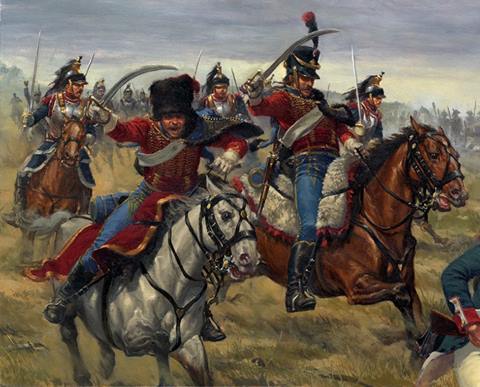
Number 6 in the Sharpe series. This story takes place just after the French defeated the British at the battle of Corunna in 1809. The British are in disarray trying to get to safety via the coast where the British fleet is waiting to evacuate the defeated army. The 95th Rifles are separated from the main army and are being harassed by French dragoons. There are constant rearguard skirmishes which are taking a toll on the troops of the 95th. In one skirmish the last, but one, officer is killed. The last officer standing is Lt Richard Sharpe. Up to this point Lt Sharpe was the company quartermaster. Look down on by his fellow officer because he was promoted from the ranks. He is also ignored by the rank and file because he’s nothing but a jumped up soldier, just like themselves. They bitterly resent being told what to do by a pretend officer. If these men are to survive, Sharpe has to gain the respect of these men and soon. Whilst struggling with the bitter cold in the Spanish mountains Sharpe and his men fall in with a group of Spanish soldiers. The Spanish troops are on a mission to plant the flag of Santiago in the French garrisoned town of Santiago de Compostela. Although he feels that this is nothing more than a pipe dream, Sharpe feels he has no choice but to fall in with the Spaniards. As usual, there is a young attractive woman, but for once, she is immune to Richard’s masculine appeal. Falling instead for the dashing commander of the Spanish troops.
This, once again, is a fast paced, rollicking adventure.
I am reading the Sharpe books in chronological order and have just reached Sharpe's Rifles, the first meeting of Lt. Richard Sharpe and his best friend, Sgt. Harper, and I have to admit that the moment doesn't mean all that much to me.
It's crafted to be one of those great moments in fiction, and I suppose it could have been if I had approached Sharpe's Rifles from a different direction. Had I been reading the books in order of publication or even seen the occasional installment of the BBC's Sharpe movies, I think I would have been delighted to see the meeting of these men. But reading the books in order gives me no stake in their relationship. I have come to appreciate Sharpe, but I don't know Harper at all and just don't care about how they met yet.
That could change as the series goes on, but I am still not sure it would make a difference as far as their initial meeting is concerned because, as I said, it is "crafted" to be one of those great moments. And I don't know that the series has what it takes to be a "great" series, let alone be important enough for the meeting of its principles to be of serious interest to the literary world at large. Moreover, the crafting of the meeting feels forced in a way that truly great meetings of characters do not. Aubrey and Maturin meeting (a fine example considering their place in the Napoleonic oeuvre), coming as it does in the opening pages of the first book with no need for a prequel, is an organic growth of the story, and its impact is given a chance to grow over the course of Master and Commander with a feeling that anything could happen. And none of that is the case with Sharpe and Harper.
Regardless, Sharpe's Rifles is a decent read, but not one of the best in the series. There are too many inconsistencies with the books that come before, and Sharpe's tendency to fall for every pretty girl above his station (which he has done in ever preceding book, yet this is never mentioned in Sharpe's Rifles) is already becoming tedious.
The battles are rousing, though, and Cornwell always includes something fun and inventive -- like Sharpe's use of caltrops against the French Cavalry -- and Sharpe's brutal efficiency consistently sates the potential bloodlust of Cornwell's readers.
Bernard Cornwell also make sure there are interesting supporting characters. Despite the weakness of Sharpe's meeting with Harper, the Irish Sergeant is a promising partner for Sharpe, and the fiery Blas Vivar, the Spanish Major trying to work a miracle against the French, succeeds in overshadowing everyone in the story. The only complaint in the supporting cast is that every Frenchman is turning into a Napoleonic era Nazi -- too cruel, too dishonourable, too clever and just a little too evil. It will become downright annoying if it continues for the rest of the books, but for now it is merely noteworthy.
Sharpe's Rifles is only worth reading if you're committed to the series, if not you can probably get away with watching this installment on BBC. I have a feeling you won't miss anything of importance.
Sharpe's Rifles starts in 1809 with the Peninsular War in Spain already raging. For those who aren't familiar, the Peninsular War was one of the big conflicts of the Napoleonic Wars, with basically Britain, Spain, and Portugal duking it out with the French on the Iberian Peninsula. When we join our hero, the Spanish armies are destroyed and the British are already outnumbered and on the retreat from the French hordes. Due to some typical snobbish officer dumbassery, Sharpe and a small group of Riflemen are cut off after an attack on the British rearguard by French cavalry, and must ally with a charismatic Spanish major with his own dangerous mission.
Chronologically speaking, this is a new kind of story in the series; it's one where Sharpe is in a significant position of command. He's ultimately the one making the decisions, whether or not the Rifles like it. Cornwell presents the trials and tribulations of having command of a group of people in a wartime setting very well, and it's great to watch Sharpe deal with them. This book really feels like we're getting into the meat and potatoes of the series now: Sharpe's experiences in the Napoleonic Wars. The naval voyage, espionage, and small military engagements of the previous books are great stories for the character to shine in but at his heart Sharpe is a soldier above all things, as Cornwell is fond of reminding us.
This entry was definitely one of the most entertaining of the series so far, things start out explosive and disorienting and Sharpe and his men struggle violently to survive in war-torn Spain. I loved Blas Vivar, the Spanish Major that Sharpe falls in with early in the book. He's charismatic, stubborn, funny, brave and I enjoyed his stories about his ancestors and the Reconquista. Together they predictably wreak havoc on the French in a series of gripping encounters. When you think Napoleon you usually think big-scale set piece battles but a lot of fighting in the Peninsular War was just mean and nasty guerrilla warfare; really, the perfect setting for Sharpe.
All of that good stuff makes this one of my favorite Sharpe books so far. Then the other shoe drops...some of my friends on this site will be completely aware of how irritating I find the love stories in these books. This one was just utterly vapid and pointless. If I remember correctly there was even a scene where Sharpe first meets this girl and the chapter ended with something like "And Richard Sharpe was in love." and I just wanted to fucking hurl the book in disgust.
Please understand this is not some macho knee-jerk reaction to the concept of love stories. When well done, they can either add a wonderful level of dimension and emotional reaction from the reader or even stand as fully-formed and satisfying stories in their own stead. The love stories in these books will NEVER accomplish either of those things. I don't get why Cornwell keeps insisting on doing this shit. It literally adds nothing at this point. I liked some of the stuff with Grace but this needs to stop. It would even be more tolerable if Cornwell handled it in a James Bond-type manner, where Sharpe is just basically trying to get laid but he's not. It's almost insulting at this point how Cornwell demands on putting these subplots in every book and it's also a testament to how much I like these books that I'm willing to put up with this bullshit.
So yeah...a very fun but clearly flawed entry in the series. I'm obviously gonna read another one of these in like a week or two and see what happens when the war heats up and how Sharpe continues to grow as a commander. It's so hard to describe what makes him such a compelling character; he just utterly lacks pretense and has this vicious, scary desire to live and fight while also managing to somehow be likable and approachable, but can also be cold as ice and has straight up committed murder at this point in the series to further his own goals. It's that kind of uncomfortable but compelling complexity that makes him my favorite Cornwell character.
I've read many of his other series (Grail Quest, Saxon, Warlord, etc) but have not read any of the Sharpe's Rifles until now. Typically great fighting scenes, good characters, strong story. Brings the period to life. Now to find a bunch to acquire and read...eventually. 3 Stars
One of the best books so far in the series. The superhero excesses from the Indian campaigns have been tempered and Richard Sharpe is caught in a more convincing posture as a freshman officer recently promoted from the ranks and struggling to impose his authority on a band of recalcitrant soldiers. His encounter with Harper is memorable and I look forward to further interaction between the two personalities. As usual, there is a romance element in the novel, and this too has been treated in a more convincing manner than previous conquests of our gallant swashbuckler.
The historical background of this Spanish adventure is probably the less accurate so far, with much of the action around Santiago de Compostella coming from Cornwell imagination, but the plot is well paced and reserves some surprises.
The book, set in 1809, covers Sharpe's early days. Here he is still a reluctant officer in French-occupied Spain. He must deal with many enemies: :: the French, who outnumber the fleeing British :: Sharpe's own men (the Rifles) who believe he is in over his head, and :: his own self-doubts.
After a fight with his mutinous soldiers, Sharpe gains an ally. Don Blas Vivar, an aristocratic Spanish officer, takes over. Vivar is the guardian of a mysterious sealed chest. The French desire this enough to send a colonel and his detachment of dragoons to pursue. Vivar means to hoist the flag of Spain's patron saint over Santiago de Compostela, now in French hands. This will be a sign that Spain will be victorious. The plans become complicated when Methodist missionaries and their young niece join them.
Loads of action and a gripping tale make for another excellent Sharpe.
I re-read this as research for the next Extraordinaries book, not for facts so much as Cornwell's gift for capturing the feel of the Spanish countryside and the grittiness of military life in the 19th century. Cornwell's style in this early novel isn't as solid as it becomes in later books, and there's a feeling of distance sometimes between the story and the reader, but that's really my only complaint. Richard Sharpe is a compelling character whose strengths and weaknesses combine to keep him from being absurdly heroic or a grim anti-hero. I like him very much, even when he's being less than heroic, because Cornwell never falters in his characterization.
I'm a fan of the movies as well, and what struck me this time was how well I remembered all the secondary characters and how easy it was to picture the actors who played them. The casting choices for Sharpe's men were remarkable.
The other thing that struck me was how well Cornwell put together Sharpe's backstory. He wrote the books out of chronological order, which means he had to make things he wrote in this book stay consistent with the stories he wrote later of Sharpe's early career. That is hard, but from what I could tell, Cornwell didn't make any major contradictions. I find that impressive.
And the story is just so exciting. Battles, skirmishes, sieges, infiltration under cover of night...it's compelling without being overwhelming. I've docked it a star because of what I said earlier about Cornwell's style, which intruded on my reading experience occasionally, but in general this is just incredibly engaging. I look forward to more re-reading of the other books in the near future. And I think I've nearly convinced myself to make my next heroine a rifleman.
Bernard Cornwell was one of the first writers ever to say anything nice about me in print, and we entered into a brief correspondence – and an exchange of books – which I really should resurrect, if only to tell him how much I enjoyed Sharpe’s Rifles. I’ve dipped in and out of the Sharpe books, which details the exploits of the titular British rifleman during the period before, during, and after the Napoleonic Wars, but somehow I’d never read Sharpe’s Rifles, chronologically the first in the series but actually the sixth to be published. It’s a real gift to be able to write sustained action (in a way, it seems to go against the whole notion of “show, don’t tell,” since action requires description — “telling” — to bring it to life, and that’s harder to do than it appears) and maintain momentum over the course of an entire book without sacrificing nuances of character, but Cornwell succeeds. Neither does he overwhelm with historical and military detail, which is another rare skill: it’s obvious that he knows his stuff, and is confident in his knowledge, which allows him to leave most of it out. After all, nobody likes a show-off.
This book is three hundred pages, and it took me over a month to read. It had great battle scenes, but was completely dull when the characters weren't killing or trying to kill each other. I also really DO NOT ship Louisa and Sharpe. I think I ship Snow White and Bigby over these two. Ugh. The battle scenes are this book's redeeming quality. I've heard this is the worst place to start with Sharpe. I should've listened to Benghis and started with Sharpe's Tiger...
6th book in Cornwell's . I am glad I decided to read the books in Chronological order. If you chose/choose to go the publication route, my thought is that you would miss Sharpe's beginnings in the English service, and thus miss a lot of the background.
In this episode Sharpe is in Spain, still a Quartermaster, but this time he is allowed in the fighting lines at times. He and some of The Rifles become separated from the commanders, with Sharpe being the highest officer left in the the group. With Sharpe in command they begin a long treacherous journey to get to the troops that are hopefully still in Portugal.
This is the first of the Sharp books that I have tried as an audio book. Overall, I was a bit disappointed. The narrator had a good Oxford English accent that worked for most parts but although he gave Sharpe and Harper decent Yorkshire and Irish accents, they both came off as somewhat high pitched and whinny. To me they didn't fit at all.
In this story, Lt. Sharp's commanding officer is killed and his unit is cutoff from the rest of the British forces in Spain, 1909. So Sharp has to take command for the first time. His men resent him as he was promoted from the ranks, and in their opinion 'not a proper officer'. Of course, by the end of the book he has won their respect. Not bad story wise and as usual there are some historical facts woven in there.
I have actually read several of Bernard Cornwell's Sharpe series before, but it had been some time ago. I was glad to re-immerse myself in a Napoleonic campaign of long ago. Sharpe is a hero that comes across as a real person. He responds authentically to the challenges he faces. I am not sure how much of the book is historically accurate, but it rings true to me. Clearly, the campaign in Spain was a bloody one, and much of the book is devoted to military strategy and the nuances of battle. Some might find all that a bit much, but it is certainly my cup of tea. I gotta go back and re-read some of these, and find some new ones besides.
Cornwell owns the Peninsular War from a fictional standpoint. I am reading Esdaile's history of this campaign and Sharpe's Rifles rings true from start to finish. While this is not in the same league as the Aubrey/Maturin novels (but then no other books are), Sharpe's Rifles is a quick, gripping read.
Book 6 covers the French invasion of Galacia 1809. Sharpe is still lowly Lieutenant and disliked by his fellow officers and soldiers. The British army along with the Spanish have been defeated by the French and Sharpe and his small company of riflemen find themselves separated from the main Army and forced to decide where to flee too. They join another small group of Spanish cavalry on a mission to unfurl a sacred flag that will be ignite the Spanish people to rebel against the French. Sharpe falls in love again but he loses her as he has no money and no religion. He has great trouble leading his men and is saved by the promotion of the large Irish soldier Harper who seems to be as good as a fighter as Sharpe and equally indestructible. Sharpe and the Spanish defeat the latest nemesis and Sharpe walks off to Portugal. This book was the 9th published and earlier then the previous five books in the chronological series. So some of the back stories were missed but that is only a small criticism in what is another great historical adventure story.
Lieutenant sharp trying hard to be an officer In a brutal close fought war with the French. Sharpe teams up with a Spanish Don who is trying to Work a Religious miracle using a gonfalon banner Of Patron saint James. Sharpe finally meets his match With Patrick Harper but who becomes his life long Companion. The British Rifles are tough and help win the days.
VOTO ALL'INTERA SAGA DI RICHARD SHARPE (FINORA PUBBLICATA IN ITALIA):5 Sono decisamente di parte nell'attribuire tale voto alla saga di Richard Sharpe, in quanto non posso non rimanere del tutto razionale di fronte alla prima e vera serie di letture che mi ha spalancato le porte del piacere della lettura d'intrattenimento, e che mi ha trasformato in un vorace e incontrollabile lettore che cerca perennemente di darsi una calmata e di autocontrollarsi nello scegliere i momenti giusti per praticare la lettura d'intrattenimento, spesso invano. Ok, spesso il canovaccio in ciascun libro della saga è perennemente rispettato, spesso i personaggi sono squadrati e psicologicamente prevedibili, ma tutto questo posso accettarlo senza remore di fronte alla bellezza delle descrizioni di Cornwell e alla pura azione adrenalinica che permea ciascun volume e che terrà incollato il lettore fino al termine dello stesso, soprattutto di coloro che, come me, amano l'ambientazione delle guerre napoleoniche. Purtroppo non si ha più nessuna notizia di una prossima uscita, ormai da 6 anni abbondanti, situazione che come poche altre mi ha davvero inferto un colpo al cuore, perchè questa è una delle pochissime saghe che davvero rileggerei cento e più volte, senza annoiarmi mai.