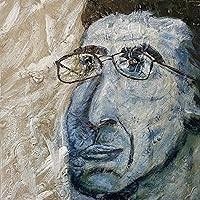
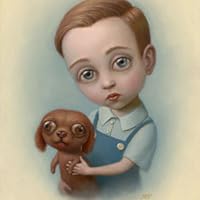
Glenn Barr's robots, creatures, and vixens live in a seedy yet swinging, 1960s universe, drenched in the haze of a postindustrial hangover. Working out of the burgeoning lowbrow movement in Detroit, Barr creates kinky inner sanctums adorned with disembodied cherubs, morally bankrupt babes, and sizzling femme fatales. Influenced by both pulp art and comics, Barr's work, beautifully sampled in this collection, is the visual equivalent of a David Lynch film.
Glenn Barr is the way art looks when you take Baby Boomer junk culture, dive bar mythology and blaxploitation nightmares and apply to canvas. His colors are dark and murky, like a pool of blood sucking you in, like quicksand.
There's Betty Rubble having a few at the local bar after coping with that wing-nut of a husband, Barney. Medusa turning tricks at a brownstone brothel. Whores and movie monsters and mermaids populate the images in "Haunted Paradise".
Glenn Barr’s Haunted Paradise reads like a visual novella: a tightly edited, obsessively staged universe in which mid-century glamour and urban rot coexist, and where the human figure—often a femme fatale, a weary vixen, or a mechanized other—functions less as subject than as cultural index. The book, co-published by La Luz de Jesus and Last Gasp in the mid-2000s, is presented as a handsome hardcover art monograph (the trade and slipcase editions run roughly in the 160–200 page range and the catalogue credits include contributors such as Jerry Vile, Carlo McCormick and J.J. Marcucci). At the level of surface, Barr’s imagery delights in pastiche: pulp illustration, pin-up calendars, and film noir signage are worked into layered tableaux that feel both vintage and anachronistic. Yet the book’s compositional unity is not nostalgia for its own sake but an ongoing interrogation of nostalgia’s dark underside. Barr’s streets are not simply retro; they are haunted—by consumer detritus, by lost modernism, by the afterimage of industrial decline. His canvases are populated with bottles, neon silhouettes, and disembodied cherubic motifs that enact a choreography of absence: what is most narratively charged is what is withheld. This assemblage of motifs—vixens, robots, and urban ruins—has repeatedly invited comparison to the dream logic of David Lynch, and the catalogue itself frames Barr as a Detroit-rooted lowbrow artist whose visual vocabulary riffs on pulp and cinematic disquiet. Formally, Haunted Paradise is as much about technique as it is about iconography. The reproductions in the volume (noted by reviewers and sellers for high-quality printing and tasteful spot varnishing) permit close study of Barr’s brushwork, surface abrasion, and collage gestures—marks that move the work between painting and ephemera. In photographs and plates that the book reproduces, one reads a meticulous attention to the facture: layers of glaze, crisp graphic outlines, and the occasional splotch of aerosol or stencil that reminds the viewer of Barr’s roots in street and lowbrow practices. The book’s design—especially in the slipcase edition—also foregrounds materiality; its clothbound presence, embossing, and die-cut details render the object an extension of the artwork’s tactile world. Thematically, Barr’s work destabilizes glamour by linking it to moral and industrial decay. Women in his paintings are often ambivalent figures: glamorous yet compromised, archetypal yet individualized. Machines and creatures—robots, winged oddities, and hybrid figures—function as interlocutors in a late-capitalist fable: they are at once companions and symptoms of a culture in which intimacy has become mediated, commodified, or obsolete. The book’s sequencing amplifies these tensions: early spreads flirt with seduction, middle sections insist on dilapidation, and later pages collapse the distinction altogether into surreal tableaux where emotion is mediated by object and architecture. This narrative pacing is one of the monograph’s quieter virtues. What distinguishes Haunted Paradise from a mere career retrospective is its curatorial point of view: the volume feels authored in the sense that it stages a concept rather than catalogues production. The essays and curatorial apparatus surrounding the plates (by the likes of Vile and McCormick) provide historical anchoring—situating Barr within the lowbrow/pop-surrealist constellation while also tracing influences from pulp, comics, and the cinematic imagination. These texts avoid both hagiography and reductive contextualization; instead, they read Barr’s imagery as symptomatic of broader cultural anxieties about desire, decay, and the afterlife of mid-century futurism. If the book has a limit, it is the very insistence on mise-en-scène: those readers seeking extensive critical apparatus—sustained theoretical readings in the language of contemporary art theory, or a fuller socio-historical excavation of Detroit’s influence on Barr—may find the analysis here elliptical. Haunted Paradise prefers suggestive montage to exhaustive exposition, and for many readers that will be precisely its appeal. The book’s project is not to solve the ambiguities in Barr’s world but to let them proliferate—inviting the viewer to linger, to reread, and to be unsettled. Haunted Paradise is a successful artist monograph: a sensorially rich object that reproduces Barr’s work with technical fidelity, frames it with measured commentary, and stages a coherent imaginative world. For students of contemporary lowbrow art, for admirers of pop-surrealist narrative, and for any reader interested in the uneasy romance between retro style and urban decline, this volume is an elegant point of departure—and a haunting one.
I have a select few books that I turn to in bored, restless times for inspiration, and this is one of them. His style is beautiful, and something you can really just flip through time and again and get just as much out of it as you did the first time you cracked the book.
Another artist whose work I admire. Great coffee table book collecting a lot of his work. Fortunate enough to own one of his works (although it's not in this book, since it was painted after this book went to printing).