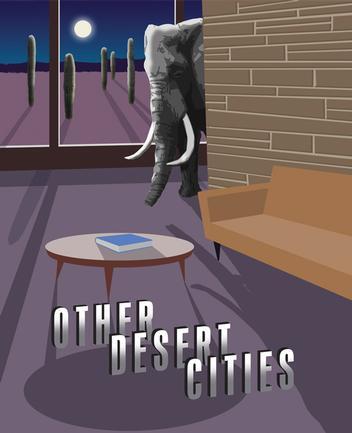
In OTHER DESERT CITIES, Brooke Wyeth returns home to Palm Springs to visit her parents after a six-year absence. A once-promising novelist, she announces to her family the imminent publication of a memoir dredging up a pivotal and tragic event in the family's history - a wound that her parents don't want reopened.
Brooke has come home to draw a line in the sand and is daring her family to cross it. Her brother won't play her game; her aunt knows way too much, and her parents fall into all their old routines as they plead with her to keep their story quiet. In this family, secrets are currency and everyone is rich.
In simplest terms, the play is about a girl who comes home to the desert with a story about where she is from, who her people really are, what she thinks they really are. Her parents represent an Establishment that she feels has betrayed this country. She goes to war with them, and blood is spilled.
Robbie Baitz was born in Los Angeles, California, the son of Edward Baitz, an executive of the Carnation Company. Baitz was raised in Brazil and South Africa before the family returned to California, where he attended Beverly Hills High School.[1] After graduation, he worked as a bookstore clerk and assistant to two producers, and the experiences became the basis for his first play, a one-acter entitled Mizlansky/Zilinsky. He drew on his own background for his first two-act play, The Film Society, about the staff of a prep school in South Africa. Its 1987 success in L.A. led to an off-Broadway production with Nathan Lane the following year, which earned him a Drama Desk Award nomination for Outstanding New Play. This was followed by The End of the Day starring Roger Rees, and The Substance of Fire with Ron Rifkin and Sarah Jessica Parker. In 1991, Baitz wrote and directed the two-character play Three Hotels, based on his parents, for a presentation of PBS's "American Playhouse", then reworked the material for the stage, earning another Drama Desk Award nomination for Outstanding New Play for his efforts. In 1993, he co-scripted (with Howard A. Rodman) The Frightening Frammis, which was directed by Tom Cruise and aired as an episode of the Showtime anthology series Fallen Angels. Two years later, Henry Jaglom cast him as a gay playwright who achieves success at an early age - a character inspired by Baitz himself - in the film Last Summer in the Hamptons; the following year he appeared as Michelle Pfeiffer's business associate in the screen comedy One Fine Day. In 1996, he was one of the three finalists for the Pulitzer Prize for his semi-autobiographical play A Fair Country. Subsequent stage works include Mizlansky/Zilinsky or "Schmucks", a revised version of Mizlansky/Zilinsky directed by Baitz's then-partner Joe Mantello (1998), a new adaptation of Henrik Ibsen's Hedda Gabler (first at L.A.'s Geffen Playhouse with Annette Bening in 1999, then at Long Island's Bay Street Theater with Kate Burton in 2000, followed by a Broadway production with the same star the following year), Ten Unknowns (2001), starring Donald Sutherland and Juliana Margulies, and The Paris Letter (2005) with Ron Rifkin and John Glover. His screenplays include the adaptation of his own Substance of Fire (1996), with Tony Goldwyn and Timothy Hutton joining original cast members Rifkin and Parker, and People I Know (2003), which starred Al Pacino. Baitz's occasional work writing for such television series as The West Wing and Alias led to his position as creator and executive producer of the ABC TV drama Brothers & Sisters, which premiered in September 2006 and ran for five seasons, ending in May 2011. Baitz was the New School for Drama's artist in residence for the 2009-2010 school year.[2] His play Other Desert Cities opened Off-Broadway at the Mitzi E. Newhouse Theater (Lincoln Center) in New York on January 13, 2011, starring Stockard Channing, Linda Lavin, Stacy Keach, Thomas Sadoski and Elizabeth Marvel. [3] The play was originally titled Love and Mercy.[4]. The production transferred to Broadway, opening at the Booth Theatre on November 3, 2011, with Judith Light replacing Lavin and Rachel Griffiths replacing Marvel.
Yes, it’s another bickering-family play ~~ but oh this one’s done right ~~ so right ~~ with sharply drawn characters and dialogue that zings into disconcerting territory. Writer Jon Robin Baitz makes us believe in this family ~~ we feel the emotional push and pull between five willful, creative, word-savvy and tired people. Clearly it’s taken years to get this bunch to the tipping point ~~ just seconds from a potentially catastrophic family blow-up ~~ but still keeping up their normal routine of joshes and jibes.
Polly and Lyman, retired from careers as Hollywood screenwriter and actor, are well-known GOP stalwarts who ran with the Reagan crowd. Their lefty children make them crazy, and vice versa. Trip works in L.A., where he produces a popular courtroom reality-TV show. Brooke lives in Manhattan, as distant from Palm Springs as she can be without getting her feet wet. She’s a novelist with a history of serious depression, coming home with what the parents hope is her long-awaited second novel.
But this time, it’s a memoir ~~ one that will blow the lid off family secrets Polly and Lyman have spent years hiding. It tells Brooke’s version of what happened to her lost older brother Henry, who as a very young man “went to war” with his right-wing parents ~~ becoming entangled in protests, and a bombing back in the Vietnam era. Henry “was most of my world,” says Brooke, who accuses her parents of erasing Henry from their lives and refusing to talk about him.
It’s a battle of priorities: left versus right, family loyalty versus artistic freedom. All of them struggle to find the right balance: Polly and Lyman are terrified of losing another child if Brooke’s depression recurs; she fears being one of her “crippled” friends who depend on a check from home. This memoir is her declaration of independence ~~ but at what cost? Our loyalties waver: there are qualities in each of these complex characters that both attract and repel. Who, if anyone, holds the truth of what happened?
But there’s more to Other Desert Cities than watching some other family go at it for a change. There are twists and turns, and a bigger secret than we know waiting in the wings. And there are choices to be made, ones we can consider in terms of our own lives. Would we be willing to destroy a family to reach some ultimate truth ~~ or can we live together, holding tight to our own divergent truths ~~ and ultimately choosing connection over principles?
"Other Desert Cities" is an intriguing play that was a little too slick and, in the end, slight for this reader. It probably plays better than it reads, epsecially with Stockard Channing and Linda Lavin (who has since left the play). Two very gifted performers. But by the time you finish the play, all the sharp dialogue, the repartee, the shrewd humor turn tiresome. And what is the play about? Very, very little. It's popular with critics, especially Ben Brantley. His sights are set too too low. At least "Clybourne Park" is tough, smart, unpredictable --and about something. "Other Desert Cities" is not about much at all.
Another living room drama in which a Big Family Secret is revealed. Seriously, can American theatre come up with nothing else? The central question is an interesting one: does the writer have the right to tell her family's story for personal gain? Unfortunately, we get sidetracked by lazy jokes, cliche political barbs, and mini-reveals that add little to the story but more drama.
Another play about chic sophisticates with emotional problems and first-world worries. Painfully burdened by the indignity of being published in a series of national magazines, the daughter of a movie star (and renowned political honcho) is wracked by anxiety about how her family will react to her new book. So, she leaves her home in Sag Harbor to visit her parents and younger brother for Christmas in Palm Springs. They play tennis, crack wise about Judaism and reality television, go shopping, and churn up a family secret. I guess there's an audience for this kind of stuff - and I suspect they're the same types of people who underwrite the fundraising efforts of off-Broadway houses. If you can relate to the trials and tribulations of overeducated, fussy, entitled wankers, well... bless your heart. Aside from all that, the writing is not bad and the plot unfolds in a steady, disciplined manner.
A finalist for the Pulitzer Prize for Drama for 2012, Other Desert Cities takes place in Palm Springs, California where a young woman (Brooke) returns home for Christmas to visit her parents (Polly and Lyman), brother (Trip), and Aunt Silda. Polly and Lyman are rich, and staunch conservatives (Lyman worked for the Reagan administration), however their children don’t share their conservative values. While the play could have focused on the cliché tension between children who don’t share their parents’ values, instead the play takes the tensions in a completely different direction. We learn that Brooke has just finished a memoir describing her family’s life – specifically an incident involving another brother who died due to an incident which Brooke ties to his having different values from their parents. The tensions from this scenario now revolve not around particular political values, but rather from the complicated relationships that exist within families. Is Brooke justified in sharing her version of truth, or is she taking advantage of her parents’ name recognition to sell a book? Are Polly and Lyman selfishly trying to protect their image, or is family that important? Baitz doesn’t take any sides in his dialogue; instead, he brilliantly shifts the reader’s sympathies to different members of the family at different times throughout these two acts. The personalities of the different characters are well-crafted, and come out through their words without any unnecessary monologues or explanatory notes. The dialogue is note-perfect and conveys the different tensions between each of the different characters well. Just a great play overall. Highly recommended.
I found all the characters hard to like. I know the audience is supposed to like at least one of these people, but I couldn't figure out which one. The daughter, Brooke, was selfish, the parents were stiff, the aunt was kooky and the son, Trip was sarcastic. In finding it hard to relate to these people, I found it hard to care about how this whole family drama turned out. I was excited about it when I saw the original cast listing, so maybe the actors saved it and are sympathetic on stage, but the writing belies any of that.
This is a privileged family, reminiscent of Ronald Reagan. The children never had to worry about money, and so became successful, self-absorbed, and then depressed. The conflict of the play is: Brooke is a novelist who decides to write a nonfiction narrative about her dead brother, who was involved in a semi-terrorist group when the father was on the political rise. She has been in a slump and has not been inspired to write anything since that semi-successful first novel. How will her parents react to this news when she tells them over the Christmas holiday that she has a publisher for her new book? Who cares? Not me. The way these characters started, I knew there could not be a happy resolution. Oh, they're all so sad; oh, they're all so repressed; oh, has any one of them actually ever had a genuine feeling? Melodrama galore. Self-righteousness galore. Huge disappointment for me. Does not make me jealous on how the other half lives if it is this hollow.
A fantastic, lesser-known family drama in the veins of The Humans. It's just as eerily relevant in today's political climate, as it was when it was first staged.
I tried to get day-of tickets to OTHER DESERT CITIES recently but refused to pay $120/seat. So I bought the script instead. I was able to picture Stockard Channing, Judith Light, and Rachel Griffiths in the roles, which made the reading fun. It's a quick read with the usual awful/delicious family revelations at the end, including a few good twists. I liked the "conservative parents/liberal kids" overlay, too.
I also bought the script to AUGUST: OSAGE COUNTY, which I'll read next, when I feel the need for another good dark comedy about messed-up families. (Although on TV, Enlightened is doing a pretty good job of filling that void these days.)
The more I read brilliant plays the more I know that I don't have what it takes to write one. Not that I won't. Not that I'll never have what it takes but damn, playwrights are good at what they do. The dialogue is crisp and flawless. The characters jump right out of the book and into my living room (just ask my neighbors, who had to listen through the walls as I read this). The story moves with ferocity towards it's inevitable end in a way that is impossible to bear and deeply satisfying. It makes me want to act and direct and see more plays.
*Note: When I read plays, I read them aloud and you should too!
I have never disliked a Baitz play, but this one was sublime. Going from a fierce argument about politics to a meditation on the state of the family in the 21st century (with sidetrips through art and trust issues), what the road that the playwright built finally brings me to is a gentle catharsis filled with hope for us all. Great play.
Damn! Just, DAMN! What an intense and uncomfortably brilliant look at family. Unbelievable! Clybourne Park better knock my socks off to validate why it won the Pulitzer and the Tony of this astonishing piece.
First play I've read in way too many years! This is a moving portrayal of the extensive damage caused by keeping family secrets and the losses we suffer because of fear. Real family tragedy here with comic relief--and insight--from Silda!
This play is 65 pages long, and it didn't pick up until page 60. Most of the dialogue is boring and repetitive, but there are a few monologues which are nice. Trip Wyeth is the most entertaining character.
Turns out I'm all plays, all the time so far this year. This is a good one. It of course relies on being well-cast to deliver the drama, but Baitz does a good job capturing family dynamics and the tensions of having different political views. Well-written and compelling.
Reading a few pages onto the first act, what is clear about playwright Jon Robin Baitz's stageplay Other Desert Cities is how he is responding to the more perfunctory stageplay Clybourne Park, which features fun but very basic dialogue that is built on one word lines
Jon's dialogue is much richer, hardly poetic, but still more grounded in how actual human beings talk. As of bewildered by how such a banal stageplay could receive what is essentially a biased award like the Pulitzer Prize, which to many of us authors actually meant something at one point in our own early literary jealousies.
Author Ernest Hemingway won the award for his novella The Old Man and the Sea, while Faulkner won his for probably every book he had ever written at that point. The issue is those awards were handed out nearly 70 years ago, and something clearly has changed in legacy media outlets.
For me personally, that change was made evident in 2016 after Harvard essentially instilled Critical Race Theories in American classrooms or so I am told by author Ben Shapiro. But for Jon, a gay man in the USA, that change was probably felt as early as 2008, and for conservatives, even further back.
YouTube has made underground journalism and opinions much more affordable and easier to accesss; before, it was radio signals broadcast on boats in international waters,.andaube some.obscure Robert Crumb comic books.
I will finish this stageplay. but I do find a hurt playwright responding to what is essentially a freshman style level of dialogue quite fascinating. We playwrights tend to stick together in our efforts, but maybe Jon has more of a personal hurt in this unfolding drama over integrity in the theatrical and broader communities.
But for thoughts on this subject, I will be presenting a world premier.of.my own plea for integrity in the arts with my debut stageplay, Do Audiences Dream of Electronic Sheep, set to debut at Penelope's Venue in Linkin Park...
Rounding up from 3.5 stars. This isn't a bad play, but I think I was expecting a bit more. I would still like to see a good production of it before I'm fully decided.
It's the story of a wealthy Southern California family. The parents are very entrenched in Reagan Republican circles. Daughter Brooke is a writer who has been stalled for several years on a second book, and she throws the whole family into a spin when she announces that she has a publication lined up, and it is a memoir. It's the story of her brother, a depressive who became active in the protest scene, then may have been involved in a bombing before killing himself, an act which sent Brooke into her own bouts with mental illness. She's hoping for a family blessing on her endeavor. Her other brother Trip has taken a lighter route to escape the pressure of the parents, become a producer of reality television. Then there's Aunt Silda, who has a long running rivalry with mother Polly.
I just wanted another five or ten pages of material here to flesh out the relationships between these characters, who are very promising, but not quite fully realized to me on the page. A great actor might be able to get enough out of them, but I felt like there might still be more to find about this family, especially Silda's relationships with the parents and with Brooke. Trip's story seems a little incomplete as well. Also, the ending is perhaps a little abrupt.
In Jon Robin Baitz's cleverly written play, family drama comes to head in a shocking way. The Wyeth family consists of the extremely conservative parents Lyman and Polly, their youngest son Trip, their liberal daughter Brooke, who is the protagonist of the story, as well as Polly's seemingly insane sister, Silda. Brooke and Trip have come to visit their parents in Palm Springs for Christmas, and while there, Brooke presents a manuscript she is publishing about the darkest chapter of their family's life - the suicide of her older brother. Defensive and bitter Polly blows up, Lyman tries to stay out of it, Trip is forced to keep things civil, and Silda smokes cigars and watches everything unfold. It is a nutty, often hilarious, and always interesting exploration of this particular screwed up family that I will definitely try and see performed if it is ever near me. The reason it doesn't get five stars is that I just couldn't connect to any of the characters (except Trip) and found myself rooting against them. All in all, a good read.
I didn’t love Other Desert Cities, which was nominated for a Pulitzer in 2012, but it should have won. Of the three plays nominated that year, it keeps a laser focus on the central plot and plays with the idea of family dysfunction within a story that doesn’t wholly work but is ambitious and thought provoking.
The Wyeth family, rich and conservative, had a tragedy befall them a few decades before: their oldest joined with anti-war protestors, blew up a recruitment center, and then committed suicide. Now, years later, their daughter has arrived with news that she plans to publish a memoir about her brother and her view of the family.
Baitz can’t quite connect his various ideas into a cohesive narrative – the play, on several occasions, gets close to coalescing into something brilliant – and the ending is both excellent and improbable. I wish Baitz had managed to corral all that potential, because the result would have been brilliant. Recommended.
I don't usually read drama, more because I don't think of it than anything against the genre. This was particularly timely read, a couple weeks after I visited the weird place that is Palm Springs, amongst the rich retirees playing in a fake oasis under barren mountains. I loved it. Yes, this is a terribly privileged white American drama, but family and old wounds really are at the heart of most of our mundane little lives. The play unapologetically centres that archetype, to great effect. Dialogue sparked with quick wit or cut uncomfortably. The family dynamic, particularly of the siblings, rang true while eschewing easy tropes. The truth that I felt is discomfiting (to be seen so clearly) but also relieving. The way the mother and daughter are hard - and alone out there yet unable to be anything but - resonated with me. I'm having trouble describing this, but I highly recommend it (but only if you have the time to read it in one sitting!)
I don't usually read drama, more because I don't think of it than anything against the genre. This was particularly suitable for me after a trip to the weird place that is Palm Springs, amongst rich retirees. It was amazing. Yes, this is a terribly privileged white American drama, but family and old wounds really are at the heart of most of our mundane little lives. The play unapologetically centres that archetype, to great effect. Dialogue sparked with quick wit or cut unerringly to raw human connections. The family dynamic, particularly of the siblings, rang true while eschewing easy tropes. The truth that I felt is discomfiting (to be seen so clearly) but also relieving. The way the mother and daughter are hard - and alone out there but unable to be anything but - resonated with me. I'm having trouble describing this - but I highly recommend
I do not care for “Who's Afraid of Virginia Woolf?,” so when I say this play is “Who's Afraid of Virginia Woolf?,” with George and Martha and their adult children, to me, it’s no compliment. I didn’t enjoy the time I spent reading it, so I have no interest in producing or doing it. I borrowed this from inter library loan.
I enjoyed this play about a daughter coming home to California to visit her family for the first time in six years. She's a novelist living on Long Island, and her family has been looking forward to reading her new book - until they find out she's written a memoir about her family and especially her older brother, who died by suicide when she was still in school.
Her parents are staunch Republicans and friends of the Reagans; she and her younger brother can't stand their parents' politics. There's both love and antipathy between all four of them, as well as between the mother and her recently sober sister who has come to live with them. I liked that the relationships were complex; you could see the characters struggle between building bridges and burning them.
While I go to plays frequently, I haven't actually read one in years and I was amazed by how the story came to life with just dialogue. That shouldn't be a surprise, but it was. By the time I got used to the format I had entered a richly developed world with a devastating family story at its center. Brooke, a daughter of privilege & money (and heartache) comes home with a draft of her memoir that skewers and devastates her conservative parents. She longs for their blessing even knowing how utterly she is punishing them. Smart, spare and poignant.
Brooke finally comes back to California to visit her family during the holidays. However, to the surprise of her Republican old-school parents, she also brings home her memoir. In the pages of her new book, she tries to process her own feelings about the family's best kept secrets. What else to do on Christmas Eve besides have the fight of their existence?
Overall, it was very natural and flowing, but there is only so much to focus on when there is one fight for the entire play. There's very little left unsaid and the characters rarely hold their cards to their chest.
I can see how this would work very well on stage, especially with Rachael Griffiths in the lead role as Brooke Wyeth and Stockard Channing as her mother Polly, as was the case for its Broadway run in 2011. It still works well on the page, with some sharp dialogue and a decent twist, although its analysis of the rightward turn of the Republican Party seems almost quaint in the age of Trump. The testy family reunion feels a little too familiar and I get a bit tired of the lifestyles of the rich and famous, but this is worth a read.
Some good characters in what is essentially a "well made play" structure. What's frustrating about it are the politics, which set pretty enormous stakes at the beginning but seem hollow by the end. Baitz's point may, indeed, be that political differences pale in importance to interpersonal connections. But characters with the most appealing politics tend to be revealed as the shabbiest souls, and vice versa, which suggests an unappealing and false binary.