

What do you think?

Alan Lomax: The Man Who Recorded the World
The definitive biography of Alan Lomax-from John Szwed,"the best music biographer in the business" (L.A. Weekly).
One of the most remarkable figures of the twentieth century, Alan Lomax was best known for bringing legendary musicians like Woody Guthrie, Pete Seeger, Muddy Waters, Lead Belly, and Burl Ives to the radio and introducing folk music to a mass audience. Now John Szwed, the acclaimed biographer of Miles Davis and Sun Ra, presents the first biography of Lomax, a man who was as influential as he was controversial-trailed for years by the FBI, criticized for his folk- song-collecting practices, denounced by some as a purist and by others as a popularizer. This authoritative work reveals how Lomax changed not only the way everyone in the country heard music but also the way they viewed America itself.
One of the most remarkable figures of the twentieth century, Alan Lomax was best known for bringing legendary musicians like Woody Guthrie, Pete Seeger, Muddy Waters, Lead Belly, and Burl Ives to the radio and introducing folk music to a mass audience. Now John Szwed, the acclaimed biographer of Miles Davis and Sun Ra, presents the first biography of Lomax, a man who was as influential as he was controversial-trailed for years by the FBI, criticized for his folk- song-collecting practices, denounced by some as a purist and by others as a popularizer. This authoritative work reveals how Lomax changed not only the way everyone in the country heard music but also the way they viewed America itself.
448 pages, Paperback
Published December 27, 2011
Ratings & Reviews
Friends & Following
Create a free account to discover what your friends think of this book!
Community Reviews
Displaying 1 - 30 of 61 reviews

January 10, 2011
If you’re American, Alan Lomax probably recorded your grandma. Alan Lomax was the man, he was an American giant, and he embodied or became embroiled in every twist and turn and up and down of every phase of American folk music in the 20th century. As soon as he heard folk singers he knew it was all pure gold. There was no money in anything he did but it didn’t stop him. He was too impatient for the academics, he attempted gargantuan feats of research with no resources, he lived like a bohemian from tiny grant to temporary position to royalty payment to tiny grant. He was in his 50s before he got anything looking like a regular source of income. He was a big Texan guy who had limitless energy, combine-harvesting charm and total commitment. He loved folk music and he even loved the folk who sang it. And sometimes he was a bull and the whole world was his chinashop.
TEN GALLON HAT
But we need start with John Lomax, brought up as “the upper crust of the po’ white trash” (his words) in Meridian, Texas. He was born in 1867 and grew up amongst actual cowboys, boys with cows. He had one year of college and became a teacher in the backwoods for six years. In 1895 at the age of 28 he scraped enough together to go to the University of Texas in Austin to get a degree and then wound up at Harvard doing some research into cowboy songs. His professor was George Kittredge, who had studied under Francis J Child himself. Talk about the apostolic succession. Soon he turned himself into a star after-dinner speaker. Subject : cow boys and what they like to sing about. In 1910 he published Cowboy Songs and Other Frontier Ballads published with an introduction by only-just-ex-President Theodore Roosevelt.

- the unlikely cultural radical
By now the ballad-collecting, ten-gallon-hat-wearing, cigar-smoking, raconteuring good ole boy persona was fully formed and this is who Alan grew up with. Alan was born in 1915 when the family fortunes were at their peak. He went to the poshest schools, ending up at Harvard and flirting with communism.
DOUBLE ACT
By 1931 with the Depression crushing the country the Lomaxes had crashed down, like millions of others, and were broke and jobless. John decided his lecturing was the only money-making prospect for the time being. He proposed another book and got a tiny advance from Macmillan. By May 1933 John and teenage Alan were on the road , the first field trip. It’s amazing this has never been turned into an earnest but cringe-making tv movie – it has all the ingredients : the firebrand proto-communist son, the conservative Southern father, continually at loggerheads about the purpose of their song-collecting, the dire expectations heaped upon the enterprise (this has to make some money!) , the wardrobe size shellac disc recording machine bouncing around in the back half of the car, the boldly going where no folk song collectors have previously gone, into black prisons, black churches, black Saturday night dances, into the black world of the South at a point where if the white administrators and officials weren’t already paranoid about their black populations and the pressure of exposes and contempt from Northern liberals already, the Lomaxes arrived just in time to redouble their suspicions. You can hear the prison officials dripping their venom all over J & A, this burly old boy and his teenage son, and they have to charm and smarm and hustle their way inside the prisons and then ingratiate themselves with the convicts who were had a tendency to think that if the Lomaxes made a record of them then it would be released and then they would be famous and then they would be released just like their record.
The people who sang for us were in stripes and there were guards there with shotguns. They were singing there, under the red hot sun of Texas, people obviously in enormous trouble. But when they opened their mouths, out came this flame of beauty. This sound which matched anything I’d ever heard from Beethoven, Brahms or Dvorak.
LEADBELLY
So 1933 and 34 was driving all over the South to the most isolated locations to record white and black performers. On their second foray into a black prison, Angola Penitentiary, Louisiana, they discovered Leadbelly, the human jukebox of black folk music. He got out of prison in 1934 and they became his managers, and he became their house servant and chauffeur. They took him to Washington and New York, laid on concerts, and became embroiled in a horribly complex relationship of mutual admiration, dependency and exploitation. (15 years after his discovery, Leadbelly’s signature song Goodnight Irene became the biggest hit of the year but a little late for him as he died the same year.)
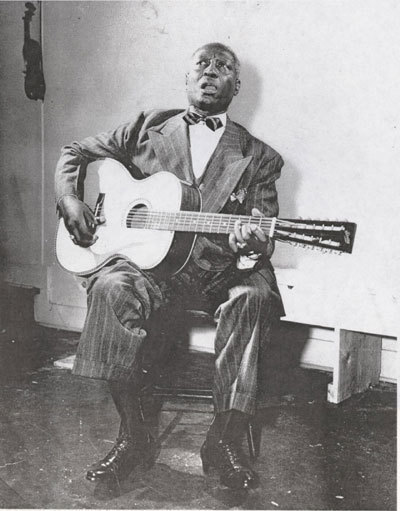
The American South of the 1930s were of course was where all the great blues singers were, from Son House to Skip James all the way to Robert Johnson. But the Lomaxes didn’t record them at all, thought they were just black pop song stylists. Alan later struggled with trying to figure out if the blues were part of folk culture or merely popular culture. It took him till 1940 to wake up. So his ears and his cultural antennae were not perfect.
The Lomaxes were amassing huge piles of recordings for the Library of Congress in Washington. They were folklorists and they thought that commercial music was the opposite of what they were doing. But of course while they were recording Texas Gladden in Saltville, Virginia singing The Devil’s Nine Questions in 1933 just a few dozen miles away in Norfolk a record company would be recording the exact same type of folk song, which they called hillbilly music, in a hotel suite which they’d booked for that purpose. The record companies would then issue their records in the Southern states, and the Lomaxes would drive back to Washington and deposit their records in a library. When 23 year old Alan finally did turn his attention to the commercial records, he was thunderstruck by their quality. He compiled the List of American Folk Songs on Commercial Records in 1940 and – lo and behold – it was this list which Harry Smith used to compile his now very famous Anthology 12 years later. That appears to have been overlooked.
MR ANONYMOUS
AL conceived it as his mission to introduce the rest of America to its own folk music. That was his thing. The city-dwellers had been treated to actors and intellectuals polishing up folk songs and presenting then in suave concerts. There was John Jacob Niles followed by Richard Dyer-Bennett followed by Burl Ives and Carl Sandberg. Finally, in 1940, out of the swirl of Oklahoman dust came Woody Guthrie. AL was gobsmacked.
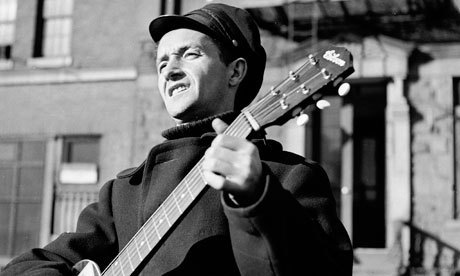
I realised…that I was meeting a guy who was a ballad-maker in the same sense as the people who made…all the ballads that I spent my life trying to find and preserve for the American people. I thought they were from anonymous people. Well, here was Mr Anonymous singing to me.
INVASION OF BRITAIN, 1952
After the war the heat from Joseph McCarthy’s red scare was beginning to rain down on AL’s friends and neighbours. This folk song thing was encouraging the negro and encouraging striking workers everywhere and something was going to be done. Alan was probably exactly right when he figured they were coming after him, so decided to take his tape recorder to Europe for a while. He came to England, met and Lomaxed all the folkies of that early time, and got busy recording folk singers in England, Scotland and Ireland along with Peter Kennedy and Seamus Ennis. After that he did Spain and Italy, then more America (with Shirley Collins), then the Caribbean, and finally, in 1963, he slowed down.
Rushing about the world recording every singer and player he could find in America, then Britain, then Spain, then Italy and the Caribbean took its toll even on a guy whose energy makes even reading about him exhausting. He’s like Dickens, he lived three lives in one, the pace was relentless, and not surprisingly he fell into periods of burnout and self-doubt.
A cloud of anxiety hung over everything I did… I could never keep a systematic notebook. In the office I could never get around to cataloguing or classifying the songs. So behind me, year by year, there accumulated an ever-growing black mountain of unfinished and unorganised work… What are my reasons for continuing to immerse myself deeper and deeper in this quagmire of folklore?
THE THEORY OF FOLK EVERYTHING
The rest of AL’s career (the final thirty years) is strange. He finally developed a Theory. It was called cantometrics and it was not a little barmy, from what I read. In the 1940s anthropology had met musicology at a party and one thing led to another and suddenly there was a new discipline called ethnomusicology. You might have thought that AL was a born ethnomusicologist, but those guys were too humble for AL, they were all too devoted to spending 15 years studying the use of nose flutes in the hill tribes of the Philippines. Alan wanted to study the folk music – and the folk dances – of the entire world, all of it. He was after a giant theory of folk, just like historians like Spengler and Toynbee had had their giant theories of history. He didn’t care that the days of the giant theory had passed and that they were now thought of as too bombastic, too arrogant, too Victorian and too mystical.
I could try to summarise what cantometrics was and how it was supposed to make things better but.. I can’t. And frankly, neither can John Szwed. Here’s a tiny inkling of what cantometrics involved :
"When we have described the musical styles of humanity and with their families and sub-families, we shall have the principal formative aesthetic currents of human history finally in our view" (1954a). From a hand-sorted sample of world music classified according to vocal qualities, ornamentation, organization (solo or choral), and tonal unity he derived a provisional map of the distribution of nine "grand families" of music, which he announced in a 1955 communiqué to Charles Seeger: Pigmy-Bushman (the oldest); Proto-Melanesian (Highland New Guinea, Central Formosa and Borneo, Melanesian forest, Andaman); Melanesian; Australian; Amerindian; Polynesian; Negro-African; Eurasian; and Old European.
I turn with a shudder back to the records, back to Flora O’Neill, the Trallalero singers of Genoa, the chain-gang laments, Vera Hall, Fred McDowell, all the calypsonians and all the singers of joy and sorrow and love and pain that flood through the 100 plus cds which should be in every library (and for which we desperately need a buyer’s guide).
THE FOGGY FOGGY DEW
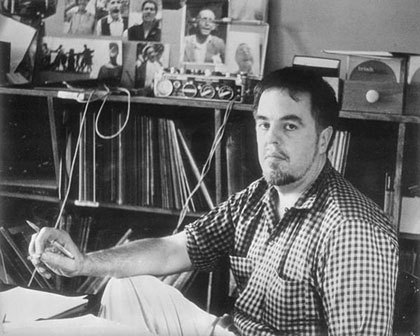
This biography is a grand piece of work, but mildly distressing for its extreme lack of interest in AL’s personal life. There is one single photo in 438 pages. Girlfriends suddenly appear and are never mentioned again. A second wife makes a one line appearance and is replaced within four pages by another woman, no explanation. The woman who replaced the second wife was Joan Halifax, and this is what became of her :
Joan Halifax and Alan had now been together for almost four years. They went to conferences and meetings, wrote articles together… did fieldwork in the Dominican Republic and Morocco… when they returned they made plans to be married in Florida where Joan had grown up and where her family still lived, but Alan never appeared for the wedding. Their relationship ended shortly thereafter.
Yes, well, I suppose it did. That’s about as much personal detail as you get.
SIGNS AND WONDERS
For Lomax, singing styles and dancing styles were like species and just like the worried ecologists he was living through a century which was rapidly tarmacking them over, where the transmitters of culture had become few in number and bloated with power, their networked voices beamed into every home, spraying everywhere evenly with the same products, the same dreams, and the same future. He had to run to capture something of all these voices and lifestyles before the Cheshire cat fade-out. So an essentially melancholy tone reverberates through AL’s life – the things he loves are vanishing, he’ll never get enough on tape, and so few other people seem to understand how important this is. In this he fits right into the elegiac tone of many cultural commentators, from DH Lawrence and Black Elk to Rachel Carson and Greenpeace. More optimistically he also embodied another of the 20th Century’s great discoveries – that technology now allows us to capture forever what was previously impossibly transient and ephemeral. Not just the songs, but the performances themselves, these particular unique voices. So the butterflies themselves may have perished but we still have great butterfly cds.
This is a biography in which every page counts. For anyone interested in folk music it’s essential.
PS
There’s a perfect epilogue to this book in the form of a documentary made in 2004 by Rogier Kappers called Lomax the Songhunter. Highly recommended.
PPS
Rounder Records are in the process of issuing the best of the folk music field recordings Alan Lomax made during his career. They’ve issued around 80 cds so far and they think there’s about 20 more to come. That’s just the a selection.
TEN GALLON HAT
But we need start with John Lomax, brought up as “the upper crust of the po’ white trash” (his words) in Meridian, Texas. He was born in 1867 and grew up amongst actual cowboys, boys with cows. He had one year of college and became a teacher in the backwoods for six years. In 1895 at the age of 28 he scraped enough together to go to the University of Texas in Austin to get a degree and then wound up at Harvard doing some research into cowboy songs. His professor was George Kittredge, who had studied under Francis J Child himself. Talk about the apostolic succession. Soon he turned himself into a star after-dinner speaker. Subject : cow boys and what they like to sing about. In 1910 he published Cowboy Songs and Other Frontier Ballads published with an introduction by only-just-ex-President Theodore Roosevelt.
- the unlikely cultural radical
By now the ballad-collecting, ten-gallon-hat-wearing, cigar-smoking, raconteuring good ole boy persona was fully formed and this is who Alan grew up with. Alan was born in 1915 when the family fortunes were at their peak. He went to the poshest schools, ending up at Harvard and flirting with communism.
DOUBLE ACT
By 1931 with the Depression crushing the country the Lomaxes had crashed down, like millions of others, and were broke and jobless. John decided his lecturing was the only money-making prospect for the time being. He proposed another book and got a tiny advance from Macmillan. By May 1933 John and teenage Alan were on the road , the first field trip. It’s amazing this has never been turned into an earnest but cringe-making tv movie – it has all the ingredients : the firebrand proto-communist son, the conservative Southern father, continually at loggerheads about the purpose of their song-collecting, the dire expectations heaped upon the enterprise (this has to make some money!) , the wardrobe size shellac disc recording machine bouncing around in the back half of the car, the boldly going where no folk song collectors have previously gone, into black prisons, black churches, black Saturday night dances, into the black world of the South at a point where if the white administrators and officials weren’t already paranoid about their black populations and the pressure of exposes and contempt from Northern liberals already, the Lomaxes arrived just in time to redouble their suspicions. You can hear the prison officials dripping their venom all over J & A, this burly old boy and his teenage son, and they have to charm and smarm and hustle their way inside the prisons and then ingratiate themselves with the convicts who were had a tendency to think that if the Lomaxes made a record of them then it would be released and then they would be famous and then they would be released just like their record.
The people who sang for us were in stripes and there were guards there with shotguns. They were singing there, under the red hot sun of Texas, people obviously in enormous trouble. But when they opened their mouths, out came this flame of beauty. This sound which matched anything I’d ever heard from Beethoven, Brahms or Dvorak.
LEADBELLY
So 1933 and 34 was driving all over the South to the most isolated locations to record white and black performers. On their second foray into a black prison, Angola Penitentiary, Louisiana, they discovered Leadbelly, the human jukebox of black folk music. He got out of prison in 1934 and they became his managers, and he became their house servant and chauffeur. They took him to Washington and New York, laid on concerts, and became embroiled in a horribly complex relationship of mutual admiration, dependency and exploitation. (15 years after his discovery, Leadbelly’s signature song Goodnight Irene became the biggest hit of the year but a little late for him as he died the same year.)
The American South of the 1930s were of course was where all the great blues singers were, from Son House to Skip James all the way to Robert Johnson. But the Lomaxes didn’t record them at all, thought they were just black pop song stylists. Alan later struggled with trying to figure out if the blues were part of folk culture or merely popular culture. It took him till 1940 to wake up. So his ears and his cultural antennae were not perfect.
The Lomaxes were amassing huge piles of recordings for the Library of Congress in Washington. They were folklorists and they thought that commercial music was the opposite of what they were doing. But of course while they were recording Texas Gladden in Saltville, Virginia singing The Devil’s Nine Questions in 1933 just a few dozen miles away in Norfolk a record company would be recording the exact same type of folk song, which they called hillbilly music, in a hotel suite which they’d booked for that purpose. The record companies would then issue their records in the Southern states, and the Lomaxes would drive back to Washington and deposit their records in a library. When 23 year old Alan finally did turn his attention to the commercial records, he was thunderstruck by their quality. He compiled the List of American Folk Songs on Commercial Records in 1940 and – lo and behold – it was this list which Harry Smith used to compile his now very famous Anthology 12 years later. That appears to have been overlooked.
MR ANONYMOUS
AL conceived it as his mission to introduce the rest of America to its own folk music. That was his thing. The city-dwellers had been treated to actors and intellectuals polishing up folk songs and presenting then in suave concerts. There was John Jacob Niles followed by Richard Dyer-Bennett followed by Burl Ives and Carl Sandberg. Finally, in 1940, out of the swirl of Oklahoman dust came Woody Guthrie. AL was gobsmacked.
I realised…that I was meeting a guy who was a ballad-maker in the same sense as the people who made…all the ballads that I spent my life trying to find and preserve for the American people. I thought they were from anonymous people. Well, here was Mr Anonymous singing to me.
INVASION OF BRITAIN, 1952
After the war the heat from Joseph McCarthy’s red scare was beginning to rain down on AL’s friends and neighbours. This folk song thing was encouraging the negro and encouraging striking workers everywhere and something was going to be done. Alan was probably exactly right when he figured they were coming after him, so decided to take his tape recorder to Europe for a while. He came to England, met and Lomaxed all the folkies of that early time, and got busy recording folk singers in England, Scotland and Ireland along with Peter Kennedy and Seamus Ennis. After that he did Spain and Italy, then more America (with Shirley Collins), then the Caribbean, and finally, in 1963, he slowed down.
Rushing about the world recording every singer and player he could find in America, then Britain, then Spain, then Italy and the Caribbean took its toll even on a guy whose energy makes even reading about him exhausting. He’s like Dickens, he lived three lives in one, the pace was relentless, and not surprisingly he fell into periods of burnout and self-doubt.
A cloud of anxiety hung over everything I did… I could never keep a systematic notebook. In the office I could never get around to cataloguing or classifying the songs. So behind me, year by year, there accumulated an ever-growing black mountain of unfinished and unorganised work… What are my reasons for continuing to immerse myself deeper and deeper in this quagmire of folklore?
THE THEORY OF FOLK EVERYTHING
The rest of AL’s career (the final thirty years) is strange. He finally developed a Theory. It was called cantometrics and it was not a little barmy, from what I read. In the 1940s anthropology had met musicology at a party and one thing led to another and suddenly there was a new discipline called ethnomusicology. You might have thought that AL was a born ethnomusicologist, but those guys were too humble for AL, they were all too devoted to spending 15 years studying the use of nose flutes in the hill tribes of the Philippines. Alan wanted to study the folk music – and the folk dances – of the entire world, all of it. He was after a giant theory of folk, just like historians like Spengler and Toynbee had had their giant theories of history. He didn’t care that the days of the giant theory had passed and that they were now thought of as too bombastic, too arrogant, too Victorian and too mystical.
I could try to summarise what cantometrics was and how it was supposed to make things better but.. I can’t. And frankly, neither can John Szwed. Here’s a tiny inkling of what cantometrics involved :
"When we have described the musical styles of humanity and with their families and sub-families, we shall have the principal formative aesthetic currents of human history finally in our view" (1954a). From a hand-sorted sample of world music classified according to vocal qualities, ornamentation, organization (solo or choral), and tonal unity he derived a provisional map of the distribution of nine "grand families" of music, which he announced in a 1955 communiqué to Charles Seeger: Pigmy-Bushman (the oldest); Proto-Melanesian (Highland New Guinea, Central Formosa and Borneo, Melanesian forest, Andaman); Melanesian; Australian; Amerindian; Polynesian; Negro-African; Eurasian; and Old European.
I turn with a shudder back to the records, back to Flora O’Neill, the Trallalero singers of Genoa, the chain-gang laments, Vera Hall, Fred McDowell, all the calypsonians and all the singers of joy and sorrow and love and pain that flood through the 100 plus cds which should be in every library (and for which we desperately need a buyer’s guide).
THE FOGGY FOGGY DEW
This biography is a grand piece of work, but mildly distressing for its extreme lack of interest in AL’s personal life. There is one single photo in 438 pages. Girlfriends suddenly appear and are never mentioned again. A second wife makes a one line appearance and is replaced within four pages by another woman, no explanation. The woman who replaced the second wife was Joan Halifax, and this is what became of her :
Joan Halifax and Alan had now been together for almost four years. They went to conferences and meetings, wrote articles together… did fieldwork in the Dominican Republic and Morocco… when they returned they made plans to be married in Florida where Joan had grown up and where her family still lived, but Alan never appeared for the wedding. Their relationship ended shortly thereafter.
Yes, well, I suppose it did. That’s about as much personal detail as you get.
SIGNS AND WONDERS
For Lomax, singing styles and dancing styles were like species and just like the worried ecologists he was living through a century which was rapidly tarmacking them over, where the transmitters of culture had become few in number and bloated with power, their networked voices beamed into every home, spraying everywhere evenly with the same products, the same dreams, and the same future. He had to run to capture something of all these voices and lifestyles before the Cheshire cat fade-out. So an essentially melancholy tone reverberates through AL’s life – the things he loves are vanishing, he’ll never get enough on tape, and so few other people seem to understand how important this is. In this he fits right into the elegiac tone of many cultural commentators, from DH Lawrence and Black Elk to Rachel Carson and Greenpeace. More optimistically he also embodied another of the 20th Century’s great discoveries – that technology now allows us to capture forever what was previously impossibly transient and ephemeral. Not just the songs, but the performances themselves, these particular unique voices. So the butterflies themselves may have perished but we still have great butterfly cds.
This is a biography in which every page counts. For anyone interested in folk music it’s essential.
PS
There’s a perfect epilogue to this book in the form of a documentary made in 2004 by Rogier Kappers called Lomax the Songhunter. Highly recommended.
PPS
Rounder Records are in the process of issuing the best of the folk music field recordings Alan Lomax made during his career. They’ve issued around 80 cds so far and they think there’s about 20 more to come. That’s just the a selection.

May 1, 2022
Alan Lomax: The Man Who Recorded the World, John Szwed (1936- ), 2010, 438pp., Dewey 781.620092
Alan Lomax (1915-2002) collected and recorded thousands of songs, dances, stories, folkways, all over the world. He discovered folk musicians who would otherwise have been unknown; he preserved and popularized their work. He was a musicologist, archivist, singer, musician, disk jockey, filmmaker, photographer, author of books, producer of dozens of radio, television, video, and concert programs and hundreds of recordings, and was the world's most famous folklorist. He was an anthropologist, political activist, lobbyist, and social theorist. pp. 388, 381-383, 371-372, 310.
Alan lived the life of collector, performer, and broadcaster at full tilt, whether or not he was making money. No one around him could match his pace, his conversation, the songs he knew, the hours he kept, his brashness. p. 296.
He never held an academic post nor a high government position. p. 388. He worked and lived on very little money, grants from foundations. When he had grant money, he would hire a staff of other experts in music, social science, and recording and filming. p. 383. "I have been really pioneering, doing advanced research without help of any fellowship or the support of any institution, making my way as a freelance, living mostly in cheap hotels and furnished rooms and working like a dog. There's been no time or energy left over, but someday I think you'll all be pleased with how things have turned out." p. 297.
Between 1940 and 1960, he was the single greatest force in bringing folk songs to American awareness. pp. 390-391.
See also /The Land where the Blues Began,/ Alan Lomax, 1993.
Books by Alan Lomax https://www.goodreads.com/author/list...
Films by Alan Lomax https://www.imdb.com/name/nm0518250/
Alan Lomax wikipedia page: https://en.wikipedia.org/wiki/Alan_Lomax
"Son House was the greatest folk musician of the Western world."--Alan Lomax. p. 2. (Lomax said this about many folk musicians.)
Works by and about Alan's father, John Lomax: https://archive.org/search.php?query=...
John Szwed's wikipedia page: https://en.wikipedia.org/wiki/John_Szwed
Books by John Szwed: https://johnszwed.com/more-books/
Errata
p. 232 John Lomax turned 80 as he published his autobiography, Adventures of a Ballad Hunter, in 1947. John Lomax lived 1867-1948.
Permalink:
https://www.worldcat.org/profiles/Tom...
(To share anything with a goodreads nonmember, it must be somewhere other than goodreads.com.)
Alan Lomax (1915-2002) collected and recorded thousands of songs, dances, stories, folkways, all over the world. He discovered folk musicians who would otherwise have been unknown; he preserved and popularized their work. He was a musicologist, archivist, singer, musician, disk jockey, filmmaker, photographer, author of books, producer of dozens of radio, television, video, and concert programs and hundreds of recordings, and was the world's most famous folklorist. He was an anthropologist, political activist, lobbyist, and social theorist. pp. 388, 381-383, 371-372, 310.
Alan lived the life of collector, performer, and broadcaster at full tilt, whether or not he was making money. No one around him could match his pace, his conversation, the songs he knew, the hours he kept, his brashness. p. 296.
He never held an academic post nor a high government position. p. 388. He worked and lived on very little money, grants from foundations. When he had grant money, he would hire a staff of other experts in music, social science, and recording and filming. p. 383. "I have been really pioneering, doing advanced research without help of any fellowship or the support of any institution, making my way as a freelance, living mostly in cheap hotels and furnished rooms and working like a dog. There's been no time or energy left over, but someday I think you'll all be pleased with how things have turned out." p. 297.
Between 1940 and 1960, he was the single greatest force in bringing folk songs to American awareness. pp. 390-391.
See also /The Land where the Blues Began,/ Alan Lomax, 1993.
Books by Alan Lomax https://www.goodreads.com/author/list...
Films by Alan Lomax https://www.imdb.com/name/nm0518250/
Alan Lomax wikipedia page: https://en.wikipedia.org/wiki/Alan_Lomax
"Son House was the greatest folk musician of the Western world."--Alan Lomax. p. 2. (Lomax said this about many folk musicians.)
Works by and about Alan's father, John Lomax: https://archive.org/search.php?query=...
John Szwed's wikipedia page: https://en.wikipedia.org/wiki/John_Szwed
Books by John Szwed: https://johnszwed.com/more-books/
Errata
p. 232 John Lomax turned 80 as he published his autobiography, Adventures of a Ballad Hunter, in 1947. John Lomax lived 1867-1948.
Permalink:
https://www.worldcat.org/profiles/Tom...
(To share anything with a goodreads nonmember, it must be somewhere other than goodreads.com.)
September 20, 2015
The title makes the same outsize claims as its subject did, but Alan Lomax's contribution to the preservation of certain musical traditions is invaluable. His obsessive recording trips, often, as John Szwed points out, with primitive equipment, gave us a record of popular music as it existed across America, Europe and the Caribbean just before technology and mass marketed song vanquished it. To him we owe recordings of African-American fife and drums, laments and lullabies from the far corners of Spain and Italy, Caribbean rituals, and he encouraged and influenced folklorists elsewhere. The theoretical framework he tried to erect around this massive trove of recordings is less distinguished; he spent years trying to obtain academic bona fides for a sketchy universal theory of music, and he tended to idealize what he called "folk" traditions as timeless and pure--not far from being static museum pieces. And his ambition knew no bounds--he created "folk operas" and sent suggested plots to the Italian director Roberto Rossellini. But beyond all the fruitless theorizing, the braggadocio, the extravagant, unfinished projects, and the poor treatment of spouses and child, he saved all that music from oblivion, and that achievement speaks for itself.

July 5, 2011
This is not so much a biography of the man as one of his career. But it was an incredible and fascinating career which makes this book worth reading for one interested in what he did. So one is left with a feeling for the deeds of Lomax, but despite the many pieces of his writing the reader does not get so much of who he was. Interestingly there is only one photo of Lomax in the book, so you also don't get that view of him.
I knew very little about Lomax going in to this book, and I didn't live through the time period covered. With that as a context, I did get a 'myth-making' feel out of the story arc. It isn't that anything comes across as untrue - there is far too much detail for that - but it is clearly written by a great admirer of Lomax's. I don't think this is a negative; after all my interest was based on admiration as well.
In the end, this book is like a biography of an explorer (he was a modern day Magellan) and the author does well to let Lomax's imagination drive the narrative.
I knew very little about Lomax going in to this book, and I didn't live through the time period covered. With that as a context, I did get a 'myth-making' feel out of the story arc. It isn't that anything comes across as untrue - there is far too much detail for that - but it is clearly written by a great admirer of Lomax's. I don't think this is a negative; after all my interest was based on admiration as well.
In the end, this book is like a biography of an explorer (he was a modern day Magellan) and the author does well to let Lomax's imagination drive the narrative.

December 2, 2012
A comprehensive, probably definitive, study of the life and work of Alan Lomax, one of the greatest, most important Americans who has ever lived. The audiobook goes into significant detail of the development of Lomax's views and work on folklore, musicology, and humanity in general, beginning even before he was born, with his family influences and the work of his father, John Lomax, a great musicologist and folklorist in his own right. The author ably describes the ordeals Lomax endured in his quest to preserve and recognize the music and lifestyles of "the folk" of the world -- ordeals that included: racism; anti-"communist" hysteria (white people who cared about the lives of black people were naturally assumed to be communists in the J. Edgar Hoover [one of the worst Americans who ever lived] days); elitism (academic and social); and a failure to understand the substance and significance of his work.
After finishing this book, it is impossible not to conclude that Alan Lomax was truly a brilliant "Renaissance Man," who devoted his life to the study and promotion of humanity, particularly those ignored and/or scroned by the elite of the world.
I strongly recommend listening to the audio version of the book, which includes interludes of performances from musicians recorded by Lomax.
After finishing this book, it is impossible not to conclude that Alan Lomax was truly a brilliant "Renaissance Man," who devoted his life to the study and promotion of humanity, particularly those ignored and/or scroned by the elite of the world.
I strongly recommend listening to the audio version of the book, which includes interludes of performances from musicians recorded by Lomax.

May 30, 2013
This is an interesting book - a book that attempts to tell the story of a man whose life was dedicated to the art of collecting stories and songs. Interesting in theory for me, though, since in practice this is an exhausting read that is a hell of a slog to plow through. The book is nothing but an endless name-dropping of people that I have never heard of (save Leadbelly and Jelly Roll Morton, the only two names in this book so far that I've seen before). Maybe that's a slight on my intelligence, maybe it's a poor reflection on my behalf. Maybe it isn't and this is just a boring book. I don't know, and I'm not very willing to delve into this any more to figure it out. I've stopped reading in the middle of the sixth chapter after a week. I'm sure the book involves many, many more of the interesting people of history, but I would rather be reading their books than a listing of events from the life of Alan Lomax, man who travels to find people more interesting than him and then gets sick.
Maybe I'll pick this book up again some other time but it's not doing anything for me now.
One star
Maybe I'll pick this book up again some other time but it's not doing anything for me now.
One star

April 14, 2023
Anyone who digs beneath the surface of popular music even a little bit will run into Alan Lomax. I knew a little about the Lomaxes, a family dynasty of folksong collectors and popularizers, but my knowledge was pretty sketchy. Where papa John Lomax mostly explored the world of "cowboy songs," son Alan went after the excluded classes in American life, bringing music out of the Old South, still feudal in rural regions, and places like the sea islands. Lomax the younger's accomplishments and discoveries fill this book and one gets the idea that the author ran out of space before he could do justice to all of them.
What I didn't know about Alan Lomax until recently, and the impetus for me reading this book, is how much work he also did in the British isles and Europe, among other things helping shape the popular music called skiffle by bringing his found music to the BBC. In the realm of darker folklore, his 1953 film documentary "Oss, Oss, Wee Oss," about the Padstow hobby horse, is like a test reel for THE WICKER MAN.
Lomax is by no means universally acclaimed. He was arguably self-serving, sometimes appearing to exploit the musicians he found, a constant womanizer, and possibly a Communist, a political position that kept him under observation by the FBI for most of his career. The author deals with the controversies even-handedly but his admiration for Lomax's dedication shines through all the criticisms. The only minor complaint I have is that, since much of Lomax's life was spent in essentially the same work of traveling, finding music, and then trying to make his discoveries profitable (or at least academically recognized), the book sometimes feels repetitive.
I suspect Lomax's politics have kept him from receiving the recognition he deserves in America, though I also understand the sense of cultural appropriation that some critics feel. Whatever his faults, he did an enormous amount to rescue local culture from the fatal wave of electronic modernism that engulfed the world in the 20th Century, collecting music from real villages before the global mash-up of McLuhan's world became our noisy, inescapable anthem.
Recommended.
What I didn't know about Alan Lomax until recently, and the impetus for me reading this book, is how much work he also did in the British isles and Europe, among other things helping shape the popular music called skiffle by bringing his found music to the BBC. In the realm of darker folklore, his 1953 film documentary "Oss, Oss, Wee Oss," about the Padstow hobby horse, is like a test reel for THE WICKER MAN.
Lomax is by no means universally acclaimed. He was arguably self-serving, sometimes appearing to exploit the musicians he found, a constant womanizer, and possibly a Communist, a political position that kept him under observation by the FBI for most of his career. The author deals with the controversies even-handedly but his admiration for Lomax's dedication shines through all the criticisms. The only minor complaint I have is that, since much of Lomax's life was spent in essentially the same work of traveling, finding music, and then trying to make his discoveries profitable (or at least academically recognized), the book sometimes feels repetitive.
I suspect Lomax's politics have kept him from receiving the recognition he deserves in America, though I also understand the sense of cultural appropriation that some critics feel. Whatever his faults, he did an enormous amount to rescue local culture from the fatal wave of electronic modernism that engulfed the world in the 20th Century, collecting music from real villages before the global mash-up of McLuhan's world became our noisy, inescapable anthem.
Recommended.

April 16, 2018
This book was utterly absorbing. Alan Lomax had his faults but his utter tenacity and unfailing dedication to capturing and understanding the world’s cultures through music (later, dance and speech) is breathtaking.
It’s also extremely relevant for where we are now in such a fractured and polarized America.
As Szwed puts it, “he felt that the solution to the country’s internal crisis lay in some form of multicultural awareness, a process of making all peoples aware of their histories, and creating pride in what America had achieved with its cultural mix.”
By recognizing and elevating original folk music -by Black America especially- Lomax embodied the view that “Folklorists should be interpreters to the world outside the folk community, but they should also champion these peoples who are subjects to the control of the modern world.”
As much as I loved reading this book, I did get frustrated at times with the density of certain sections and the relative thinness of others.
Lomax’s treatment of women is deplorable and Szwed’s breezy comments on Lomax's infidelities and his abandonment of women in his life seems to gloss over them, ultimately doing them a disservice. It pushes them into the background where whatever voice they had is lost.
Also, I’ve read other reviews here that question how compressed the last couple of decades were. It does read as if Szwed had a deadline, and as a result, it gets a bit blurry as to what was going on. Perhaps, or it could be that Lomax was not discovering or recording or performing music as much as analyzing it, which may be less interesting to Szwed.
This is unfortunate, because the last section of Lomax's life seems to be where the real beauty and synthesis of his ideas and work began to reveal themselves. I was especially and personally struck by a comment made by Michael Naimark, an associate of Lomax’s on the “Global Jukebox” project.
“The Global Jukebox has fallen into an abyss beetween academic and pop culture, between world-saving and money-making, and between content and technology. And in the new media industry, the technology folks seem to drive the content, rarely the other way around… it’s too bad, since most of the planet's cultures have the content but not the technology.”
My last note is that Szwed made the decision to tell the story of Lomax and his work predominately through Lomax's writings and letters.
While I liked reading snippets from Lomax's letters and papers from over the years, I would have liked a bit more substantive, first person commentary from those around him. Charles Seeger, Carl Sandburg, and especially Elizabeth Lomax (his first wife) are voices that seem to have complex opinions about Lomax and the work they were doing together and apart that don't get examined too closely. I find it hard to believe this doesn't exist, but as a professor of music and jazz studies, Szwed seems more interested in the scope of the music -which of course is vast- so there it is.
I’m sure glad I read this book, though, and I’m encouraged to read Lomax’s actual writings and to listen to the music he collected. Given the huge scope of his work, a recommendation for where to start by Szwed would have been helpful but I’m sure I can Google it.
It’s also extremely relevant for where we are now in such a fractured and polarized America.
As Szwed puts it, “he felt that the solution to the country’s internal crisis lay in some form of multicultural awareness, a process of making all peoples aware of their histories, and creating pride in what America had achieved with its cultural mix.”
By recognizing and elevating original folk music -by Black America especially- Lomax embodied the view that “Folklorists should be interpreters to the world outside the folk community, but they should also champion these peoples who are subjects to the control of the modern world.”
As much as I loved reading this book, I did get frustrated at times with the density of certain sections and the relative thinness of others.
Lomax’s treatment of women is deplorable and Szwed’s breezy comments on Lomax's infidelities and his abandonment of women in his life seems to gloss over them, ultimately doing them a disservice. It pushes them into the background where whatever voice they had is lost.
Also, I’ve read other reviews here that question how compressed the last couple of decades were. It does read as if Szwed had a deadline, and as a result, it gets a bit blurry as to what was going on. Perhaps, or it could be that Lomax was not discovering or recording or performing music as much as analyzing it, which may be less interesting to Szwed.
This is unfortunate, because the last section of Lomax's life seems to be where the real beauty and synthesis of his ideas and work began to reveal themselves. I was especially and personally struck by a comment made by Michael Naimark, an associate of Lomax’s on the “Global Jukebox” project.
“The Global Jukebox has fallen into an abyss beetween academic and pop culture, between world-saving and money-making, and between content and technology. And in the new media industry, the technology folks seem to drive the content, rarely the other way around… it’s too bad, since most of the planet's cultures have the content but not the technology.”
My last note is that Szwed made the decision to tell the story of Lomax and his work predominately through Lomax's writings and letters.
While I liked reading snippets from Lomax's letters and papers from over the years, I would have liked a bit more substantive, first person commentary from those around him. Charles Seeger, Carl Sandburg, and especially Elizabeth Lomax (his first wife) are voices that seem to have complex opinions about Lomax and the work they were doing together and apart that don't get examined too closely. I find it hard to believe this doesn't exist, but as a professor of music and jazz studies, Szwed seems more interested in the scope of the music -which of course is vast- so there it is.
I’m sure glad I read this book, though, and I’m encouraged to read Lomax’s actual writings and to listen to the music he collected. Given the huge scope of his work, a recommendation for where to start by Szwed would have been helpful but I’m sure I can Google it.

February 20, 2011
3 1/2 star book. Well-written and well-researched, but it really felt like the last 3/4s or so were skimpy on a lot of Lomax's work/life details - as if Szwed was in a hurry to get done or something. Worth reading.
January 19, 2014
A chore. Too many moment-by-moment details about fundraising and not enough of Lomax himself.

Did Not Finish
May 27, 2026not sure whether Alan Lomax didn't have an interesting enough life to make a good book or the author just did a bad job making it engaging but damn this is a boring book

December 28, 2015
As a musician and music lover with a strongly developed sense of history, I have great respect for the late Alan Lomax and his work as a musicologist. This one man studied, recorded and preserved an improbably large share of the extant corpus of American folk music. The influence of his recordings and writings on the development of popular music in the late twentieth century is matched by no-one else, not even Bob Dylan. Indeed, without Lomax, Dylan might not even have existed. More broadly still, black American music might never have found a mass white audience if not for his efforts, which means the great creative explosion that resulted from this cultural conjunction couldn’t have happened without him either. The world owes Alan Lomax an incommensurable artistic debt.
I was excited when I picked up this book. The little I knew about Lomax – about his shoestring travels across America with a recording machine in the trunk of his car, his risky encounters with redneck cops, prison wardens and the suspicious poor, his adoption of the blues singer Leadbelly, his troubles with Senator McCarthy and the FBI, his tireless championship of black causes, his purist rejection of artists like Dylan who put the material he had discovered and preserved to their own artistic uses – made him sound like a thoroughly fascinating character, the sort of man about whom it would be impossible to write a dull book. This, after all, was the man who ended up rolling in the dirt with Albert Grossman at the Newport Folk Festival in 1964 after Grossman caught him and Pete Seeger trying to take an axe to Dylan’s band’s power cable while they were on stage. How could a book about a man like that be boring?
Oh, easy. Just leave it to John Szwed. An associate of Lomax during the great man’s later years, his attitude towards his subject is one of obsessively hagiographic adoration. In this plodding, barely readable book, the arc of Lomax’s life-story is lost to view under an avalanche of irrelevant minor details. It is as if Szwed was determined to capture every move and gesture made by his subject, to describe and comment upon every essay, article, letter, postcard or shopping-list that Lomax ever wrote, regardless of its relative importance or thematic value. This suffocating mass of detail completely obscures what is really important in Lomax’s story. One of the most important traits of a biographer or historian is selectivity. Szwed appears quite incapable of it.
He is also incapable of admitting any serious faults in his hero, despite the evidence – given to us here in as much detail as everything else – that Lomax was manipulative, selfish and self-serving, and tended to exploit and betray the women in his life. The author finds excuses for it all. Lomax was academically and politically quarrelsome – but in this book it’s always the other guy’s fault. Szwed does not even scruple to slap on a coat or two of whitewash if the occasion demands it – having abandoned sequential reading about three-fifths of the way through the book, I skipped forward to see what the author had to say about the Newport incident, and discovered that he barely mentions it, and then only to dismiss it as ‘apocryphal’. This is simply untrue; several eyewitnesses have gone down in print with their descriptions, and there is no doubt that it happened.
This dreary book has only one redeeming quality, and that is the obsessive depth of its scholarship with respect to matters concerning its subject. Perhaps one day a real historian or biographer will find it useful as a compilation of primary sources from which to produce a really good biography of Alan Lomax. There’s no doubt that one is needed. This isn’t it.
I was excited when I picked up this book. The little I knew about Lomax – about his shoestring travels across America with a recording machine in the trunk of his car, his risky encounters with redneck cops, prison wardens and the suspicious poor, his adoption of the blues singer Leadbelly, his troubles with Senator McCarthy and the FBI, his tireless championship of black causes, his purist rejection of artists like Dylan who put the material he had discovered and preserved to their own artistic uses – made him sound like a thoroughly fascinating character, the sort of man about whom it would be impossible to write a dull book. This, after all, was the man who ended up rolling in the dirt with Albert Grossman at the Newport Folk Festival in 1964 after Grossman caught him and Pete Seeger trying to take an axe to Dylan’s band’s power cable while they were on stage. How could a book about a man like that be boring?
Oh, easy. Just leave it to John Szwed. An associate of Lomax during the great man’s later years, his attitude towards his subject is one of obsessively hagiographic adoration. In this plodding, barely readable book, the arc of Lomax’s life-story is lost to view under an avalanche of irrelevant minor details. It is as if Szwed was determined to capture every move and gesture made by his subject, to describe and comment upon every essay, article, letter, postcard or shopping-list that Lomax ever wrote, regardless of its relative importance or thematic value. This suffocating mass of detail completely obscures what is really important in Lomax’s story. One of the most important traits of a biographer or historian is selectivity. Szwed appears quite incapable of it.
He is also incapable of admitting any serious faults in his hero, despite the evidence – given to us here in as much detail as everything else – that Lomax was manipulative, selfish and self-serving, and tended to exploit and betray the women in his life. The author finds excuses for it all. Lomax was academically and politically quarrelsome – but in this book it’s always the other guy’s fault. Szwed does not even scruple to slap on a coat or two of whitewash if the occasion demands it – having abandoned sequential reading about three-fifths of the way through the book, I skipped forward to see what the author had to say about the Newport incident, and discovered that he barely mentions it, and then only to dismiss it as ‘apocryphal’. This is simply untrue; several eyewitnesses have gone down in print with their descriptions, and there is no doubt that it happened.
This dreary book has only one redeeming quality, and that is the obsessive depth of its scholarship with respect to matters concerning its subject. Perhaps one day a real historian or biographer will find it useful as a compilation of primary sources from which to produce a really good biography of Alan Lomax. There’s no doubt that one is needed. This isn’t it.

April 10, 2019
It has interesting moments but the book could have been half as long.
September 27, 2014
Alan Lomax had a profound effect on my young life. My mother was artistically enlightened for the suburbs, and through friends followed the art movements of the 1950s and 1960s. One of the things she brought home was Everybody Sing, Volume 3: Songs for seniors. I wore this disc out. More often than I want, Hand Me Down My Walking Cane, Who Killed Cock Robin, Crows in the Garden,I Shall Not Be Moved and other songs from this album rise up in my memory and I begin to sing. As I probably started to sing these songs when I was six or seven, I can honestly say no album had a more profound effect of me, either as a listener or a performer.
Alan Lomax is the reason this album existed. He was the one who brought together these performers, and so it is only natural I treat this biography as a bit of a personal hagliography.
Lomax was no saint in the conventional sense, but his herculean attempt to record and collect the music of the world, his boundless energy, and his ability to have brought folk and blues particularly to the masses is remarkable.
This is a good book. We get a fair feeling for Lomax's many struggles, but it falls short of elucidating the profound effect that Lomax had on people like me. Also, the last two chapters, which occur after Lomax had made his major contribution, feel too much like summaries. It seems that after following the manic trail of projected projects or actual creations, he ran out of steam--much the same as Lomax seems to.
Then why four stars? For the other chapters that move at a lively pace and recount with verve how this great man who 'discovered' Son House, Woody Guthrie, Leadbelly, Mississippi Fred McDowell, and brought these and so many other great musicians to Americans of all sorts through records, concerts, radio shows, and documentaries, many of which he produced, directed, wrote and even play music in. this book falls short of bottling Alan Lomax, but for the the admiring fan there is much to revel in here.
Alan Lomax is the reason this album existed. He was the one who brought together these performers, and so it is only natural I treat this biography as a bit of a personal hagliography.
Lomax was no saint in the conventional sense, but his herculean attempt to record and collect the music of the world, his boundless energy, and his ability to have brought folk and blues particularly to the masses is remarkable.
This is a good book. We get a fair feeling for Lomax's many struggles, but it falls short of elucidating the profound effect that Lomax had on people like me. Also, the last two chapters, which occur after Lomax had made his major contribution, feel too much like summaries. It seems that after following the manic trail of projected projects or actual creations, he ran out of steam--much the same as Lomax seems to.
Then why four stars? For the other chapters that move at a lively pace and recount with verve how this great man who 'discovered' Son House, Woody Guthrie, Leadbelly, Mississippi Fred McDowell, and brought these and so many other great musicians to Americans of all sorts through records, concerts, radio shows, and documentaries, many of which he produced, directed, wrote and even play music in. this book falls short of bottling Alan Lomax, but for the the admiring fan there is much to revel in here.

January 11, 2013
Alan Lomax was a wonder - folklorist, writer, performer, record producer, recording engineer, filmmaker, scholar, but most of all, the world's foremost authority on folk music. He began his career by recording folk songs in the field, and by the end of his life had developed his theory of cantometrics, which was nothing less than an attempt to classify, compare, and relate all of the world's music.
Szwed's biography is full of details about his work; so much so that I found myself skimming passages. However, it's short on personal details. Here's the end of one chapter; the passage concerns Lomax's relationship with Joan Halifax: "Later that year they traveled to Morocco for more recordings for cantometrics. When they returned they made plans to be married in Florida, where Joan had grown up and where her family still lived, but Alan never appeared for the wedding. Their relationship ended shortly thereafter." Is that really all of the story we get?
But, to be fair, Lomax's life was, to a large extent, defined by his work. He worked constantly, taking on so many projects that he couldn't finish them all. And his work resulted in little financial reward - in 1986 he was awarded the National Medal of the Arts; his adjusted gross income for the previous year was $11,531.
But his work lives on, largely through his field recordings - hours and hours of them have been issued over the years on various labels. I have many of them - on CD, LP, and even 78 RPM records - and it was fascinating to listen to the recordings as they were discussed in the book.
If Goodreads allowed half stars, I would give this book three and a half stars, in spite of its weaknesses. As it is, I'm so in awe of Lomax's contributions to the world's culture that I'll gladly give it the extra half star.
Szwed's biography is full of details about his work; so much so that I found myself skimming passages. However, it's short on personal details. Here's the end of one chapter; the passage concerns Lomax's relationship with Joan Halifax: "Later that year they traveled to Morocco for more recordings for cantometrics. When they returned they made plans to be married in Florida, where Joan had grown up and where her family still lived, but Alan never appeared for the wedding. Their relationship ended shortly thereafter." Is that really all of the story we get?
But, to be fair, Lomax's life was, to a large extent, defined by his work. He worked constantly, taking on so many projects that he couldn't finish them all. And his work resulted in little financial reward - in 1986 he was awarded the National Medal of the Arts; his adjusted gross income for the previous year was $11,531.
But his work lives on, largely through his field recordings - hours and hours of them have been issued over the years on various labels. I have many of them - on CD, LP, and even 78 RPM records - and it was fascinating to listen to the recordings as they were discussed in the book.
If Goodreads allowed half stars, I would give this book three and a half stars, in spite of its weaknesses. As it is, I'm so in awe of Lomax's contributions to the world's culture that I'll gladly give it the extra half star.

January 8, 2012
Alan Lomax was one of those people without whom, the twentieth C. would have been nearly unlivable. For his energy in collecting the music of North America (first the States, and then, the Caribbean, Europe and beyond) world musical culture owes him a tremendous debt. Consider all the cross pollination which his obsessive collecting would inspire & consider how impoverished the music of the world would be today, had none of that happened.
Lomax fought several battles, not the least of which was to be taken seriously as a full-fledged member of American culture and society, in an era when anything "left wing" would be considered close to treason. The book helps to chronicle not only the minutae of his life and travels, but the close eyes fixed on him by both J. Eager Beaver and Joe ("Charlie") McCarthy. But he won in the end. Awarded an Arts & Culture medal by- Ronald Reagan- <?!> he was the poorest American to ever receive the reward. But this was a man whose life was a dedication in integrity. The kind of person who's an inspiration to me, on that level, since in this day and age, too many Americans sell out for the easy buck, or hope to make one off someone else's sweat.
An early defender of rock and roll, the story of Lomax fighting in the grass at the Newport Folk Festival over Bob Dylan's performance is probably a lot less real than some memories have blown it up to be. Without his awareness of the worthiness of either, Chuck Berry and Elvis Presley probably never would have hit on the fortuitous marriage that created 50's, 60's, 70's and beyond's musical culture.
And surely Bob Dylan would have had that many fewer tunes in his early repertoire. This is a great book about a great man.
Lomax fought several battles, not the least of which was to be taken seriously as a full-fledged member of American culture and society, in an era when anything "left wing" would be considered close to treason. The book helps to chronicle not only the minutae of his life and travels, but the close eyes fixed on him by both J. Eager Beaver and Joe ("Charlie") McCarthy. But he won in the end. Awarded an Arts & Culture medal by- Ronald Reagan- <?!> he was the poorest American to ever receive the reward. But this was a man whose life was a dedication in integrity. The kind of person who's an inspiration to me, on that level, since in this day and age, too many Americans sell out for the easy buck, or hope to make one off someone else's sweat.
An early defender of rock and roll, the story of Lomax fighting in the grass at the Newport Folk Festival over Bob Dylan's performance is probably a lot less real than some memories have blown it up to be. Without his awareness of the worthiness of either, Chuck Berry and Elvis Presley probably never would have hit on the fortuitous marriage that created 50's, 60's, 70's and beyond's musical culture.
And surely Bob Dylan would have had that many fewer tunes in his early repertoire. This is a great book about a great man.

September 11, 2014
A very detailed Look at Lomax's life; if you wanted to know 'where he was when' this book would tell you. It's fascinating to see the way Szwed slurs over some things, and emphasises others. The cast of characters is daunting. If you're interested in Lomax's type of music they are all here. And it all seems to belong to a different world. Disputes over the educational value of radio, the possibility of oral history, the idea of putting a subject in front of a microphone and getting them to talk about their lives, were all novel ideas in Lomax's lifetime.
It's fascinating to read this against or with "The land where the blues began' not just for the different information but for the very different styles. And it's also interesting to read it against Seamus Ennis's 'Field Diaries'. (Ennis appears briefly in Szwed when Lomax visits Ireland.)
Lomax appears as a driven, doubting, hard-working character. Whether he bent the information he collected, whether he misrepresented or invented "the blues' or whether he bent the stories about the collecting, his enthusiasm for what he collected was genuine, and his appetite for work was undoubted and the amount he got through more than impressive.
Szwed situates Lomax's work in the gradual development of a distinct American National Identity.
The most striking thing about the book is that the sub title is really not an exaggeration. He really did get around with his recording gear.
It's fascinating to read this against or with "The land where the blues began' not just for the different information but for the very different styles. And it's also interesting to read it against Seamus Ennis's 'Field Diaries'. (Ennis appears briefly in Szwed when Lomax visits Ireland.)
Lomax appears as a driven, doubting, hard-working character. Whether he bent the information he collected, whether he misrepresented or invented "the blues' or whether he bent the stories about the collecting, his enthusiasm for what he collected was genuine, and his appetite for work was undoubted and the amount he got through more than impressive.
Szwed situates Lomax's work in the gradual development of a distinct American National Identity.
The most striking thing about the book is that the sub title is really not an exaggeration. He really did get around with his recording gear.

April 13, 2013
Picked this up for the roots music history and boy did Lomax have his hand in every pot and then some. Lead Belly, Zora Neale Hurston, Woody Guthrie, and even Margaret Mead were personal friends, just to name a few. But I quickly became drawn to Lomax as a personality - I mean he was a true Artist, with all the bohemian genius and unstable personal life that suggests. He poured everything into his life's work, with complete disregard to his personal wealth or popular convention. His fight was steadfast against cultural appropriation and for racial justice. His contributions to ethnomusicology and his ideas about democratizing popular media were insanely ahead of his time. What a guy, basically.
Favorite fact: As Voyager passes into deep space, I take comfort in the fact that Lomax chose many of the music selections that represent our species!
I should probably mention that my five stars is not as much for Szwed's prose as it is for the subject, but I can't imagine finding a more thorough or readable account of Lomax.
Oh, and singing friends, this book is truly about his efforts to record the world, not just the American South, but there are actually more relevant references to Sacred Harp than the singular page included in the index. Highly recommended.
Favorite fact: As Voyager passes into deep space, I take comfort in the fact that Lomax chose many of the music selections that represent our species!
I should probably mention that my five stars is not as much for Szwed's prose as it is for the subject, but I can't imagine finding a more thorough or readable account of Lomax.
Oh, and singing friends, this book is truly about his efforts to record the world, not just the American South, but there are actually more relevant references to Sacred Harp than the singular page included in the index. Highly recommended.

July 16, 2017
This biography of song collector, ethnomusicologist, and singer Alan Lomax was endlessly fascinating and wonderful to read. This is one of the rare non-fiction books that is as compelling and absorbing as a good novel. Szwed takes an all-encompassing view of Lomax, delving into his beginnings as an assistant to his father's song-collecting, his alliance with progressive causes, the FBI's investigations of him, his sometimes contentious views on the importance of folksong - especially that of African-Americans - to American national identity, and his complex relationships to the worlds of academia and popular culture. The only thing that gets a little shorted is Lomax's personal life and relationships, as Szwed concentrates mainly on Lomax's career.
Although the biography is clearly not a hagiography, it is clear that Szwed admires Lomax and it is hard not to share in that admiration. Whatever Lomax's personal failings, Szwed makes it clear that Lomax was an important figure in the preservation and popularization of American folk music, an ardent promoter of the musicians who played it, and a true believer in its value.
Although the biography is clearly not a hagiography, it is clear that Szwed admires Lomax and it is hard not to share in that admiration. Whatever Lomax's personal failings, Szwed makes it clear that Lomax was an important figure in the preservation and popularization of American folk music, an ardent promoter of the musicians who played it, and a true believer in its value.

March 9, 2014
A very scholarly book about a scholar who left many letters and documents behind. The book is jammed full of facts. Facts about all kinds of things about the life of Alan Lomax. Yet, it is up to us, the reader, to assess the person and it is hard to see him from 2014. From here he seems like an exploiter - he recorded people transcribed their songs and tried to make a living from this. This included copywriting some songs/ or gaining some credit for it. He seems to me to be like the a collector who ventured out from his world and came back with treasures from a world that quickly ceased to be. However, his treasures inspired many of musicians that followed and still allow us to hear a distant past. In older age he came up with grandiose schemes to globally catergorise music. I think his attitudes to women and race are products of the time, but I don't think he was a great human being. For me this example speaks volumes, he had a steady girlfriend for 4 years and they decided to marry, but Lomax didn't turn up for the wedding.

March 29, 2012
Fascinating story, with all kinds of interesting people wandering in and out...Leadbelly, Woody Guthrie, Shirley Collins, Dylan, Muddy Waters, not to mention Lomax's outsized-personality dad, John Lomax, the big hard-core conservative Texan who nonetheless provided some of the earliest documentation of blues, cowboy music and other traditional styles. Lomax's later-life attempts to systematically categorize folk music and dance, and to extrapolate from that ideas about culture and society are intriguingly described, but I'm not sure I really understood them, at least not from this book. Also encouraging: how much this guy got done while enmeshed in institutional racism, bureaucracy, poverty and an ongoing FBI/CIA inquiry into whether or not he was a communist. (He certainly took the side of producers over capital.)
August 15, 2013
The title is not an exaggeration. Alan Lomax went everywhere, recorded everyone, and tried to catalog all the world's singing styles. As if that wasn't enough, he wanted to record all the world's dance and conversational styles, too. A man of amazing energy, stamina, and productivity, he started a hundred projects for every one he finished. That wasn't necessarily his fault; he fit uneasily between the commercial and the educational, the popularizer and the academic. Nothing human was alien to him; he could find meaning and beauty in almost anything. If at times Szwed's book is a little peripatetic, that's because of its subject. There are many paragraphs of the "he went there and recorded so-and-so" variety. He was an idiosyncratic genius, and there will probably never be anyone who can follow all his footsteps.

January 6, 2014
If you've not come across Alan Lomax and his father John Lomax, their contribution to music was the work to captured music initially in the US, but Alan also worked in Europe for a while. Their story starts out in the 1920s and 30s. Alan's influence on music perhaps isn't as widely appreciated, as more recent figures such as Berry Gordy, Jerry Wexler and so on. But actually it is astonishing, from the `discovery' of Lead Belly; to breaking Jelly Roll Morton, setting Muddy Waters onto the road to blues fame; to introducing Dylan to early folk music.
The book itself is a substantial volume, and at times feels very scholarly in nature - but then Alan approached his subject in a manner that was scholarly. It does however make the reading a bit dry at times, but ultimately very rewarding. If you want to seriously understand some music history you can't go wrong with this book.
The book itself is a substantial volume, and at times feels very scholarly in nature - but then Alan approached his subject in a manner that was scholarly. It does however make the reading a bit dry at times, but ultimately very rewarding. If you want to seriously understand some music history you can't go wrong with this book.

August 1, 2021
One of the most influential men of the 20th Century. An musicologist , archivist , singer , photographer , author of books ,producer of dozens tv , music concert programs as well anthropologist , lobbyist and social theorist . From Texas early life up bringing of hard work from the family fields to Alan Lomax journey through Southern Americas to Europe recording archives for Library of Congress and introducing the world to many folklorist & blues to the world of slavery cotton fields . Alan's development of Cantometric is anything but commonplace but rather compelling study of linguist of tones, breathe, pitch ,harmony in relations to everyday life. Magnificent read for any historian and enthusiast of ethnography! Thank you personally for introducing the world to the Great Lead Belly , Willie Guthrie and Muddy Water's , to name a few. :)

August 19, 2013
This is Book is OK. The problems with it are at least somewhat unavoidable. The first few chapters, also about his father John, were great. I would have given 5 stars to a book just about those years.
The rest gets a little dull because life is like that. Basically he would have an idea, raise some money (or fail), succeed with his idea (or fail), have relationship problems (they all failed and some made him seem kinda creepy) then start all over again. Frankly I was left impressed with his work and influence while at the same time being fine with never having met the guy.
Finally, while I am sure the author got most of his facts straight, What human being in our day thinks Mr. Hooper was on the Muppet Show?
The rest gets a little dull because life is like that. Basically he would have an idea, raise some money (or fail), succeed with his idea (or fail), have relationship problems (they all failed and some made him seem kinda creepy) then start all over again. Frankly I was left impressed with his work and influence while at the same time being fine with never having met the guy.
Finally, while I am sure the author got most of his facts straight, What human being in our day thinks Mr. Hooper was on the Muppet Show?

gave-up-on
April 7, 2012I got a notice from the library that this had come due, and I was going to return it without finishing it, as it's so dense, but just now I was dipping in, and there are so many gems and vignettes, I think I'll renew it and see if I can't read a little more, glean a little more.
...Okay, I did give up on this. Outside of the section on Alan Lomax's friendship with Zora Neale Hurston (which was fascinating), I found the rest of the book too dense with moment-by-moment facts, events, and people; I guess I wanted more of a narrative? Less information? I'm not sure. The things I liked best were the actual quotes from folksongs and descriptions of places he visited.
...Okay, I did give up on this. Outside of the section on Alan Lomax's friendship with Zora Neale Hurston (which was fascinating), I found the rest of the book too dense with moment-by-moment facts, events, and people; I guess I wanted more of a narrative? Less information? I'm not sure. The things I liked best were the actual quotes from folksongs and descriptions of places he visited.

January 11, 2014
Pretty good summation of one of the great American lives. So much music we take for granted was discovered and saved from oblivion by Alan Lomax and his father John. Other outsized personalities that he discovered and/or nurtured, from Jelly Roll Morton to Leadbelly to Woody Guthrie, dominate the pages they appear on. Lomax's political engagement and activism, complicated personal life, and crucial worldwide efforts to record and classify folk musics occupy most of the book; his misguided sociology and his half-baked Cantometrics theory take up less space, thankfully. Best of all, you can hear the music as you read. Recommended for everyone curious about the Old, Weird America.
April 7, 2014
I loved this book, but I suspect it would only interest a select group of readers. As a folklorist as well as having been a student of the author, Alan Lomax is a major figure in the history of folklore studies and probably one of the most significant folklorists of the twentieth century. So his personal history is, in many ways, the history of folklore studies.
John Szwed is a fabulous biographer and kept it interesting and moving forward the whole time. Again, many might not find this for them unless they had a strong interest in the history of the study of folk music, including blues, jazz, everything else. If so, then this is one for you!
John Szwed is a fabulous biographer and kept it interesting and moving forward the whole time. Again, many might not find this for them unless they had a strong interest in the history of the study of folk music, including blues, jazz, everything else. If so, then this is one for you!

June 24, 2012
Tedious and longwinded...
As interesting and influential as Alan Lomax' life may have been, this biography totally fails to make his character come alive. This is more like a scholarly account of his actions rather than a literary biography. Really boring to read, frankly, I didn't even bother finishing it - I may pick it up again once in a while to read another chapter, but fun reading it's not!
As interesting and influential as Alan Lomax' life may have been, this biography totally fails to make his character come alive. This is more like a scholarly account of his actions rather than a literary biography. Really boring to read, frankly, I didn't even bother finishing it - I may pick it up again once in a while to read another chapter, but fun reading it's not!

April 11, 2013
A very fine-grained account of the life of a man with one of the coolest careers ever. Full of fascinating detail. It basically made me wonder what I've done with my life. Alan Lomax did more by the time he was 25 than I probably will in my whole life, traveling all over America (and even to Haiti) recording folk music, getting a job at the Library of Congress, meeting and chatting with a series of musical legends. Amazing.
Displaying 1 - 30 of 61 reviews